
On November 13, 2026, the electric cab company Green SM announced its next leg in India. The company says it has completed more than 1.5 million rides in five months since its June 2026 launch in Delhi-NCR. It runs in Delhi NCR and Hyderabad, holds aggregator licences in Delhi, Haryana, Uttar Pradesh and Karnataka, and plans to add Chennai and Bengaluru. That works out to roughly 10,000 rides a day. The same week in November 2026, BRS general secretary RS Praveen Kumar demanded a ban on the company in Telangana, arguing that its Rs 8 per kilometre fares in Hyderabad were hurting nearly six lakh cab drivers. Read the coverage and this is a ride-hailing story: a cheap new entrant, an angry incumbent, a political fight over fares.
It is worth slowing down on that. Those rides run on cars made by VinFast, the Vietnamese carmaker. Green SM's own release says its Indian fleet is thousands of VinFast Limo Green electric vehicles. And the company behind Green SM is not a stranger to VinFast. VinFast's annual report to the US SEC describes GSM (Green and Smart Mobility) as a ride-hailing company owned by Pham Nhat Vuong, VinFast's founder. So the useful question is not whether Green SM can win riders. It is how much of VinFast's Indian factory depends on whether it does.
The fleet car behind the factory
VinFast launched in India on September 6, 2025, and per SIAM data analysed by Autocar Professional, it produced 14,116 EVs at its Thoothukudi plant in Tamil Nadu and dispatched 13,307 to dealers in April to September 2026. The top model was the Limo Green, which Autocar Professional calls a seven-seat commercial fleet car, with over 7,000 units and an estimated 54% of dispatches. That is the number that carries this piece: more than half of what VinFast sent out in India in April to September 2026 was a car built for fleets.
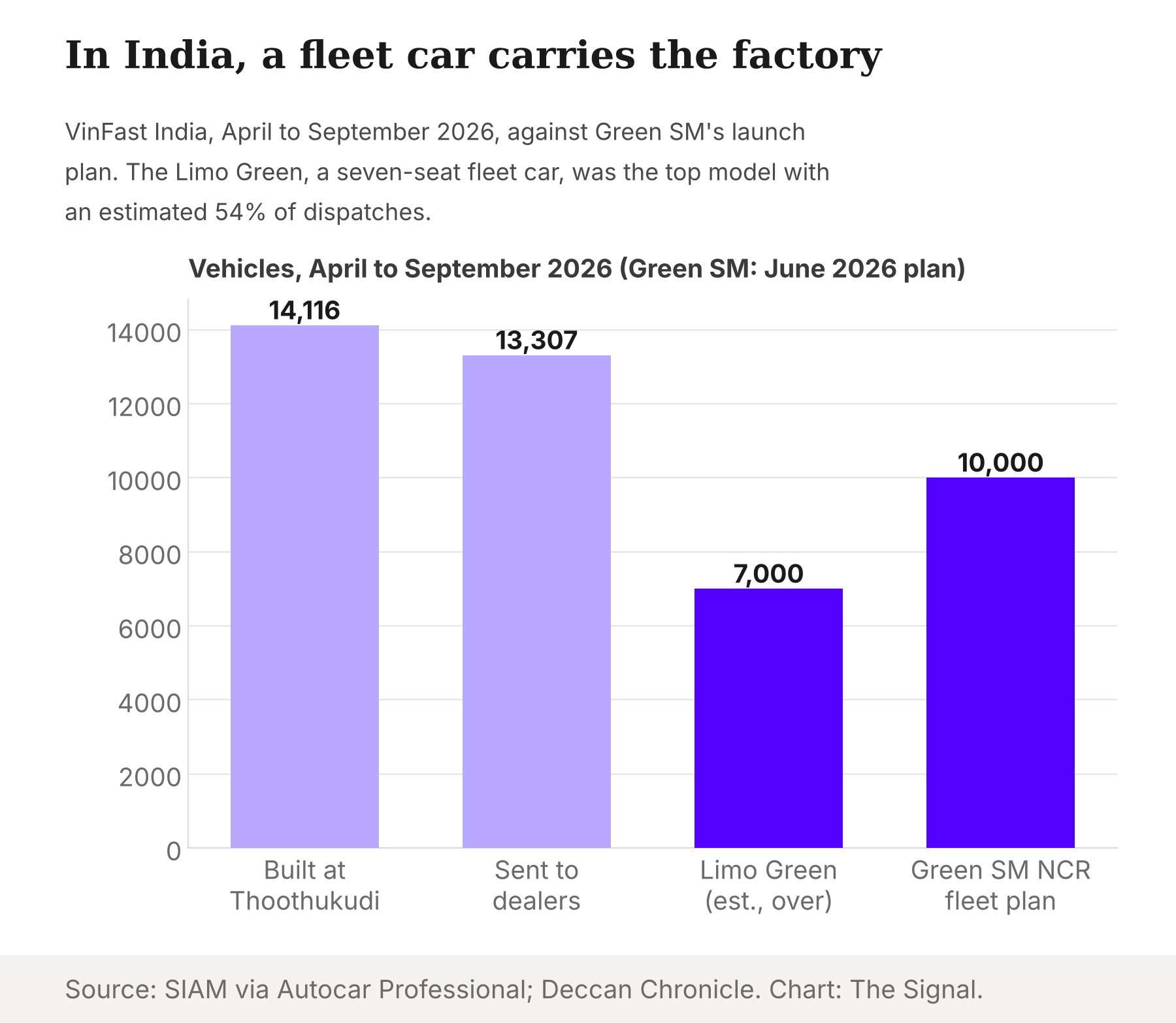
Set that beside what Green SM said it wanted. At its June 5, 2026 launch, Green SM planned to deploy around 10,000 EVs in Delhi-NCR alone, mostly Limo Green MPVs. One city's plan was larger than six months of Limo Green dispatches for the whole country. Hyderabad, Chennai and Bengaluru come on top.
The launch quarter shows the same pattern from the other side. In April to June 2026, VinFast India dispatched 6,001 EVs, 2,746 of them Limo Greens, or 46%, while Vahan recorded 4,060 retail deliveries. Dispatches ran about 1,900 cars ahead of registrations in April to June 2026 (our calculation), so not every car that left the plant was yet on the road. Shortly after its June 2026 launch, Green SM had deployed about 1,000 of its Limo cabs, according to an Indian Express report cited by electrive. Autocar Professional also draws the link the filings do not: it says the Limo Green is retailed through Green SM's brand.
There is a gap here that matters, and it should be stated plainly. No filing in the evidence discloses how many cars Green SM's Indian operation bought from VinFast India. Dispatches go to dealers, and other fleet operators can buy a Limo Green too. The link between Green SM and Thoothukudi's order book is an inference from two facts that sit side by side: the fleet car leads the plant, and the founder's taxi company runs that car. It is a strong inference. It is not a disclosed number.
Why the filings point the other way
Outside India, VinFast's reliance on GSM has fallen sharply, and that is the strongest reason not to call Green SM its biggest customer. In 2025, 27.3% of VinFast's EV deliveries went to related parties, mostly GSM, and revenue from sales to GSM and its subsidiaries was VND21,877.4 billion ($870.9 million). The share then peaked in late 2025. About 33% of VinFast's 86,557 EV deliveries in the fourth quarter of 2025 went to related parties, driven by GSM subsidiaries in Indonesia and the Philippines.
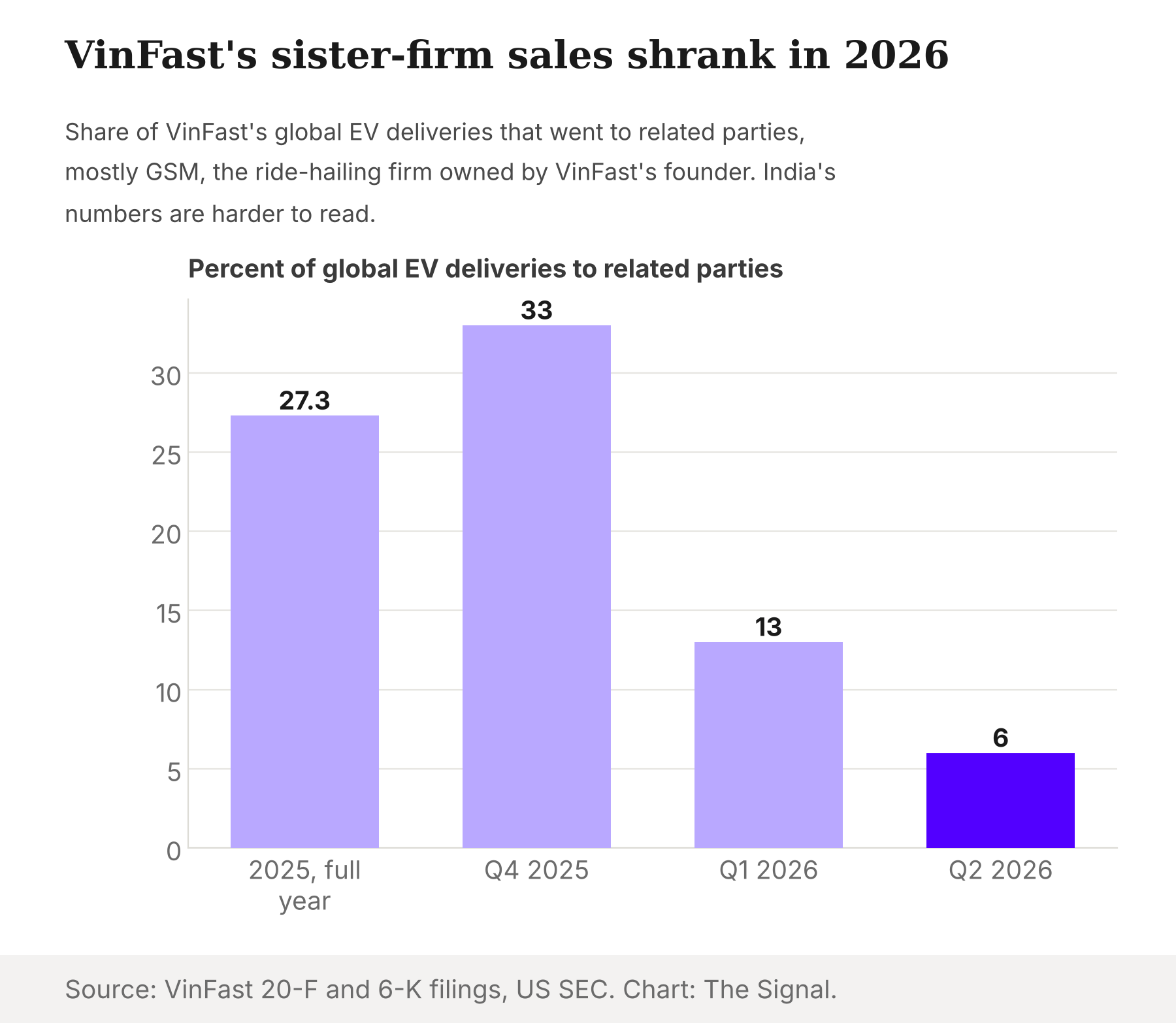
Then it collapsed. Related parties took about 13% of VinFast's 58,577 EV deliveries in the first quarter of 2026. In the second quarter of 2026 the figure was about 6% of 70,085, or roughly 4,200 vehicles. That quarter is April to June 2026, which overlaps Green SM's Indian launch. If the Indian arm is counted as a related party, as the Indonesian and Philippine subsidiaries were, its purchases in that quarter fit inside those 4,200 vehicles worldwide.
The headline share hides a second channel. VinFast's July 2026 Vietnam deliveries included 3,785 vehicles delivered to GSM in Vietnam for later export to international markets. And the relationship has a contract behind it now. In May 2026 VinFast and GSM signed a framework agreement for about one million EVs and four million e-scooters for GSM's platforms between 2026 and 2030, with base discounts and volume incentives. VinFast's guidance of at least 300,000 EVs in 2026 excludes those GSM deliveries.
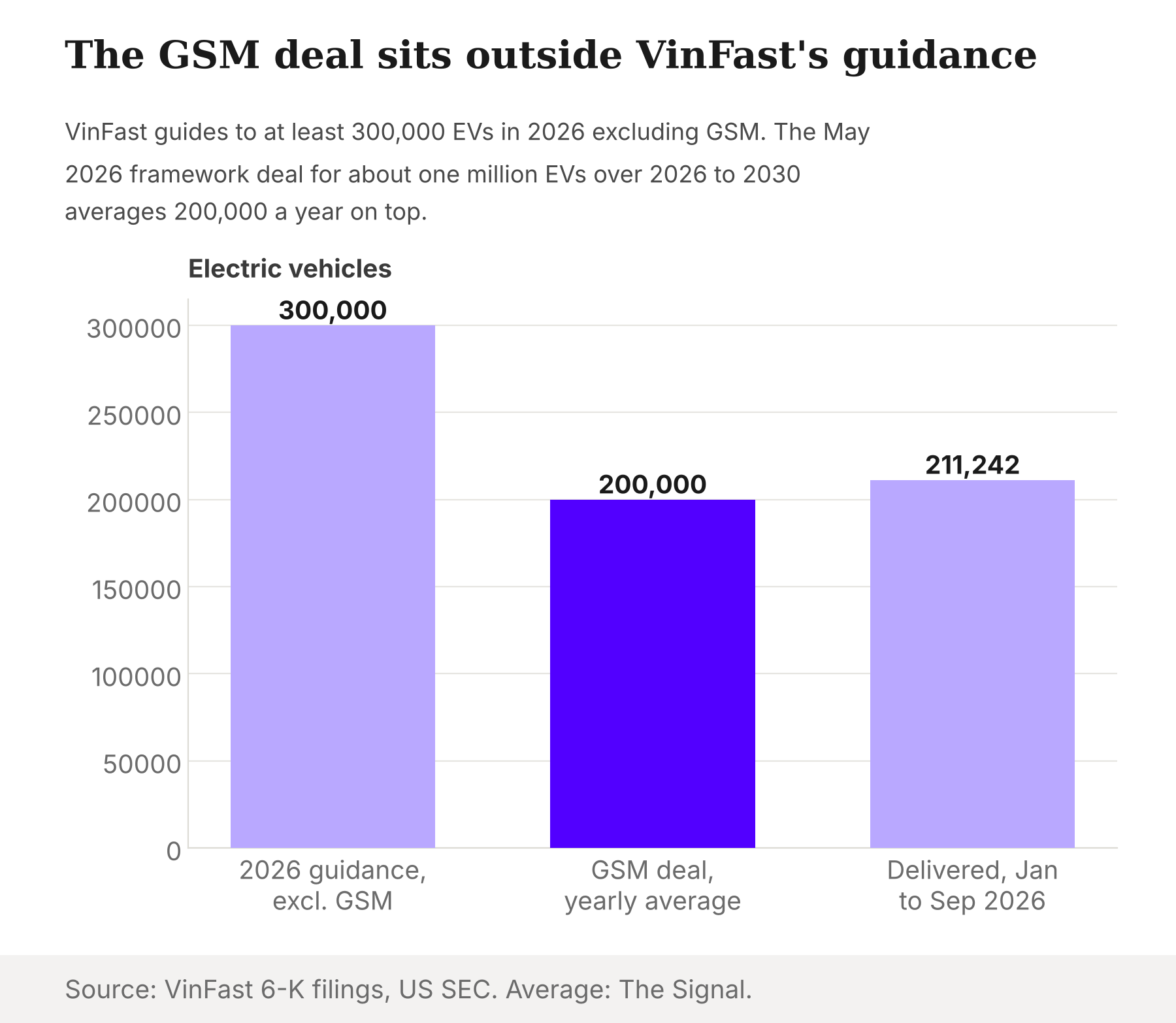
Spread evenly, one million EVs over five years is 200,000 a year. VinFast delivered 211,242 EVs worldwide in the first nine months of 2026. On paper, the GSM deal adds close to nine months of VinFast's current global volume every year, and none of it sits in the guidance.
What the India numbers can and cannot show
India's retail numbers are real, but the fleet car still leads.
| Measure | Figure | Period |
|---|---|---|
| EVs built at Thoothukudi | 14,116 | April to September 2026 |
| EVs dispatched to dealers | 13,307 | April to September 2026 |
| Limo Green share of dispatches (estimate) | 54% (over 7,000 units) | April to September 2026 |
| EVs retailed to buyers (Vahan) | 14,637, a 4% share | September 6, 2025 to October 14, 2026 |
| India plant capacity | 50,000 EVs a year | As of December 31, 2025 |
Sources: Autocar Professional, analysing SIAM and Vahan data; VinFast Q4 2025 results, Form 6-K.
India's plant is rated at 50,000 EVs a year, out of roughly 600,000 across VinFast's four factories. Doubling the April to September output of 14,116 gives about 28,000 a year, a little over half of rated capacity (our calculation). A fleet buyer that wants 10,000 cars for one region is not a rounding error for a plant running at that pace.
The Limo Green matters globally too. It was VinFast's second-best-selling model in the third quarter of 2026, at 19,100 of 82,580 deliveries, or about 23%. In India, in April to September 2026, the same car was more than half.
The BluSmart lesson
India has seen a car fleet built around a related party before. SEBI's July 2025 order on Gensol Engineering records that the company took ₹663.89 crore of IREDA and PFC loans to buy 6,400 EVs to lease to BluSmart, a related party, procured 4,704, and left ₹262.13 crore unaccounted. Nothing in the evidence suggests anything comparable at VinFast or Green SM. The parallel is structural, not moral. When one affiliated fleet is the swing buyer, the car orders rise and fall with that fleet's fortunes, not with what households want.
The honest objection
The strongest case against this reading is that India's demand for VinFast is broader than one taxi company. Per Vahan, VinFast India retailed 14,637 EVs from September 6, 2025 to October 14, 2026, a 4% share of 343,876 electric passenger vehicles, ranking fourth. VinFast ranked fifth among battery-EV brands in India in the second quarter of 2026. The 54% is an estimate, the Limo Green has other fleet buyers, and the global related-party share had fallen to a sliver by the second quarter of 2026. All of that is true.
But it argues for a narrower claim, not against this one. A top-five brand can still lean on one model, and in India that model is the Limo Green fleet car. The global related-party share is one company-wide number. It does not say who bought the Limo Greens leaving Thoothukudi. And the May 2026 framework deal points the other way: VinFast has agreed to supply GSM's platforms at scale through 2030, outside its guidance.
The Signal
The fight in Hyderabad looks like a fare war. Underneath it is a factory question. If Telangana restricts Green SM, or the planned Chennai and Bengaluru rollout stalls, the cost does not land only on a cab company. It lands on the best-selling model of the plant in Tamil Nadu, which ran at a little over half its rated capacity in April to September 2026. Watch two numbers. The first is VinFast's third-quarter 2026 results, the next filing with a related-party split, for any India detail. The second is the Limo Green's share of Thoothukudi dispatches once the Chennai and Bengaluru fleets begin. A factory whose best customer might be its founder's taxi company has to hope the taxis keep running.
Reporting basis: VinFast's related-party delivery shares, GSM's ownership, GSM revenue, capacity, guidance, the May 2026 framework agreement and global delivery counts and VinFast's India brand ranking are from VinFast's own filings with the US SEC, its Form 20-F for 2025 and its quarterly and monthly Form 6-K reports, all one origin. India production, dispatch, retail and the Limo Green share, for both April to June and April to September 2026, are SIAM and Vahan data as analysed by Autocar Professional, which is also the source for the Limo Green being retailed through Green SM's brand; the Limo Green unit count and share are that outlet's estimate and rest on that single source. Green SM's ride count, licences, city plans and the VinFast make of its fleet are the company's own claims in its November 13, 2026 release, and its Delhi-NCR fleet plan is as reported by Deccan Chronicle at the June 2026 launch. The launch deployment of about 1,000 cabs is an Indian Express report as relayed by electrive. The BRS fare and driver figures are that party's claims, as reported by The Hans India. The Gensol and BluSmart figures are from SEBI's July 2025 confirmatory order. No source discloses Green SM India's purchases from VinFast India; that link is the piece's inference. The rides per day, the gap between April to June dispatches and registrations, the related-party vehicle count for the second quarter of 2026, the GSM deal's annual average, the Limo Green's global share and the plant's annualised output are The Signal's calculations from those figures.