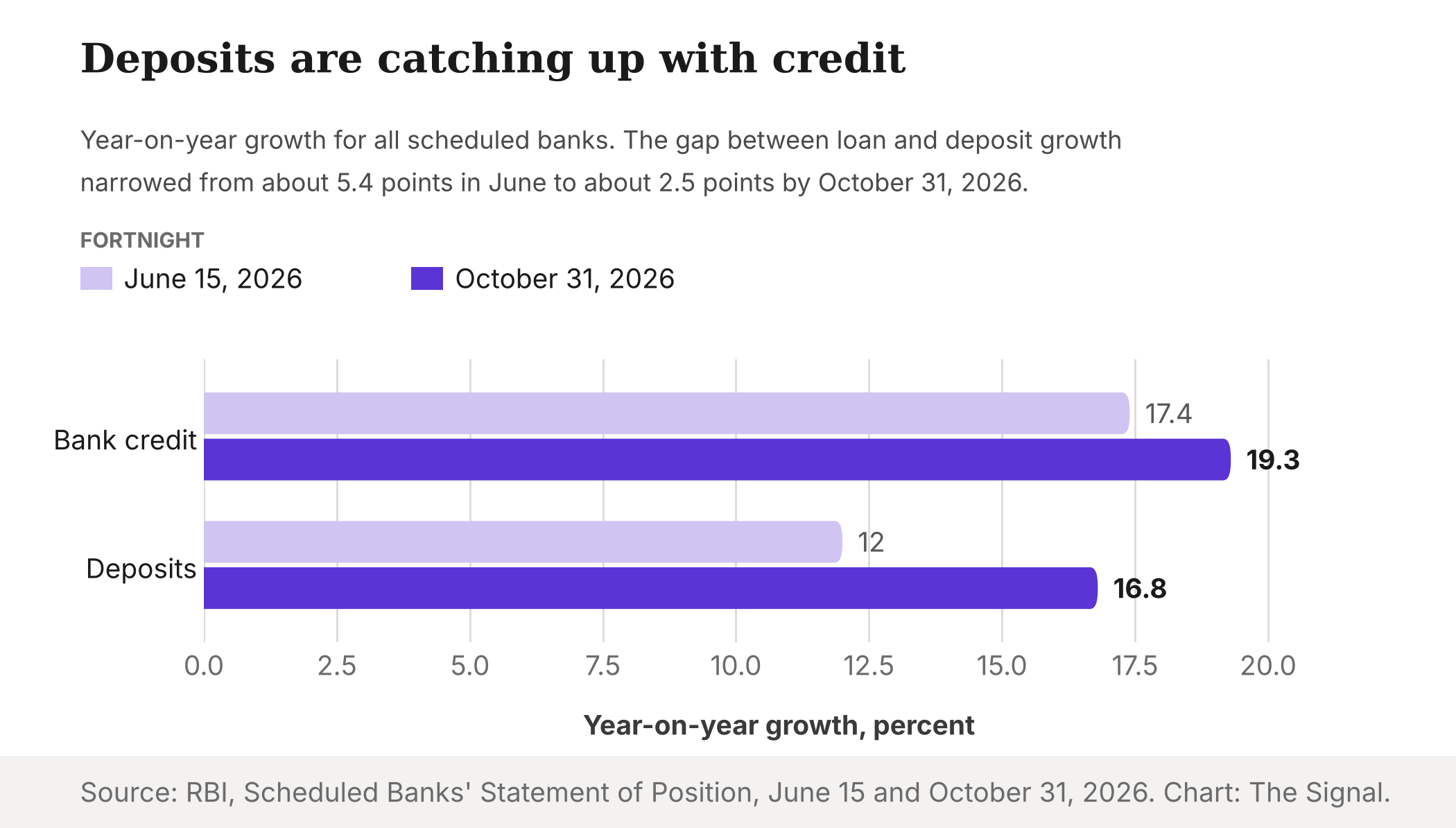
The headline on India's banks this week was simple. In the fortnight ended October 31, 2026, credit at all scheduled banks stood at ₹2,37,03,225 crore against ₹1,98,76,054 crore a year earlier, growth of about 19.3 percent, while deposits grew about 16.8 percent. Loans are outrunning deposits, the read goes, so banks are running out of money to lend.
It is worth slowing down on that. Growth rates hide the base. Indian banks hold far more deposits than loans, so a smaller growth rate on the bigger number can still mean more rupees. Over the same year, deposits rose to ₹2,88,16,080 crore from ₹2,46,79,735 crore. That is ₹41.36 lakh crore of new deposits against ₹38.27 lakh crore of new credit. Banks gathered more new money than they lent.
So the strain is not where the headline puts it. It shows up in what banks are buying less of.
The number that carries the story
Banks have two big uses for deposits: loans, and government bonds. In the year to October 31, 2026, their holdings of central and state government securities rose to ₹77,03,321 crore from ₹70,49,263 crore. That is an increase of ₹6.54 lakh crore, or about 16 paise of bonds for every new deposit rupee.
That ratio matters because of a rule. Under the RBI's CRR and SLR Directions, every commercial bank must hold SLR assets worth at least 18 percent of its net demand and time liabilities. On new money in the past year, banks bought bonds at a pace below that statutory floor. They can do this only because they started the year holding more than the minimum, and they are now spending that cushion. Government securities equalled about 28.6 percent of deposits in October 2025 and about 26.7 percent in October 2026.
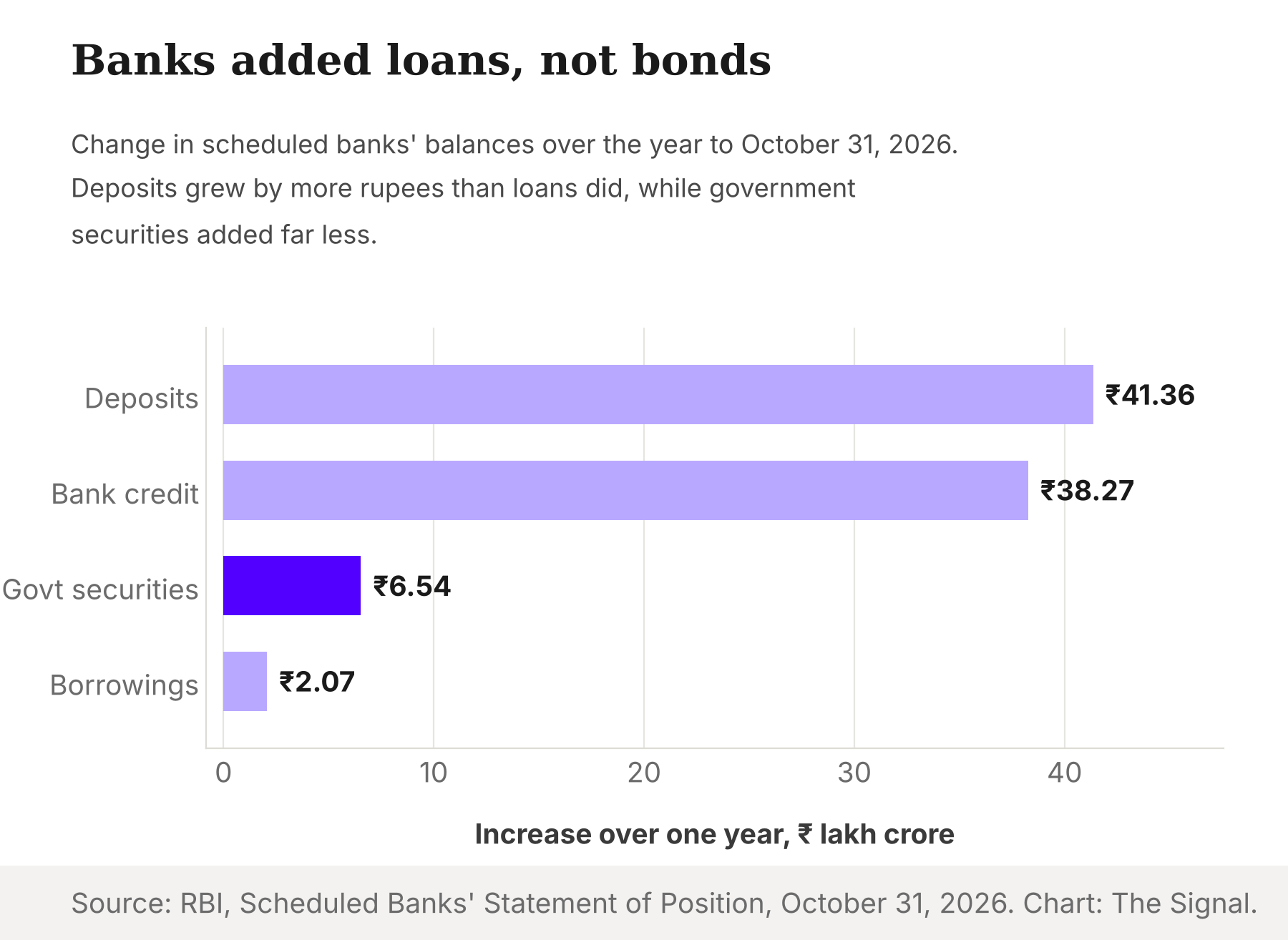
The other lever is wholesale money. Borrowings by scheduled banks stood at ₹10,57,579 crore on October 31, 2026, against ₹8,50,802 crore a year earlier, growth of about 24.3 percent. A CareEdge Ratings note of October 12, 2026 reports that banks raised certificate of deposit issuance to ₹74.6 thousand crore at September-end from ₹39.9 thousand crore in mid-September, which it read as greater reliance on wholesale funding.
Deposits are catching up, not falling behind
The second surprise is direction. The gap between loan and deposit growth has been closing. On June 15, 2026, scheduled banks' credit was growing about 17.4 percent a year against deposit growth of about 12.0 percent, a gap of about 5.4 points. By October 31 it was about 2.5 points.
The funding story is improving. The lending story is not slowing. That leaves the question of what the loans are doing to the wider economy.
Credit is growing at nearly twice the pace of the economy
The National Statistics Office estimates that nominal GDP grew 10.3 percent in April to June 2026, the latest quarter it has reported. Bank credit at 19.3 percent in the year to October 31 is running at close to twice that pace. The periods differ, and the second-quarter GDP estimate is not yet out, but the size of the gap is hard to explain away.
A wider measure points the same way. Bank for International Settlements data put India's credit-to-GDP gap at plus 4.3 points in the first quarter of 2026, up from minus 8.1 points in the first quarter of 2024. The BIS series covers all credit to the private non-financial sector, not just bank loans.
That gap is the main input to a rule the RBI wrote for exactly this moment. The RBI's countercyclical capital buffer guidelines set the activation threshold at a credit-to-GDP gap of 3 percentage points, with the buffer rising to a maximum of 2.5 percent of risk-weighted assets at 15 points. The RBI computes its own version of the gap, so the BIS figure is not the number the RBI acts on. Still, the outside measure has moved past the line. As recently as May 18, 2026, the RBI decided it was not necessary to activate the buffer.
The monetary side has already moved. On October 7, 2026, the Monetary Policy Committee raised the repo rate by 25 basis points to 5.50 percent and changed its stance to calibrated tightening. The minutes of that meeting record that high bank credit growth has now spread into virtually all sectors and segments, after being concentrated in retail and MSME loans.
Who buys the government's bonds instead
Here is the second-order effect. When banks slow their bond buying, someone else has to take up the slack. The government's issuance calendar for October 2026 to March 2027 sets dated-securities borrowing at ₹7,86,000 crore. If banks keep adding bonds at 16 paise per deposit rupee, the gap has to be filled by insurers, pension funds, foreign investors or the RBI, and usually at a higher yield.
Higher yields feed back into lending. ICRA analysts told Business Today that bank credit growth touched 21.4 percent through the July to September quarter, that elevated bond yields had made bank loans relatively attractive to borrowers, and that ICRA projects around 15.5 percent credit growth for the year to March 2027. Part of the loan boom is firms that would otherwise have issued bonds.
The honest objection
The strongest case against alarm is that none of this is a funding crisis. Deposits are growing faster than they were in June, banks still hold bonds well above the 18 percent floor, and the RBI's own reading in May found no need for a capital buffer. A bank system that funds loans out of excess bonds is using a cushion it built for exactly this purpose. The credit growth also partly reflects firms moving from the bond market to banks, which shifts borrowing rather than adding to it.
That case is real, and it explains why nothing has broken. But it describes a cushion being drawn down, not a cushion being rebuilt. The 2.5 point growth gap still compounds against a falling bond share, and the BIS gap measures all private credit, so firms switching lenders does not lower it.
The Signal
The surface story is that loans have outrun deposits. The better story is that deposits are keeping up and banks are paying for the boom by adding bonds at a slower pace per new rupee than the statutory floor implies. That shifts the pressure onto the government's ₹7.86 lakh crore borrowing plan and onto a capital-buffer rule the RBI has so far declined to use. Watch two things: the next quarterly GDP estimate, and whether the next policy decision mentions the countercyclical buffer. A bank can lend out its bond cushion only once.
Reporting basis: bank credit, deposits, government securities holdings and borrowings are from the Reserve Bank of India's fortnightly Scheduled Banks' Statement of Position for June 15 and October 31, 2026; the repo rate decision, MPC minutes, SLR rule, countercyclical buffer framework and May 2026 buffer review are from RBI releases and directions; the borrowing calendar is the RBI's, issued in consultation with the Government of India. Nominal GDP is from the National Statistics Office's Q1 2026-27 press note. The credit-to-GDP gap is the Bank for International Settlements' published series. The ICRA credit projection and bond-yield view are per Business Today's interview with ICRA analysts, and the certificate of deposit figures are per a CareEdge Ratings note, each a single source. Year-on-year growth rates, rupee increases, the bonds-per-deposit-rupee ratio, the bonds-to-deposits shares and the growth gaps are The Signal's calculations from those figures.