Apps now sell house help the way quick commerce sells groceries: by the slot, booked on a phone, priced by the hour. The policy story that follows them writes itself. India has finally put gig workers inside its social-security law. A Press Information Bureau backgrounder on the labour codes (9 December 2025) states that under the Code on Social Security, aggregators must contribute 1 to 2% of their annual turnover to a Social Security Fund, capped at 5% of what they pay or owe gig and platform workers. Read that and the protection question looks settled. The platforms pay in; the workers are covered.
It is worth slowing down on that. The levy is measured in money that changes hands. An hourly house-help job is measured in time, and part of a worker's day can be time that no booking pays for: the ride to the next flat, the gap until the next slot opens. The levy's ceiling is set by what a platform pays for booked hours. Time that nobody pays for adds nothing to that base.
What a booked hour costs
The price side is public. Decode (BOOM) ground reporting (28 April 2026, updated 14 July 2026) found that Urban Company's InstaHelp is priced around ₹99 an hour, while the company says its partners earn ₹150 to ₹180 an hour. Take the company at its word and it pays a worker 1.5 to 1.8 times what the customer pays for the same hour. The same reporting found that travel between jobs is paid out of workers' own pockets, and that workers wait between bookings with nowhere to sit. Those are the hours no payout covers.
The gap between price and cost is being financed. Reuters reported on 14 April 2026 that Urban Company received 1.61 million home-help orders in October to December 2025 and lost ₹381 on each, and that the company says order values need to almost double to break even. That is roughly ₹61 crore lost on home help in a single quarter (our calculation from Reuters' figures). Its rival is funded for the same race: TechCrunch reported on 27 April 2026 that Snabbit closed a $56 million round, has raised about $112 million in total, and runs more than 15,000 workers processing over 40,000 jobs a day.
So the customer's ₹99 is subsidised twice. Investor money covers the gap between the price and the payout. The worker's own time and fare cover the gap between the payout and the working day. The levy can see only the middle number.
The ceiling is pegged to payouts
Start with the rule itself. Per the PIB backgrounder of 9 December 2025, the contribution is 1 to 2% of turnover, but never more than 5% of payments made or payable to gig and platform workers. Put plainly, for every ₹100 a platform pays its workers, the fund can claim at most ₹5.
The two limits meet at a specific point. A 1% turnover rate hits the 5% payout cap when worker payments fall to 20% of turnover; at a 2% rate, the crossover is 40% (our calculation from the PIB backgrounder's figures). Above that share, turnover sets the bill. Below it, the payout cap does, and the levy moves rupee for rupee with what workers receive.
| Turnover rate set | Payout cap | Cap binds when worker payments fall below |
|---|---|---|
| 1% of annual turnover | 5% of payments to workers | 20% of turnover |
| 2% of annual turnover | 5% of payments to workers | 40% of turnover |
Source: PIB backgrounder on the labour codes, 9 December 2025. Crossover shares are The Signal's calculation.
That design is sensible for what it measures. A levy has to be computed on something a tax officer can audit, and payouts leave a paper trail. But the consequence is mechanical. The levy is silent on how many hours sit behind each rupee of payout. A worker paid for six booked hours in a ten-hour day and a worker paid for six booked hours in a seven-hour day generate the same base.
States writing their own gig laws have made the same choice, more sharply. The News Minute reports, on Karnataka's 13 February 2026 labour department order, that professional-service platforms must pay a welfare fee of 1% of each payout, capped at ₹1.50 per transaction, under an Act that allows 1% to 5%. At 1%, that cap binds once a payout passes ₹150, which is the bottom of the ₹150 to ₹180 hourly range Urban Company cites for its partners. If house-help bookings fall in that category, a one-hour job and a three-hour job would pay the same ₹1.50. That fee counts the task, not even the payout. Telangana went the other way on one point: its Act 21 of 2026, gazetted on 28 April 2026, states that the welfare fee "shall not be deducted from any amount payable to the platform-based gig worker". The Act leaves the rate to government notification and counts the fee toward contributions under section 114(4) of the central Code. That protects the payout. It does nothing for the wait.
The register is a fraction of the workforce
The second gap is who the fund can reach at all. A PIB backgrounder marking five years of e-Shram (25 August 2026) reports that around 11.5 lakh platform workers had registered on the portal by that date. The Economic Survey 2025-26 (Chapter 12, Ministry of Finance) reports that India's gig workforce stood at 120 lakh in FY25, the latest year it covers.
Set those side by side and the register holds under a tenth of the workforce: 11.5 lakh against 120 lakh is about 9.6%, using the August 2026 e-Shram count and the Survey's FY25 figure. The comparison is rough. "Platform workers" on e-Shram and "gig workers" in the Survey are not identical populations, and the dates are about 17 months apart. Read the gap as an order of magnitude, not a precise coverage rate.
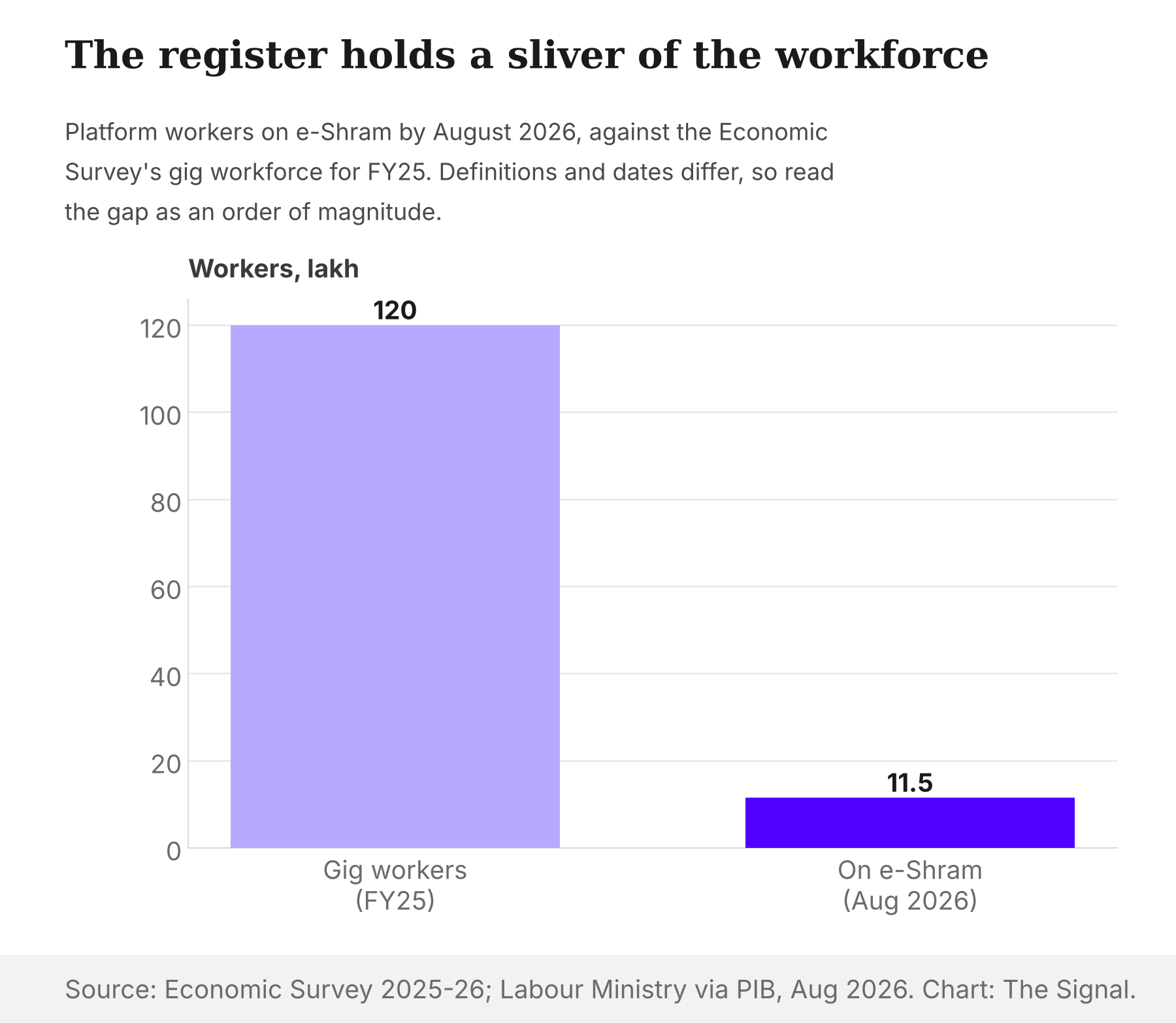
Source: PIB backgrounder on five years of e-Shram, 25 August 2026; Economic Survey 2025-26, Chapter 12. Chart: The Signal.
A fund built on contributions can only pay benefits to people it can identify. On these figures, the money side of the system has a clear formula, while the people side is still being counted.
The workforce is outrunning the rulebook
The pool these rules must cover is growing fast. The Economic Survey 2025-26 (Chapter 12, Ministry of Finance) reports a 55% rise in the gig workforce, from 77 lakh in FY21 to 120 lakh in FY25. That is 43 lakh more workers in four years, each one a person the levy and the register now have to reach.
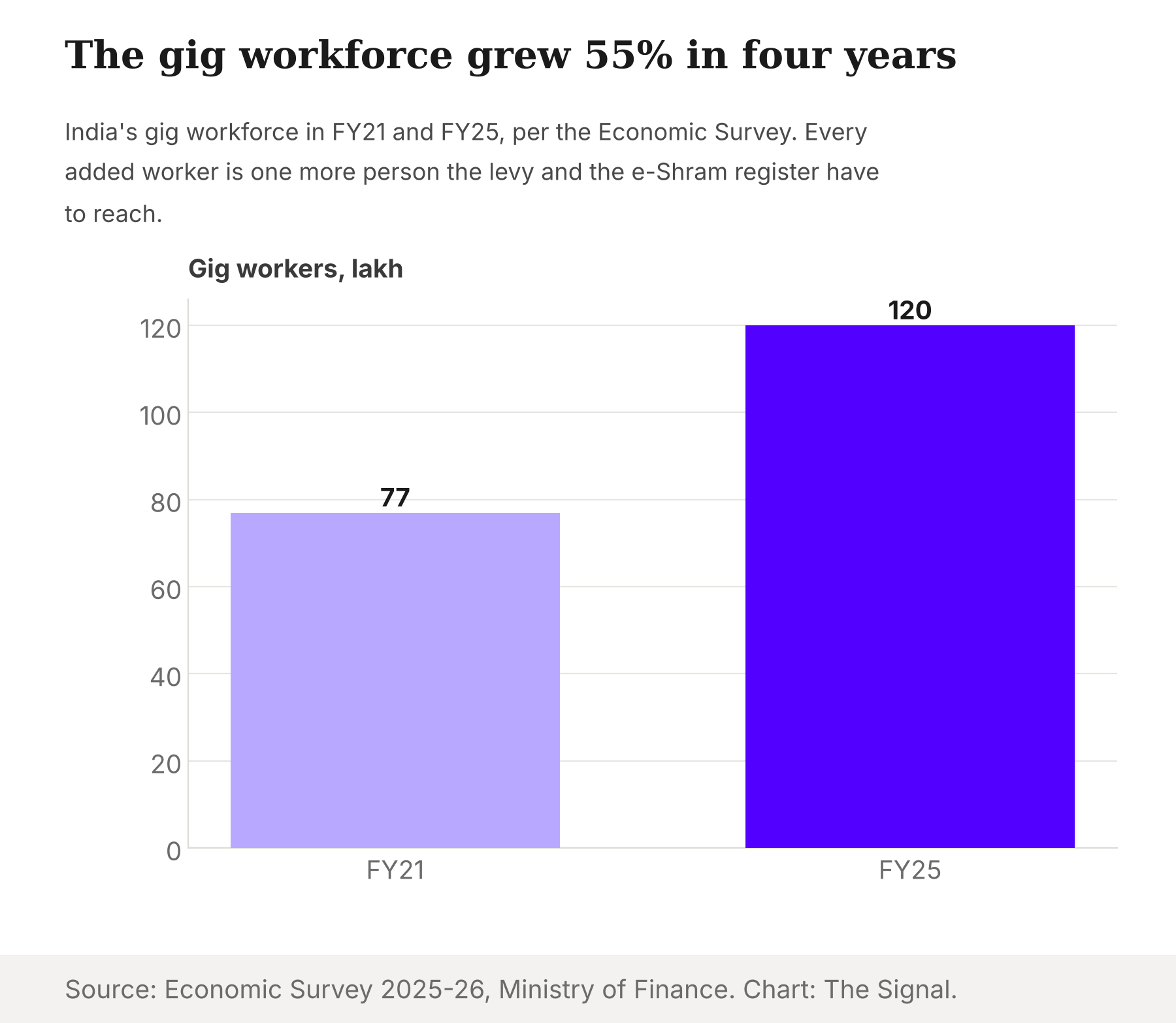
Source: Economic Survey 2025-26, Chapter 12. Chart: The Signal.
Pay is the other half of that picture. The Economic Survey 2025-26 reports that about 40% of gig workers earn below ₹15,000 a month. Applied to the Survey's FY25 workforce of 120 lakh, that is roughly 48 lakh people. For them, a levy capped at a share of payouts can only yield a small contribution per head, because the payouts themselves are small.
The Survey names the missing variable
The sharpest line on this sits in the government's own annual review. The Economic Survey 2025-26 (full volume, Ministry of Finance) recommends "setting minimum per-hour or per-task earnings (including waiting time)" for gig workers. The same passage frames the goal as reducing "the cost gap between regular and gig work" by limiting incentives to avoid mandatory benefits.
Two things follow from that sentence in the Survey. First, it treats waiting time as part of the working hour. That is exactly the time a payout-based levy cannot see. Second, it treats the cost gap between a salaried job and a gig as a policy problem: if gig work is cheaper partly because benefits are avoided, a percentage-of-payout levy narrows that gap only as far as payouts allow.
For hourly house help, this is the whole question. The product is priced per booked hour. The worker's day is booked hours plus travel plus idle gaps. A floor that counts waiting time, as the Survey recommends, would put a price on the hours between bookings. The levy, as the PIB backgrounder describes it, puts a price only on the money paid for the bookings themselves.
The honest objection
The strongest case against this reading is that the two instruments were never meant to do the same job. A social-security levy funds insurance, pensions and accident cover. It is not a wage law, and asking it to price idle time confuses a benefit fund with a pay floor. Tying it to payouts is also what makes it collectable. A levy on hours would need platforms to log every minute of every worker's day, which is costly to enforce and easy to dispute. And an hourly floor carries its own risk: if waiting time must be paid, a platform could respond by booking fewer workers or tightening slots, so some would earn less overall.
That case is real, and it is right that a levy is not a wage. But it concedes the point. If the levy cannot see the wait, the instrument that can is the hourly floor the Economic Survey 2025-26 recommends, a separate rule from the levy PIB describes. Treating the levy as the protection story means treating the unpaid hour as no one's problem.
The Signal
India has built half a system for gig work. The half that exists counts money: a fund fed by up to 5% of payouts, drawing on a register of 11.5 lakh platform workers as of August 2026. The half that is missing counts time, and the government's own Economic Survey has already written its specification. For apps that sell house help by the hour, that missing half is where the cost of the commute and the empty slot sits today. Watch whether any rule that follows the levy defines a working hour to include waiting time. Until one does, nothing in the levy puts a price on the gap between bookings. A booking pays for an hour. A working day has more of them.
Reporting basis: the aggregator levy rate and payout cap are from the Ministry of Labour and Employment's backgrounder on the labour codes, via PIB (9 December 2025); the e-Shram platform-worker registration count is from the same ministry's five-year e-Shram backgrounder, via PIB (25 August 2026), so these two facts share one origin. The FY21 to FY25 workforce growth, the FY25 count and the share earning below ₹15,000 a month are from Chapter 12 of the Ministry of Finance's Economic Survey 2025-26, and the recommendation of an hourly floor including waiting time is from the Survey's full volume; the two Survey documents are one origin. Telangana's bar on deducting the welfare fee is from the state's Act 21 of 2026 as gazetted (copy hosted by PRS Legislative Research). Karnataka's 1% fee capped at ₹1.50 is as reported by The News Minute; we did not see the order itself. The InstaHelp price, Urban Company's stated partner earnings and the unpaid travel and waiting are from Decode (BOOM) ground reporting; the partner-earnings figure is the company's own claim. Urban Company's home-help orders and per-order loss are from Reuters, and Snabbit's funding and scale from TechCrunch. The piece therefore rests on seven independent origins: two official central sources, one state statute, and four news organisations. The company figures are reported, not audited, and none of the figures is independently corroborated by a second body. The levy crossover shares, the register-to-workforce ratio, the four-year increase in workers, the count of workers below ₹15,000 a month, the payout-to-price multiple, Urban Company's quarterly home-help loss and the ₹150 point where Karnataka's cap binds are The Signal's calculations from those figures.