India's current account deficit widened to $25.8 billion in April to September 2026, from $18.0 billion a year earlier, according to the Reserve Bank of India's preliminary balance of payments data released on November 13. The same table shows an overall balance of payments surplus of $66.8 billion for the half year, against a deficit of $6.4 billion in the same months of 2025. Read together, the two lines look reassuring. The deficit grew, money poured in anyway, and reserves were topped up.
It is worth slowing down on where that money came from. Almost none of it was investment.
One line did nearly all the work
Net inflows into non-resident Indian deposits were $125.6 billion in April to September 2026, RBI's September release shows, up from $6.1 billion a year earlier. Against a $25.8 billion deficit, that is cover of almost five times. The two classic sources of foreign capital did the opposite. Net foreign direct investment was $8.8 billion and net foreign portfolio investment was minus $10.4 billion over the same six months, so together they netted to an outflow of about $1.6 billion.
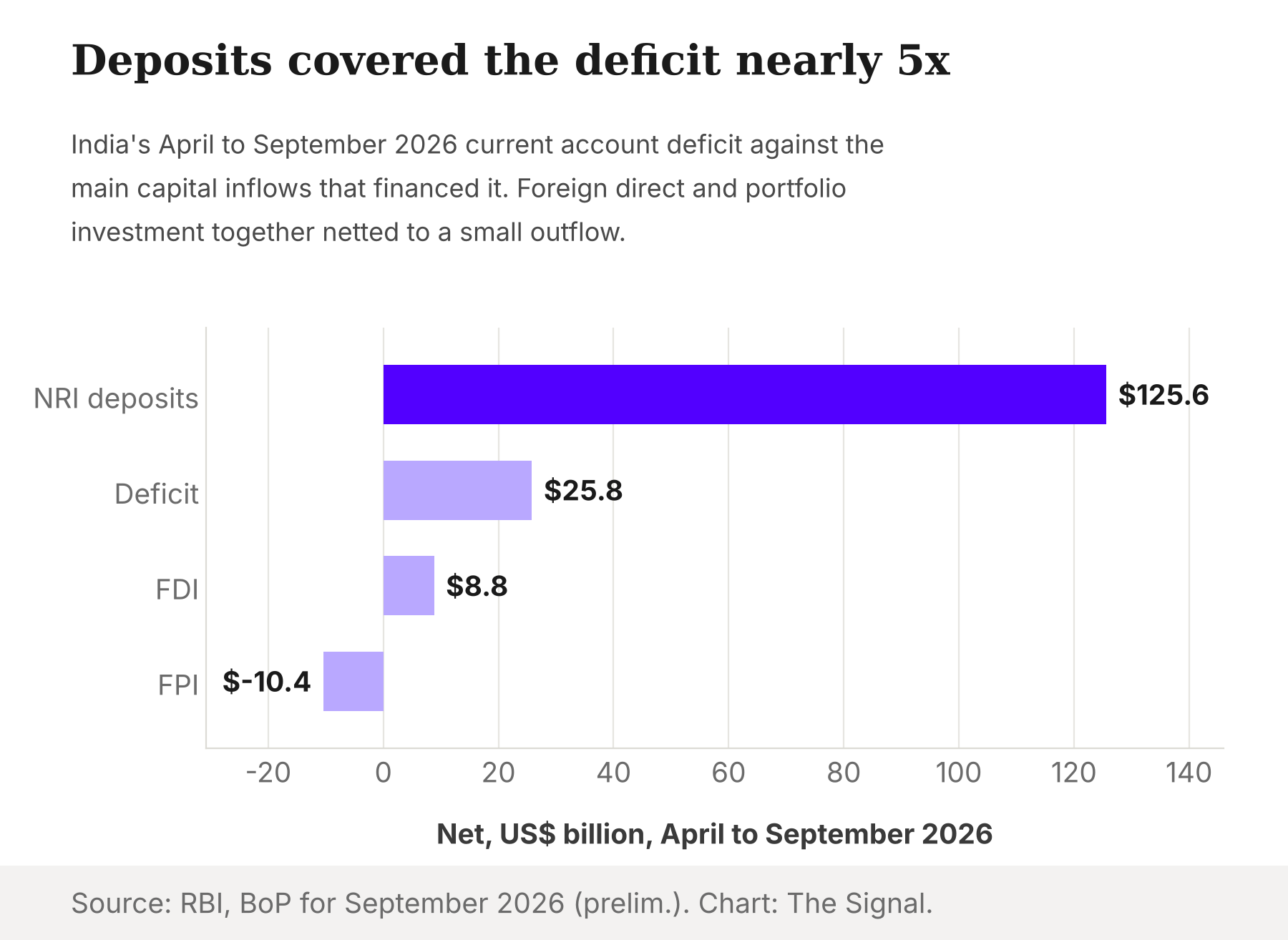
Put plainly: in the first half of this fiscal year, foreign investors paid for none of India's deficit. Indians abroad, parking dollars in Indian banks, paid for all of it and several times more.
A window, not a trend
Those deposits were not a spontaneous vote of confidence. They answered a price. On June 17, 2026, the RBI lifted the interest rate ceiling on fresh FCNR(B) deposits of three to five years, stating that the ceiling "is temporarily withdrawn with effect from June 17, 2026, for the period until September 30, 2026". Fresh FCNR(B) deposits raised in that window were also exempted from the cash reserve ratio and statutory liquidity ratio, the reserves banks must normally hold against deposits. Vinod Kothari Consultants noted that the government would bear the full hedging cost for banks on these deposits, and that the package followed a $13.7 billion outflow by foreign institutional investors in under two months.
Banks priced accordingly. Business Today reported that banks raised FCNR(B) rates from around 3 to 4 percent to 6 to 7 percent, and AU Small Finance Bank offered 7.10 percent, up from 5.15 percent.
Then the window shut early. On August 25, the RBI amended its directions so the relaxation ran "with effect from June 17, 2026, for the period until August 31, 2026", a month sooner than first announced. Law firm King Stubb & Kasiva notes that the window for mobilising FCNR(B) deposits under the swap facility also closed on August 31.
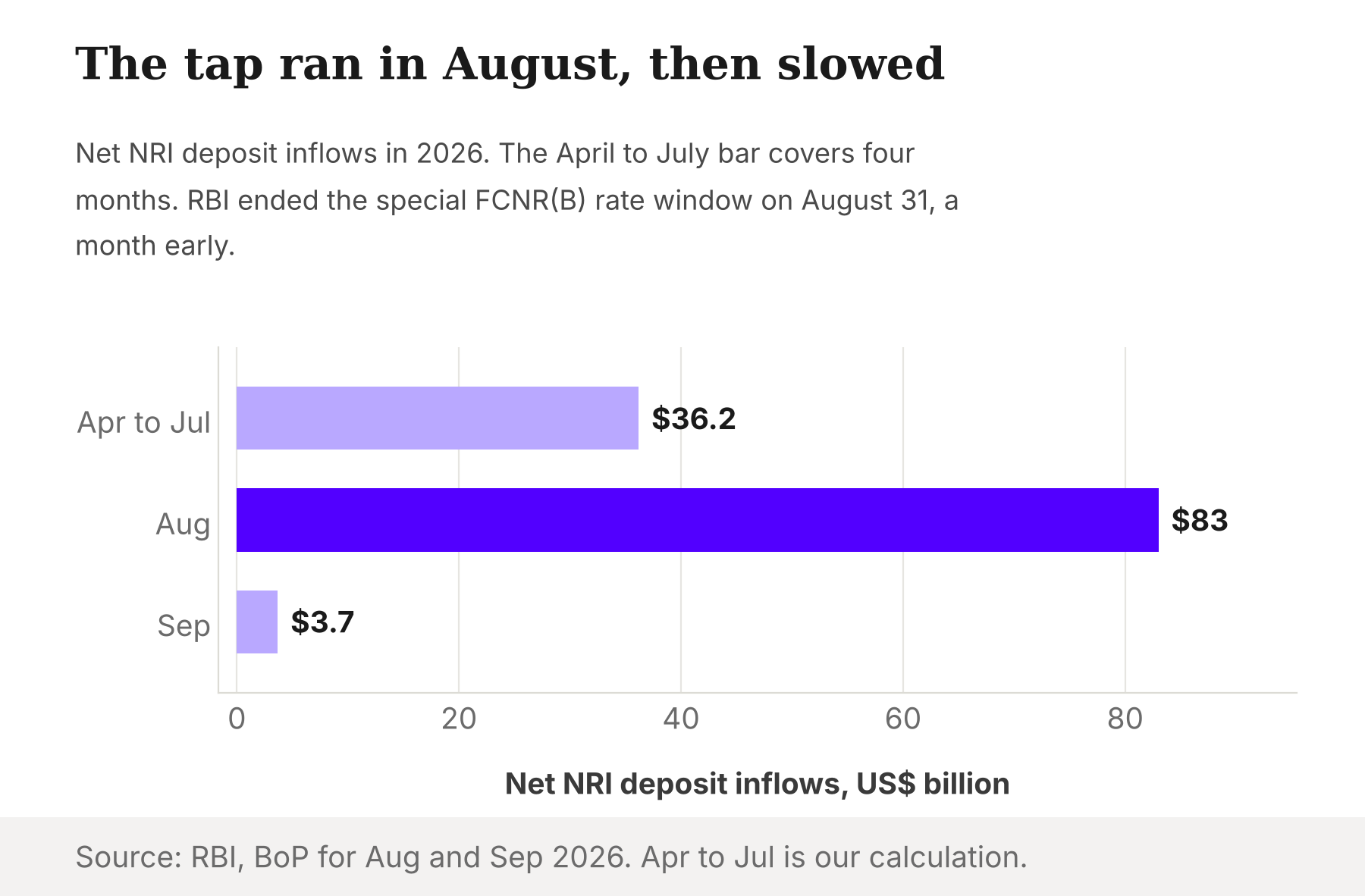
The monthly data show what that did. NRI deposits brought in a net $83.0 billion in August 2026 alone, RBI's August release shows, and $119.2 billion across April to August. In September, with the window closed, net NRI deposit inflows were $3.7 billion, per the September release.
September was the first month without the tap
September is the month to read closely, because it is the first one after the window. The current account deficit widened to $7.4 billion from $5.2 billion a year earlier, and foreign portfolio investors pulled out a net $6.7 billion, Millennium Post reported from the RBI data. Net income outgo, the line that records interest, dividends and profits paid to foreign holders of Indian assets, more than tripled to $7.6 billion from $2.2 billion.
The overall balance still ended September in surplus, at $8.8 billion, RBI's table shows, because banking capital brought in $22.2 billion. Only $3.7 billion of that was NRI deposits. The rest of the banking inflow is not broken out in the release, so it cannot be read as a new, durable source.
Trade was not the problem
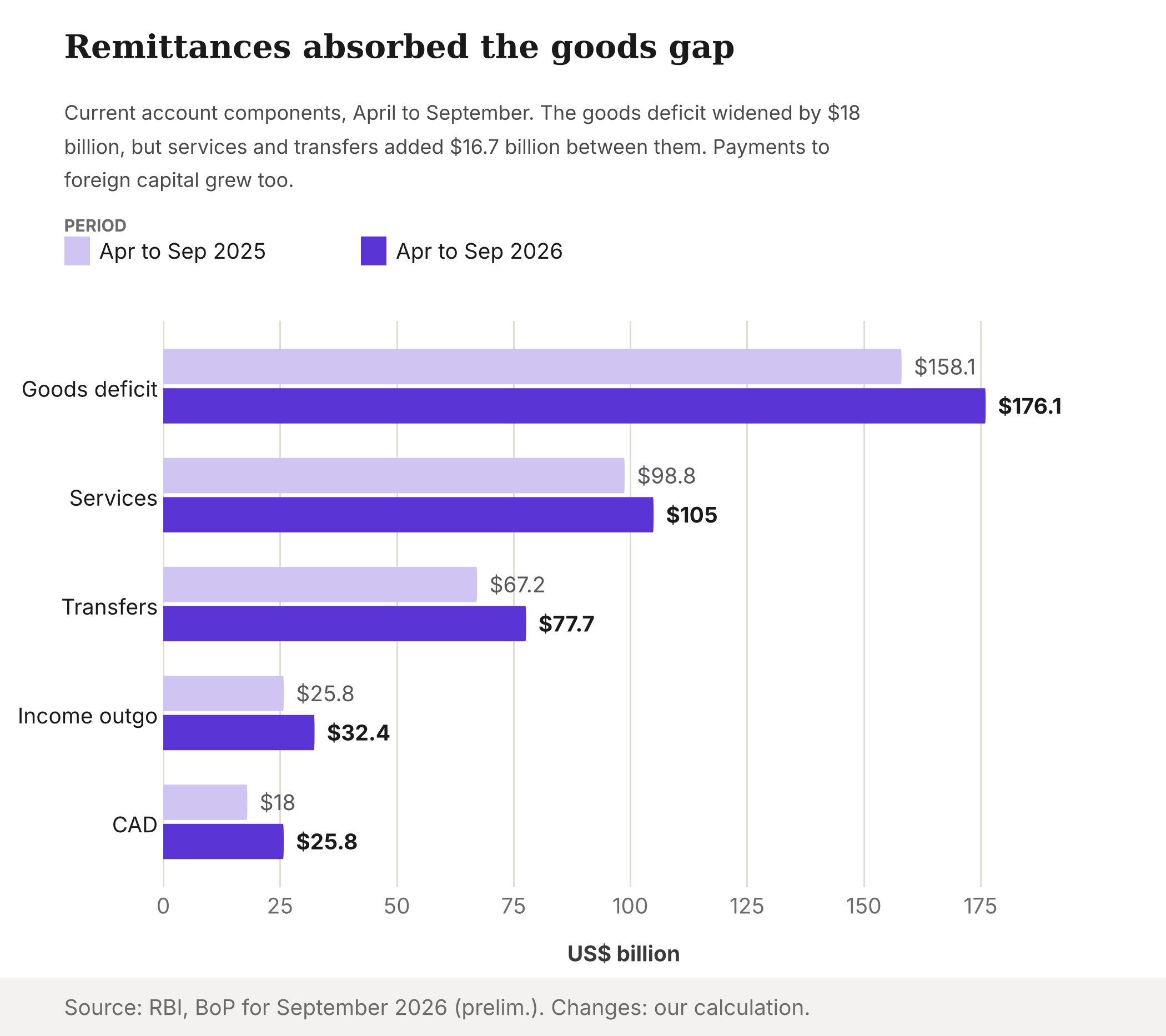
The consensus explanation for a wider deficit is a wider goods gap, and that gap did widen. The merchandise deficit rose to $176.1 billion in April to September 2026 from $158.1 billion, RBI's data show, even as merchandise exports rose 18.51 percent to $259.89 billion, per government data reported by Business Today.
But the rest of the current account absorbed nearly all of that. Net services receipts rose to $105.0 billion from $98.8 billion, and net transfers, mostly remittances, rose to $77.7 billion from $67.2 billion. That is $16.7 billion of extra cushion against an $18.0 billion wider goods gap. The bigger drag was the income account: net outgo grew to $32.4 billion from $25.8 billion, a $6.6 billion increase that accounts for most of the $7.8 billion by which the deficit widened.
Bigger than anyone planned for
The scale is the second surprise. Ahead of the window, Goldman Sachs estimated about $60 billion of additional inflows and Emkay about $50 billion, Business Today reported, while Vinod Kothari Consultants wrote that banks "may be able to raise up to $40 billion". The actual half-year NRI deposit figure of $125.6 billion is roughly double the highest of those forecasts.
The only real precedent is 2013. The 2013 FCNR(B) swap scheme, launched after the taper tantrum, mobilised nearly $34 billion, Canara Bank's economists write, a figure Business Today also reports. This year's six-month NRI deposit inflow is about 3.7 times that.
The honest objection
The strongest case against worry is simple. The money is already in. India's foreign exchange reserves stood at $719.5 billion on November 6, 2026, up $32.5 billion over the year, RBI's weekly supplement shows. The deposits were taken for three to five years, so they cannot leave next quarter. Services and remittances are growing and nearly offset the goods gap on their own. And closing the window a month early can be read as a sign the RBI got more than it needed, not that it lost control.
All of that is true, and it changes the question rather than answering it. The deposits bought time, not a financing model. Deposits taken from June 2026 for three to five years fall due between mid-2029 and 2031. Until then, the deficit needs a source that is not a one-off rate window, and in September the two market sources, FDI and portfolio flows, were both negative. A buffer built on a single concessional window is strong on the day it closes and weaker every month after.
The Signal
India's external accounts look stronger than they did a year ago, and the reason is one policy decision, not a shift in how the world sees India. Net NRI deposits of $125.6 billion paid for a $25.8 billion deficit nearly five times over in April to September 2026, while foreign direct and portfolio investment together netted to an outflow. The window that drew those deposits closed on August 31, and September's inflow was $3.7 billion. Watch three numbers in the October release: net portfolio flows, the income account, and NRI deposits without a subsidy behind them. If the first two stay negative while the third stays small, the surplus will turn out to have been a loan with a date on it.
Reporting basis: The balance of payments figures for April to September 2026 and for September 2026 (the current account deficit, the goods, services, transfers and income lines, net FDI, net FPI, banking capital, NRI deposits and the overall balance) come from the Reserve Bank of India's preliminary release of November 13, 2026; the August 2026 deposit figures come from RBI's release of October 15, 2026; and the reserves figure comes from RBI's weekly statistical supplement of November 13, 2026. The September portfolio outflow and the tripling of income outgo were reported by Millennium Post from the same RBI data, so they share RBI as their origin. The FCNR(B) rate relaxation, its shortening to August 31 and the CRR and SLR exemption are taken from RBI's own directions of June 17, August 25 and August 7, 2026; the swap window's closing date is per law firm King Stubb & Kasiva. Bank deposit rates and the Goldman Sachs and Emkay estimates are per Business Today; the government hedging-cost point, the $13.7 billion FII outflow and the $40 billion estimate are per Vinod Kothari Consultants; the 2013 scheme size is per Canara Bank's economic research, as also reported by Business Today; and the export growth figure is per Business Today, reporting government data that The Signal did not verify at source. The piece rests on six independent origins, with RBI carrying every load-bearing balance of payments number. The five-times cover ratio, the combined FDI and FPI outflow of $1.6 billion, the April to July deposit total of $36.2 billion, the $16.7 billion services and transfers increase, the $6.6 billion income increase, the comparison with forecasts and with 2013, and the 2029 to 2031 maturity range are The Signal's calculations from those figures.