On November 13, Eicher Motors reported the best quarter in its history, and the headline numbers made the case on their own. Royal Enfield sold a record 376,722 motorcycles in July to September 2026, up 15% from a year earlier, according to the company's earnings call. On the same call, consolidated revenue rose to ₹7,422 crore from ₹6,172 crore, and profit after tax rose to ₹1,573 crore. Read the top line and the story is a brand at the peak of its demand.
It is worth slowing down on that. The record describes what Royal Enfield shipped, not what buyers wanted. A different figure from the same call answers that question.
The number that carries the story
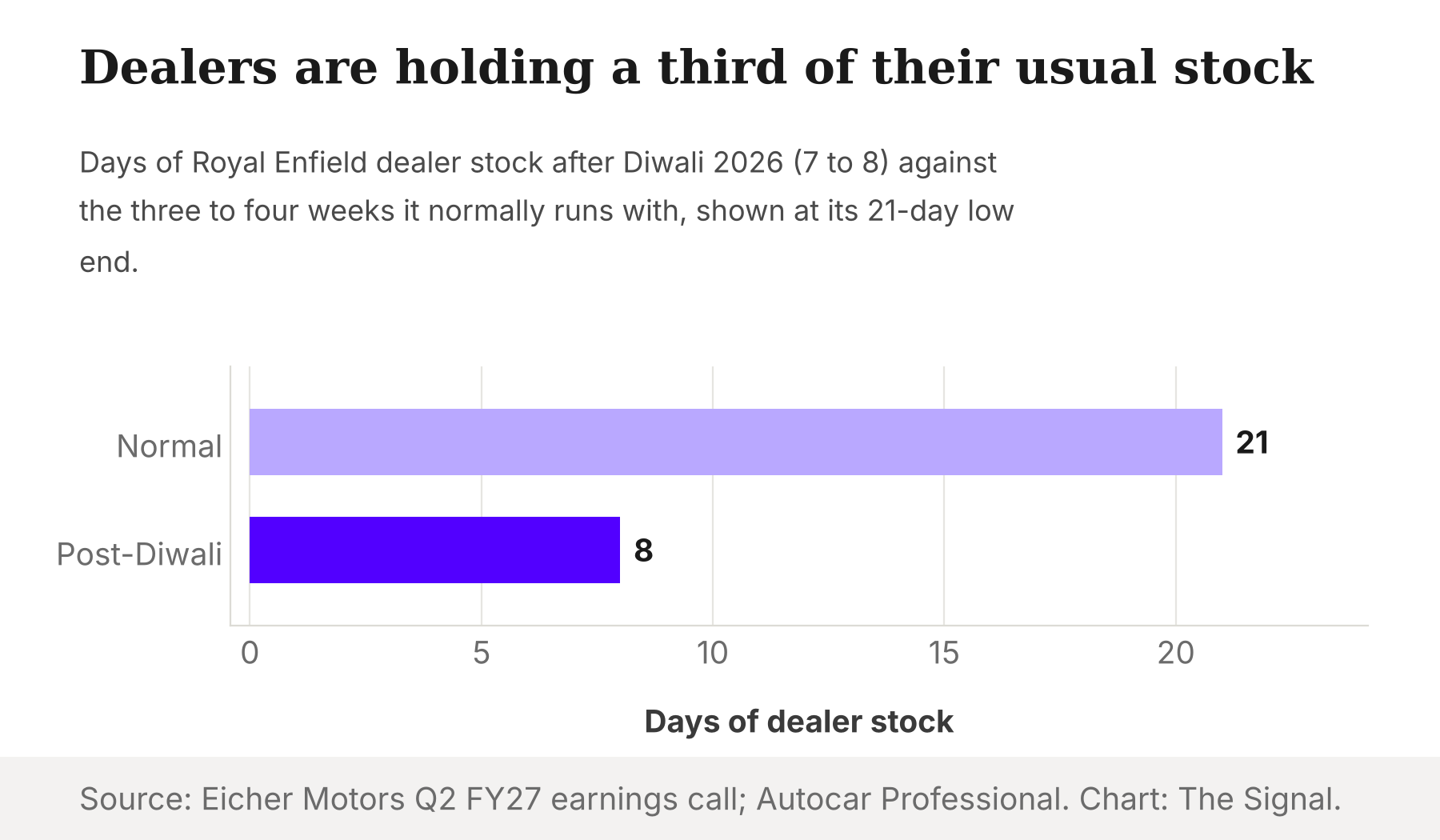
That number is a week. After Diwali, Royal Enfield's channel stock was about seven to eight days, against the three to four weeks it normally operates with, chief executive B. Govindarajan said on the call. Autocar Professional reports the same 7-8 days, including motorcycles still in transit.
A dealer network that ends its biggest selling season this lean has not run out of customers. It has run out of motorcycles. Even against the low end of the normal three-to-four-week range, dealers are holding roughly a third of their usual cover.
Orders are running ahead of the factory
The gap shows up in the order book too. Royal Enfield's motorcycle bookings grew around 21% year-on-year, Autocar Professional reports. Production did not keep pace: monthly production is up about 15% this year, Govindarajan said. When orders grow at 21% and output at 15%, the difference has to come from somewhere. This festive season, it came out of dealer stock.
The newest model makes the point most sharply. Royal Enfield says the Himalayan 440, launched in September, was fully booked for six months. Its own monthly figures show the strain as well. September 2026 dispatches reached a record 1,33,958 motorcycles, yet that was only 8% more than a year earlier, in a festive month with bookings running 21% ahead.
It is still outgrowing its own market
None of this means demand is soft. The opposite is true. SIAM data show India's motorcycle sub-segment grew 7.4% in July to September 2026, while scooters grew 27.7%. Royal Enfield's own releases let us isolate its domestic quarter. Domestic sales were 6,42,021 for April to September 2026 and 3,01,174 for April to June. That leaves about 3,40,847 for July to September, up roughly 16.4% on the same quarter a year earlier.
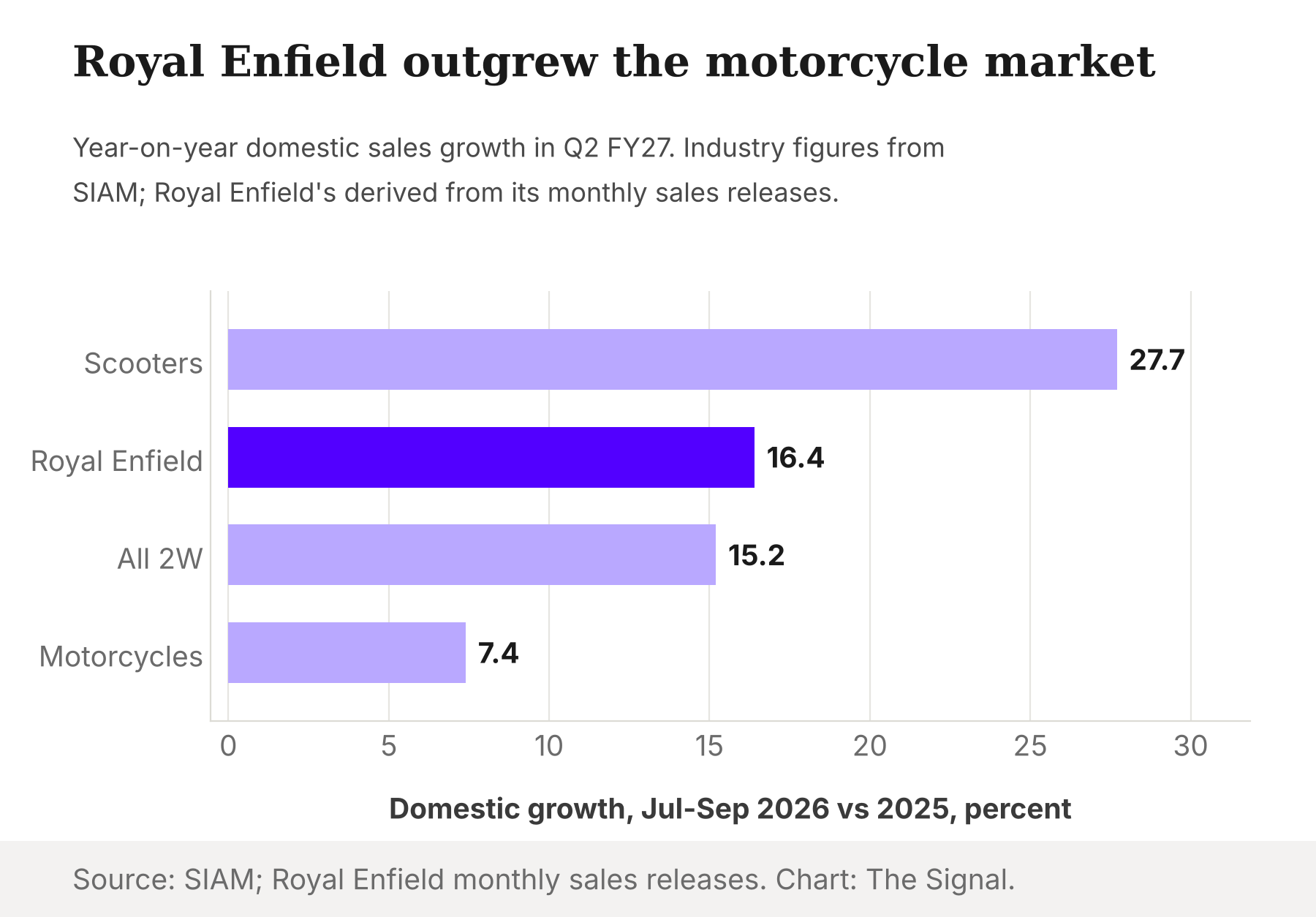
So Royal Enfield grew more than twice as fast as motorcycles overall, in a quarter when its dealers were short of stock. Part of the tailwind is tax. Under the GST changes effective September 22, 2025, motorcycles up to 350cc moved from 28% to 18%, which covers the 350cc models at the core of Royal Enfield's range. The wider market is still moving: domestic two-wheeler sales rose 16.1% in October 2026, SIAM says. Larger rivals grew faster in the same month Royal Enfield slowed. Honda's domestic two-wheeler sales grew 26% in September 2026, against Royal Enfield's 7%.
The run rate has reached the ceiling
The capacity arithmetic explains why. Royal Enfield's September and October dispatches totalled 2,67,400 motorcycles. Annualised, that two-month pace is about 16.0 lakh motorcycles a year. Its installed capacity is currently 16.5 lakh a year, rising to 18 lakh by the fourth quarter of FY27 and to 20 lakh when the third module at its Cheyyar plant starts in the second quarter of FY28.
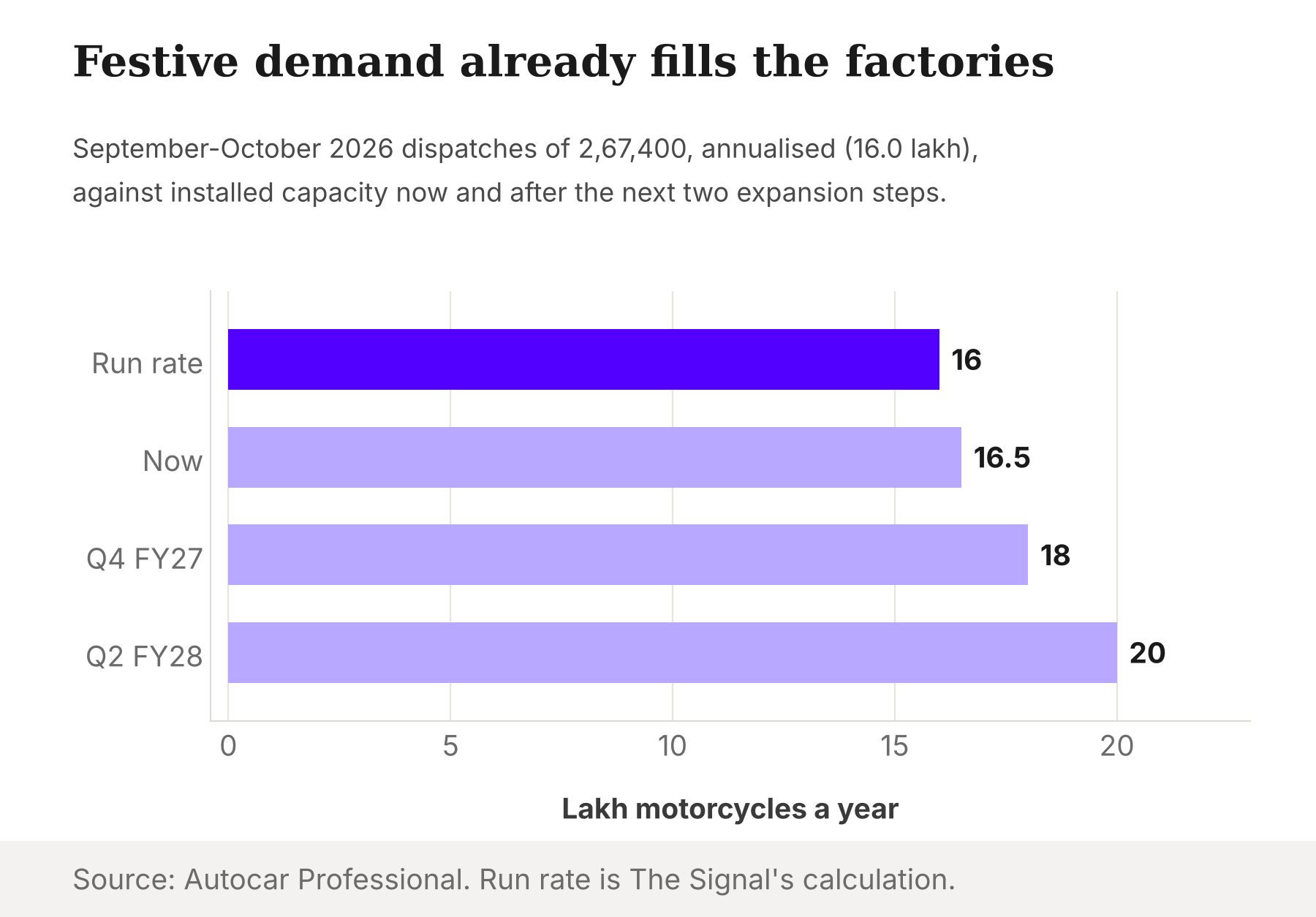
A festive run rate within 3% of the 16.5 lakh nameplate leaves almost no room to rebuild a depleted channel and meet fresh orders at once. That is why the next 1.5 lakh units of capacity matter more to the next two quarters than any launch or campaign.
There is one more tell. When a manufacturer is short of supply, where it sends its scarce units reveals its priorities. Royal Enfield's April-October domestic sales rose 20%, while exports stayed flat at 78,990 against 78,528 a year earlier. India got the extra bikes.
The honest objection
The strongest counter-case is that thin dealer stock is a choice, not a constraint. Manufacturers often run lean after a festive season to avoid discounting. Royal Enfield also changed how it ships: direct shipments to dealers rose to about 18% during the festive window from 1-2% earlier, Govindarajan said, which by itself lowers the stock any snapshot captures. And a supply squeeze has a cost of its own. Management said price increases have covered only about half of the commodity cost impact, with a further rise of about 0.7% taken in October. A brand that cannot fully pass on costs is not obviously in a seller's market.
That case is real, and it should temper any claim of unlimited demand. But it explains lean stock, not a six-month queue for a new model or bookings outrunning production by six points. Royal Enfield also plans to rebuild dealer inventories over the next two months, Autocar Professional reports. A company that chose lean would not need to.
The Signal
Royal Enfield's record quarter is best read as a ceiling, not a peak. The company puts its share of India's middleweight motorcycle market at around 80-82%, so for now the segment's growth is close to whatever Royal Enfield's factories can build. That shifts what to watch. Monthly dispatches will track capacity steps, so the 18 lakh module due by the fourth quarter of FY27 is the real growth catalyst. If dispatches jump when that module starts while dealer stock climbs back towards three weeks, the shortage was supply. If stock rebuilds and dispatches stall, demand has caught up with the factory. For a brand this dominant, the next record will be decided on the shop floor.
Reporting basis: quarterly volumes, revenue, profit, dealer-stock levels, production growth, direct-shipment share, pricing and market-share statements are from Eicher Motors' Q2 FY27 earnings call on November 13, 2026, as transcribed by Investing.com; Autocar Professional's report of the same results is the source for bookings growth, installed and planned capacity, September-October dispatches and April-October domestic and export volumes, and independently reports the same 7-8 day stock figure. Monthly and year-to-date domestic volumes and the Himalayan 440 booking status are from Royal Enfield's own sales releases for June and September 2026. Industry segment growth is from SIAM's Q2 FY27 and October 2026 releases. The GST rate change and Honda's September sales are as reported by Autocar India. The company-specific figures therefore rest largely on Eicher's own disclosures, with Autocar Professional as the main independent relay. Royal Enfield's July-September domestic sales and growth, the annualised festive run rate and its gap to capacity, and the dealer-stock ratio are The Signal's calculations from those figures.