Vodafone Idea's results for the September 2026 quarter, filed on November 12, read like a company finally turning. Revenue rose 6.15% from a year earlier to ₹11,884 crore, per the filing as reported by Upstox. Average revenue per user (ARPU) climbed 9.7% to ₹198, and the customer base grew to 194.4 million from 193.1 million in the June quarter. For a telco that spent years losing customers, a second straight quarter of growth is real news.
It is worth slowing down on that. The question for Vi was never whether it could post a better quarter. It is whether it can earn enough to pay the government, and on the company's own plan the answer depends on a single coincidence of numbers.
The two numbers that line up
Start with what Vi actually generates in cash. CEO Abhijit Kishore told analysts on the August 11 earnings call that Vi made ₹9,200 crore of cash EBITDA in FY26, and that its guidance for the next three years is to triple it. Cash EBITDA is operating profit after rent on towers and other leases, the closest thing to money a telco has left to spend. Three times ₹9,200 crore is ₹27,600 crore.
Now the bill. Chairman Kumar Mangalam Birla told the August 2026 AGM that Vi will pay around ₹7,000 crore of spectrum dues in FY27, ₹15,000 crore in FY28 and ₹27,000 crore in FY29, as reported by Outlook Business, which described these dues as the company's largest remaining financial obligation.
Set the two side by side. The FY29 instalment of ₹27,000 crore is nearly three times FY26 cash EBITDA of ₹9,200 crore, and almost exactly the ₹27,600 crore that a tripling would deliver. The payment schedule nearly quadruples in two years, from ₹7,000 crore to ₹27,000 crore. The turnaround plan and the spectrum bill are, give or take ₹600 crore, the same number.
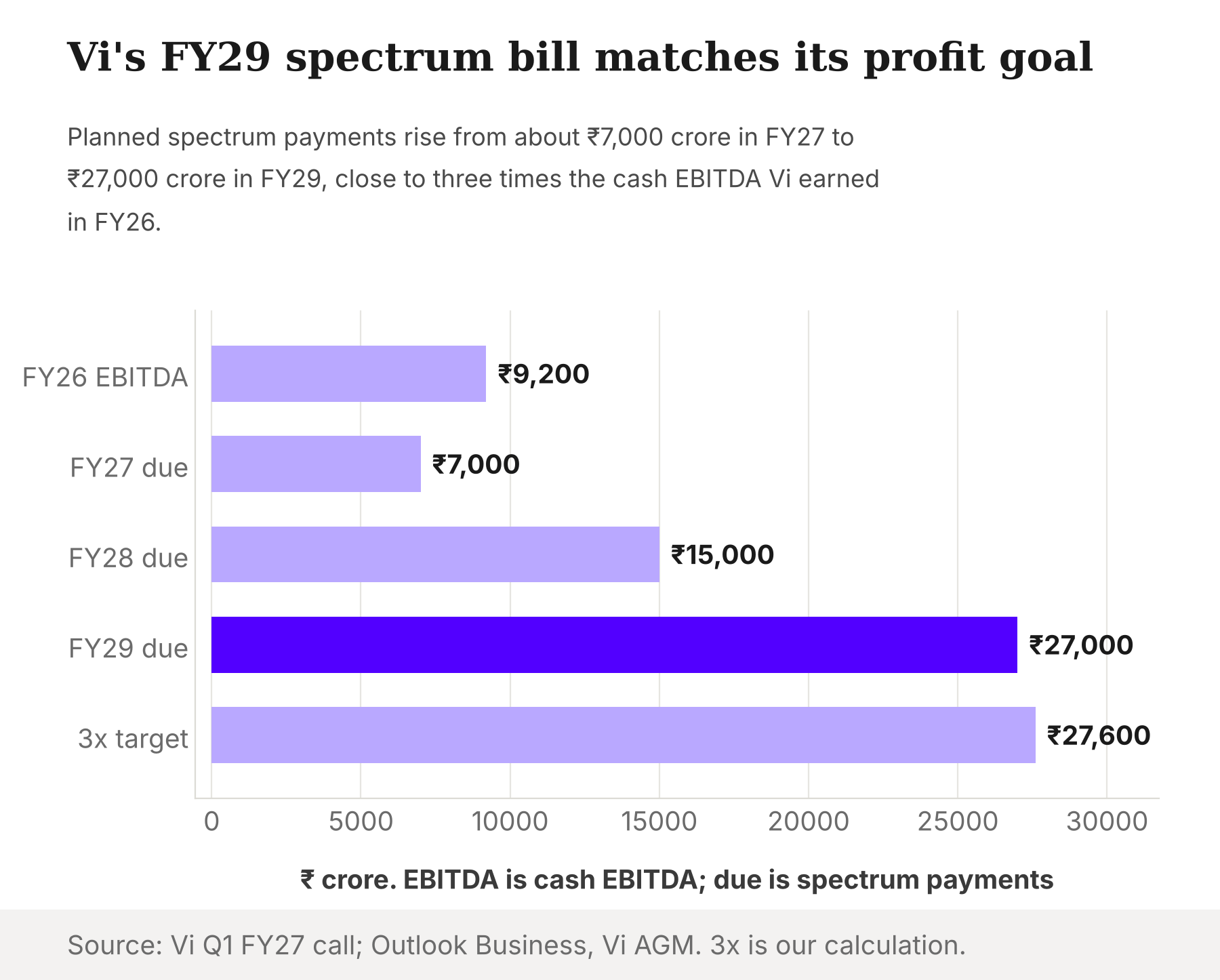
Put plainly, if Vi hits its guidance exactly, its FY29 cash profit covers the FY29 spectrum instalment and little else. Capital spending, interest and any return to shareholders would have to come from somewhere other than operations.
The AGR fix solved the smaller problem
The relief most investors remember was on adjusted gross revenue (AGR), the licence-fee dispute that ran for over a decade. On December 31, 2025, the Cabinet froze about ₹87,695 crore of Vi's AGR dues and pushed repayment to the window between FY32 and FY41, Outlook Business reported.
Spectrum was left untouched. Emkay Global noted on January 1 that Vi still carried ₹1.2 trillion of deferred spectrum obligations, with significant payments scheduled between FY26 and FY44, and said its EBITDA was insufficient to meet capex or spectrum repayment. That spectrum balance, ₹1,20,000 crore, is larger than the AGR amount the Cabinet froze. The headline relief moved the smaller bill to the 2030s and left the bigger one running.
The government sits on both sides
Here the story stops being about one company. The government's holding in Vi rose from 22.60% to about 48.99% in 2025, after ₹36,950 crore of spectrum auction dues were converted into equity, while operational control stayed with Vodafone Plc and the Aditya Birla Group, per Business Today.
The tool for that conversion was built in 2021. The Cabinet's 2021 telecom package allowed deferment of dues and gave the government the option to convert the deferred amount into equity at the end of the moratorium, according to the Press Information Bureau.
So the state is Vi's largest shareholder and the creditor on its biggest liability at once. The spectrum instalments Vi pays go to the government as creditor, and what it cannot pay can be turned into more equity, as happened in 2025. Either way, the government ends up carrying the third player in India's mobile market.
Where the extra profit has to come from
Tripling cash profit in three years means growth of about 44% a year. Vi is not close yet. Its cash EBITDA was ₹2,475 crore in the June 2026 quarter, an annualised pace of about ₹9,900 crore, roughly 8% above FY26.
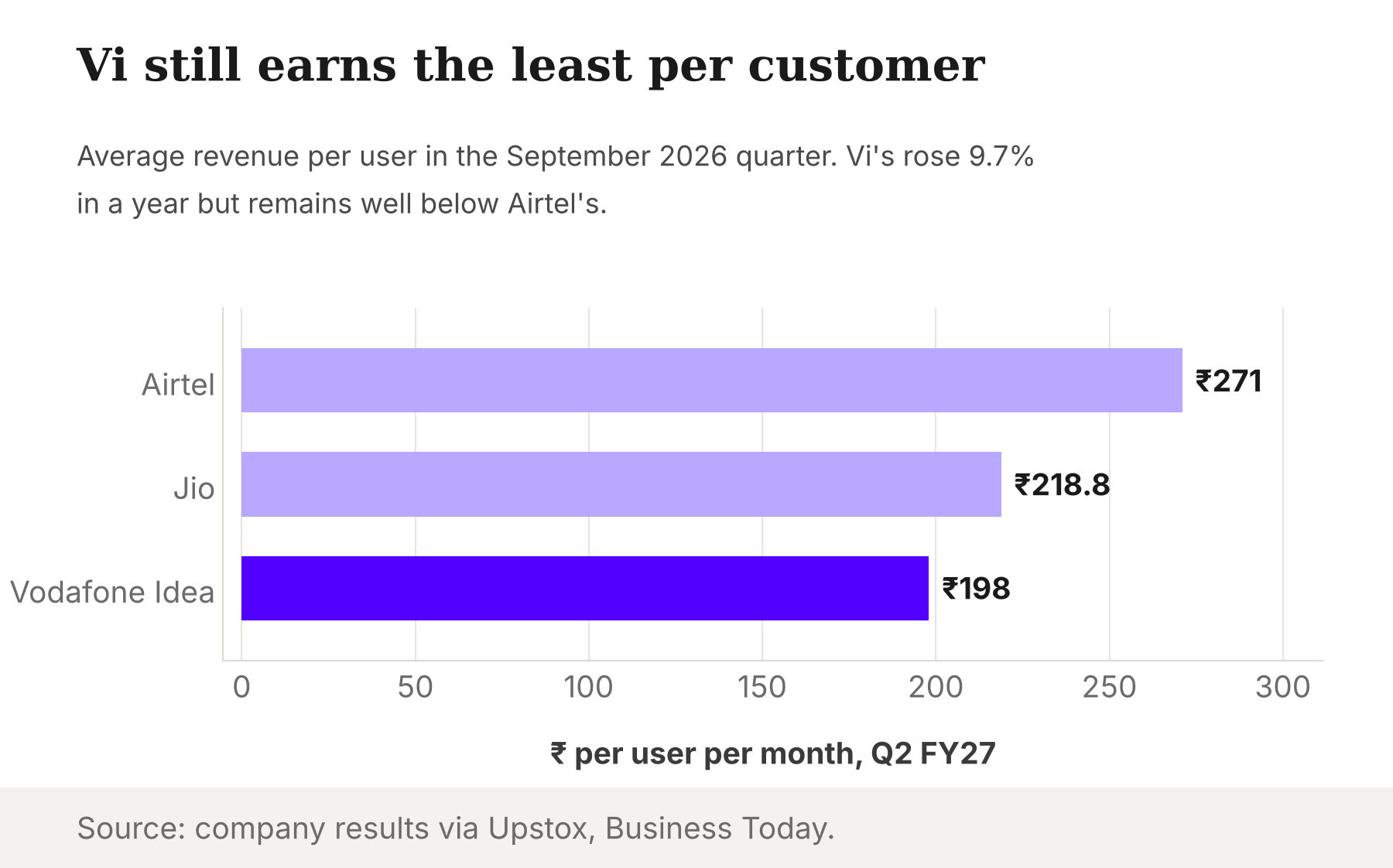
Most of the gap has to come from charging each customer more. Vi's ARPU was ₹195 in the June 2026 quarter against ₹177 a year earlier, growth of 10.2% that Vi called the highest in the industry. It is still the lowest of the three private carriers.
| Operator | ARPU, September 2026 quarter |
|---|---|
| Bharti Airtel | ₹271 |
| Reliance Jio | ₹218.8 |
| Vodafone Idea | ₹198 |
Airtel's ARPU rose to ₹271 from ₹256 a year earlier (Business Today); Jio's rose to ₹218.8 (Upstox, quoting Jio Platforms).
At ₹271 against ₹198, Airtel earns about 37% more per user than Vi. Closing even part of that gap requires either Vi customers to upgrade faster than anyone else's, or industry-wide tariff increases that lift Airtel and Jio too.
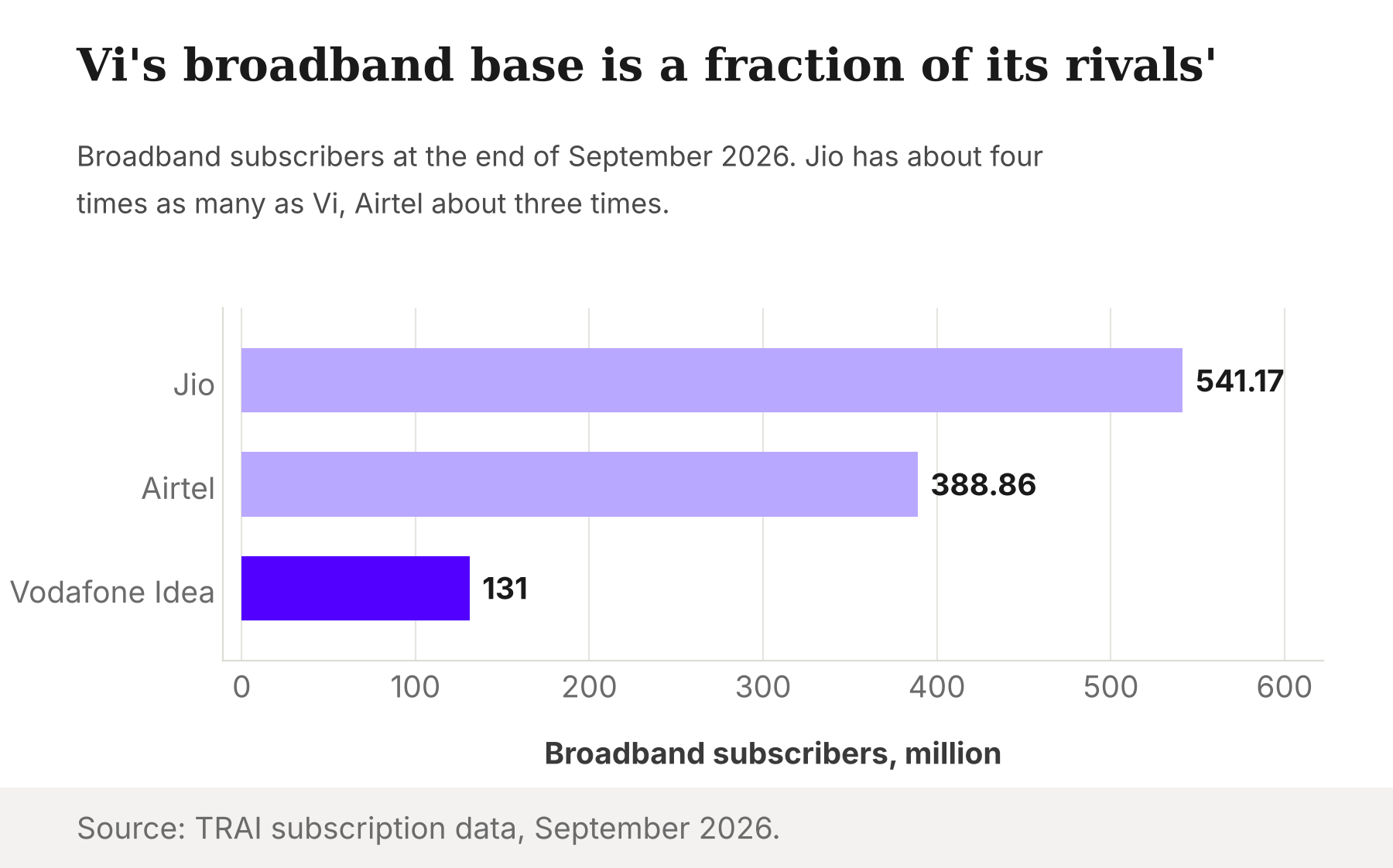
Network scale is the other constraint. TRAI data show Vi had 131.00 million broadband subscribers at the end of September 2026, against 541.17 million for Jio and 388.86 million for Airtel. Jio's base is about four times Vi's. Vi is spending to catch up: it has placed capex orders of over ₹13,200 crore, of which nearly ₹6,000 crore has been executed. That spending competes for the same cash as the spectrum instalments.
The honest objection
The strongest case for Vi is that the plan is back-ended on purpose. FY27's ₹7,000 crore instalment sits comfortably below current cash EBITDA, which buys two years for new towers and price increases to work. Vi is adding customers for the first time since its merger, its ARPU is growing faster than Airtel's (9.7% against roughly 6%), and the chairman said the company will not seek any further moratorium, planning to fund payments through higher EBITDA, internal cash and bank loans. Lenders, the argument goes, can bridge the gap if the trajectory holds.
That case is real, and it explains why FY27 and FY28 look manageable. It does not change FY29. Bank loans can cover capex, but borrowing to pay the government a sum equal to a full year's target cash profit is a refinancing of the state, not a turnaround. The plan works only if guidance is met in full, on time, with nothing left over.
The Signal
Vodafone Idea's recovery is genuine but narrow: about a million customers and a few rupees of ARPU a quarter. Its spectrum schedule asks for something else, nearly a fourfold rise in payments by FY29 that matches its three-year profit goal almost rupee for rupee. Watch two things: whether cash EBITDA growth moves from single digits toward the roughly 44% a year the guidance implies, and whether the next round of tariff increases comes from Vi alone or from all three carriers. If it is all three, India's mobile users are in effect funding Vi's payments to its own largest shareholder. Vi's turnaround has been sized to the bill, not to the business.
Reporting basis: Vi's September 2026 quarter revenue, ARPU, subscriber count and capex orders are from the company's results filing and press release, as reported by Upstox. FY26 cash EBITDA, the three-year tripling guidance and the June quarter cash EBITDA are from the company's own Q1 FY27 earnings call transcript, and the June quarter ARPU from its Q1 FY27 press release. The FY27 to FY29 spectrum payment plan and the no-further-moratorium pledge are per Outlook Business, reporting the chairman's remarks at the August 2026 AGM; that schedule rests on this single reported account. The ₹1.2 trillion spectrum balance is Emkay Global's estimate, via Outlook Business, and the AGR freeze is per Outlook Business's report of the December 31, 2025 Cabinet decision. The government's 48.99% stake is per Business Today, reporting Vi's March 2025 announcement; the 2021 equity-conversion option is from the Press Information Bureau. Broadband subscriber counts are from TRAI. Airtel's ARPU is per Business Today and Jio's per Upstox, each reporting company results. The ₹27,600 crore tripled target, the 44% annual growth rate, the annualised June-quarter cash EBITDA, the ARPU gaps, and the subscriber and payment multiples are The Signal's calculations from those figures.