India's consumer regulator has fined Ola for asking riders to pay extra before a driver accepted their trip. The Central Consumer Protection Authority's order is dated November 10, 2026, in Case No. CCPA-2/55/2025-CCPA. It imposed a penalty of ₹10 lakh, the maximum prescribed for a first contravention. The coverage has settled on one reading: a large platform got a small fine, and the law has no teeth.
That reading is accurate, and it misses the more useful part of the order. The CCPA did not only rule on what Ola said. It entered into the record what Ola's own data showed about whether the promise came true. It did not.
What the button promised, and what the data recorded
The prompt appeared while the app searched for a driver. It told riders an add-on might help them get a ride faster, with preset amounts underneath. Over the life of the feature, the suggested amounts rose from the ₹10 to ₹40 range to as high as ₹140.
Ola's data for June 1 to 15, 2026, recorded in the order, cover Delhi, Bengaluru and Mumbai. Across those cities Ola logged 39,94,464 ride requests, of which 3,93,221, about 9.8 percent, carried an add-on. Of those add-on requests, only 1,51,829, about 39 percent, were accepted.
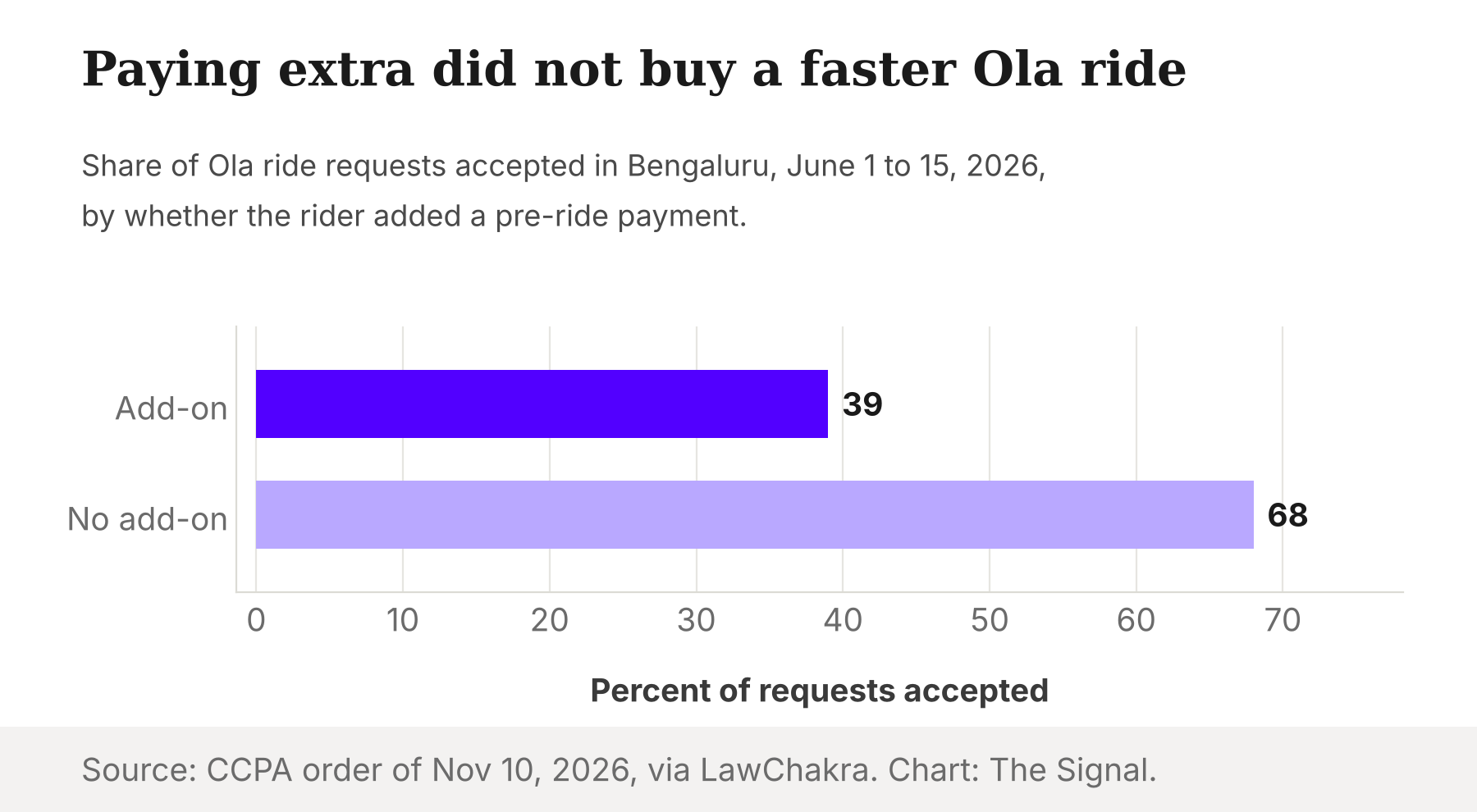
The city split makes the gap plain. In Bengaluru, 39 percent of requests with an add-on were accepted, against 68 percent of those without one. A rider who paid extra was not moved up a queue. On the order's own numbers, that rider sat in the group least likely to be picked up at all.
Why the fine is ₹10 lakh and not more
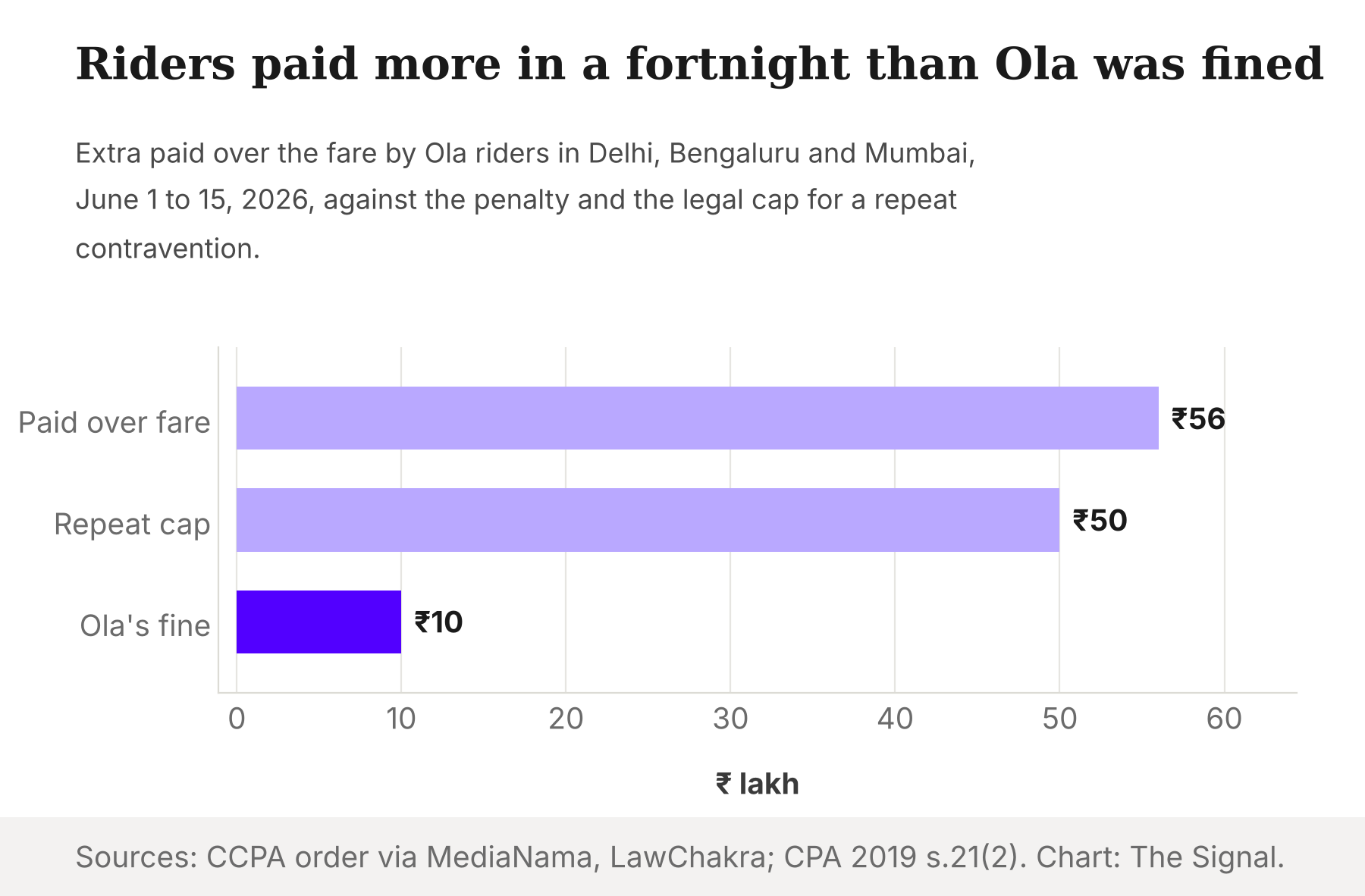
The penalty size is not a choice the CCPA made. Section 21(2) of the Consumer Protection Act, 2019, says a penalty may extend to ten lakh rupees, and may extend to fifty lakh rupees for every subsequent contravention. A first offence by a company of any size is capped at the same figure.
Set that against Ola's scale. Ola Cabs' consolidated revenue fell about 42 percent to ₹1,170.9 crore in FY25. The ₹10 lakh fine is under one-hundredth of one percent of that revenue.
A better comparison is what riders paid. In the same June fortnight, in three cities, riders paid about ₹56 lakh over the fare. That is 5.6 times the penalty, from two weeks of data in three of Ola's markets.
The regulator's wider record follows the same scale. A Rajya Sabha reply on dark patterns, reported in August 2026, showed penalties totalling ₹20 lakh imposed in seven cases. In June 2026 the CCPA penalised a coaching institute and a software company for dark pattern practices that misled consumers and influenced their choices on digital platforms, with fines of ₹5 lakh and ₹1 lakh.
The repeat clause is where the money is
The law does let penalties climb, and the CCPA has used that room in one sector. It fined Vision IAS a penalty of eleven lakh rupees in December 2025, after the institute had earlier been proceeded against for misleading advertisements. In February 2026 it imposed a penalty of 15 lakh rupees on Vajirao & Reddy Institute. Both were coaching institutes. Ride-hailing has now entered the same ladder.
Ola's own history makes a second contravention a live question. The order notes that MoRTH's directive to remove pre-ride tip prompts is dated August 11, 2026, and that Ola's app still showed the prompt afterwards. Ola has 15 days to pay the penalty and file a compliance report. If a renamed prompt surfaces again, the next order is not capped at ₹10 lakh. It can reach ₹50 lakh.
Ola is not alone in the queue. The CCPA fined Rapido ₹10 lakh in an order decided on August 31, 2026, over prompts such as "Higher the price, higher the chance of getting a ride." Two ride-hailing apps have now been told, in writing, that a payment requested before the service is not a tip.
The honest objection
Ola's strongest defence deserves full weight. It told the regulator the entire add-on went to drivers, and that it took no commission on it. On that account, Ola made no money from the button, and a penalty sized against its revenue is the wrong yardstick.
The lower acceptance rate also has an innocent explanation. Riders reach for an add-on when a request is already struggling: a long pickup, a bad hour, a short trip drivers avoid. Those requests would be accepted less often with or without a tip. The 39 percent against 68 percent comparison does not prove the add-on made anything worse.
Both points are fair, and neither rescues the prompt. The case was never that the payment slowed rides down. It was that the app told riders paying would help, while Ola's records showed paying riders were the ones least often served. A promise that the seller's own data contradict is the definition of a misleading claim, whoever keeps the money. And driver income is not a defence for consumers: the ₹56 lakh left riders' pockets on a representation the order found unfounded.
The Signal
The ₹10 lakh number will dominate the headlines, and it is the least informative part of the order. The penalty is a statutory constant, the same for Ola as for a small app. What changed on November 10 is that a regulator put a platform's own acceptance data on the record and held the promise against it.
Three things are worth watching. First, whether Ola's compliance report removes every pre-ride payment prompt, or only renames one again. Second, whether the cases against other ride apps end with the same finding as Ola and Rapido. Third, whether any platform is fined under the ₹50 lakh ceiling for a repeat contravention. A fine this size is a cost of doing business; a button two regulators have now ruled against is a liability.
Reporting basis: the order's date, case number, the ₹10 lakh penalty and its status as the ceiling for a first offence, the suggested add-on amounts and the Bengaluru acceptance rates are from the CCPA's final order of November 10, 2026, as reported by LawChakra; the three-city request, add-on, acceptance and amount-paid figures for June 1 to 15, 2026, the MoRTH directive date and the 15-day compliance deadline are from the same order, as reported by MediaNama. These two outlets relay one origin, the CCPA order, which The Signal did not read directly. The penalty ceilings are from the text of Section 21(2) of the Consumer Protection Act, 2019. Ola Cabs' FY25 revenue is from the company's regulatory filing, via Tofler, as reported by Outlook Business. The Rapido order is per SCC Online. The ₹20 lakh dark-pattern total is from Rajya Sabha Unstarred Question 1798, as reported by The Policy Edge. The Vision IAS, Vajirao & Reddy and June 2026 dark-pattern penalties are CCPA actions as reported by All India Radio News. The penalty as a share of revenue and the 5.6 multiple of riders' payments to the fine are The Signal's calculations from those figures.