On 10 November 2026, India stopped letting lithium-ion battery waste leave the country. The Directorate General of Foreign Trade's notification moved unsorted battery waste and scrap that contains no lead, cadmium or mercury, which it names as lithium-ion battery black mass, from "Free" to "Prohibited" with immediate effect, until further orders. Black mass is the dark powder left after spent cells are discharged, shredded and sieved. It holds the lithium, nickel and cobalt a new battery needs. The obvious read is the one the government intends: keep the critical minerals at home rather than ship them to refiners abroad.
That read is right as far as it goes. The ban is also narrower than the headlines suggest. The Tribune reports that it does not state a blanket prohibition on every battery or battery-related export. It closes one code for one product.
It is worth slowing down on who makes that product. India's recycling industry has two layers. Shredders, known as R2 recyclers, turn dead batteries into black mass. Refiners, known as R4 recyclers, dissolve black mass and recover the metals. An industry executive quoted by EVreporter says R2 recyclers form over 80 percent of India's lithium-ion battery recycling industry. The ban does not touch the refiners' business. It rewrites the shredders' one, because their entire output is now a product with a single legal buyer pool: Indian refiners.
The volume problem is smaller than it looks
The worry with any export ban on an intermediate good is that the material piles up with nowhere to go. On capacity, that worry mostly fails.
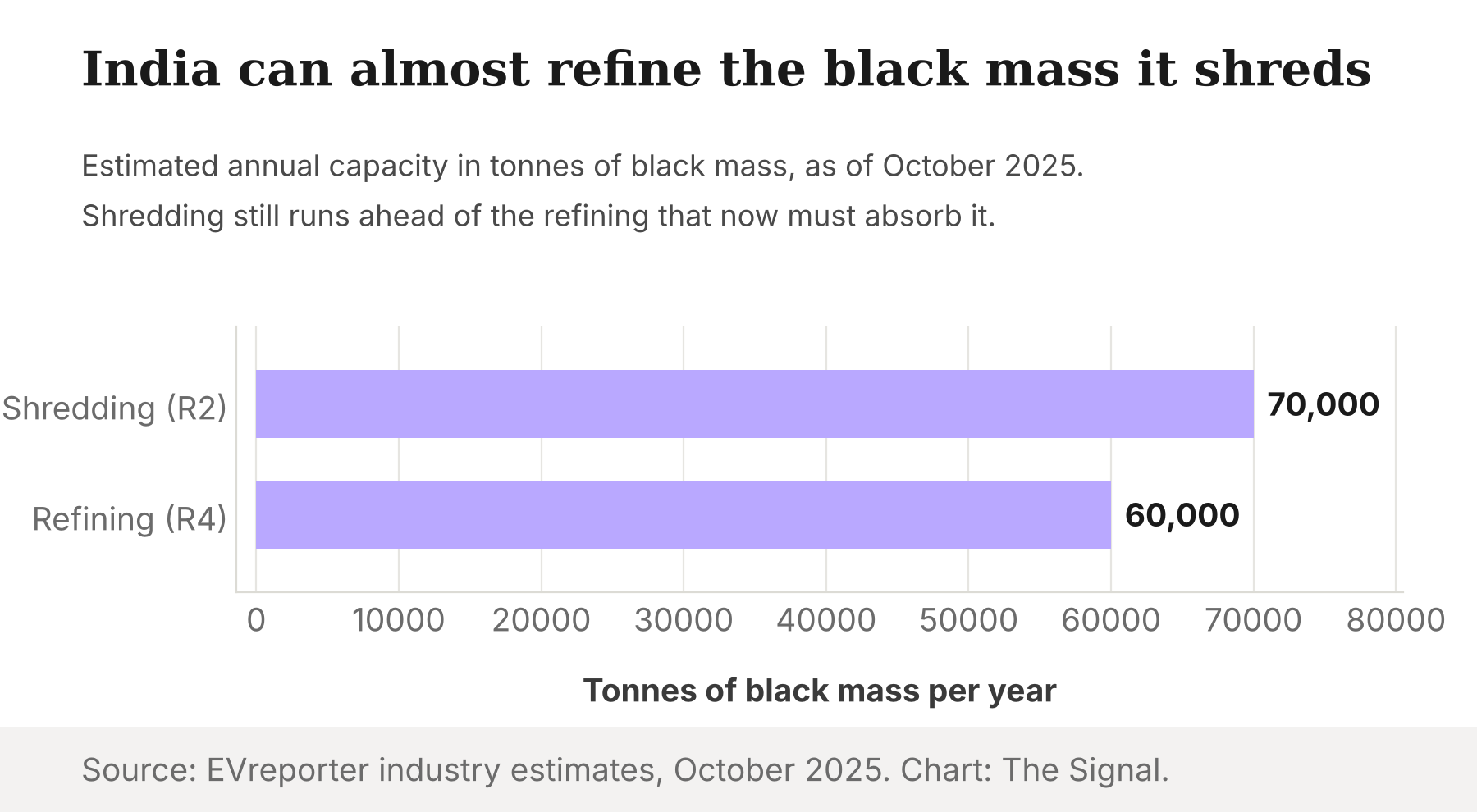
EVreporter estimated in October 2025 that India's shredding capacity is nearly 70,000 tonnes of black mass a year, and that Indian players' refining capacity is about 60,000 tonnes a year. Refiners can, on paper, take about 86 percent of what shredders can make. The gap is roughly 10,000 tonnes a year.
Those are capacities, not flows. Neither plant type runs full all year, and the EVreporter estimates date from October 2025. But they show the ban is not a bet on refineries that do not exist yet. The refineries are there. What the ban changes is who holds the bargaining power when the two sides negotiate.
The refiners now set the price
Refining capacity is concentrated. EVreporter reports that Attero has built capacity to refine up to 15,000 tonnes of black mass a year and Rubamin 10,000 tonnes a year at its Gujarat plant. Those two firms alone hold 25,000 tonnes, about 42 percent of the estimated national refining capacity. A shredder that could once weigh a foreign bid against a domestic one now compares Indian bids with each other.
Shredders were already complaining before the ban. Some R2 recyclers told EVreporter in November 2025 that Indian refineries pay about 2 percent less on black mass. That is their claim, not a verified price series. The ban removes the outside option that kept even that gap from widening.
State policy points the same way. The PMO's release on the Cabinet decision says the ₹1,500 crore critical mineral recycling scheme pays for the value chain involved in actual extraction of critical minerals, and not the value chain involved in only black mass production. The same release expects the scheme to develop at least 270 kilotonnes of annual recycling capacity, yielding around 40 kilotonnes of critical minerals a year. All India Radio News reports that the scheme runs six years, from FY2025-26 to FY2030-31, and that its incentives include a 20 percent capex subsidy on plant and machinery. Subsidy goes to the refiners. Export rights have now been taken from the shredders. Both levers push the industry's margin toward the same layer.
Capacity is coming, on paper
The best case for the ban is the pipeline behind it.
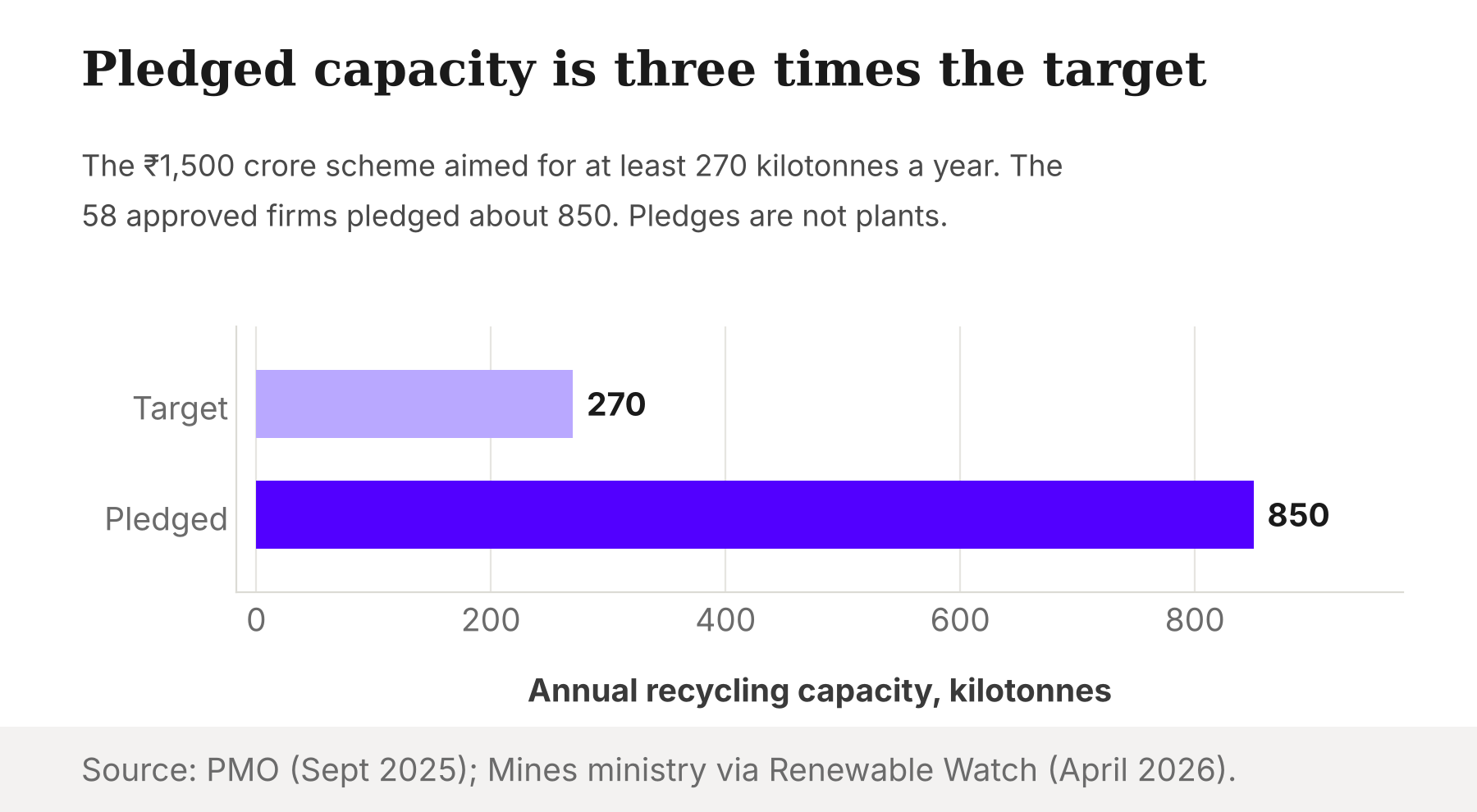
Renewable Watch, citing the Ministry of Mines, reports that 58 companies were approved under the scheme by 29 April 2026 with a combined capacity of about 850 KTPA and cumulative investment of around ₹50 billion. Against the 270-kilotonne target, that is more than three times the capacity the government set out to buy. That capacity covers e-waste and industrial scrap too, not only batteries, and a pledge is not a running plant. But if even part of it is built as refining, the buyer pool for black mass grows and the concentration problem eases.
Why the door was shut now
The timing has a cause outside India. Enviliance, summarising the Chinese ministries' notice, reports that China's rules allowing standard-compliant recycled black mass to be imported freely, rather than treated as solid waste, took effect on 1 August 2025. Chinese refiners became legal buyers of black mass.
Indian material started to leak toward that demand. EVreporter reported in October 2025 that at least four domestic recyclers had re-labelled black mass as "non-hazardous goods containing cobalt and nickel", with nearly 250 tonnes booked for China via a bill-of-lading switch in Singapore. Black mass had already been treated as hazardous waste needing permits. The relabelling worked by moving the material out of that category. The new notification hardens the line on the right code. It does not, by itself, stop the material from being declared as something else.
The honest objection
The strongest case for the ban is that India is not alone. The European Commission says that classifying black mass as hazardous waste in March 2025 will lead to a ban on its export to non-OECD countries. The EU, which also wants a domestic battery supply chain, has reached for a similar tool. Exporting black mass means exporting the most valuable part of a dead battery and buying it back later inside imported cells. A 2 percent payables gap, if that is what it is, is a modest price for building a domestic refining industry that can supply India's own cell makers.
That case is strong, and it is mostly right on strategy. The answer is about design, not direction. A ban protects a refining industry only if that industry competes for feedstock. With two firms holding over 40 percent of estimated refining capacity and a scheme that subsidises only refiners, the risk is not that black mass has nowhere to go. It is that shredders, who do the collection, earn less for it. Lower prices at the collection end risk pushing spent batteries back toward informal handlers.
The Signal
India has chosen to keep its battery metals at home, and on volume it can almost do so: refining capacity is close to shredding capacity, and pledged recycling capacity is three times the scheme's target. The open question is price. The ban has handed the industry's dominant layer, the shredders, a buyer market run by a few refiners, at the same time the state's subsidy flows to those refiners. Watch two things: whether pledged refining plants under the scheme actually start production, and whether black mass turns up again in India's export data under other descriptions. If refiners multiply, the ban builds an industry. If they do not, it builds a toll booth.
Reporting basis: the export prohibition and its scope are from DGFT Notification No. 49/2026-27, checked directly, with the point that it is not a blanket battery ban per The Tribune. The recycling scheme's size, tenure, targets, capex subsidy and exclusion of black-mass-only plants are from the Union Cabinet decision, via the Prime Minister's Office release and All India Radio News. The 58 approved firms and their pledged capacity are per Renewable Watch, reporting Ministry of Mines figures. Shredding and refining capacity estimates, the Attero and Rubamin capacities, the share of R2 recyclers, the claimed payables gap and the 2025 relabelling episode all come from one origin, EVreporter, across three of its reports; these rest on a single trade publication and its industry sources. China's August 2025 import rules are per Enviliance's summary of the Chinese ministries' notice, and the EU classification is from the European Commission. The 86 percent absorption ratio, the 10,000-tonne gap, the 42 percent concentration figure and the pledged-to-target multiple are The Signal's calculations from those figures.