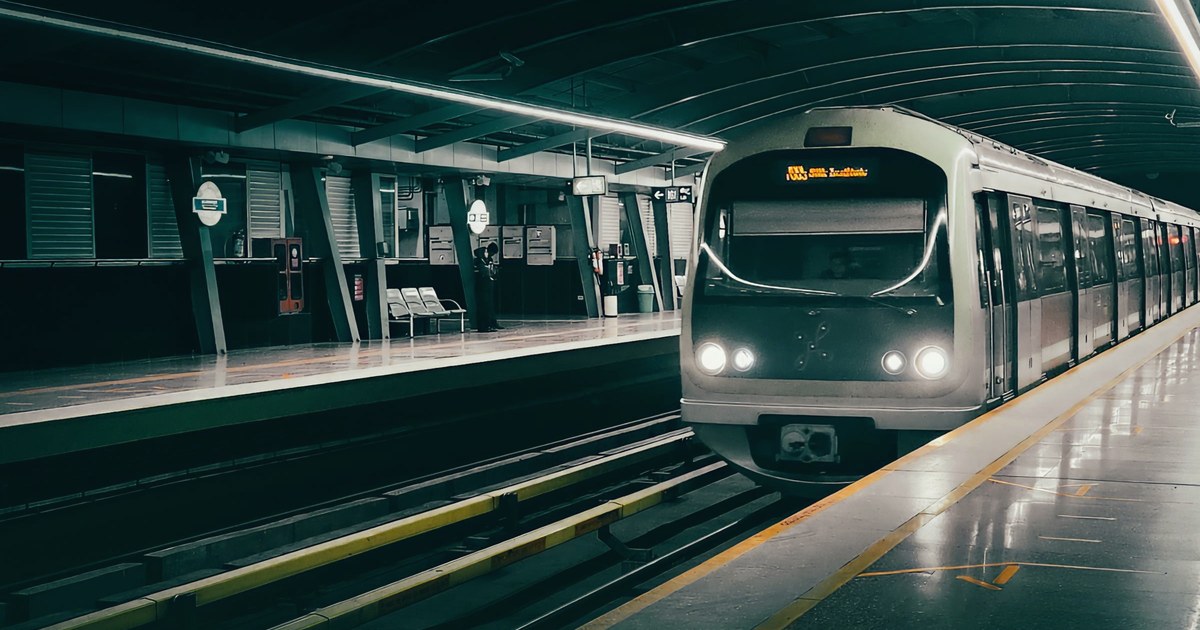
On November 13, 2026, the Prime Minister is due to open a 7.5 km elevated stretch of Bengaluru Metro's Pink Line, which Construction World reports will take the network from 96.1 km to 103.6 km. The opening has set off a fight over the bill. On November 10, 2026, Karnataka Congress said the state accounts for ₹65,291 crore of a total it put at ₹77,891 crore, leaving the Centre ₹12,600 crore, or 16.2%. That makes Karnataka's share about 84%. Days earlier, in early November 2026, Bengaluru South BJP MP Tejasvi Surya said the Centre had committed ₹41,557 crore across the metro's phases, against ₹36,332 crore committed by Karnataka.
Read the coverage and it looks like two parties describing two different projects. One says the state carried the metro almost alone. The other says the Centre committed more than the state did.
The two totals are the same number
It is worth slowing down on that. Add up Surya's two figures and you get ₹77,889 crore. Karnataka Congress's total is ₹77,891 crore. The two sides are not arguing about how much Bengaluru Metro costs. They agree on that to within ₹2 crore. They are arguing about whose name goes on the same money.
The size of the disputed slice is easy to compute. The Centre's figure jumps from ₹12,600 crore in the Karnataka Congress count to ₹41,557 crore in Surya's, a difference of ₹28,957 crore. Karnataka's figure drops by almost exactly the same amount, from ₹65,291 crore to ₹36,332 crore. Roughly ₹29,000 crore, or about 37% of the whole bill, sits in a column each side assigns to itself.
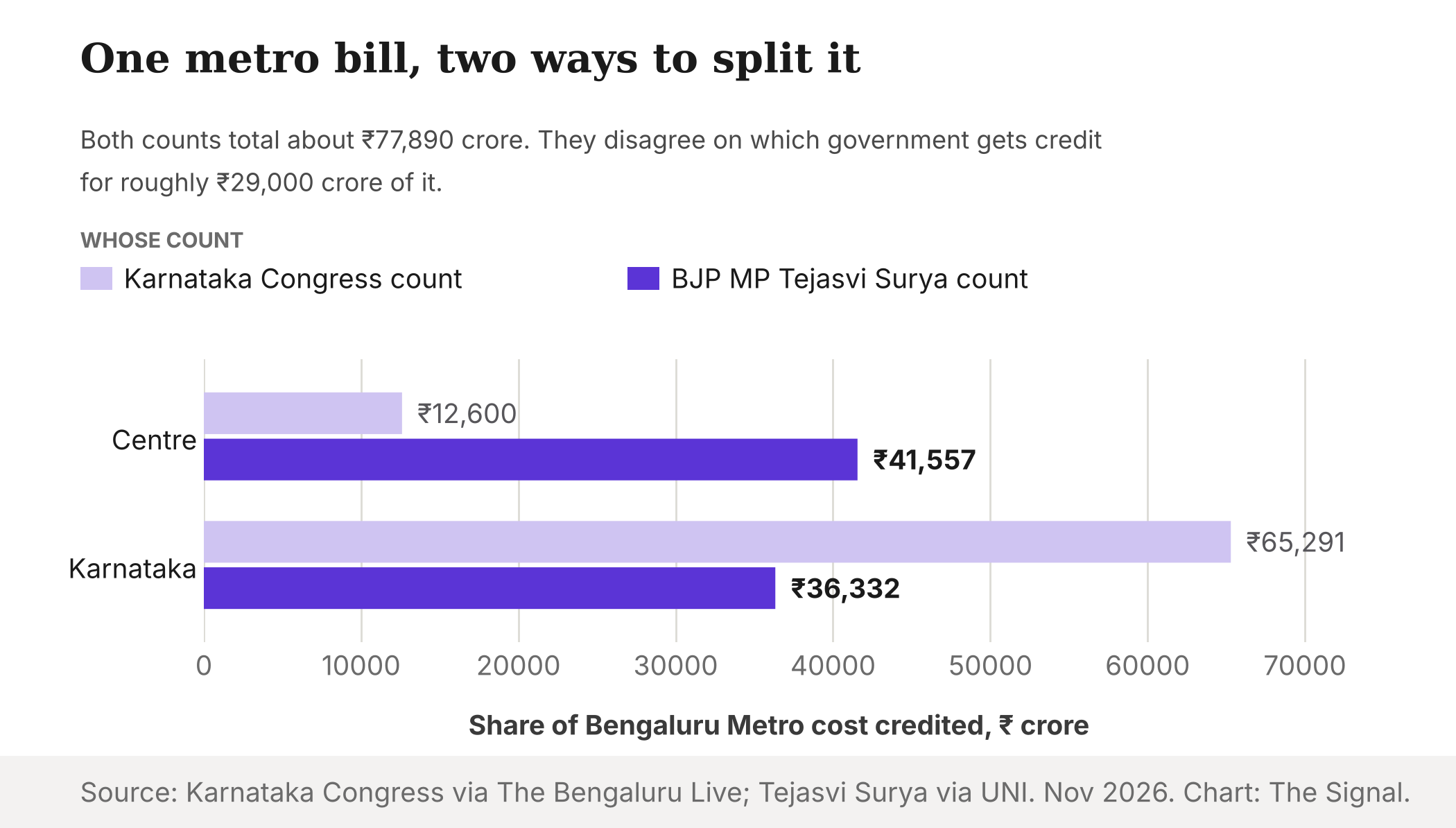
On Surya's numbers, Karnataka's share is about 47% and the Centre's about 53%. On Karnataka Congress's numbers, the state's share is about 84%. Same project, same total, a 37-point swing in who paid. Neither statement, as reported in the sources here, itemises what that ₹29,000 crore consists of.
A 50:50 company is not a 50:50 bill
The confusion starts with the label. Bengaluru Metro Rail Corporation is, in the words of a Union urban development ministry brief from 2017, a 50:50 joint venture of the Government of India and Karnataka. That describes who owns the company. It does not say who pays for the track.
The rulebook makes the distinction explicit. The Union Cabinet's Metro Rail Policy of August 2017 offers states three routes to central help: a public-private partnership with viability gap funding, a lump-sum grant of 10% of project cost, or a 50:50 equity-sharing model between the Centre and the state. Equity is one slice of how a metro is financed. Whatever the project needs beyond that slice has to come from somewhere, and the policy's label does not settle whose account it is booked to.
The Union government's baseline position frames the rest. In a parliamentary reply in August 2022, the housing ministry said urban transport is a state subject, so states are responsible for initiating, developing and funding metro rail. On that reading, anything the Centre adds is help, not an obligation.
Chennai shows the column can move
There is a recent case where the same question got a different answer. In October 2024, the Centre took Chennai Metro Phase 2 into the "Central sector", and the housing ministry said the Centre would now finance almost 65% of its estimated ₹63,246 crore cost, including the entire ₹33,593 crore loan and ₹7,425 crore of equity and subordinate debt.
How the Centre's credited share changes with the accounting route
| Project | Route | Centre's share as stated | Who states it |
|---|---|---|---|
| Chennai Metro Phase 2 | Central sector, from Oct 2024 | Almost 65%, loan included | Union housing ministry |
| Bengaluru Metro | 50:50 joint venture | 16.2% (₹12,600 crore) | Karnataka Congress, Nov 2026 |
| Bengaluru Metro | 50:50 joint venture | About 53% (₹41,557 crore committed) | BJP MP Tejasvi Surya, Nov 2026 |
Sources: PIB, 5 October 2024; The Bengaluru Live; UNI. Bengaluru's 53% is computed from Surya's two figures.
The Chennai release matters for one reason. When the Centre took that project onto its own books, the loan was counted as central financing. In Bengaluru, which stays a joint venture, both parties can tell a coherent story about the same borrowed rupees. The fight is over which story the ledger should tell.
Whose name is on the loans
The lenders' own paperwork shows how the borrowing is routed. JICA's appraisal of its Phase 2 loan names the President of India as borrower and BMRCL as executing agency, and records that the Indian government also raised about US$500 million from the Asian Development Bank for lines 2A and 2B, and US$583 million from the European Investment Bank plus US$335 million from the Asian Infrastructure Investment Bank for Line 6. JICA's own loan, signed with the Government of India in March 2021, is JPY 52,036 million, about ₹3,717 crore. The Asian Development Bank lists its US$500 million loan as a sovereign project, with the Union housing ministry as executing agency.
Those records cut both ways. The Government of India is the borrower the lenders deal with, which gives the Centre a basis for counting this money as its support. The same documents do not say how repayment is shared among the Centre, Karnataka and BMRCL, which is the question the state's count turns on. Neither side's figures, as reported, say how much of the disputed ₹29,000 crore is this borrowing.
The bills keep getting bigger
The stakes grow with each phase. The Centre sanctioned Phase 2 (72 km) in February 2014 at ₹26,405.14 crore, with completion expected by March 2020. The Union Cabinet approved Phases 2A and 2B (58.19 km) in April 2021 at ₹14,788.101 crore, and Phase 3 (44.65 km) in August 2024 at ₹15,611 crore. Costs also move after sanction: Construction World reported in November 2026 that the wider Phase II programme's estimate has risen from ₹30,695 crore to ₹40,425 crore, an increase of about 32%.
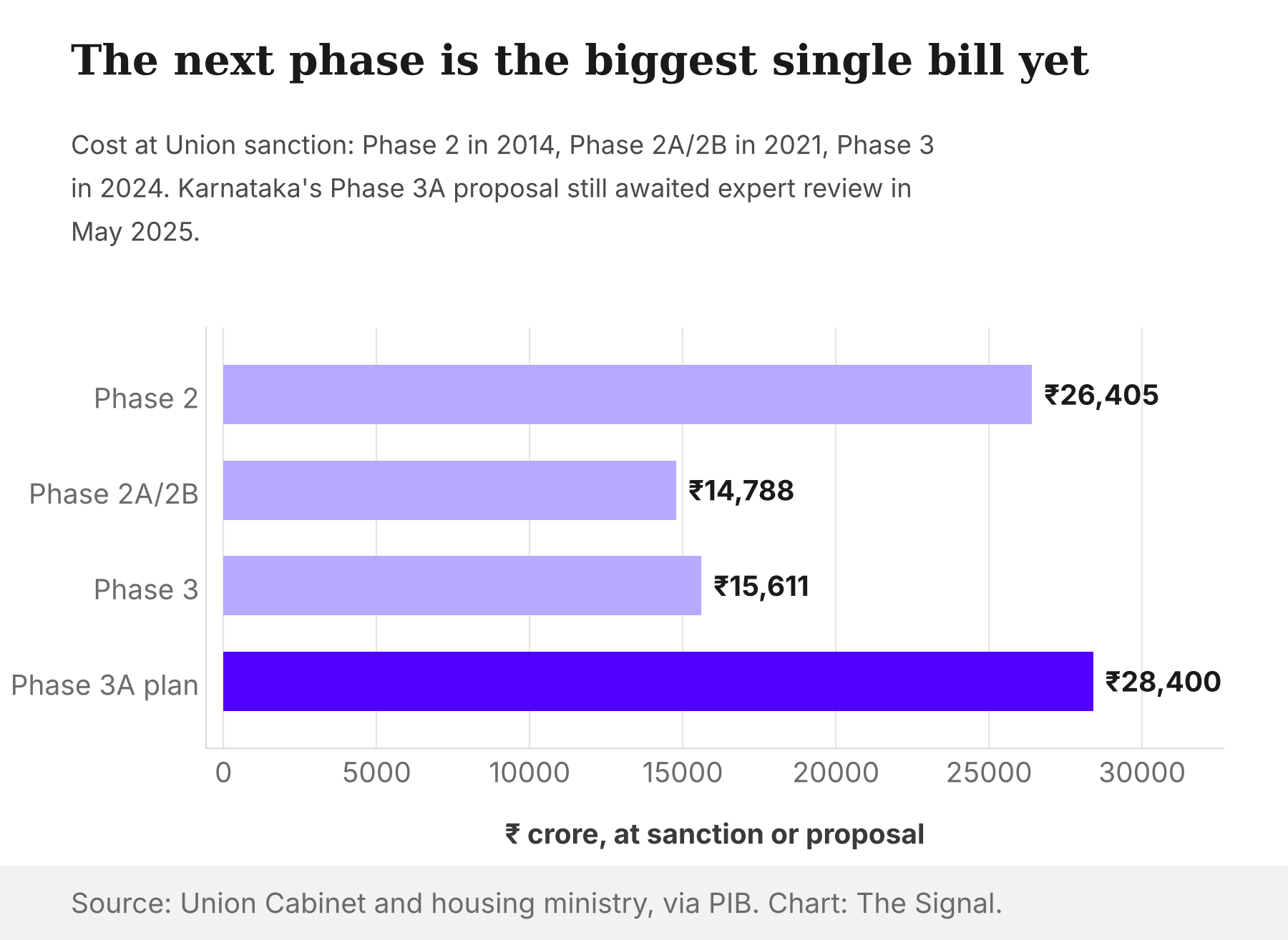
Next in line is the largest single ticket. In May 2025, the housing ministry said Karnataka had proposed a Phase 3A of about 37 km at roughly ₹28,400 crore, and that its cost estimate needed examination by an expert agency. The same release said the revised cost of Phase 2 awaited a proposal approved by the state cabinet. Those are the latest official statuses in the record here, and both date from May 2025.
Riders pay a bill nobody owns
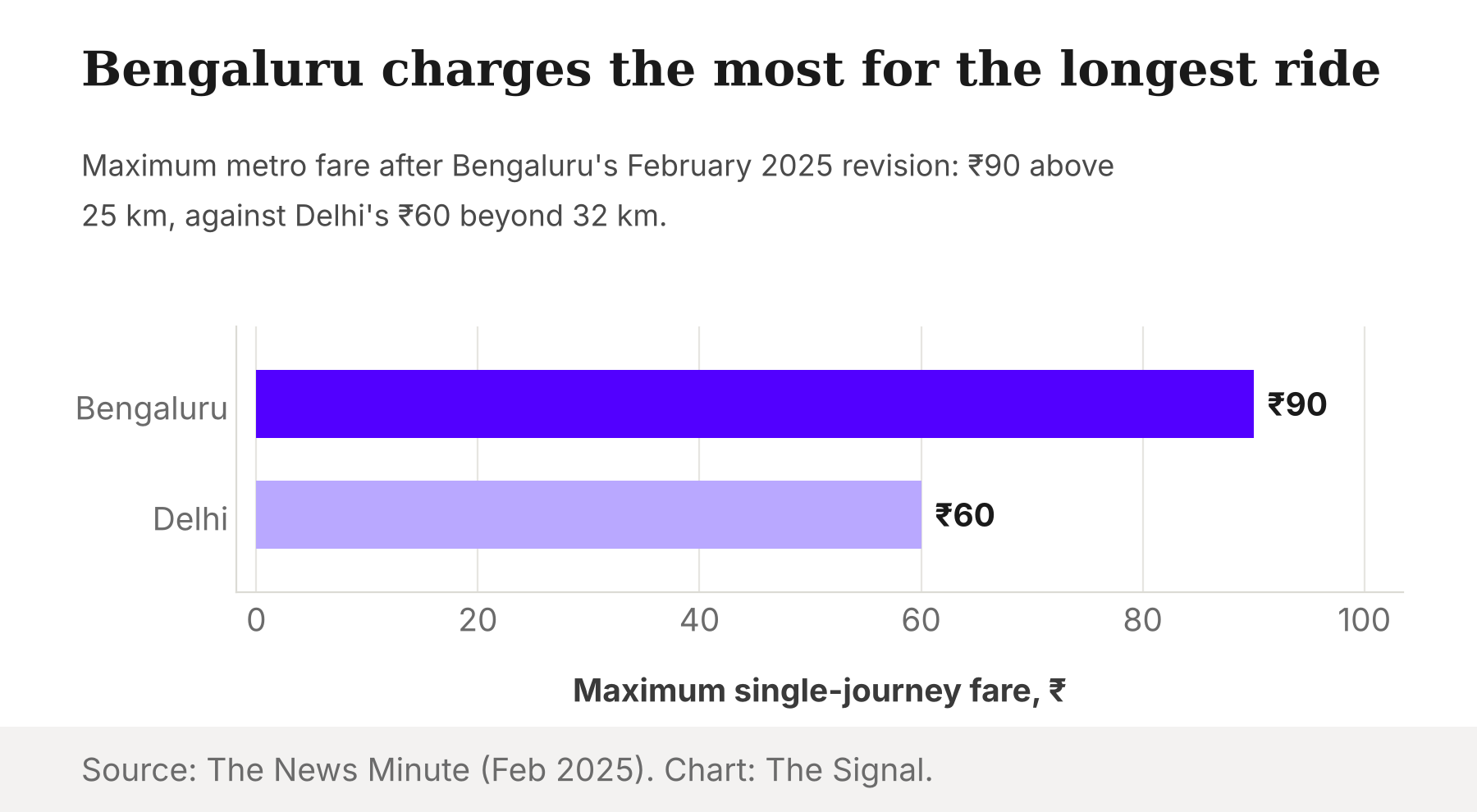
Whoever is credited with the capital, the operating side lands on passengers. After the February 2025 revision, The News Minute reports the maximum Bengaluru fare is ₹90 for trips above 25 km, the highest among Indian metro systems. Delhi charges ₹60 beyond 32 km, so Bengaluru's top fare is 50% higher, and it applies from a shorter distance.
The fare decision has the same shared-ownership blur as the funding. The South First reports that the Fare Fixation Committee was formed on Union directions in September 2024, that its cost-based calculation supported a 105% rise, and that BMRCL raised fares by 71% instead. A further 5% increase took effect on February 9, 2026. Both partners can point to the other's hand on that decision too.
The honest objection
The strongest case for Karnataka's count is that money the Centre "commits" is not the same as money it spends. If a large part of the Centre's ₹41,557 crore is borrowing that the project must ultimately repay, then crediting it to the Centre describes who arranged the finance, not who bears it. On that view, the 16.2% Karnataka Congress cites is the cleaner measure of central cash.
The strongest case for Surya's count is that commitments are what make borrowing possible at all. The Union government's own position is that metro funding is a state responsibility and central help is discretionary, so any central commitment beyond the equity share is support the state could not otherwise count on. On that view, leaving it out understates the Centre's role.
Both arguments hold together, and that is the point. Each is a defensible convention for the same disputed ₹29,000 crore. Nothing in the public statements cited here settles which convention is right, because neither side has published the line items behind its total.
The Signal
Bengaluru Metro's funding fight is a fight over attribution, conducted with numbers that agree on the total. The 50:50 label describes the company's ownership, and neither side's arithmetic is wrong on its own terms. What is missing is a shared ledger.
Watch Phase 3A. At about ₹28,400 crore, it would cost more than any Bengaluru phase the Centre has sanctioned since 2014. Whether it is approved as a joint venture or under a Chennai-style central route will decide whose column the next borrowed rupee sits in. Until a sanction order spells that out, every new line will open with two invoices for one bill.
Reporting basis: the state's ₹65,291 crore of ₹77,891 crore and the Centre's ₹12,600 crore are Karnataka Congress figures as carried by The Bengaluru Live, and they rest on that single relay of a party claim. Tejasvi Surya's ₹41,557 crore and ₹36,332 crore are as carried by UNI, also a single relay of a party claim. Metro Rail Policy 2017, the sanctioned costs of Phases 2, 2A/2B and 3, the May 2025 Phase 3A status, the Chennai Phase 2 financing and the state-subject position are Union government statements released through the Press Information Bureau, from the Union Cabinet, the urban development ministry and the housing ministry. The Phase 2 lender details (borrower, executing agencies, loan amounts and the ADB loan's sovereign classification) are from JICA's ex-ante evaluation and March 2021 press release and from the Asian Development Bank's project record. The Pink Line distances and the Phase II cost revision are per Construction World. Fare levels are per The News Minute, and the fare committee details are per The South First. The state's 84% share, Surya-implied shares of 47% and 53%, the ₹28,957 crore gap and its 37% share of the total, the 32% Phase II revision and the fare comparison are The Signal's calculations from those figures.