The headline version of the India-UK trade deal is simple. India said it would cut its tariff on whisky "from 150% to 75% at entry into force, following to 40% after 10 years." The deal took effect on 15 July 2026. Scotch got cheaper at the border, and the Scotch Whisky Association (SWA), the industry's trade body, forecast £1 billion of extra exports over five years.
Three and a half months after entry into force, the first dispute has arrived, and it is not about the rate. It is about which whisky the rate applies to.
The cut is real for bottled whisky
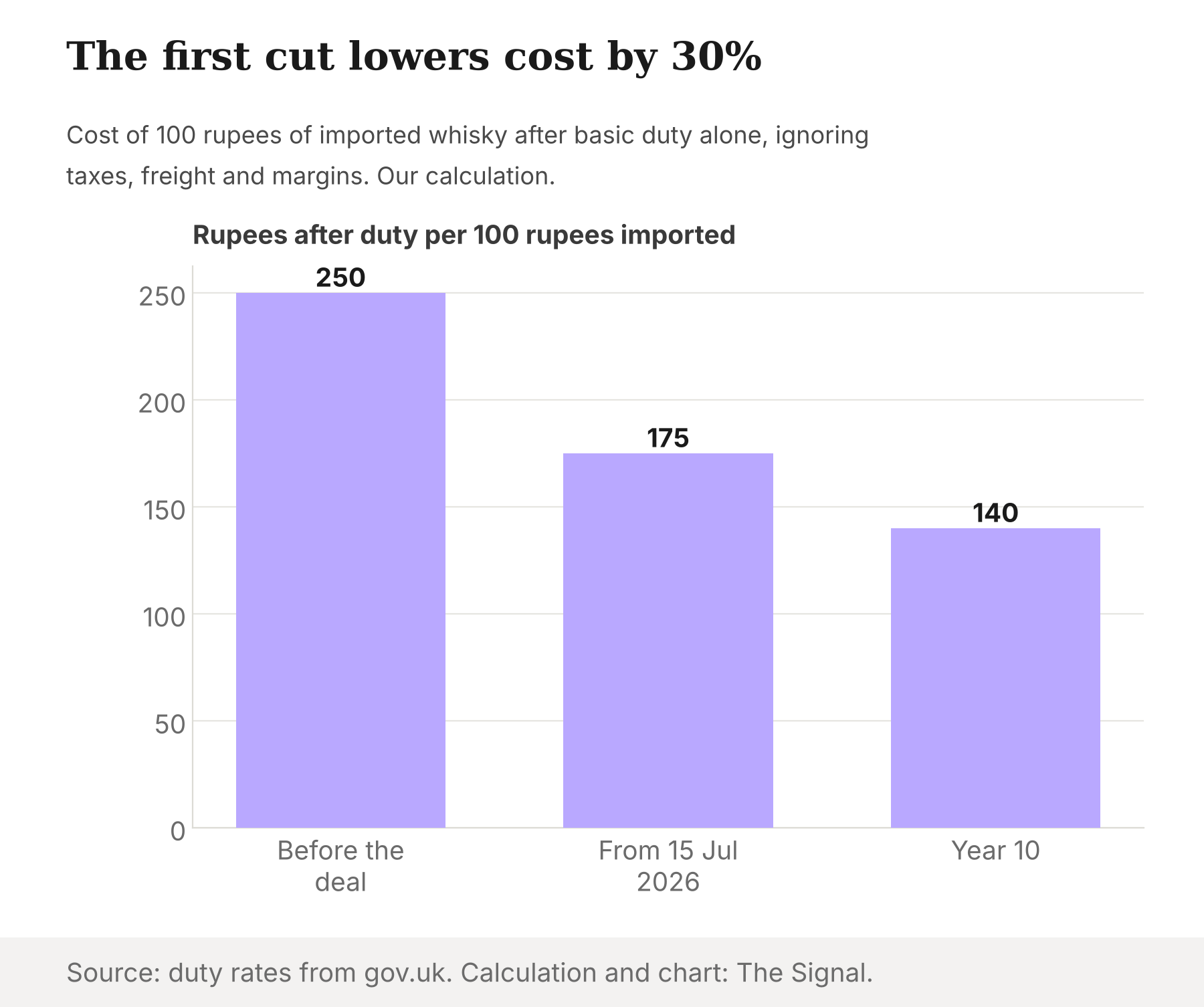
Start with what the cut does. Take 100 rupees of imported whisky. At the old 150% duty, it cost 250 rupees after duty. At 75% it costs 175, which is 30 percent less. At the 40% rate reached in year 10, it costs 140. That is basic duty only, with no taxes, freight or margins.
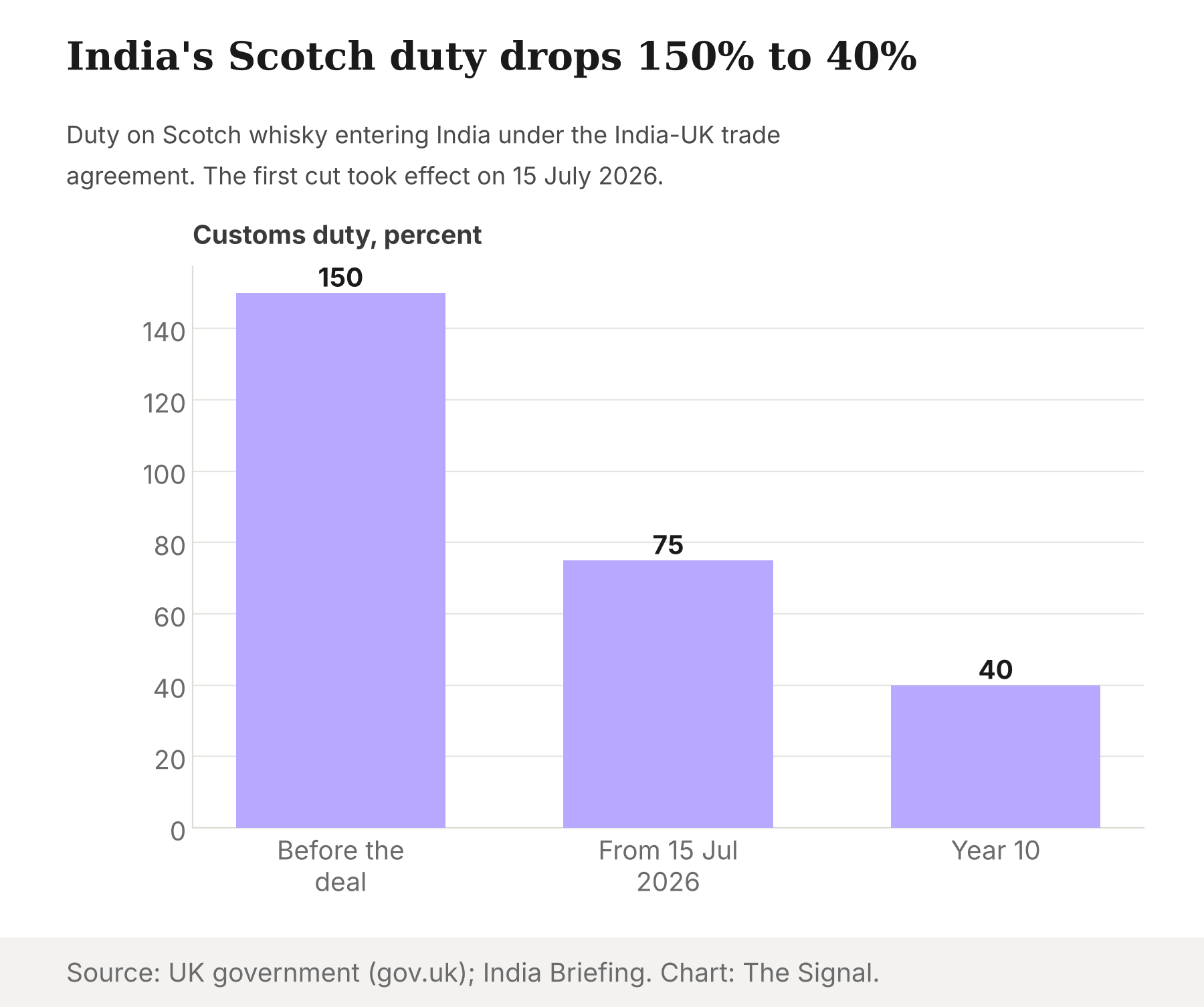
The schedule is not unconditional. India Briefing, a trade advisory, reports that the duty "falls immediately to 75 percent" and reaches 40 percent in year 10, and that the whisky "must satisfy applicable origin requirements."
But much of the Scotch India buys is not bottled
Here is the fact that complicates the picture. The SWA says a lot of the whisky exported to India is sent in bulk, most of it for use in Indian whisky. It is whisky that gets blended into Indian brands rather than sold under a Scotch label. The same page puts Scotch at just a 3% share of the Indian whisky market. The SWA gives no percentage for how much is bulk, only the word "most", so the exact split is unknown here.
The scale of the trade is not in doubt. The SWA reports that Scotch exports to India reached £286 million and 220 million 70cl bottles in 2025, each up 15 percent on 2024.
Where the dispute starts
On 20 October 2026, Business Today, relaying Reuters, reported that tax inspectors had visited Pernod Ricard's India headquarters near New Delhi, questioned executives and reviewed bulk import documents. The question is whether bulk Scotch concentrate was misclassified to qualify for the 75 percent duty. Pernod and Diageo both say they are cooperating. Diageo's Indian unit, United Spirits, disclosed that its offices were searched as part of an industry-wide exercise.
A few days later, The Week reported on a letter from the International Spirits and Wines Association of India. According to the letter, which Reuters accessed, bulk Scotch concentrates are excluded from the tariff reduction. The letter warned that this "risks undermining, in practice, an important market-access benefit."
That is a sharp claim, and it is contested. Some trade coverage read the schedule as covering both forms. The text of Annex 2A, which would settle it, was not available to this analysis, so the exclusion is reported by The Week and not independently confirmed here.
The older fight sits underneath
The classification question lands on top of a valuation fight that predates the deal. In May 2026, The Daily Pour, citing Reuters, reported that Indian investigators concluded Pernod India undervalued imported Scotch concentrates by 67.49 percent, producing a tax demand of nearly 30 billion rupees, about $314 million. Pernod rejects any suggestion of wrongdoing and is pursuing the matter legally.
Read together, the two disputes share a mechanism. The duty is charged on declared value. When the rate is 150 percent, an understated value is worth a lot. When the rate halves, the incentive shrinks, but the argument about which shipments qualify grows. Bulk concentrate is the product where both arguments meet.
The honest objection
The strongest case against reading this as a problem is that early friction is normal. A tariff schedule is written in advance, and customs officers apply it for the first time to real shipments. Investigators checking whether bulk imports were misclassified to claim a lower rate are doing what tax enforcement is for. Pernod and Diageo say they are cooperating.
That case is fair, and it explains why an inquiry exists. It leaves open what happens if the answer is that bulk is excluded, because then the largest-volume form of the trade keeps paying the old rate while the headline says the duty has halved.
The Signal
The test of the India-UK deal's first consumer-facing benefit is not the 75 percent figure. It is a definition. If bulk concentrate qualifies, the cut flows into the cost base of Indian blends, where Scotch is a small share of the market. If it does not, the cut reaches mainly the bottled imports, a smaller part of a trade that the SWA says is largely bulk.
For Indian blenders the stakes are practical: the answer decides whether a deal signed to lower costs lowers theirs. For Scotch producers it decides whether the benefit reaches the form of the product the SWA says it ships to India in large volumes.
Watch two things. The first is whether either government clarifies the treatment of bulk in writing. The second is whether the inspections end in a ruling or a quiet settlement. A tariff is only as cheap as the shipment that qualifies for it.
Reporting basis: the tariff schedule is from the UK government's trade-deal announcement and India Briefing's summary of CETA Annex 2A, which was not itself checked. Export figures and the bulk statement are from the Scotch Whisky Association, an interested party, whose figures are based on HMRC data. The inspections are from Reuters reporting as carried by Business Today, and the bulk exclusion letter is from Reuters as carried by The Week. The undervaluation finding is from Reuters as carried by The Daily Pour. The bulk exclusion rests on one letter reported by one outlet and is contested. The 30 percent cost reduction is The Signal's calculation from the published duty rates.