South Korea's exports rose 93.7 percent to a record $115.3 billion in October 2026, a record. The easy read is that the AI boom is lifting everyone who touches electronics, India included, and that India's phone-export industry should ride the same wave.
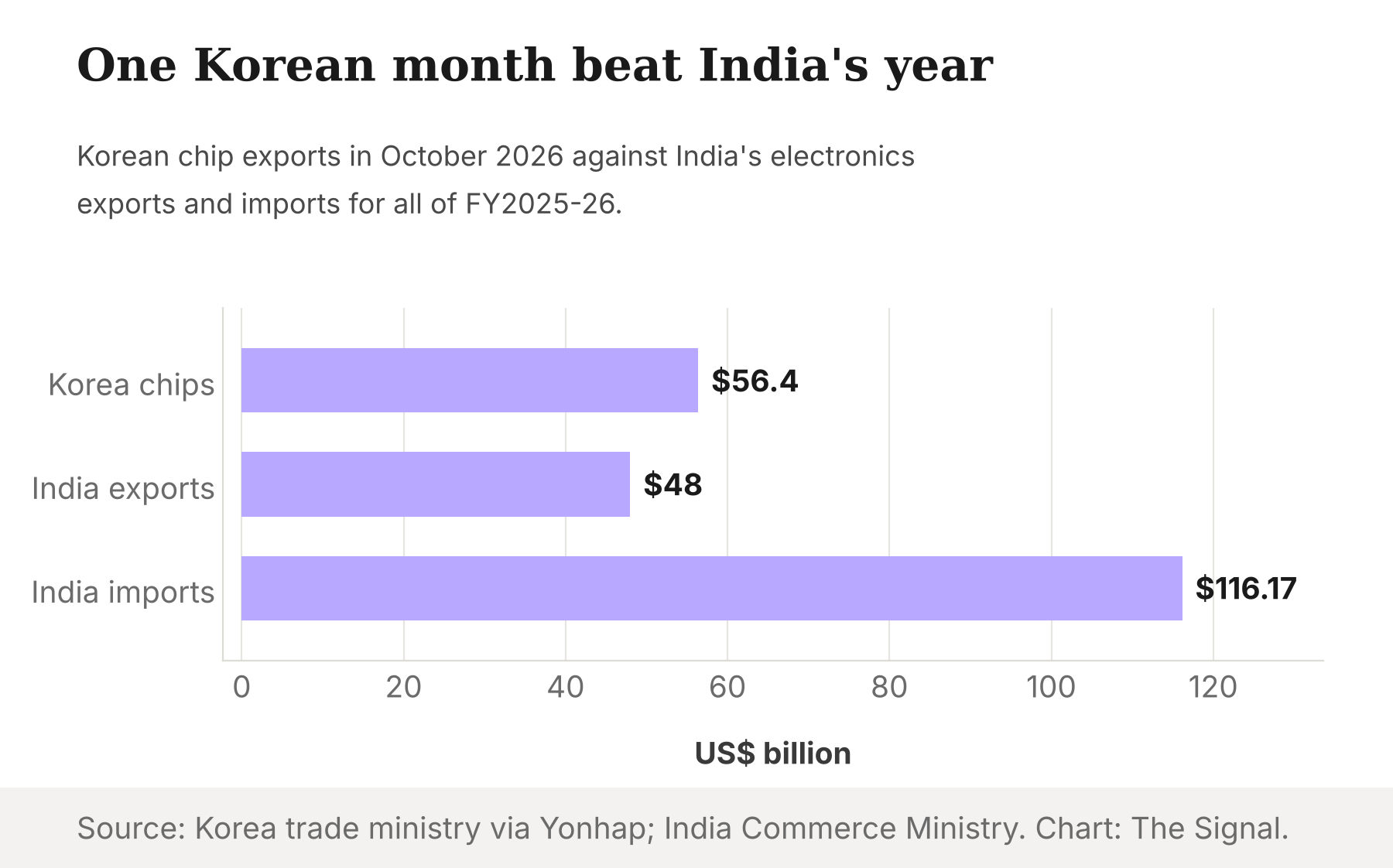
It is worth slowing down on that. One category carried the Korean number: semiconductor exports climbed 259 percent to $56.4 billion in October, according to the ministry's release. India's entire electronics export year, FY2025-26, came to $48.0 billion, per commerce ministry data. One month of Korean chips outsold twelve months of everything India ships in electronics, by roughly $8.4 billion.
The boom pays the scarce component
The AI build-out runs on memory and logic chips, and a few economies make them. Korea is one. In the first 20 days of October, chips made up 44.7 percent of Korea's exports, up 16.2 percentage points from a year earlier, per Korea Customs Service data. The share rose sharply in a single year.
Taiwan shows the same pattern. Its exports hit a record $87.22 billion in September 2026, 35 consecutive months of year-on-year growth, according to the Ministry of Finance as reported by CNA. In both places the money lands with whoever controls the scarce input.
What India actually exports
India's electronics story is real. Electronics exports reached about ₹4.24 lakh crore in FY2025-26, up from about ₹38,000 crore in 2014-15, and the same PIB factsheet puts mobile phone exports at about ₹2.59 lakh crore. Phones lead the basket, and in dollars the total was $48.0 billion, up 24.7 percent.
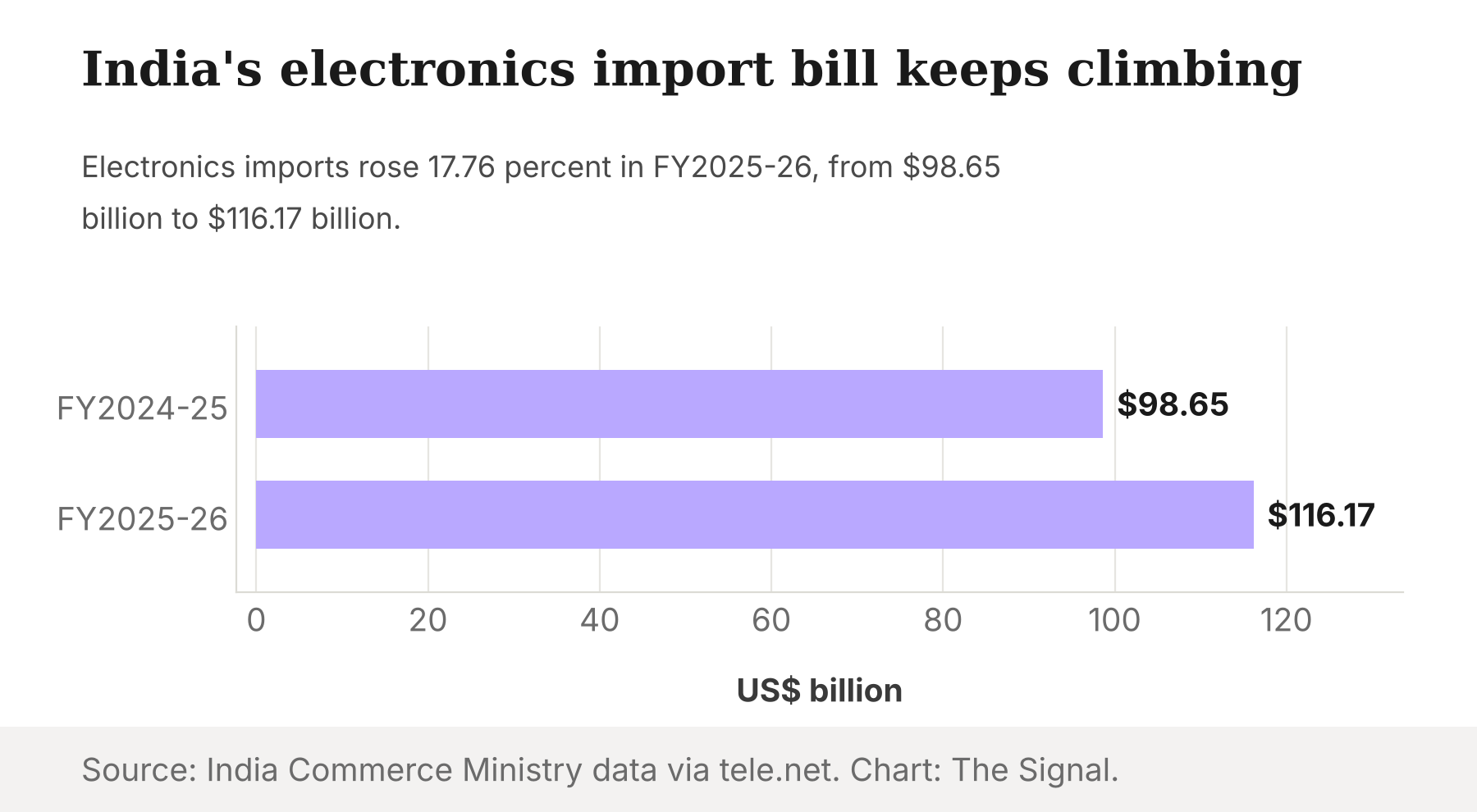
The catch is on the other side of the ledger. Electronics imports rose 17.76 percent to $116.17 billion in FY2025-26, against $98.65 billion a year earlier. Set against $48.0 billion of exports, that is a gap of about $68 billion, and India bought roughly 2.4 dollars of electronics abroad for every dollar it sold.
Assembly keeps a thin slice
The reason is in how phones are built here. An external evaluation of the production-linked incentive scheme, cited by PIB, found domestic value addition rose to 23 percent in FY2023-24. That is a real improvement, and it also means roughly three-quarters of the value of a made-in-India phone, on that measure, was imported.
That figure is for FY2023-24 and for mobile manufacturing under the scheme, not for all electronics today, so it should not be stretched. But it explains the shape of the two charts. Rising export numbers and rising import numbers are two sides of one fact: India is the assembly step, and the components arrive from elsewhere.
The honest objection
The strongest case against the comparison is that it sets unlike things side by side. Chip demand runs in cycles, and a single record month should not be read as a permanent gap. Assembly also employs people at scale and builds the supplier base that later pulls components onshore. On that view India is early on the same path Korea and Taiwan walked, and imports are the price of climbing it.
All of that can be true. It does not change who captures the AI windfall today. The boom is being paid out at the chip and component layer, and a country that mostly assembles will see export growth that is real but largely pass-through. The test of the objection is the value-addition figure, and the latest one on record is the 23 percent for FY2023-24.
The Signal
India's electronics exports grew 24.7 percent in FY2025-26, and its electronics imports grew 17.76 percent on a base more than twice as large. Unless the import line bends, each new dollar of phone exports will pull a large share of itself back out in components. The number to watch is not export growth. It is the electronics trade gap, about $68 billion in FY2025-26, and whether the next evaluation shows domestic value addition well above 23 percent. Korea sold India's year in a month. The question is how long India is content to sell the box rather than what goes inside it.
Reporting basis: Korea's export and chip figures are from the Ministry of Trade, Industry and Resources release, as reported by Yonhap through The Korea Times and The Korea Herald, which share one origin. The chip-share figure is Korea Customs Service data, also via Yonhap. Taiwan's figure is Ministry of Finance customs data, via the Central News Agency. India's electronics export and production figures are from MeitY, via PIB, and the value addition figure is an external evaluation of the incentive scheme as cited by PIB. India's electronics import and export dollar totals are Department of Commerce data as relayed by PTI and tele.net, one origin, and were not checked against the primary trade release. The Korea-India difference, the trade gap and the import-to-export ratio are The Signal's calculations from those figures.