The September number looks fine at first glance. India's services exports were US$39,305 million in September 2026, growth of 7.2%, according to the Reserve Bank of India's monthly release published on October 30. That is still the highest monthly level in the 2026 series the RBI has published so far, and the service sector remains the part of the external account that nobody worries about. The easy read is a mild cooling in an otherwise strong export story.
It is worth slowing down on that. The same release shows services imports of US$20,097 million, up 12.6%. Imports grew almost twice as fast as exports. The net surplus is what matters for the external account, and a surplus only grows when exports add more dollars than imports do.
A sharp break from the summer run
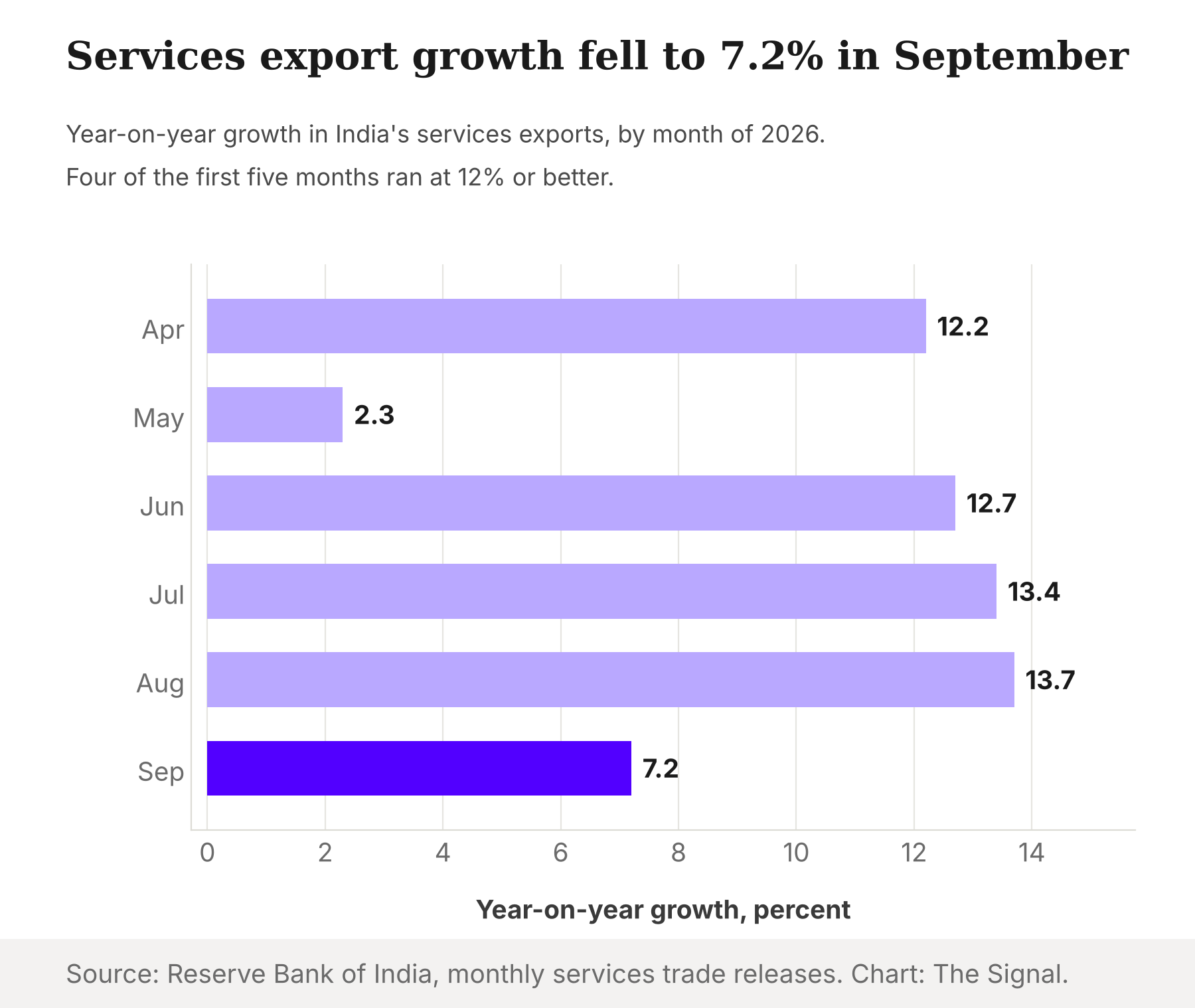
The slowdown stands out against the months before it. The RBI's August release shows services exports up 12.2% in April, 12.7% in June, 13.4% in July and 13.7% in August. May was the lone dip, at 2.3%. September's 7.2% is the weakest reading since that May dip.
Services export growth ran at 12% or better in four of the first five months of 2026, then fell to 7.2%.
The import side moved the other way. In August, services imports grew 21.4%, to US$18,934 million, against export growth of 13.7% to US$35,471 million. Imports also outgrew exports in July, when they rose 19.1% against 13.4%. The August release notes that July and August data are provisional, and September's release says the same of July to September, so the exact figures can move.
The monthly net, in dollars, is still large. Subtracting the September services imports from services exports gives a surplus of about US$19.2 billion for the month. What has changed is how fast it is growing, and that matters more than the level for a country that has to fund a widening goods deficit.
What the surplus has to cover
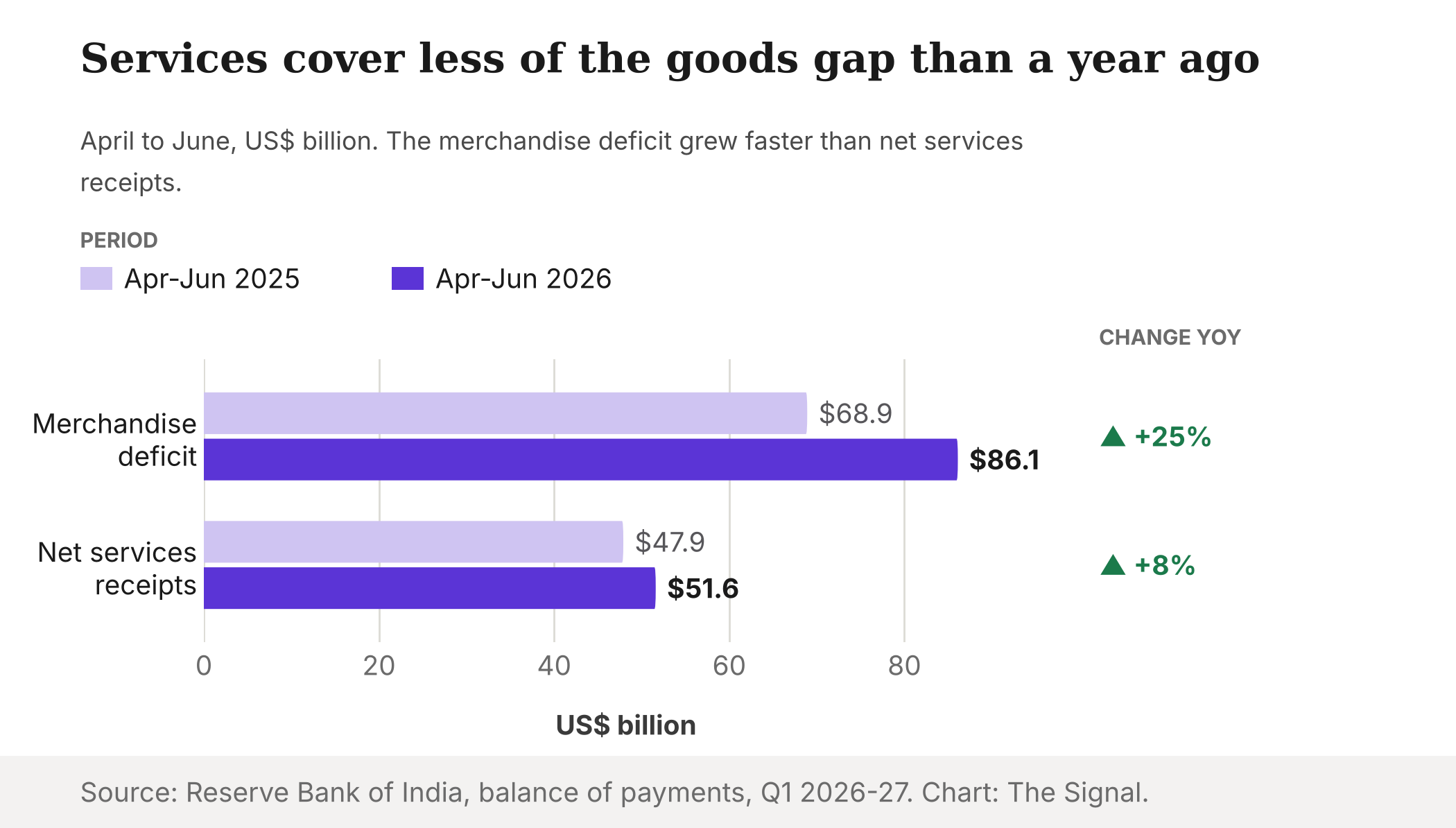
The services surplus has a specific job. It offsets the merchandise trade deficit, so that the current account gap stays small. In April to June 2026, net services receipts rose to US$51.6 billion from US$47.9 billion a year earlier. Over the same quarter, the merchandise trade deficit was US$86.1 billion, higher than US$68.9 billion in April to June 2025.
Put those together. Net services receipts rose by about 8% (from US$47.9 billion to US$51.6 billion), while the goods deficit rose by about 25% (from US$68.9 billion to US$86.1 billion). Services receipts covered about 60% of the goods gap in April to June 2026, against about 70% a year earlier. Both are The Signal's calculations from the RBI's figures.
Net services receipts of US$47.9 billion paid for about 70% of the goods deficit in April to June 2025. A year later, US$51.6 billion paid for about 60%.
The result shows up in the headline balance. India's current account deficit was US$4.2 billion, 0.5% of GDP, in April to June 2026, against US$3.4 billion, 0.4% of GDP, a year earlier. That is small by any standard. But the direction is the point: the gap widened because the goods side grew faster than the services cushion.
The honest objection
The strongest case against reading too much into September is that one month is noisy. May showed the same sort of dip, at 2.3%, and growth bounced straight back to 12.7% in June. A single soft print after four strong ones is not a trend.
There is also good news elsewhere in the data. India's merchandise trade deficit narrowed to US$30.21 billion in September from US$33 billion a year earlier, as exports rose 23% to US$44.4 billion, Business Today reported from the Commerce Ministry's figures. Against that September goods deficit, the month's services surplus of about US$19.2 billion covers roughly 64%, which is better than the April to June ratio. The two sources use different publishers, so treat the ratio as indicative.
And the cushion is not gone. The services trade surplus was US$85.8 billion in April to August 2026, the RBI Governor said in the October policy statement, and the same statement described the current account deficit as modest and well below sustainable levels.
The answer is that both things hold. September's goods deficit improved, and the services surplus is still large. But the services side was the one steady offset in the accounts, and its growth has now fallen behind the growth in what India spends on services abroad. The Governor also noted the merchandise deficit rose to US$58.7 billion in July to August, mainly on electronics and crude oil imports. If oil stays costly, the goods gap will test the cushion again.
The Signal
The headline question for India's external account is no longer whether services exports are growing. They are. It is whether they are growing fast enough to keep covering a goods deficit that expanded from US$68.9 billion to US$86.1 billion in April to June. In that quarter the answer was no: coverage fell from about 70% to about 60%.
September gave a mixed reply. Services exports slowed to 7.2% and imports grew 12.6%, while the goods deficit narrowed. Watch the October release, due around the end of November, for two numbers: whether services export growth returns to double digits, and whether services imports keep growing faster than exports. If both repeat September's pattern, the surplus that has quietly paid a large part of India's import bill will be paying a smaller part of it.
Reporting basis: The services trade figures come from the Reserve Bank of India's September 2026 and August 2026 monthly releases, its balance of payments release for April to June 2026 and the Governor's October 2026 statement, all read on the RBI website. That is one origin, the RBI, carrying the load-bearing numbers, and July to September data are provisional. The September merchandise trade figures are from Business Today, reporting Commerce Ministry data, and were not checked against the ministry's own release. The monthly services surplus of about US$19.2 billion, the 8% and 25% growth rates, and the 60%, 64% and 70% coverage ratios are The Signal's calculations from those figures.