On 31 October, the Finance Ministry reset India's fuel export levies for the fortnight. The headline version is easy to write. Business Today reports that "the combined rate of SAED and road and infrastructure cess on exported diesel has been raised to ₹11.50 per litre", up from Rs 8.50. It adds that "the special additional excise duty (SAED) on ATF exports has been raised marginally to ₹11 per litre from ₹10.50 per litre." And "the government has reduced the windfall tax on petrol exports to zero from ₹2.50 per litre." Two fuels up, one down, domestic prices untouched. A tidy bulletin.
That reading treats the levy as one dial that the government nudges each fortnight. The record says otherwise.
The number that moved most is the one nobody is quoting
Start with where the diesel levy has been. The Petroleum Planning and Analysis Cell (PPAC), part of the petroleum ministry, publishes the full series. Its table begins on 27 March 2026 with a diesel levy of Rs 21.50 a litre. By 11 April the PPAC table shows Rs 55.50: Rs 24 of special additional excise duty plus Rs 31.50 of additional excise duty.
Two weeks ago, on 16 October, the same table shows Rs 8.50. That is a fall of about 85 percent from the April peak. The 31 October reset lifts it to Rs 11.50, which is still 79 percent below the peak, but it is the first rise after three straight cuts: Rs 25 on 1 September, Rs 20 on 16 September, Rs 16 on 1 October, then Rs 8.50.
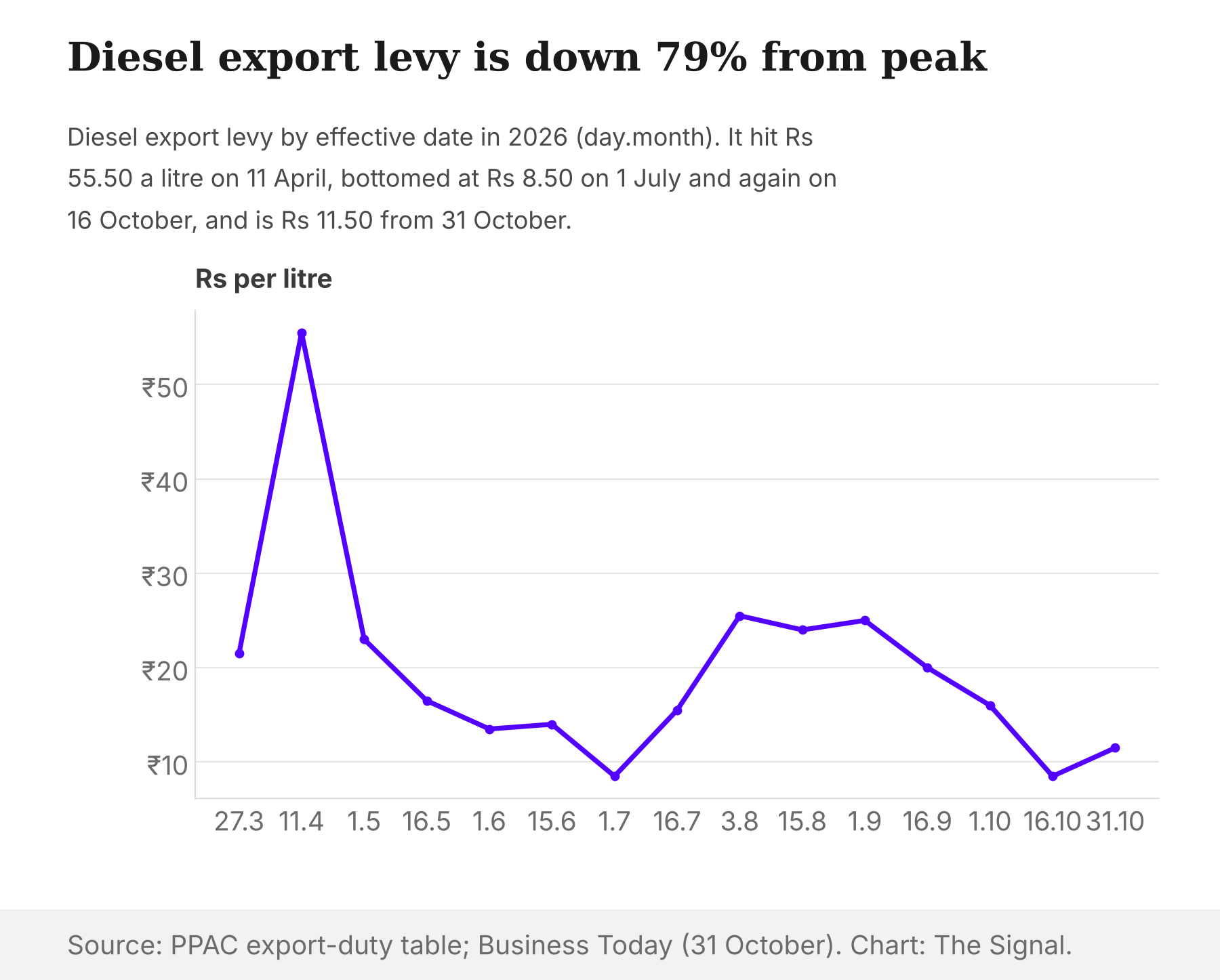
The path is not a smooth glide down. The PPAC table has the levy at Rs 8.50 on 1 July, back to Rs 15.50 on 16 July, and Rs 25.50 on 3 August. It then sat between Rs 24 and Rs 25 through 1 September before the autumn slide. A dial turned in one direction would not draw this line. Something underneath it kept moving.
What the levy is tied to
All India Radio, reporting the Finance Ministry notification for 16 October, gives the rule: "The rates are prescribed based on the average international prices of crude oil, petrol, diesel and ATF." Business Today describes the same mechanism, saying the government reviews the duties every fortnight, taking account of changes in international fuel prices.
That sentence, from the All India Radio report, matters more than any single rate. If the levy follows average international prices, then the 31 October numbers are not a policy signal about petrol, diesel or jet fuel as such. They are a reading of what each product fetched abroad over the previous fortnight. Three fuels moving in different directions is what a formula tied to each product's own international price would produce.
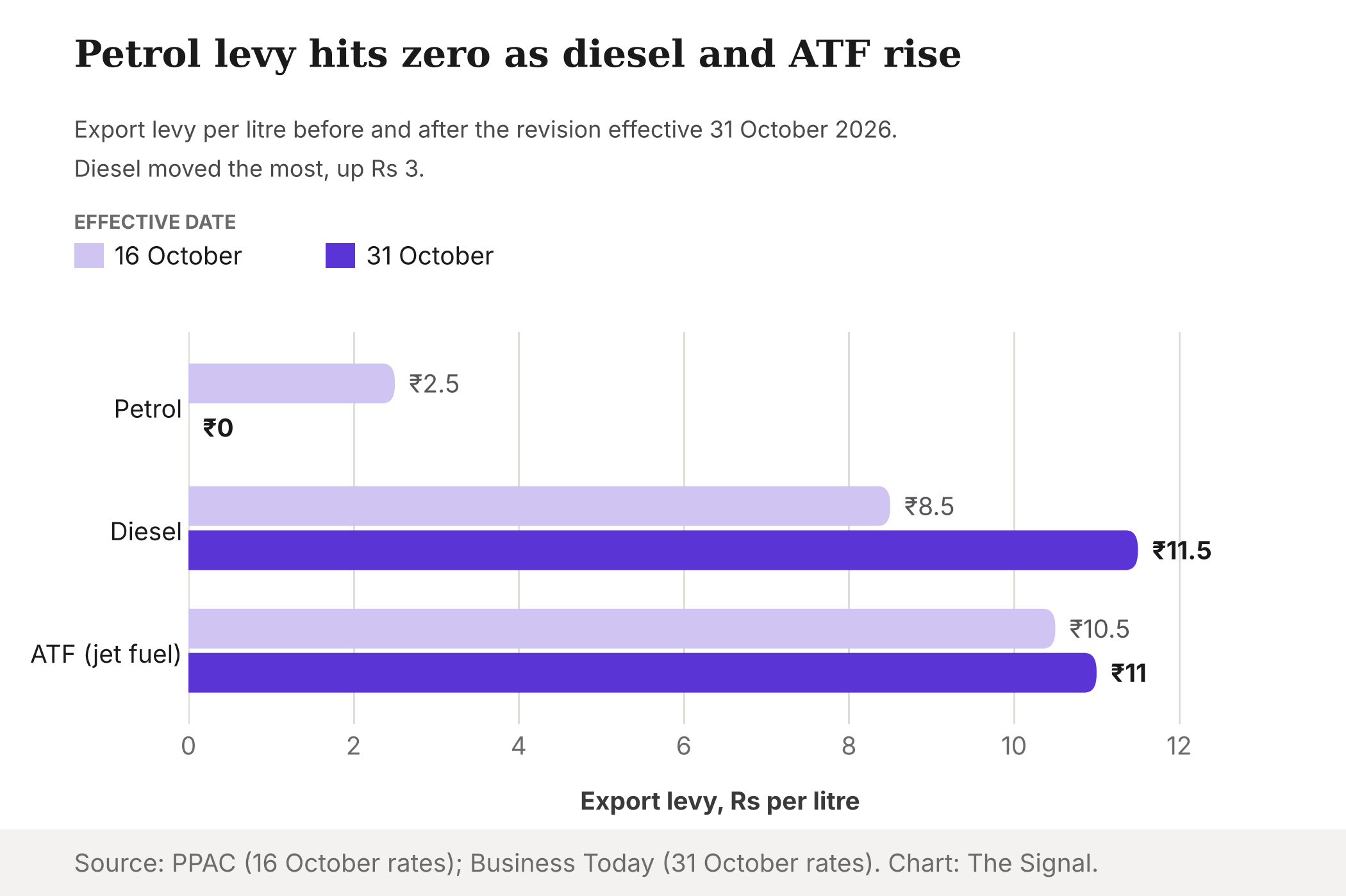
The PPAC series shows how independent the three have become. On 1 October the petrol levy was Rs 0.50 and ATF was Rs 10.50. By 16 October petrol had risen to Rs 2.50, diesel had fallen to Rs 8.50, and ATF had not moved from Rs 10.50. On 31 October, per Business Today, petrol fell to zero, diesel rose by Rs 3, and ATF rose by 50 paise.
| Fuel | 16 October (Rs per litre) | 31 October (Rs per litre) | Change |
|---|---|---|---|
| Petrol | 2.50 | 0 | Down 2.50 |
| Diesel | 8.50 | 11.50 | Up 3.00 |
| ATF (jet fuel) | 10.50 | 11.00 | Up 0.50 |
Source: PPAC export-duty table for 16 October; Business Today for 31 October.
Export levy against the domestic duty
There is a second comparison the bulletins skip. The levy applies only to fuel leaving the country. Business Today quotes the Finance Ministry as clarifying that "there is no change in the existing duty rates on petrol and diesel cleared for domestic" use.
PPAC's central excise table lists domestic high speed diesel at Rs 1.80 a litre of basic excise duty and Rs 2 a litre of road and infrastructure cess, or Rs 3.80 together. A litre of diesel that is exported from 31 October carries Rs 11.50, about three times that. A litre sold at home carries the lower, fixed figure.
The gap is not a pump price, and this piece does not claim to know what it does to a refiner's choice of market. The matrix behind it holds no export volumes and no margin data. What the two tables establish is narrower: the domestic duty is a single number that did not change, and the export levy is a fortnightly figure that has ranged from Rs 8.50 to Rs 55.50 in seven months.
The honest objection
The strongest case against reading anything into the 31 October split is that it is mechanical. The notification, as All India Radio reported it, says the rates come from average international prices. If petrol cracked weaker abroad and diesel stronger, the formula would produce exactly this pattern with no judgment involved. A reader who says "this is arithmetic, not strategy" is probably right about how each fortnight's number is produced.
That objection is sound, and it is also the point. A levy set mechanically from international prices is a floating tax. Its size tells you the gap the government sees between selling abroad and selling at home in a given fortnight, product by product. That is a more useful thing to track than a single headline rate, because it moves with each fuel's market and not with a political decision.
What the objection cannot settle is how much the levy has changed anyone's behaviour. That would take export volumes and refining margins, and this article has neither.
The Signal
Read the 31 October reset as three prices, not one policy. Petrol's export levy is back at zero. Diesel is at Rs 11.50, 79 percent below the April peak of Rs 55.50 but rising again from the Rs 8.50 low. Jet fuel is barely moving at Rs 11.
Watch the next fortnightly notification. If diesel climbs again from Rs 11.50 while petrol stays at zero, the international diesel price is still rising relative to the others. If diesel slips back toward Rs 8.50, the October rise was a blip. The domestic duty will not tell you which, because it has not moved. The export levy is the only number in the system that does.
Reporting basis: the levy rates through 16 October and the domestic diesel duties are from the Petroleum Planning and Analysis Cell's published tables, which compile the Finance Ministry notifications. The rule that rates follow average international prices is per All India Radio, reporting the 16 October Finance Ministry notification. The 31 October rates and the domestic-duty statement rest on a single source, Business Today, reporting the Finance Ministry notification; the notification itself was not checked, and PPAC's table had not yet added its 31 October row when this was written. The 79 percent and 85 percent falls and the roughly threefold gap against the domestic duty are The Signal's calculations from those figures.