On Friday, 30 October 2026, the Supreme Court changed the shape of this dispute. It referred the Krishna-Godavari gas migration dispute between Reliance Industries and the Union government to mediation under former Justice Ranjana Prakash Desai, the Free Press Journal reports. The read is simple and fair: a decade-old fight that has produced an arbitral win, a High Court reversal and a growing government demand is finally heading for a negotiated end.
The order has a feature that matters more than the referral itself. According to the same report, the bench imposed no deadline for completing mediation and asked the parties to coordinate directly with Desai. The matter returns to the Supreme Court after four weeks, but only for a progress update.
It is worth slowing down on what is, and is not, being negotiated.
A claim that kept growing
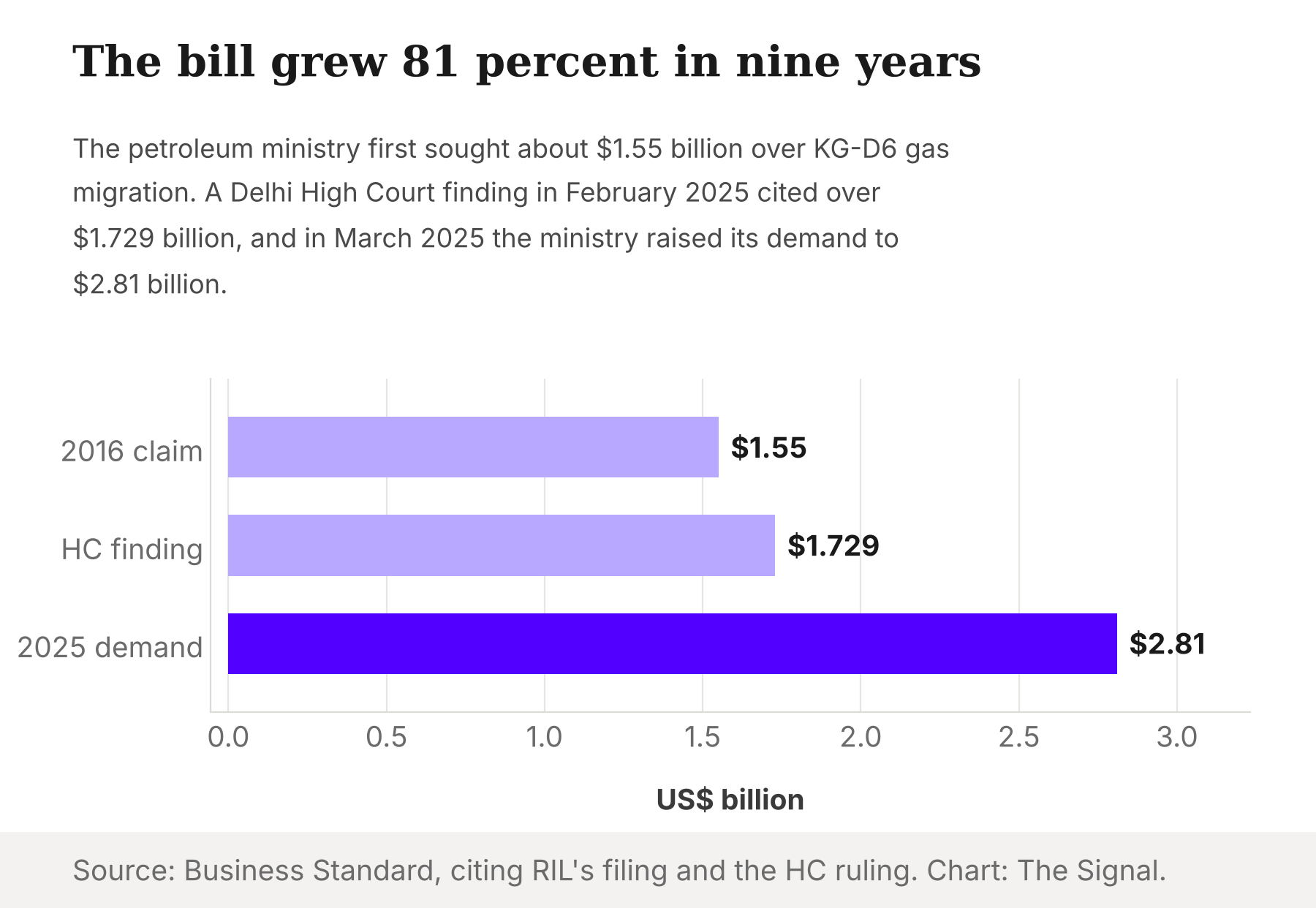
The government's case began as a number. In 2015 the Union government set up a single-member committee under Ajit Prakash Shah, a former Chief Justice of the Delhi High Court, on 15 December 2015 to look into the dispute between Reliance and ONGC over the adjoining blocks in the Krishna-Godavari basin, as the Press Information Bureau reported in 2016. The ministry's initial demand, Business Standard reports, was approximately $1.55 billion.
That figure did not hold still. In February 2025, a Delhi High Court division bench overturned the 2018 arbitral award that had favoured the Reliance-led consortium, citing "unjust enrichment" amounting to over $1.729 billion. Then, in March 2025, the petroleum ministry raised a demand of $2.81 billion, according to Reliance's exchange filing as reported by Business Standard. Set against the initial $1.55 billion, that is an increase of about 81 percent.
The sum on the other side of the ledger has its own label. Reliance, BP and Niko went to the Supreme Court in 2025 to restore an award that Business Standard describes as worth ₹12,800 crore. The petitions were filed on May 14, 2025. A mediator will therefore be bridging a gap between two numbers that each side can defend, and that has widened rather than narrowed.
The part a settlement cannot price
The bill is the part a mediator can split. The reasoning of the High Court is harder to split. The bench held that a private entity like Reliance "cannot be allowed to subsume it for its own benefit at the cost of taking the UOI for a ride", Business Standard reports, on the ground that the gas is a vital natural resource that the Union holds in trust. The Free Press Journal adds that the bench found the award in conflict with public policy and the public trust doctrine.
That reasoning reaches well beyond one block. The 2018 arbitral panel had gone the other way, ruling 2-1 in favour of Reliance and finding that the production sharing contract did not prohibit extracting gas that had migrated from an external source. An arbitral panel and a High Court bench therefore read the same contract in opposite ways. Every private operator holding a production sharing contract has a reason to want the Supreme Court to say which reading is right.
A negotiated settlement may not say. This is our inference, not something the order states: if the parties agree a payment and the appeals are closed on that basis, the question the High Court answered, and the arbitrators answered differently, could be left without a final ruling from the top court. The court's referral order, as reported, says nothing on how an agreement would be recorded.
What the gas is worth now
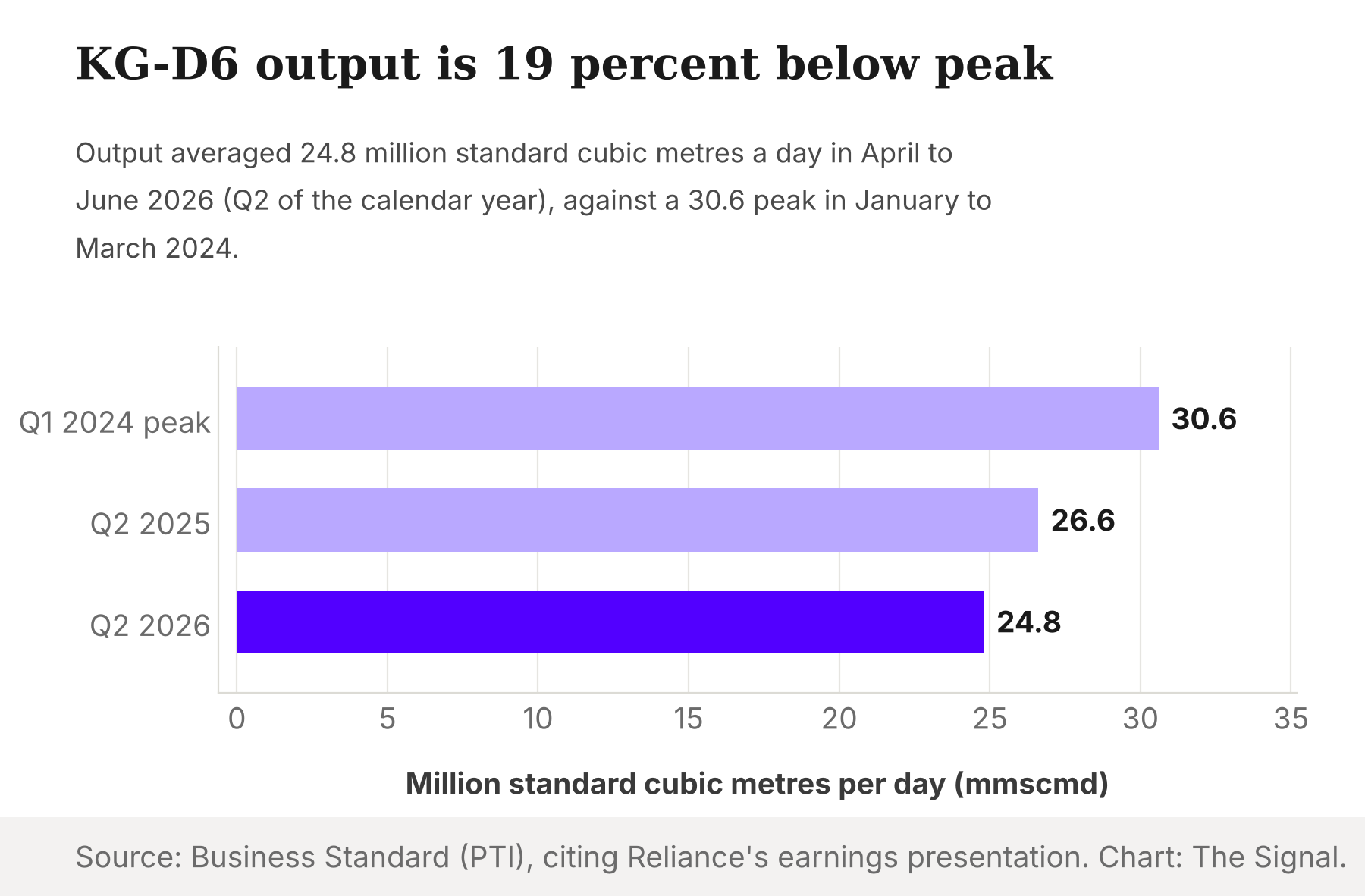
The pressure to settle may come from the other direction too. The block at the centre of the dispute is producing less. Reliance said gas output at KG-D6 averaged 24.8 million standard cubic metres per day in April to June 2026, down from 26.6 mmscmd in April to June 2025, according to a Press Trust of India report on its earnings presentation. The second-wave fields peaked at 30.6 mmscmd in January to March 2024, and output has since fallen by 19 percent.
The block still matters to the country. The Ministry of Petroleum and Natural Gas said in a 26 March 2026 release that India already produces 92 MMSCMD of natural gas domestically out of a total daily requirement of 191 MMSCMD. Putting the two together, KG-D6's 24.8 mmscmd is roughly a quarter of national output and about 13 percent of daily requirement. The periods differ by a few months, so read both ratios as orders of magnitude, not precise shares.
| Measure | Figure | Period |
|---|---|---|
| KG-D6 output at peak | 30.6 mmscmd | January to March 2024 |
| KG-D6 output, latest reported | 24.8 mmscmd | April to June 2026 |
| India's domestic gas production | 92 MMSCMD | As stated March 2026 |
| India's daily gas requirement | 191 MMSCMD | As stated March 2026 |
Sources: Business Standard (PTI) on Reliance's earnings presentation; Ministry of Petroleum and Natural Gas via PIB. Ratios are The Signal's calculations.
The honest objection
The strongest case against this reading is that a settlement is exactly what the Supreme Court should want. A decade of litigation across tribunals and courts has bought uncertainty for everyone. A negotiated figure ends the exposure, and the Free Press Journal reports that Reliance's senior advocate Kapil Sibal expressed the company's willingness to take part. Certainty on the bill has real value, and a contested legal principle is a cost that the parties, not the public, may judge acceptable to leave open.
That case is real, and it explains why mediation is sensible. But it explains the bill, not the law. A contractor in the next dispute will still ask what the public trust doctrine means for gas drawn across a block boundary, and the answer may still sit in a High Court judgment that the Supreme Court never examined.
The Signal
The mediation is a bet on two things being separable: the money and the principle. The money can be split by a mediator who, per the order, may take the help of two technical experts, one suggested by each party. The principle may not survive being split. Watch what the court records at the four-week update. If the order spells out how any settlement will be recorded, the law question is answered one way or the other. If it stays silent, a decade-old gas dispute could end with a cheque and no precedent. The most expensive thing left unpriced may be the rule.
Reporting basis: the Supreme Court referral and its terms are per the Free Press Journal, which is the single outlet verified for the 30 October 2026 order, so that account rests on one source. The Delhi High Court ruling, the 2018 panel's 2-1 award, the $1.55 billion initial claim, the $2.81 billion demand (per Reliance's exchange filing) and the ₹12,800 crore award figure are per Business Standard, reporting the court ruling and the filing. The Shah committee's constitution is per the Press Information Bureau's 2016 release for the Ministry of Petroleum and Natural Gas. KG-D6 output is per Reliance's earnings presentation as reported by Business Standard from Press Trust of India. National production and requirement are per the Ministry via PIB, 26 March 2026. The 81 percent rise, the 13 percent and quarter-of-output ratios, and the inference about the law left open are The Signal's calculations and reading from those figures.