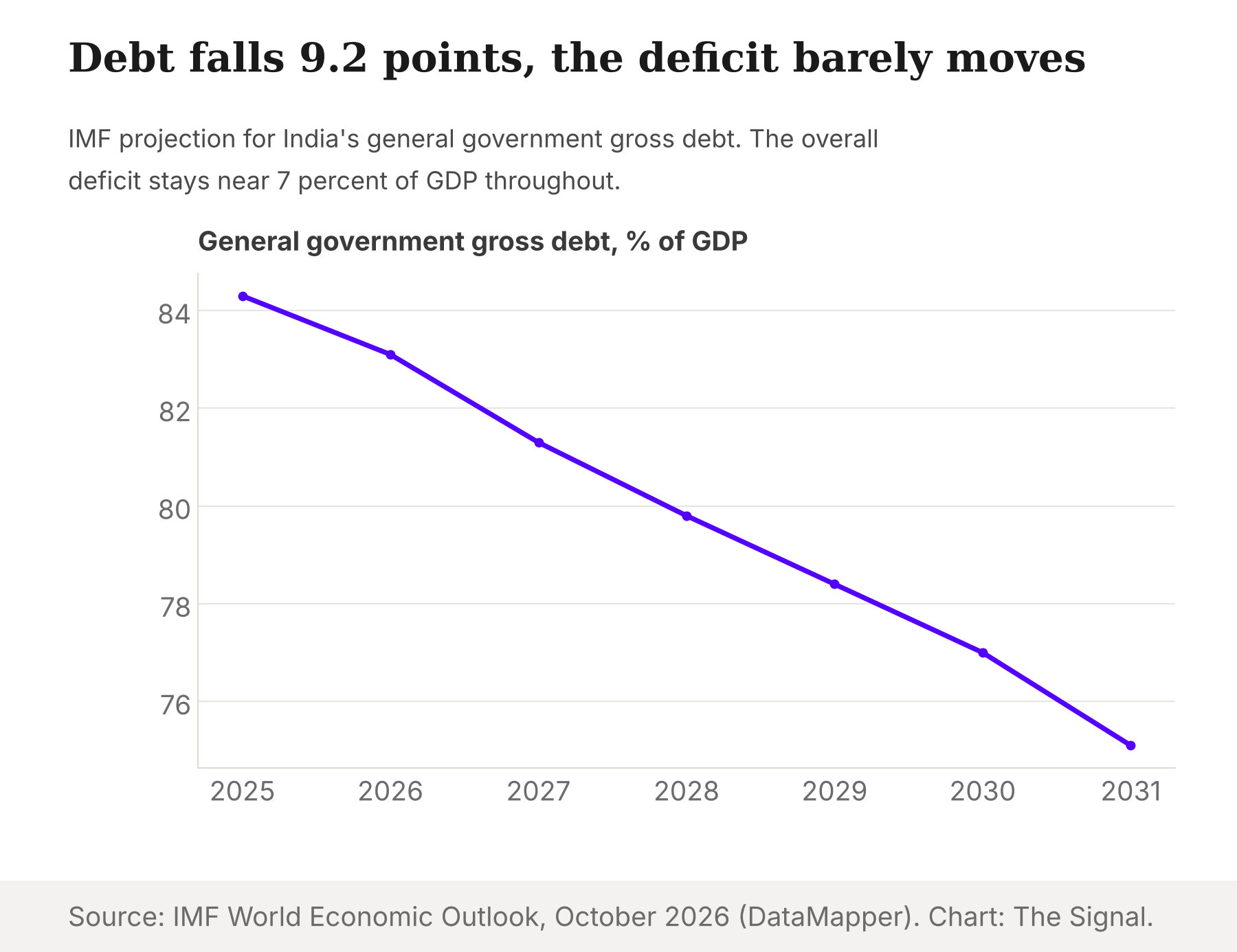
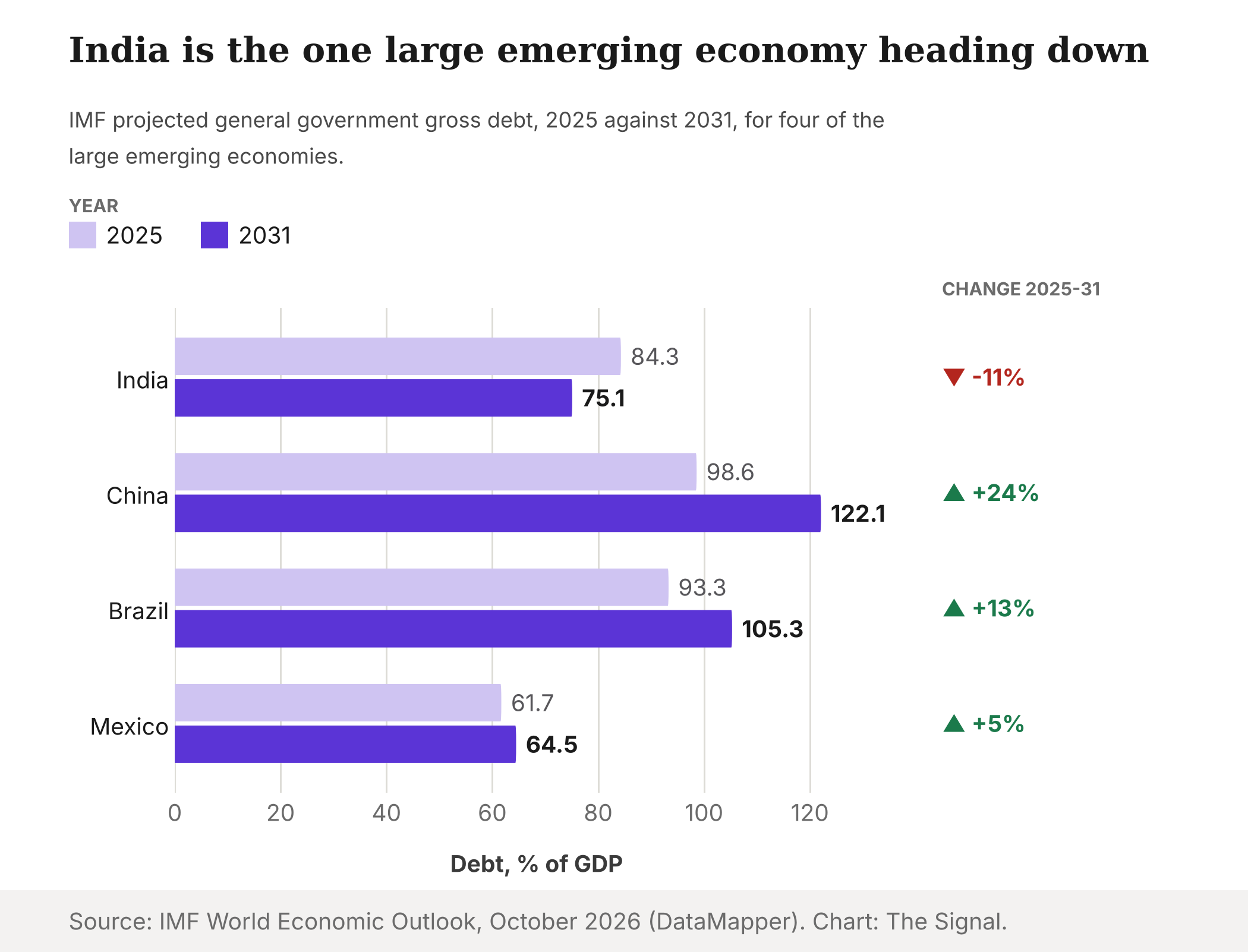
On October 28, RBI Deputy Governor Poonam Gupta made a claim that reads like good news. General government debt, she said, is projected to fall from 84.3 percent of GDP in 2025-26 to 75.1 percent by 2031-32. General government means the Centre and the states together. The IMF's October 2026 projections carry the same path, with debt easing every year from 83.1 percent in 2026 to 77.0 percent in 2030.
She added the line that makes it a headline. India is the only one of the nine emerging economies with GDP above $1 trillion whose debt ratio is projected to decline between 2025 and 2031. Read that way, India is quietly doing the fiscal homework everyone else skipped.
It is worth slowing down on that. A falling ratio can mean a government is borrowing less, or that the economy is outgrowing its debt. The two look identical on a chart and behave very differently under stress.
The deficit barely moves
Start with the part that would signal consolidation. The IMF projects India's general government deficit at 7.4 percent of GDP in 2025 and 6.7 percent in 2031. That is 0.7 points of narrowing in six years.
Strip out interest and the picture is the same. The IMF projects the primary balance, the budget before interest payments, at a deficit of 2.2 percent of GDP in 2025 and 1.7 percent in 2031. Gupta said as much herself: the debt ratio declines even though the primary deficit stays between 1.7 and 2.2 percent of GDP.
So the IMF's debt path falls by 9.2 points (84.3 minus 75.1) while the primary deficit improves by half a point. Budget discipline is not what is carrying it.
The one gap that does the work
The mechanism is a comparison of two rates. Nominal GDP growth, at about 11 percent a year, is expected to stay well above borrowing costs, with an effective interest rate of about 7 percent. Nominal means before adjusting for inflation, which is the right yardstick because debt is a rupee amount.
Each year the debt stock grows at roughly 7 percent while the economy that has to carry it grows at 11. The ratio shrinks by itself, and the new primary deficit only partly refills it. The IMF's own inputs fit this: it projects real growth of 7.0 percent in 2026 and 6.8 percent in 2031, with inflation easing from 5.0 percent in 2026 to 4.0 percent by 2029. Real growth plus inflation lands in the neighbourhood of 11 percent.
How thin is the cushion? Using the IMF's primary deficit path, the RBI's 7 percent effective interest rate and a 2025 starting point of 84.3 percent, we ran the debt arithmetic forward to 2031. Debt stays flat only if nominal growth is about 9.9 percent. At 11 percent, the ratio ends 2031 near 77.6 percent. At 10 percent it is 81.6. At 9 percent the ratio does not fall at all: it ends at 85.8 percent, above where it started. These are our calculations from the IMF and RBI figures, and a simple model lands a little above the IMF's 75.1 percent because the IMF's inputs are slightly more generous.
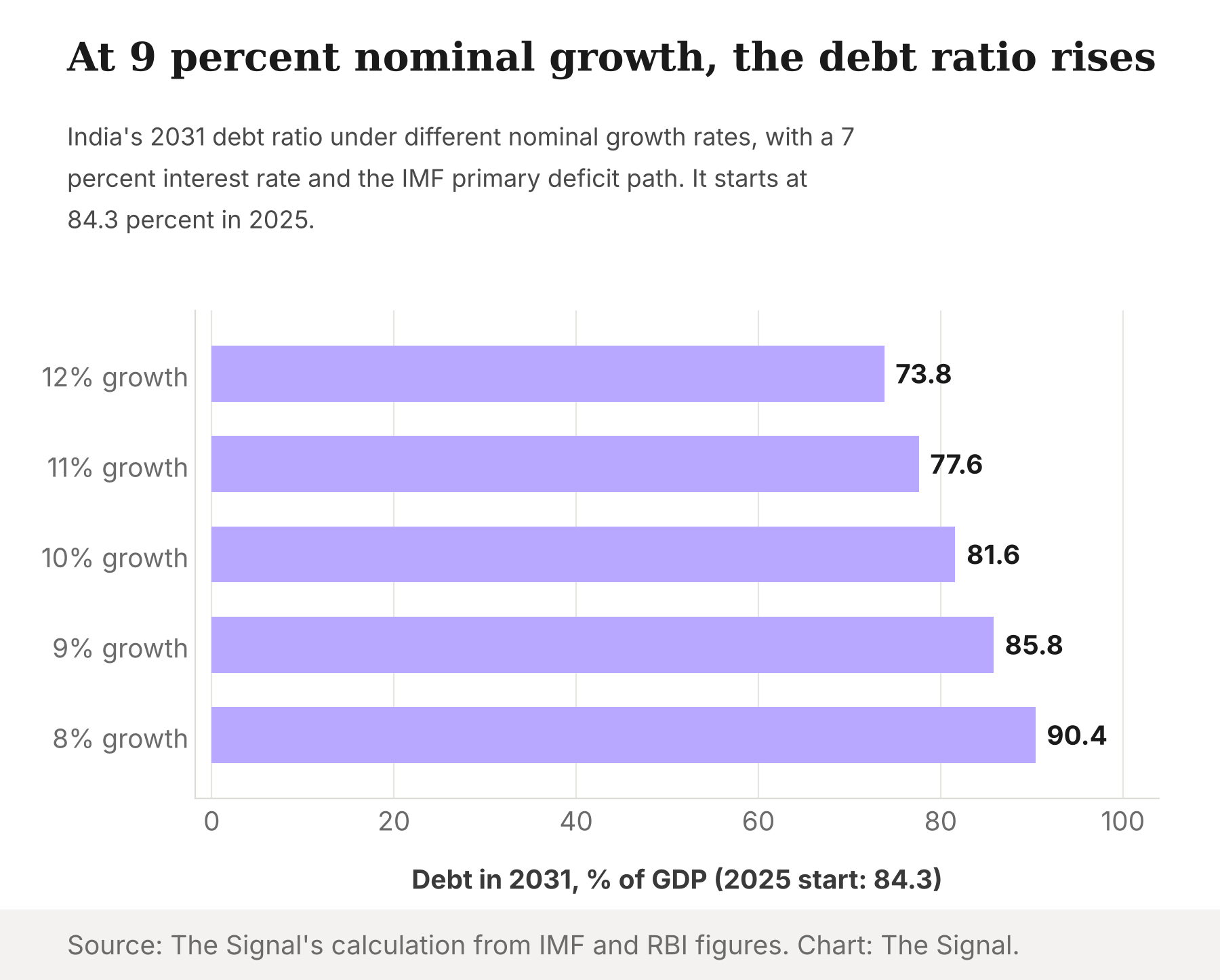
The margin between the projection and the break-even is about one and a half percentage points of growth. That is the real size of the "only emerging economy" claim.
The peers fall the other way
The comparison is stark. The IMF projects gross debt rising between 2025 and 2031 in China, from 98.6 to 122.1 percent of GDP, in Brazil, from 93.3 to 105.3 percent, and in Mexico, from 61.7 to 64.5 percent. India starts from a higher base than Mexico and falls, which is why the RBI can describe it as the exception.
Where this month's shocks land
The same week supplies the stress test. On October 7, the RBI's MPC voted unanimously to raise the repo rate by 25 basis points to 5.50 percent, and noted that the Indian crude basket averaged US$90.2 a barrel in August. The same statement projects CPI inflation of 5.2 percent and real GDP growth of 7.1 percent for 2026-27, so the growth leg is intact for now.
The interest leg is the one moving. India's 10-year yield stood at 7.40 percent on October 29, near its highest since March 2023, with Brent near $115.50 a barrel and markets pricing roughly 125 basis points of rate hikes over the next 12 months. A 10-year yield above the 7 percent effective rate means new borrowing is already costlier than the average on the stock. The effective rate then drifts up as old debt rolls over.
Abroad there is no relief. The Federal Reserve held its range at 3-3/4 to 4 percent on October 28, in a 10-2 vote, with two members dissenting in favour of a quarter-point hike.
The honest objection
The strongest counter is that inflation helps. Debt is fixed in rupees, so a burst of price rises lifts nominal GDP and shrinks the ratio. With the RBI projecting CPI inflation of 5.2 percent for 2026-27, that is a cushion for the debt ratio, at least mechanically.
That is true as far as it goes. But it only works if the interest rate does not rise in step. Here the market is doing the opposite, pricing in more hikes, with the 10-year yield already above the average rate on the stock. Inflation also feeds back into subsidy and import bills, which push the primary deficit the wrong way. The cushion is real but conditional.
A second point in the government's favour: the Centre's own plan is modest, not heroic. The Union Budget assumes FY2026-27 nominal GDP of ₹393,00,393 crore, 10 percent above the previous year's advance estimate, and a central fiscal deficit of 4.3 percent of GDP. Ten percent growth is a point below the 11 percent in the RBI's speech and still above the 9.9 percent break-even.
The Signal
India's debt story is a bet on one inequality: growth above the interest rate. The deficit is not shrinking fast enough to protect it, so the ratio is exposed to whatever hits growth or lifts the average interest rate. This month's rate hike, bond selloff and oil spike all push on the interest side.
Watch two things: nominal growth and the average interest rate. If growth slips toward the 11 percent the RBI assumes for a few quarters, the fall stops. If the interest rate creeps up while the deficit stays put, the ratio can flatten even with growth intact. A debt ratio that falls without budget discipline is not a result, it is a loan against the next few years of growth.
Reporting basis: the debt path, nominal growth, effective interest rate and peer comparison are from RBI Deputy Governor Poonam Gupta's October 28, 2026 speech and the IMF's October 2026 DataMapper series, which are the IMF's own projections. The policy decision, inflation and growth projections and crude basket figure are from the RBI Governor's statement of October 7, 2026. The Fed decision is from the Federal Reserve's October 28 FOMC statement. Budget figures are from the Ministry of Finance's Budget at a Glance for 2026-27. The 10-year yield, Brent price and rate-hike pricing rest on a single secondary source, Trading Economics market data for October 29, 2026. The 9.9 percent break-even, the 2031 sensitivity figures and the 9.2-point and 0.5-point differences are The Signal's calculations from those figures.