On 1 November, two GST changes take effect together, and the coverage has bundled them as one relief package for business. The Hans India reports that businesses facing an inverted duty structure, where GST on inputs is higher than GST on outputs, can claim 90 per cent provisional refunds upfront, subject to risk checks. The same package changes how post-sale discounts are taxed. The easy read is that both put cash back in the hands of companies faster, and that is true as far as it goes.
It is worth slowing down on the refund half. The old refund queue was already nearly empty.
The backlog the advance is meant to fix
Business Standard, citing a Lok Sabha reply from the Minister of State for Finance, reports that GST refund claims pending for more than 90 days came down to 110, worth ₹64 crore, as of 31 March 2026. The same reply puts the figure at 1,592 claims worth ₹696 crore at the end of FY24 and 712 claims worth ₹560 crore at the end of FY25.
That is a 93 percent fall in the number of old claims in two years, from 1,592 to 110, per the same reply. The money fell 91 percent, from ₹696 crore to ₹64 crore.
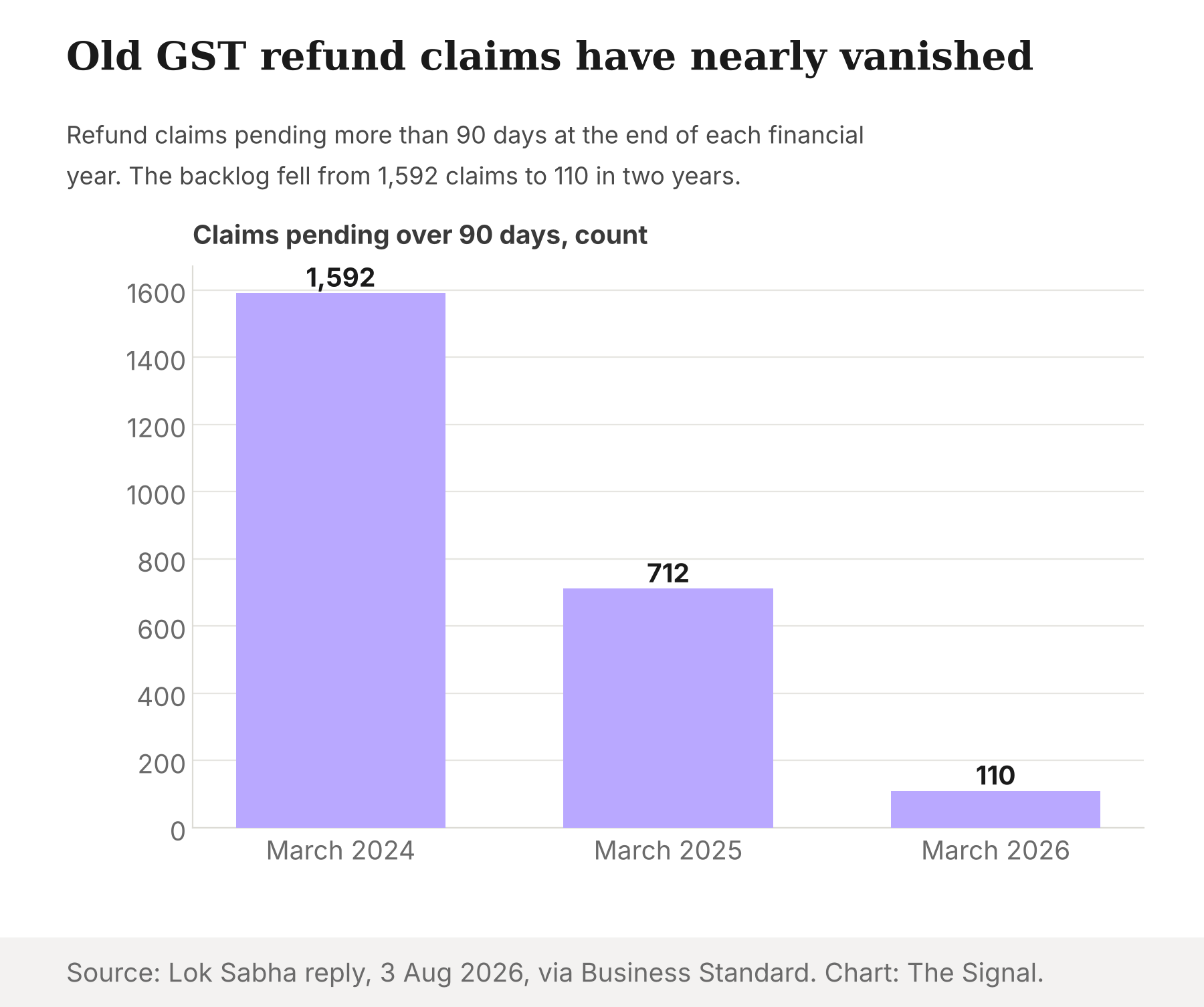
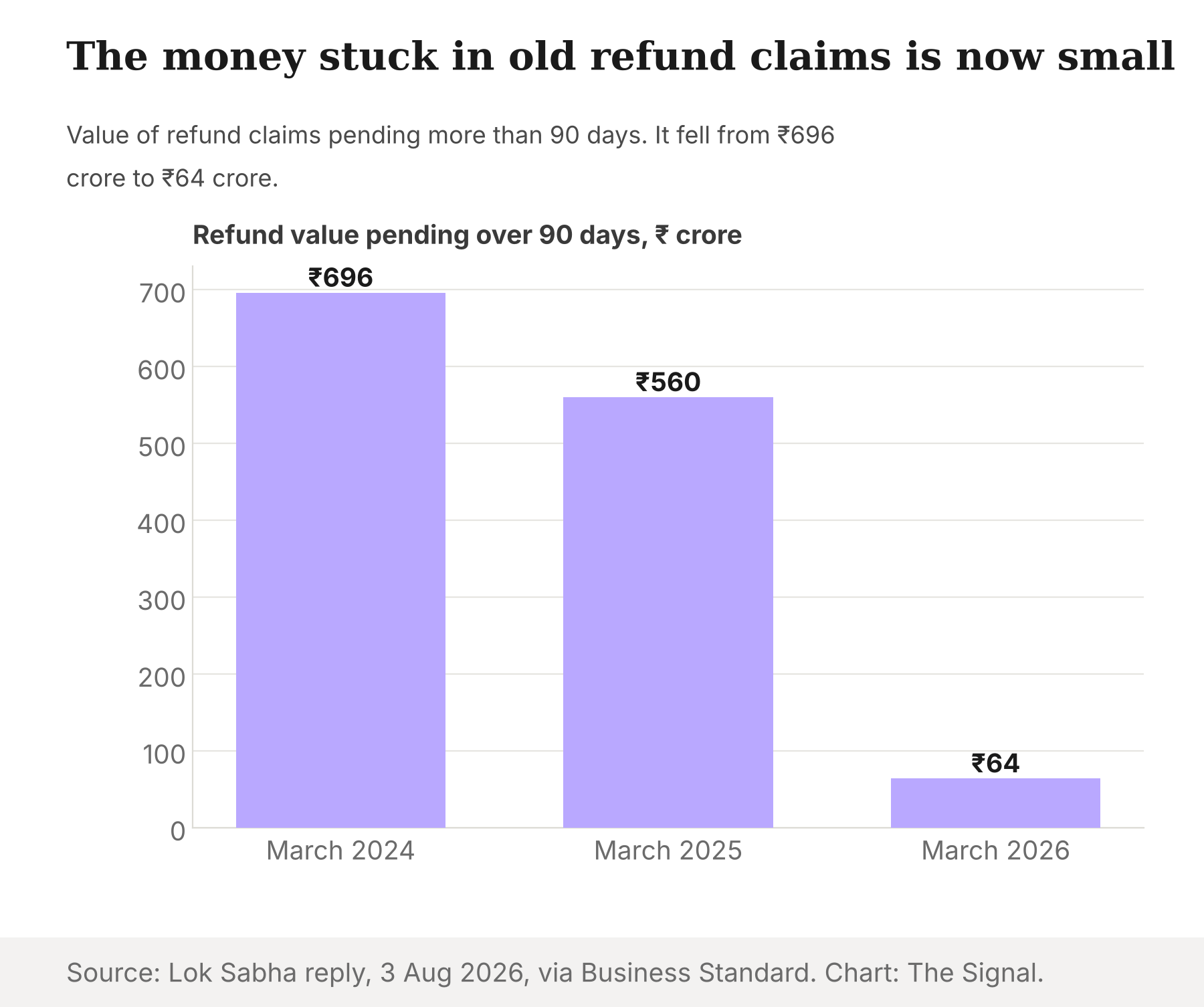
The reported pendency figures cover only claims older than 90 days. They say nothing about how long a typical claim takes in its first three months, which is where a 90 percent advance would act. No public figure for that early window was available for this piece, so the size of the working-capital gain cannot be stated. What can be said is that the stock of long-stuck refunds, the cases most likely to hurt a small exporter or manufacturer, was already small.
What the refund changes actually are
The refund changes sit in two places. The Ministry of Finance's release on the 57th GST Council meeting on 8 October 2026 says that for refund claims on zero-rated supplies and inverted duty structure, 90 percent of the amount claimed will be sanctioned provisionally and automatically by the system, without officer intervention, after the system evaluates risk. The same release recommends cutting the time limit for an acknowledgement or deficiency memo from 15 days to 10 days, with deemed acknowledgement if the officer does not act in that window.
The Council also recommended a clarification on the minimum refund. Section 54(14) is to state that the ₹1,000 threshold applies to the total refund across CGST, SGST/UTGST and IGST taken together. Those are Council recommendations. What took effect by notification is narrower: CBIC appointed 1 November 2026 as the date Sections 153 to 155 of the Finance Act, 2026 come into force, and Section 54 is among the CGST provisions they amend.
The discount rule is where behaviour changes
The post-sale discount change is a different kind of rule. It does not speed up money the government already owes. It changes who carries a tax risk.
Before the amendment, a discount could be left out of the value of supply only if it was established through an agreement made at or before the time of supply, according to Business Today. The Finance Act, 2026 removed that requirement. Under the amended Section 15(3)(b), post-supply discounts may be excluded from the value of supply where a credit note has been issued by the supplier and the recipient reverses the corresponding input tax credit attributable to the discount, SCC Online reports.
| Before 1 November 2026 | From 1 November 2026 | |
|---|---|---|
| Condition on timing | Discount agreed at or before the time of supply | No such agreement required |
| What the supplier must do | Meet the agreement condition | Issue a credit note |
| What the recipient must do | No discount-specific step reported | Reverse the input tax credit tied to the discount |
Source: Business Today and SCC Online, reporting the Finance Act, 2026 amendments and CBIC's commencement notification of 26 October 2026.
Read the right-hand column slowly. The supplier's saving now depends on an act by someone else. If the dealer does not reverse the credit, the discount cannot be excluded from taxable value. The supplier is exposed to the dealer's compliance, and the dealer gives up part of its credit in exchange for a lower price.
A tax partner at Nangia Global told Business Today that businesses can now issue GST credit notes for eligible post-sale discounts, subject to the recipient reversing the corresponding ITC, and that the change should help sectors such as FMCG, pharmaceuticals, retail and consumer durables, where dealer incentives and volume-based discounts are common. That is the part of the economy where year-end volume rebates are routine and where, until now, the agreement condition was a hurdle.
The honest objection
The strongest case for the refund side is that the advance is not about the backlog at all. A claim can be absent from the over-90-day count and still tie up a business for weeks, and an automatic advance of 90 percent addresses exactly that window. That old refunds were cleared does not prove that new refunds were fast.
That is fair, and it is why this piece does not call the advance pointless. It cannot be sized from the public figures cited here, and the backlog number is not the right yardstick for it. What the pendency numbers do show is that the long-tail problem, the one that made refunds a grievance, shrank by more than nine-tenths in two years. The advance is an improvement on a system that was catching up, not a rescue of one that was failing.
The Signal
The refund changes will be the ones that business groups welcome loudly, because cash is easy to count. The discount rule will matter more in practice because it rewires a relationship. Every supplier that runs a dealer scheme now has to decide whether its credit-note process, and its dealers' reversal habits, are tight enough to rely on. Watch the first quarterly rebate cycle after 1 November: the test is how many suppliers can show a matching reversal on the other side of every credit note. The refund queue may already be nearly empty, but the discount ledger is about to fill up.
Reporting basis: the 1 November commencement, the amended Section 15(3)(b) test and the credit-note requirement are per SCC Online's report of CBIC's notification of 26 October 2026; the pre-amendment agreement condition and the Nangia Global comment are per Business Today. The provisional refund of 90 percent, the 15-to-10-day acknowledgement limit and the ₹1,000 threshold clarification are from the Ministry of Finance's release on the 57th GST Council meeting, via PIB, and are Council recommendations; The Hans India separately reports the 90 percent advance for inverted duty claims as taking effect on 1 November. The refund-pendency figures are from a Lok Sabha reply of 3 August 2026, as reported by Business Standard, and were not checked against the parliamentary record itself. We did not read the notification text or the Finance Act text directly, so the amended wording rests on the two outlets above. The percentage declines in the number and value of old claims are The Signal's calculations from those figures.