On 28 October 2026, the Union Cabinet cleared a Rs 10,000 crore container manufacturing scheme that runs to FY 2039-40 and aims to "increase India's annual container manufacturing capacity nearly tenfold to 7.5 lakh twenty-foot equivalent units", the standard unit known as a TEU. The reading writes itself. India's exporters pay for boxes made in China, so India will make its own. The Press Information Bureau says India imports nearly 2 million empty containers every year to meet domestic demand and for repositioning, and a tenfold jump in domestic capacity sounds like the cure.
It is worth slowing down on the arithmetic. A tenfold jump to 7.5 lakh TEU implies India builds roughly 75,000 TEU a year today, so the starting point is small. The target is also small against the market it is entering.
The number that sizes the ambition
Chinese factories built 6.45 million TEU of containers in 2025, the third-highest year on record, according to The Loadstar's report citing the China Container Industry Association. India's 7.5 lakh TEU target is 750,000 TEU, which is 11.6 percent of that. The same report says Chinese manufacturers produce 95% of the world's containers.
At 750,000 TEU, India's target is 11.6 percent of the 6.45 million TEU China built in 2025.
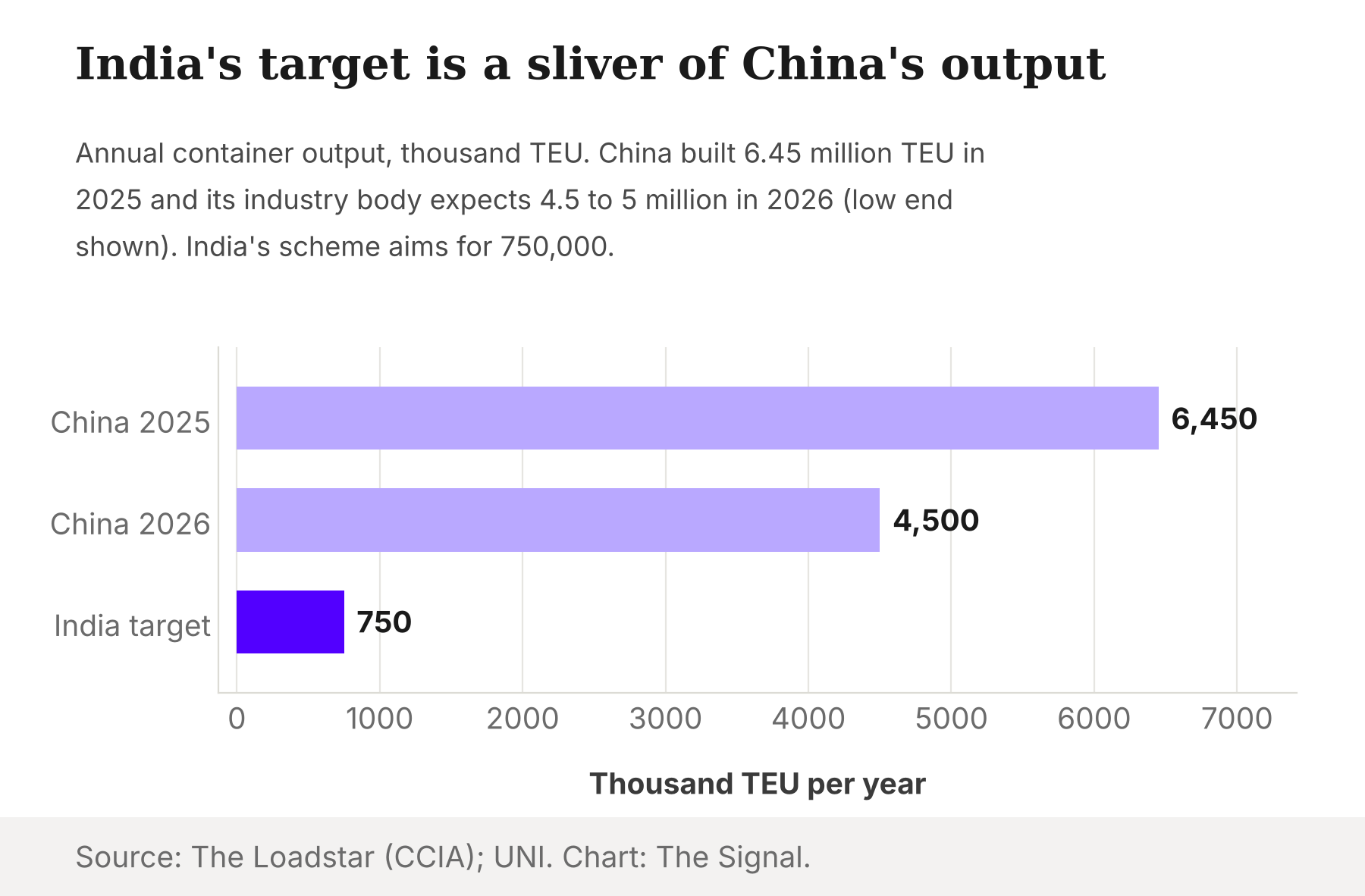
The comparison flatters India if anything. The association expects Chinese output to fall to between 4.5 million and 5 million TEU in 2026, a drop of up to 30 percent. Against the low end of that range, the target is 16.7 percent of China's output. Against the high end, 15 percent. Even a far smaller Chinese industry would be six or seven times India's goal.
Concentration is the other half of the picture. Drewry data reported by FreightWaves showed Chinese factories building more than 96% of the world's dry cargo containers, and the top three builders at 82% of output in the first quarter of 2021. That is a market with deep scale and few entrants.
What the target covers at home
Set the target against India's own import bill and the picture is more modest than the headline. The PIB figure is about 2 million empty containers a year. If every one of them counted as a single TEU, 750,000 would cover 37.5 percent. Forty-foot boxes count as two TEU, so the true share is lower. The scheme at full capacity would still leave India importing most of its empties.
A single customer gives a sense of the scale of demand. Maersk's Amdi Krogh said the carrier requires around 400,000 to 500,000 containers every year, and its first order from an Indian factory was 1,000 containers. That order equals 0.2 to 0.25 percent of one year's need at one carrier. It is a start, and a small one.
Where the money goes
The money is structured over a long horizon. The report on the Cabinet decision lists Rs 8,891 crore for operational expenditure assistance, Rs 859 crore as interest subvention at 3 percent a year, and Rs 150 crore for testing and certification. Operational assistance is 88.9 percent of the Rs 10,000 crore. The three lines sum to Rs 9,900 crore, and the report does not say where the other Rs 100 crore goes.
Spread across the 14 years to FY 2039-40, and assuming capacity ran full, the Rs 8,891 crore operating pool works out to about Rs 8,500 per TEU. That is our calculation, and it is a ceiling on what any one year could pay, since the plants will not hit 7.5 lakh TEU on day one.
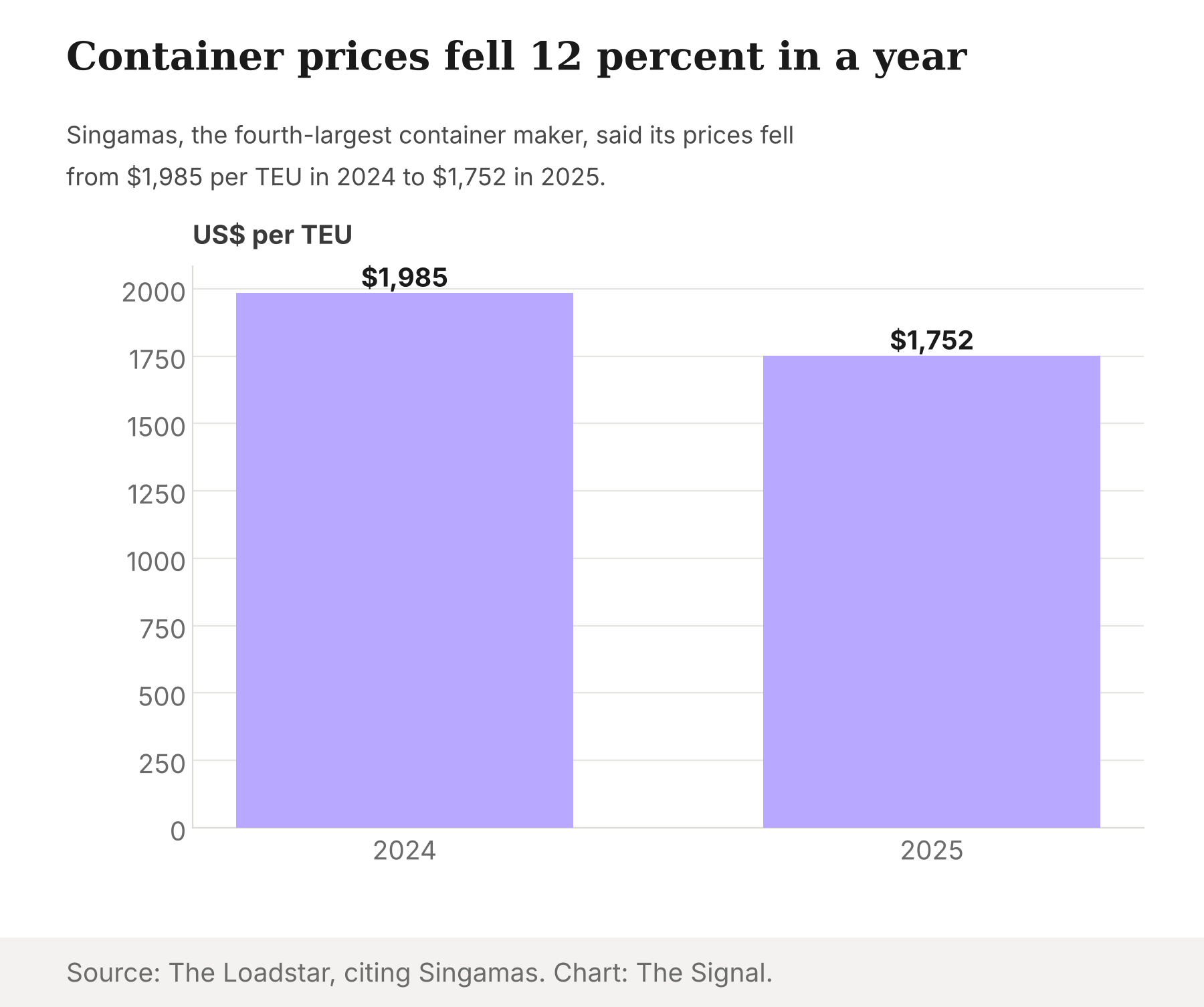
The design matters more than the sum. A scheme that mostly pays running costs is built for a cost gap that will not close on its own. That is an inference from the budget split, not a published price comparison, and this piece found no sourced figure for what an Indian-made container costs against a Chinese one. What the sources do show is that the benchmark is moving the wrong way for a new entrant. Singamas, the fourth-largest container maker, said its prices fell to $1,752 per TEU in 2025 from $1,985 in 2024, a fall of about 12 percent.
The honest objection
The strongest case for the scheme is that it was never meant to win a price war. Containers are a strategic input. When a shock hits, the box becomes scarce before the ship does, and a country with some factories of its own can hold on to supply when it matters. The size also supports the argument: the target is nearly a quarter of the 3.1 million TEU the world produced in 2020, the Drewry figure FreightWaves reported, so it would be a meaningful producer in a normal year.
That case is real, and it explains the money. It does not explain the framing. Resilience insurance and import substitution are different goals with different yardsticks. Insurance is judged by whether plants exist and run when needed. Import substitution is judged by market share, and at 11.6 percent of China's 2025 output the target will not move it.
The timeline adds a caution. The scheme was announced in the Budget, and in March the Ministry told the Rajya Sabha it had initiated the process of appraisal. Cabinet approval came more than seven months after that reply, and capacity will take longer still.
The Signal
The Cabinet has bought an option, not a supply chain. Watch three numbers: how many factories sign up in the first year, whether capacity moves past the roughly 75,000 TEU implied starting point, and whether orders like Maersk's 1,000 containers repeat at ten and a hundred times the size. If they do, the Rs 8,891 crore in running support is working as a bridge. If they stay in the thousands, it is a standing subsidy for a small industry.
Reporting basis: the Cabinet approval, outlay split, FY 2039-40 horizon and 7.5 lakh TEU target are per United News of India reporting the decision, and the original release was not checked. The 2 million empty container imports are from a PIB explainer of August 2026. China's 2025 output, the 2026 forecast and the Singamas prices are per The Loadstar, which cites the China Container Industry Association and Singamas. The 2020 and 2021 production shares are Drewry data as reported by FreightWaves. Maersk's annual requirement and its 1,000-container order are per Hellenic Shipping News. The appraisal status is from the Ministry's Rajya Sabha reply of 17 March 2026. The 11.6, 15 and 16.7 percent shares, the 37.5 percent import coverage, the 0.2 to 0.25 percent order share, the implied 75,000 TEU base, the Rs 8,500 per TEU ceiling and the 12 percent price fall are The Signal's calculations from those figures.