Tata Motors has won Iveco. On provisional results announced on 27 October 2026, Tata's holding vehicle reached 89.42 percent of the Italian truck maker, and the report says the threshold condition has been met, subject to confirmation of the final results. The headlines called it a takeover completed. That reading is fair as far as it goes.
It is worth slowing down on the number, because 89.42 is not the number that ends the process.
The 95 percent line
The offer was built around two thresholds. It required a minimum acceptance level of 95 percent of the common shares, which falls to 80 percent if shareholders adopt the Back-End Resolution at the extraordinary general meeting. Reports treating the 80 percent bar as met imply that resolution passed.
The second threshold decides what happens after the tender. According to the same joint release from Tata Motors and Iveco, at 95 percent or more the buyer starts a Dutch legal squeeze-out. Between 80 and 95 percent, it intends to implement the Post-Offer Demerger and Liquidation, if approved at the EGM.
Tata landed in the middle band. It holds 89.42 percent, 5.58 points below the squeeze-out line.
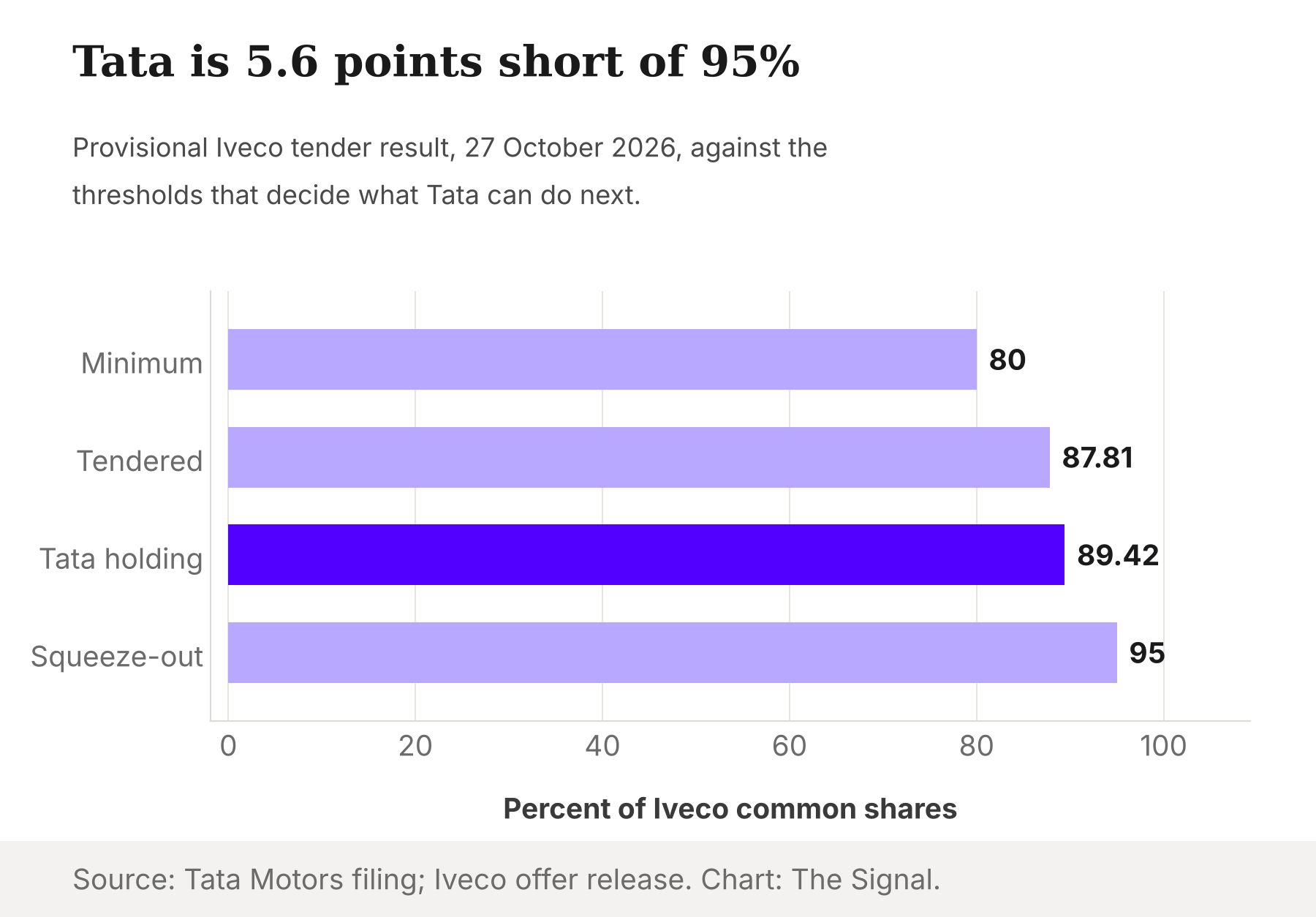
Of the 10.58 percent still outside Tata's holding, it needs just over half (52.7 percent, our calculation) to cross 95. The acceptance period reopens for five trading days from 2 to 6 November, so that gap can still close. If it does not, Tata owns a company it controls but cannot simply fold in.
What it is paying
Tata raised the offer by 0.30 euro to 14.40 euro per share, citing the slight delay in completing the offer. The revised price would value the transaction at 3.91 billion euros if every share were tendered, and it is a 33.47 percent premium over Iveco's share price on 17 July 2025.
At the European Central Bank's reference rate of 106.4935 rupees per euro on 26 October 2026, 3.91 billion euros is about ₹41,600 crore (our calculation). Tata's commercial-vehicle arm reported standalone revenue of ₹19,329 crore in the June 2026 quarter. The price is a little over two of those quarters.
What it is buying
Iveco is the bigger business by sales. Its 2025 consolidated net revenues were 13.4 billion euros, down 7 percent, which is about ₹1.43 lakh crore at the same rate. Iveco holds 11 percent of the EU truck market, and the deal does not include its defence business.
It earns little on that revenue. Iveco's consolidated adjusted EBIT margin in 2025 was 4.8 percent. In the June 2026 quarter, Industrial Activities generated an adjusted EBIT of 104 million euros on industrial revenues of 3,696 million euros, about 2.8 percent. A year earlier the same line was 143 million euros, so profit fell 27 percent while revenue rose.
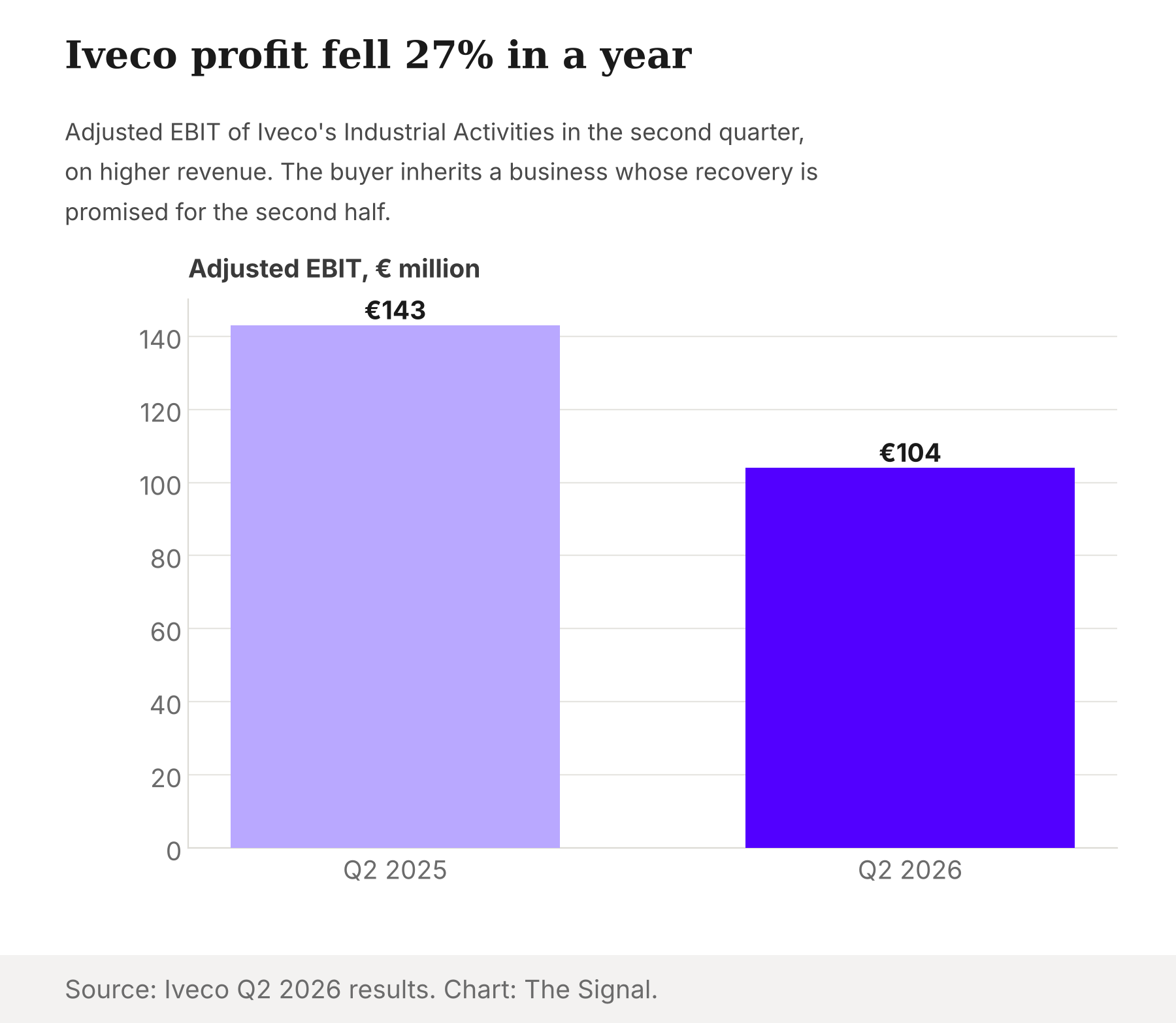
Cash is no better. In that quarter free cash flow represented an outflow of 45 million euros. Iveco itself says it expects a gradual recovery in profitability during H2 2026. That is a forecast, not a result.
Set that against the buyer. Tata's standalone commercial-vehicle EBITDA margin was 11.7 percent in the June 2026 quarter, against 12.3 percent a year earlier. EBITDA is struck before depreciation and EBIT after it, so the two margins are not like for like. The gap is still wide enough to show the direction: the parent is buying a larger, thinner-margin business.
The regulatory clock
Iveco's European market is also getting harder to serve. The European Commission requires new heavy-duty vehicle CO2 emissions to fall 45 percent by 2030, 65 percent by 2035 and 90 percent by 2040, and notes that heavy-duty vehicles cause more than a quarter of road-transport greenhouse gas emissions in the EU. The reference period varies by vehicle type.
Meeting those targets takes capital. Whoever owns Iveco funds it while Iveco's own profit is falling. That is the second-order effect of the price: the purchase is a one-time cheque, but meeting emissions targets on a thin-margin business is a running cost.
The honest objection
The strongest case against this reading is that 89.42 percent is control for every practical purpose. Exor, Iveco's largest shareholder, irrevocably committed to tender about 27.06 percent of the common shares, and the board backed the deal. Strategy, capital allocation and management are Tata's to set. The reopening may add more.
That is true, and it explains why the buyer is not worried about governance. It does not remove the difference between controlling a company and owning all of it. Below 95 percent, the joint release points to a demerger and liquidation route that needs EGM approval, rather than a squeeze-out. The structure of the exit, not the vote count, is what is still open.
The Signal
Tata Motors paid for Iveco's revenue and has so far secured its control. What it has not secured is the clean ownership that makes a business easy to fold in, or the profit that makes the price easy to defend. Watch three dates: the final results due by 29 October, the reopening on 2 to 6 November, and Iveco's third-quarter profit line. If the stake clears 95 percent and the margin recovers, the deal reads as a bargain. If not, India's largest commercial-vehicle maker bought a bigger company that earns less per euro of sales than itself. Control is a vote count; ownership is the number that is still missing.
Reporting basis: Iveco's revenue, EBIT, cash flow, guidance and offer terms, including the thresholds and the Exor commitment, are from Iveco Group's own results and offer releases, which are issuer statements and have not been independently audited here. The provisional 89.42 percent result and the reopening dates rest on a single report of Tata Motors' filing, by Angel One, and the offer-price and premium figures on a single report of Tata Motors' filing, by Autocar Professional. Tata's commercial-vehicle revenue and margin are from Tata Motors' results, via Autocar Professional. The 11 percent EU market share is per Forbes India. The exchange rate is the European Central Bank's reference rate and the emissions targets are from the European Commission. The rupee conversions, the 5.58-point gap, the 52.7 percent share of the remaining stock, the 2.8 percent industrial margin, the 27 percent profit fall and the comparison of price with Tata's quarterly revenue are The Signal's calculations from those figures.