Tesla's Indian arm has filed its first full year of accounts with car sales in them, and the headline writes itself. Tesla India Motors and Energy reported revenue of Rs 247.31 crore and a net profit of Rs 5.16 crore for FY26, the year to March 2026. Revenue from operations rose nearly 12-fold from Rs 20.83 crore a year earlier, when the company earned only service income. A new market, a premium product and a profit in year one. Read the top line and the launch is working.
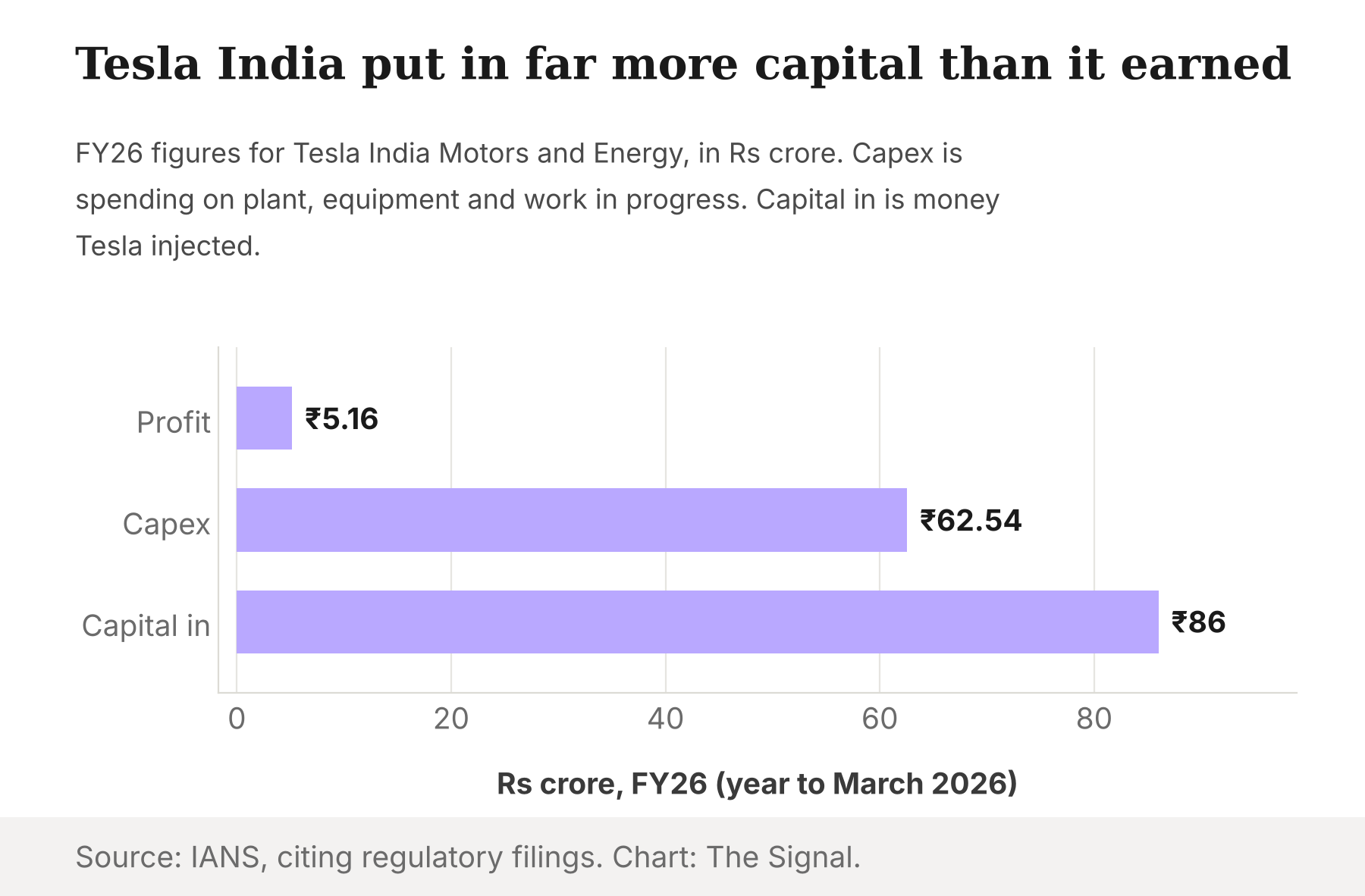
It is worth slowing down on that. A profit of Rs 5.16 crore on Rs 247.31 crore of revenue is a margin of about 2 percent. And the filing describes a company still building: Tesla injected about Rs 86 crore into the Indian subsidiary in FY26, and spending on property, plant and equipment and capital work-in-progress rose to Rs 62.54 crore from Rs 1.16 crore. Put in Rs 86 crore, earn Rs 5.16 crore. That is a year of laying foundations, not harvesting them.
The filing covers the slowest months
The accounts end in March 2026, and sales only began in September 2025. The same report counts 346 registrations in that window, about 49 a month. In April to September of FY27 it counts 650, about 108 a month, which already beats the whole of the previous year. Vehicle sales were Rs 214.69 crore of the revenue, nearly 87 percent, with services making up Rs 32.40 crore.
So the filing is a snapshot of the slowest stretch, as the registrations in the same report show. The monthly Vahan data carries the more recent story.
The number that carries the thesis
In May, Tesla cut the price of the Model Y Premium RWD by Rs 9 lakh, to Rs 50.89 lakh. Its earlier Model Y had launched at Rs 59.89 lakh, so the cut is 15 percent.
Then the deliveries moved. Autocar India, citing the Vahan registration portal, reports 38 Model Y deliveries in June, 116 in July and a record 291 in September 2026. September is about 7.7 times June. Between July and 2 October, Tesla delivered 554 cars, 54 percent of everything it has sold in India so far.
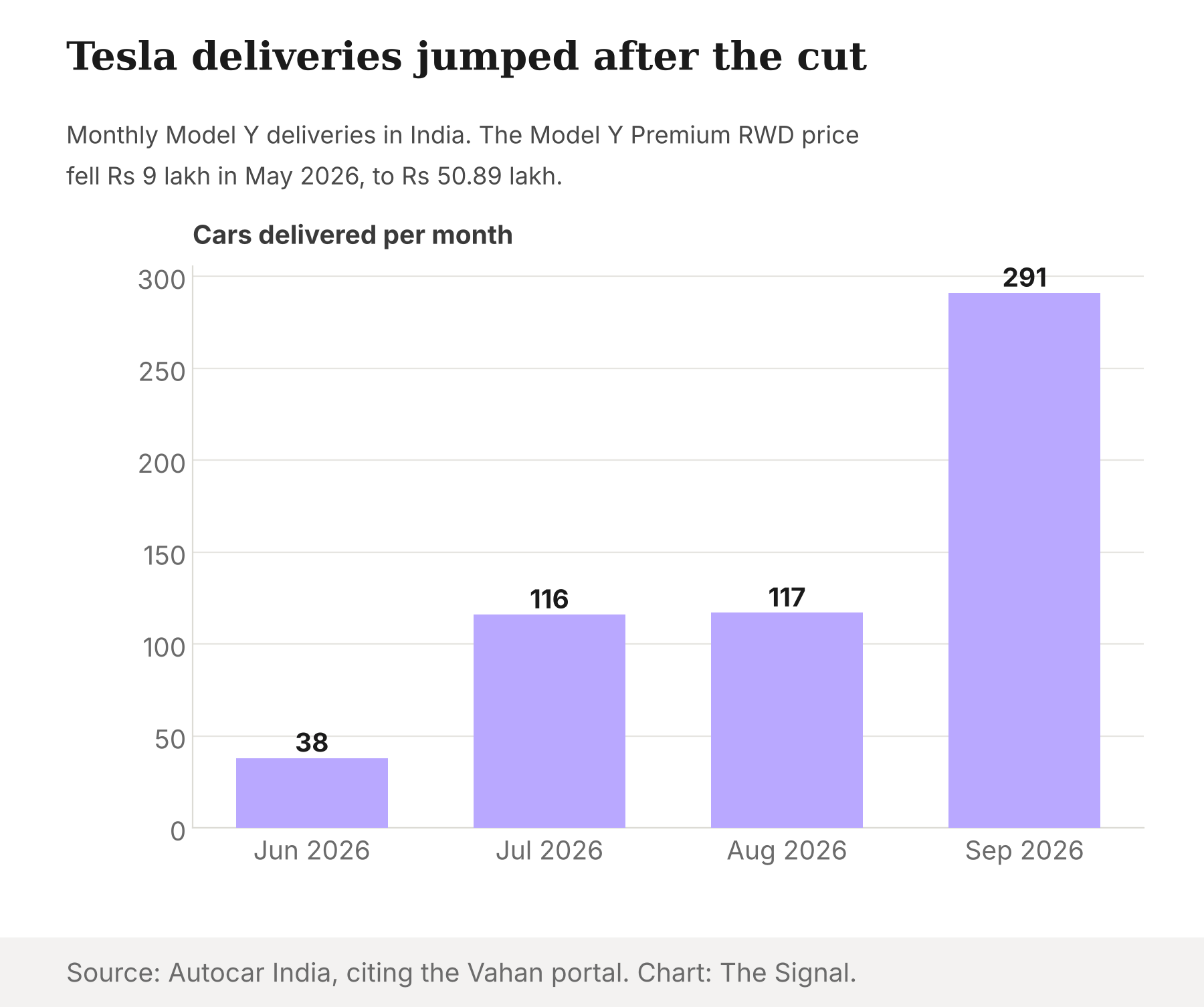
The cut also moved Tesla up the table. In September it was 0.8 percent of 35,995 electric passenger vehicles sold, and 30 percent of the luxury electric segment, up from 11 percent a year earlier. The timing is suggestive, not proof. Other things changed over those months, and a 15 percent price cut is only one of them. But a company that wanted volume bought it with price.
What the price cut says about the strategy
India offers foreign carmakers a different route to a cheaper car. Under a scheme run by the Ministry of Heavy Industries, approved companies can import up to 8,000 fully built electric cars a year at a customs duty of 15 percent. The car must have an import value of at least $35,000, and the company must set up manufacturing with a minimum investment of Rs 4,150 crore. The concession runs for five years from approval, and applications closed on 21 October 2025.
Set Tesla's FY26 capital spending of Rs 62.54 crore beside that Rs 4,150 crore threshold and it is about 1.5 percent of it. At the portal launch in June 2025, the Heavy Industries Minister said Tesla was "only interested in opening a showroom till now". We did not find a public list of approved applicants, and we cannot say what Tesla applied for. What the filing shows is a company spending on retail and service, and then using the price of the car, not a lower duty, to move volume.
That reading carries a cost. A price cut taken from a thin margin has a floor. With a 2 percent margin on Rs 247.31 crore of revenue, a 15 percent cut leaves little room per car, and the filing does not give the margin per vehicle. So volume has to do the work.
The honest objection
The strongest case against this reading is that a first-year profit of any size is a good result for a car maker. Most new entrants lose money for years, and Tesla India made a profit of Rs 5.16 crore while building showrooms and service capacity. The registrations support that: monthly registrations rose from about 49 to about 108, and a retail footprint is an asset.
That case is fair. But it answers a question about the launch, not about the next step. A profitable showroom business and a manufacturing commitment are different bets, and the difference shows up in the capital line. Tesla's India sales are growing on price. Whether they hold at a lower price, on a thin margin, is the open question.
The Signal
The Rs 5.16 crore profit is the number everyone will quote and the least informative one. It describes a slow, expensive launch year. The more useful pair is Rs 9 lakh and 291: a 15 percent price cut, and a record month that followed it.
Watch two things. First, whether monthly deliveries stay near September's 291 or fall back toward the 116 and 117 of July and August once the discount stops being new. Second, whether Tesla's next filing shows capital spending that begins to approach the Rs 4,150 crore scale the duty scheme asks for. If it does not, nothing in the accounts points to a manufacturing commitment, and the price of the car stays the main lever. Tesla has just shown where it thinks that price is.
Reporting basis: the FY26 revenue, profit, capital injection, capital spending and registration counts are from Tesla India's regulatory filings as reported by IANS, carried by The Hans India, and rest on that single reporting; we did not review the filing itself. Monthly delivery counts, the May price cut and the September market shares are from Autocar India, citing the Vahan registration portal, and the launch price is per Outlook Business. The import scheme terms are from the Ministry of Heavy Industries, in a Lok Sabha reply of 16 December 2025 and a Press Information Bureau release of 24 June 2025. The minister's remark about Tesla is from ANI, via The Tribune, dated 24 June 2025, and may not reflect Tesla's current position. We did not locate a public list of approved applicants under the scheme. The profit margin, the 15 percent price cut, the 7.7 times rise in monthly deliveries, and the 1.5 percent comparison of capital spending with the scheme's investment threshold are The Signal's calculations from those figures.