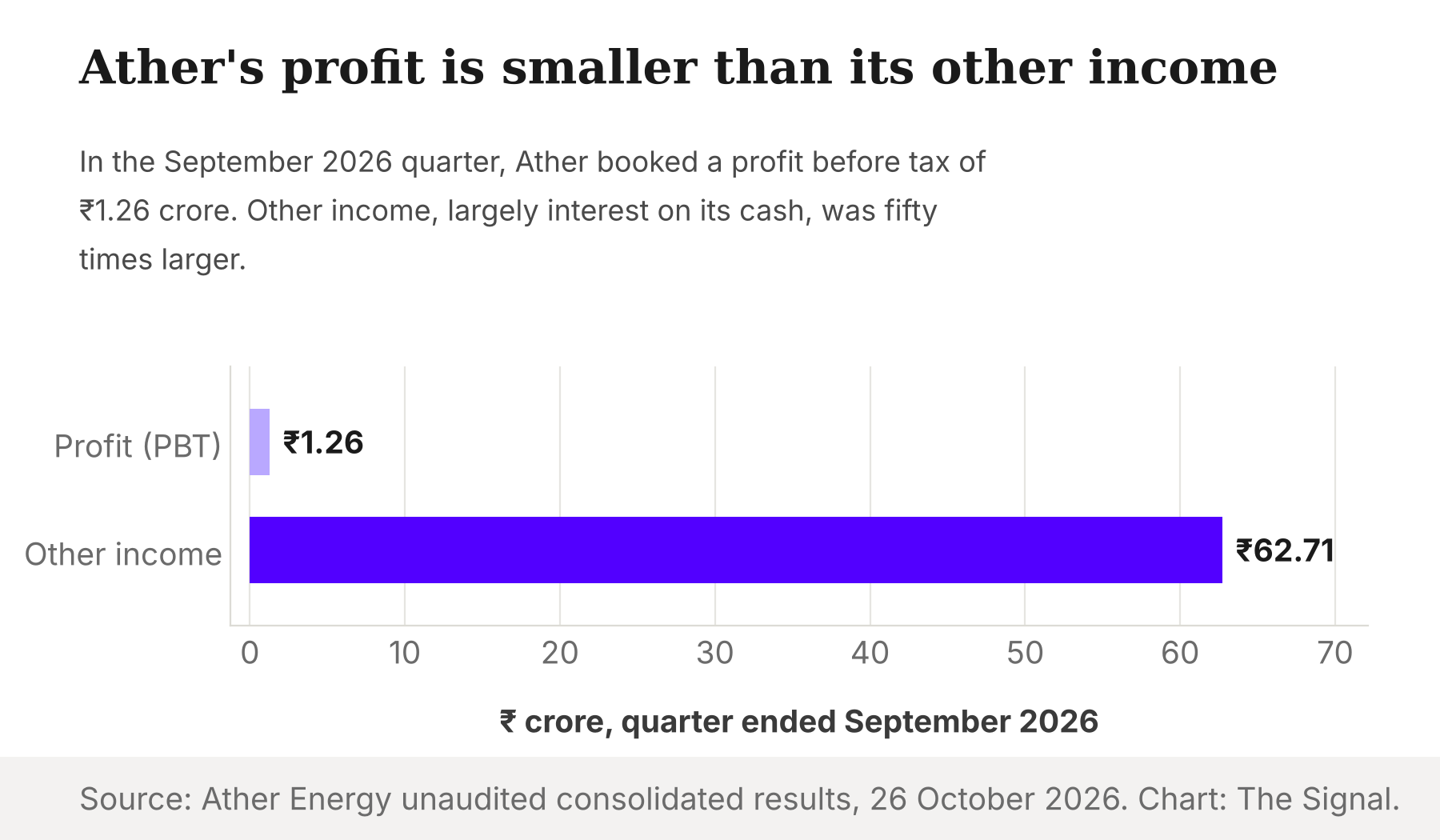
Ather Energy has posted the number its investors have waited years for. In the quarter ended September 2026, the electric scooter maker reported a profit before tax of ₹1.26 crore, against a loss of ₹154.07 crore a year earlier. The company's own release leads with something bigger: EBITDA of ₹74.2 crore, its second consecutive EBITDA-positive quarter. Read the headlines and a loss-making start-up has become a profitable manufacturer.
It is worth slowing down on that. The same filing carries a line that the headlines skipped. Ather's other income for the quarter was ₹62.71 crore, roughly fifty times the profit. Take it out and the quarter is a loss of about ₹61 crore.
The number that carries the story
Profit before tax is revenue plus other income, minus costs. Other income is money that does not come from selling scooters. The table shows what each quarter looks like with and without it.
Ather's reported profit crossed zero. Its profit without other income did not.
| Quarter | Other income (₹ crore) | Reported profit before tax (₹ crore) | Without other income (₹ crore) |
|---|---|---|---|
| Q2 FY26 (Sept 2025) | 41.79 | -154.07 | -195.86 |
| Q1 FY27 (June 2026) | 42.73 | -51.09 | -93.82 |
| Q2 FY27 (Sept 2026) | 62.71 | 1.26 | -61.45 |
Source: Ather Energy unaudited consolidated results filed 26 October 2026. The last column is The Signal's calculation.
What the EBITDA figure includes
The ₹74.2 crore headline needs the same reading. Ather's investor presentation defines its EBITDA margin as earnings before exceptional items and tax, plus finance cost and depreciation, divided by total income. Total income includes other income. So the measure starts from a profit that other income has already lifted.
The arithmetic is short. Finance costs were ₹26.04 crore and depreciation ₹46.87 crore. Add them to the ₹1.26 crore profit and you get ₹74.17 crore. Subtract the ₹62.71 crore of other income and EBITDA from scooters and their services is about ₹11.5 crore.
The "second consecutive positive quarter" claim shifts too. Ather's own release puts the Q1 FY27 EBITDA margin at 0.8%, which is a small positive number. Using the same formula, the Q1 loss of ₹51.09 crore plus ₹21.58 crore of finance costs and ₹38.96 crore of depreciation gives about ₹9.5 crore. That quarter had ₹42.73 crore of other income. Without it, Q1 EBITDA was a loss of roughly ₹33 crore. On that stricter basis, Q2 FY27 is the first positive quarter of the three in the table, not the second.
Where the other income comes from
The filing does not break out other income for the quarter. The half-year cash flow statement gives the clearest clue. It shows interest income of ₹82.44 crore for April to September 2026, against ₹64.00 crore a year earlier, and ₹555.57 crore net put into mutual funds. Other income for the half was ₹105.44 crore (₹62.71 crore plus ₹42.73 crore), so interest accounts for about 78 percent of it.
The cash has a source. Ather allotted shares worth about ₹1,300 crore to institutional buyers at ₹1,202 a share on 20 July 2026, inside the quarter. Other income rose by about ₹20 crore from Q1 to Q2. The filing does not say the placement caused that rise, but the timing fits. A company that raises capital and parks it earns interest. That is ordinary treasury management. It is not scooter profit.
The honest objection
The strongest case for Ather is that the operating line is moving fast. Strip out other income in every quarter and the loss shrinks from ₹195.86 crore in Q2 FY26 to ₹61.45 crore in Q2 FY27, a swing of about ₹134 crore in a year. Revenue from operations rose to ₹1,464.24 crore from ₹898.88 crore, up about 63 percent. Other income grew by only about ₹21 crore over the same period. Most of the improvement came from the core business.
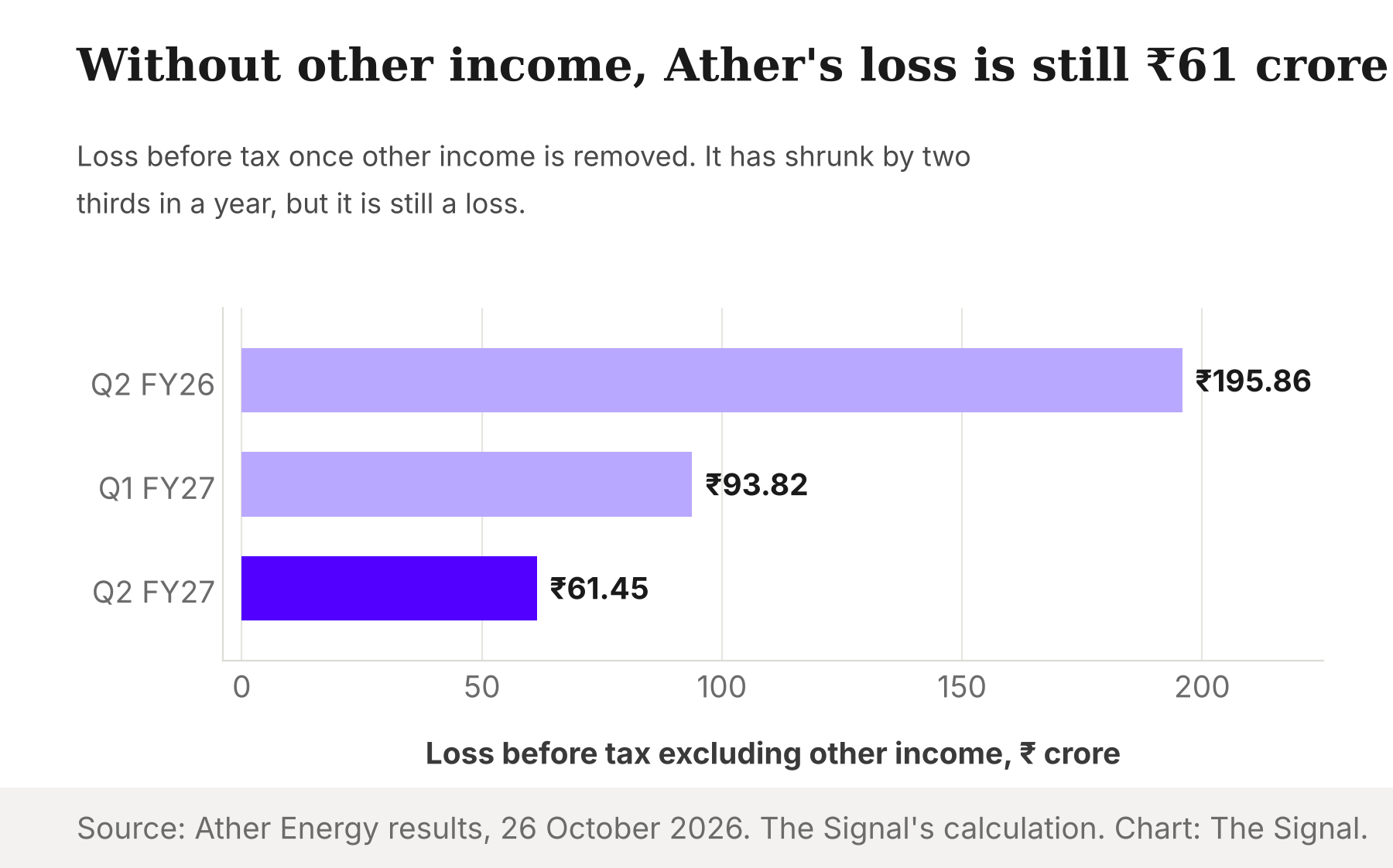
That case is right, and it is why the real story is a turnaround still in progress rather than a false profit. Interest income is also real cash, and a treasury balance is a legitimate asset. But the ₹62.71 crore of other income comes from a one-time raise being invested, not from a repeating sale. As that cash is spent, the income it earns falls with it.
Growth, but not share
There is one more thing the profit does not show. Ather's investor presentation, citing Vahan registrations, puts its electric two-wheeler market share at 15.1% in Q2 FY27, down from 17.2% a year earlier. The market grew faster than Ather did. Industry registrations were 5,88,740 in the quarter, up 80 percent, by Nuvama's compilation of Vahan data.
In September, Ather registered 30,477 scooters, behind TVS Motor at 53,990 and Bajaj Auto at 48,383. Ather is closing its loss while giving up a little ground to two larger rivals. That is a margin story, not a market-conquest story.
The Signal
Ather's quarter is two different facts. The first is that reported profit before tax crossed zero for the first time. The second is that the scooter business alone still lost about ₹61 crore. Both are true.
Watch the next result for two numbers. One is the loss without other income, which needs to keep shrinking from ₹61 crore toward zero. The other is other income itself, which has to stay stable while the cash is deployed. The RBI raised the repo rate by 25 basis points to 5.50 percent on 7 October 2026, which may help yields on treasury balances for now. A profit that rests on interest rates is not the same as one that rests on scooters.
Reporting basis: every Ather figure is from the company's own filings with the stock exchanges on 26 October 2026 and 20 July 2026: the unaudited consolidated results, the results press release, the investor presentation and the share allotment letter. These are a single origin, the company itself, and the Q2 FY27 numbers are unaudited. Market-share data is Ather's own citation of Vahan registrations. Industry and brand registrations are Vahan data compiled by Nuvama and reported by Autocar Professional. The repo rate is from the Reserve Bank of India's Monetary Policy Committee resolution. The split of other income is inferred from the half-year cash flow statement, since the filing does not itemise it. Profit without other income, EBITDA without other income, Q1 EBITDA, the interest share of other income and the year-on-year changes are The Signal's calculations from those figures.