The September-quarter results from India's two largest IT services companies carry the same headline. Infosys said AI revenue was 10.5 percent of its total in the quarter and grew 29 percent from the June quarter. TCS said its annualised AI revenue crossed $3 billion, which it puts at more than 10 percent of its revenue. Read the headline and the story is simple: the AI business is arriving, and it is already a tenth of the company.
It is worth slowing down on that. Infosys reported constant-currency growth of 1.2 percent from the previous quarter, and TCS reported 0.5 percent. Put the two sets of numbers side by side and the AI line starts to look less like new demand and more like a new label on work that was already there.
The Infosys arithmetic
Infosys reports AI as a share of revenue, so the dollar amounts take one step to recover. In the June quarter, Infosys reported revenue of $5,082 million and AI revenue at 8.2 percent of it. That is about $417 million of AI work. In the September quarter, it reported revenue of $5,145 million, with AI at 10.5 percent. That is about $540 million.
AI revenue therefore rose by about $123 million, against a rise in total revenue of $63 million ($5,082 million to $5,145 million). The AI gain was nearly twice the company's entire gain, and the only way both can be true is that everything else got smaller: from about $4,665 million to about $4,605 million, a fall of roughly $60 million.
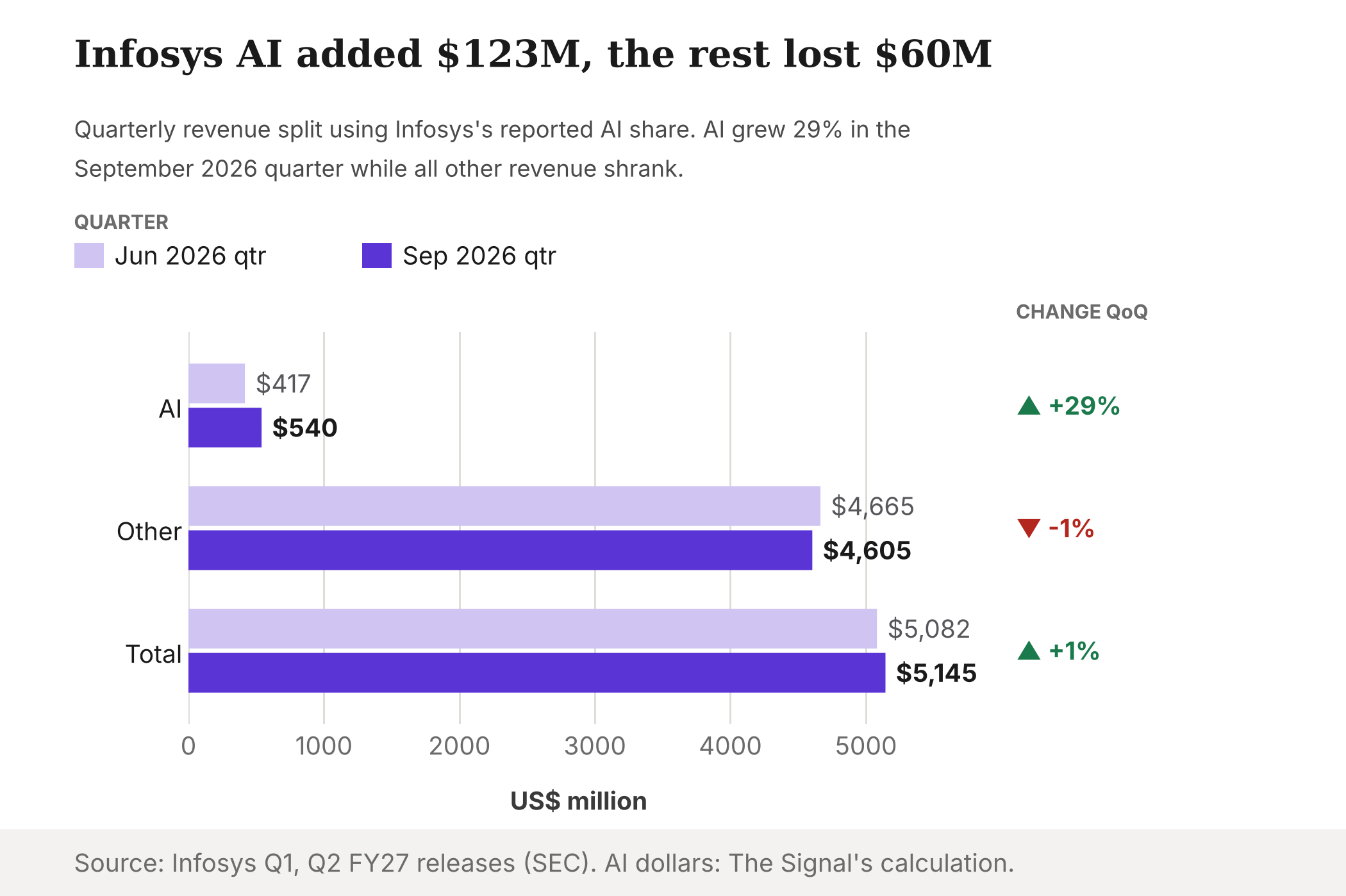
These are reported dollars, so currency moves blur the exact size of the fall, but the direction is hard to escape. Constant-currency growth was only 1.2 percent from the previous quarter, and AI alone supplied more than the whole of it.
TCS shows the same shape
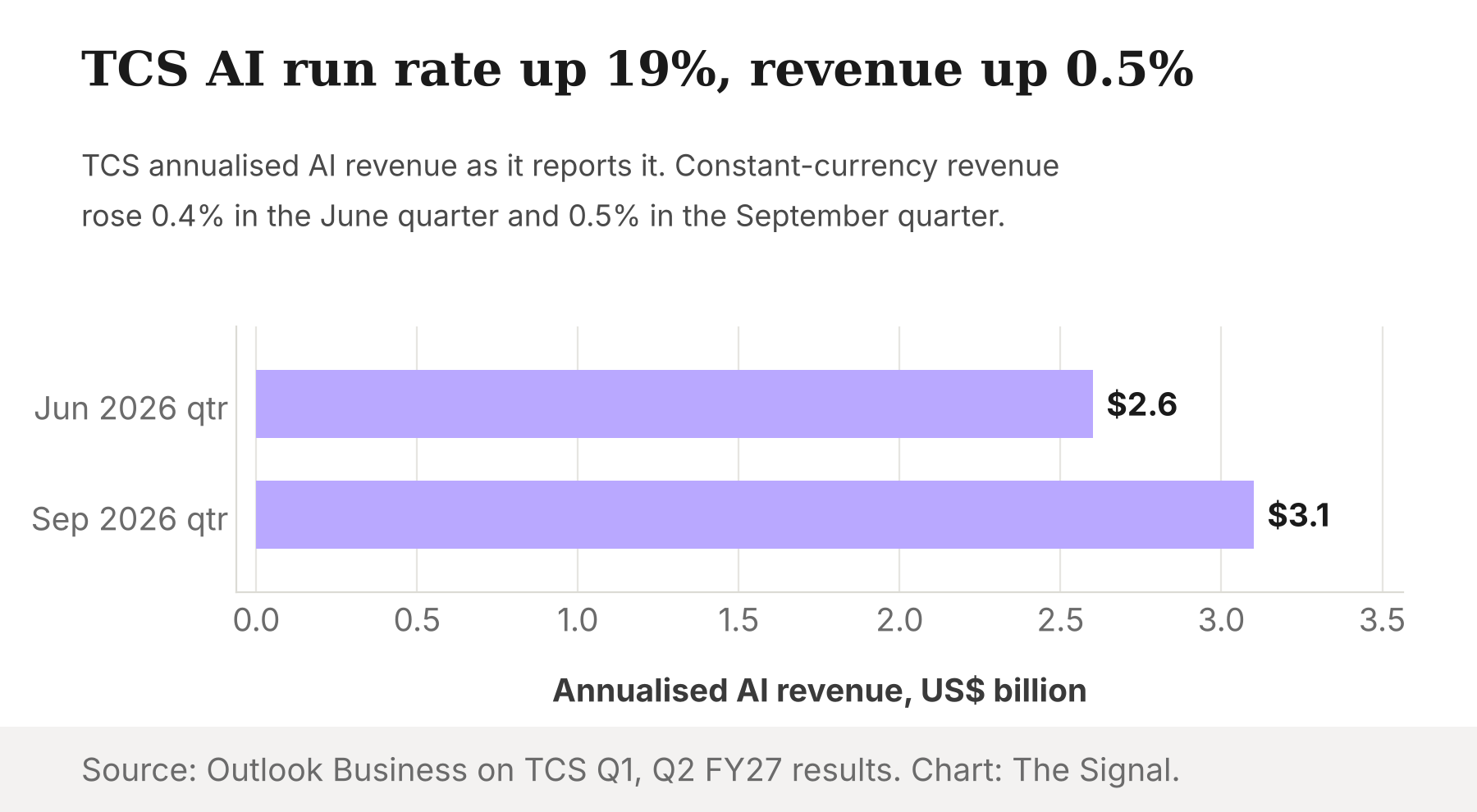
TCS does not report AI as a share of revenue. It reports an annualised run rate. In the June quarter that run rate was $2.6 billion, up 13.6 percent from the previous quarter, while constant-currency revenue rose only 0.4 percent. In the September quarter it passed $3 billion, while revenue rose 0.5 percent in constant currency.
A run rate moving from $2.6 billion to $3.1 billion is a rise of about 19 percent in one quarter. If AI is roughly a tenth of a company's revenue, a 19 percent rise in it adds nearly 2 percent to the total. TCS grew 0.5 percent. This is a rough check, because a run rate is not the same thing as a quarter's recognised revenue and TCS does not publish the revenue base in the sources used here. Even so, it points the same way as Infosys: for the total to be nearly flat, the non-AI business has to be giving ground.
Why the rest shrinks
There are two readings, and they matter differently.
One is substitution. A client that used to pay for a team to test, maintain or migrate software may now pay for an AI-led version of the same job, and pay less. The vendor books the new contract as AI revenue and loses the old one from the base.
The other is deflation. If AI tools make each unit of work cheaper to deliver, clients can ask for a share of that saving at renewal. Volume holds, price per task shrinks, and the rest of the business gets smaller.
Neither reading needs the AI work to be fake. Both say that a rising AI share is not the same as rising demand.
The honest objection
The strongest case against this view is that a company in transition always looks like this. A new line grows from a small base while an old one decays, and the crossover comes later. On that view, 10 percent today is the start of a curve. That is a fair reading, and the Infosys numbers ($417 million to $540 million of AI revenue, by our calculation) cover two quarters, not a trend.
There is also a definitional caveat. Infosys's own release gives the AI share without a definition of what counts, and the TCS sources used here do not define it either. If companies count AI-assisted delivery of existing contracts, part of the "growth" is reclassification, which would make the non-AI decline smaller and the AI gain less new than it looks.
But the objection does not rescue the growth rate. Whatever the label, the quarter's total grew by about one percent. Infosys cut its full-year guidance to 1 to 2 percent growth in constant currency, after the AI share had already risen by more than two percentage points in one quarter.
The Signal
The disclosed AI share may say more about how much of the old business has been rebuilt as AI work than about how much new money has arrived. For Infosys, a reader can see the difference in one subtraction: $123 million more AI, $63 million more in total.
Watch two things. The first is whether either company defines AI revenue in the next release. The second is whether the non-AI line stops falling, because only then does a rising AI share add to growth. Infosys has already cut full-year guidance to 1 to 2 percent, so a bigger AI share can sit alongside a smaller business.
Reporting basis: Infosys figures are from its Q1 and Q2 FY27 earnings releases, as lodged with the US Securities and Exchange Commission, and both were read directly. TCS figures are per Outlook Business (Q1, Q2), reporting the company's results, and rest on that single outlet because TCS's own release could not be opened for this piece. The AI dollar amounts for Infosys, the roughly $60 million shortfall in other revenue, the 19 percent move in the TCS run rate and the 2 percent rough check are The Signal's calculations from those figures.