The headline version of the story is that the government is selling its stake in state-run banks. Four lenders are involved: Indian Overseas Bank, UCO Bank, Punjab & Sind Bank and Central Bank of India. In November 2024, a government source told Reuters the plan under consideration was an open-market offer for sale in those four banks. The word "sale" suggests privatisation. The target says otherwise.
The aim is to meet a public float rule, not to hand the banks to private owners. The Finance Ministry's 2024 notification gave listed public sector companies, including banks, until August 1, 2026 to raise public shareholding to at least 25 percent. Public shareholding of 25 percent means the government can keep 75. A state that holds three of every four shares is not a minority owner.
Four banks, one rule
Most state banks already comply. Seven of the 12 public sector banks were compliant as of March 31, 2024. The four laggards are the four smallest of the 12 by market capitalisation in DIPAM's table, and they sit furthest above the line.
The table shows how far. The first column is the government's stake on March 31, 2026, from RBI data published by the Department of Financial Services. The second is the stake implied by DIPAM's market-value table, last updated in September 2026, which lists the government's shares and each bank's total market capitalisation.
Every one of the four sits well above the 75 percent line, by the DIPAM and RBI figures alike.
| Bank | Government stake, March 31, 2026 (RBI data) | Stake implied by DIPAM values, September 2026 |
|---|---|---|
| Indian Overseas Bank | 92.44% | 92.44% |
| Punjab & Sind Bank | 93.85% | 93.85% |
| UCO Bank | 90.95% | 90.95% |
| Central Bank of India | 89.27% | 81.19% |
Source: Department of Financial Services, citing RBI; DIPAM. Implied stake is The Signal's calculation (government holding value divided by market capitalisation).
Three banks match across the two sources. Central Bank of India does not, and the reason is a sale in between. The RBI figure is 89.27 percent for March 2026, while the DIPAM values imply 81.19 percent. The government sold nearly 8 percent of the bank in an offer for sale on May 22 and 25, 2026, which accounts for most of the drop.
What the sell-down costs
DIPAM lists the government's holding in each bank in rupees. The government's Indian Overseas Bank shares were worth Rs 53,170.06 crore against a market capitalisation of Rs 57,518.45 crore. UCO Bank's government holding was worth Rs 25,740.88 crore of Rs 28,302.24 crore. Punjab & Sind Bank's was Rs 13,557.83 crore of Rs 14,446.27 crore. Central Bank of India's was Rs 22,053.69 crore of Rs 27,163.06 crore.
To reach 75 percent, the government must sell its holding minus 75 percent of market capitalisation (our calculation from the DIPAM figures above). At those September 2026 values, that comes to about Rs 10,031 crore for Indian Overseas Bank, Rs 4,514 crore for UCO Bank, Rs 2,723 crore for Punjab & Sind Bank and Rs 1,681 crore for Central Bank of India. Together that is about Rs 18,950 crore.
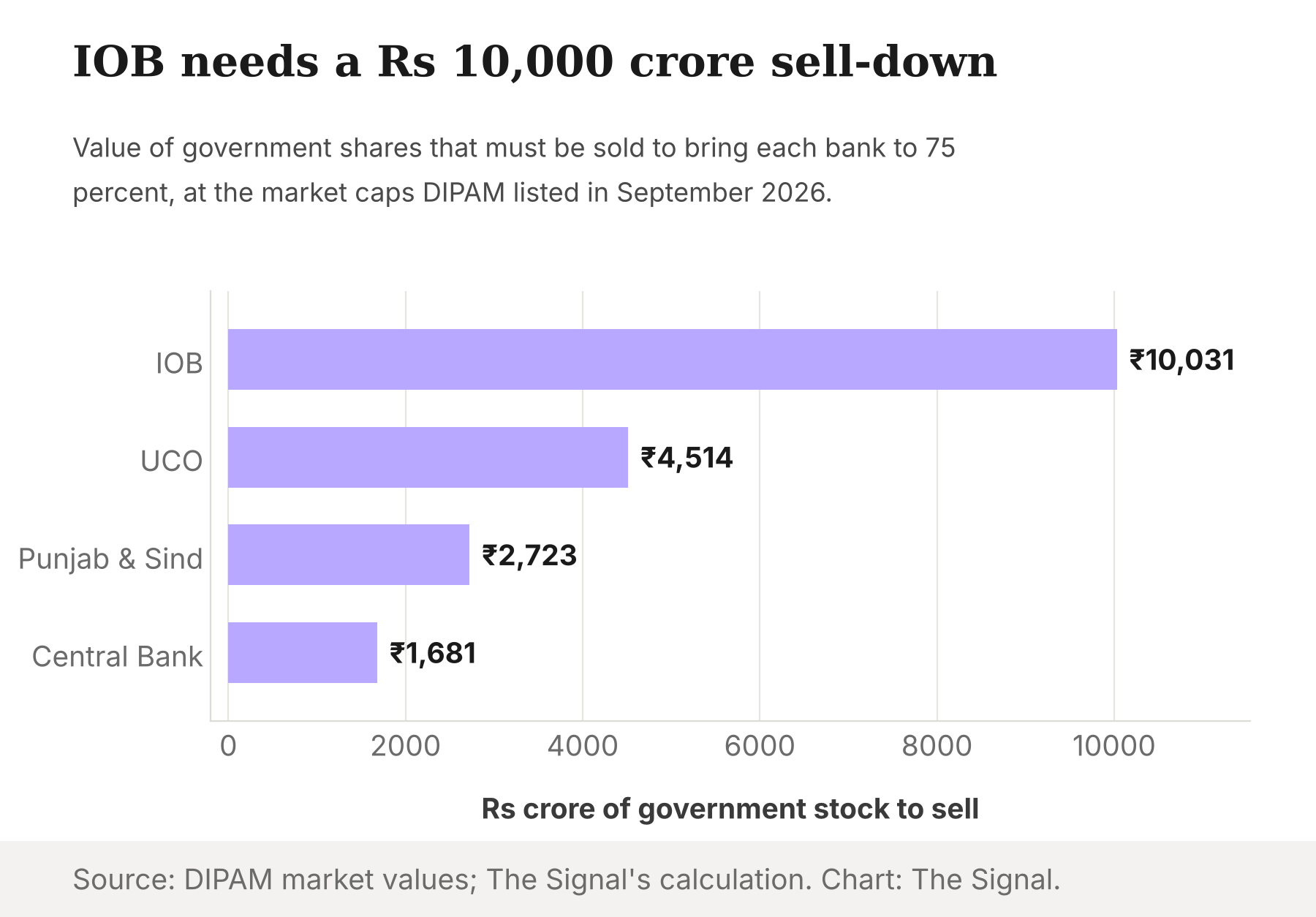
Indian Overseas Bank is more than half of the total, going by DIPAM's values. It is also a bank where the government has already sold.
The Indian Overseas Bank sale was small
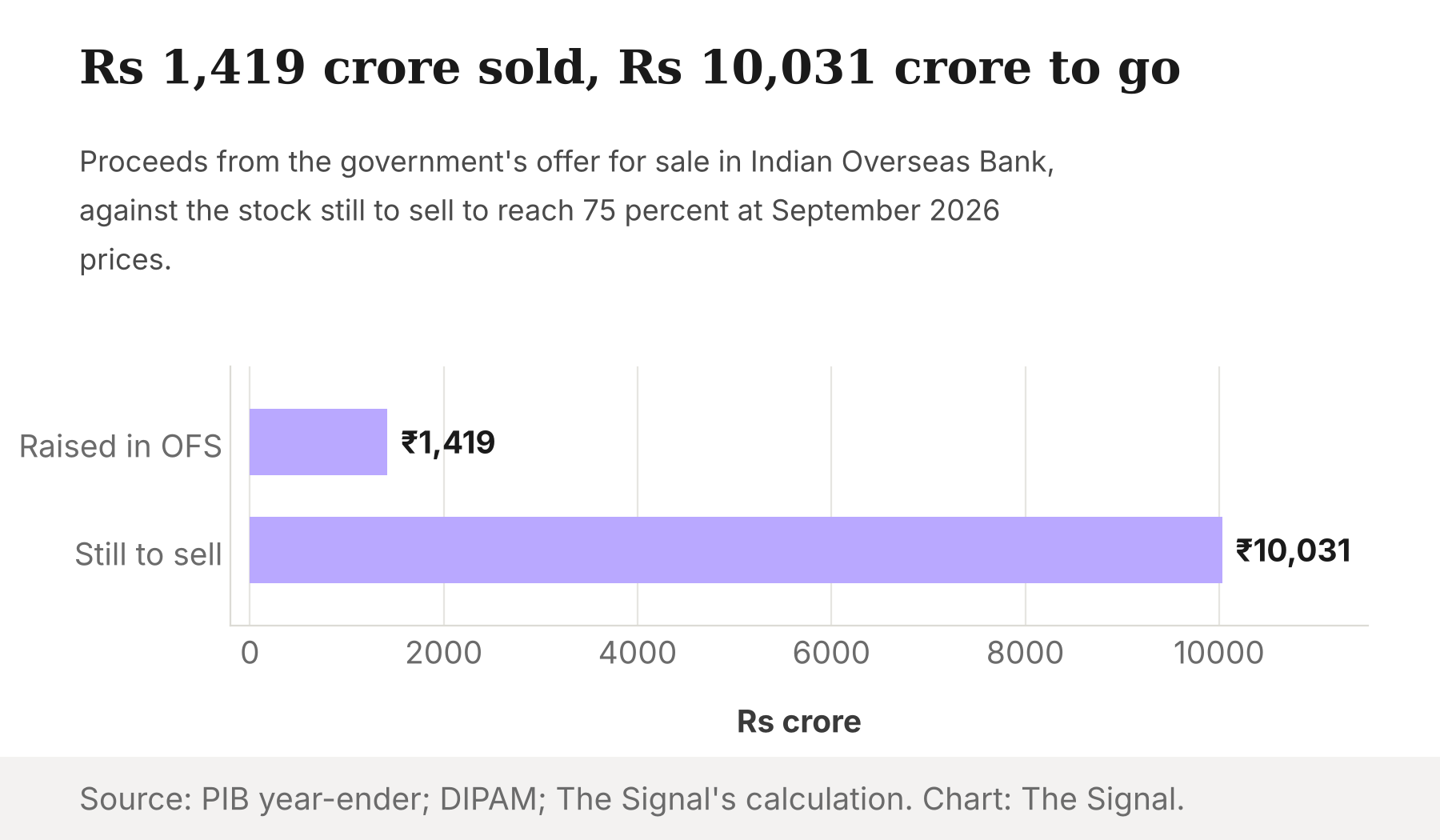
The Finance Ministry's 2025 year-end review says the government realised Rs 1,419.36 crore through an offer for sale of its Indian Overseas Bank shares. RBI data show the government's stake in the bank fell from 94.61 percent in March 2025 to 92.44 percent in March 2026. That is 2.17 percentage points.
The same bank still needs 17.44 points to come off, from a stake of 92.44 percent. Against the Rs 1,419.36 crore already raised, the Rs 10,031 crore left (our calculation from DIPAM) is about seven times as large. The comparison mixes two dates and two share prices, so treat it as an order of magnitude, not a forecast. The order of magnitude is the point: the first offer was a fraction of the job.
Why the banks asked for more time
The deadline was never easy to meet. In July 2025, Business Standard reported that Indian Overseas Bank, UCO Bank, Punjab & Sind Bank and Central Bank of India had told the Department of Financial Services they could not meet the August 2026 deadline through qualified institutional placements and wanted another year. In the same report, a senior official said the four needed to offload over 10 percent.
That is the real constraint. A qualified institutional placement means the bank issues new shares to institutions. An offer for sale means the government sells the shares it already owns, and the cash goes to the government. Either way, the market has to absorb the stock.
The honest objection
The strongest case against this reading is that a sell-down opens the road to privatisation. Once the float is real, the government has a listed, liquid bank and a price to sell against. That is a fair point, and a bank with a deeper float is easier to sell down further.
But the rule does not require it. The 2024 exemption asked for public shareholding of at least 25 percent, and the plan reported that November was an offer for sale on the open market, not a sale of control. Nothing in the sources used here describes a plan to go below 75 percent.
The Signal
The sell-down is a plumbing job. By DIPAM's values, it moves roughly Rs 19,000 crore of state-owned stock into private hands, and the banks stay under state control when it is done. The market has to find buyers, including for about Rs 10,031 crore of Indian Overseas Bank alone.
One thing could not be confirmed. The newest policy document found is the 2024 notification setting the August 1, 2026 date. This piece found no later notification, so whether that deadline has been extended is open. Watch for it, and watch whether the next Indian Overseas Bank offers look more like Rs 1,419 crore than Rs 10,031 crore.
A float is not a flip. The government can pass the rule and keep the bank.
Reporting basis: the government's rupee holdings and market capitalisations come from DIPAM's table of government equity in listed public sector banks, last updated in September 2026. The March 2026 shareholding percentages are from RBI data as published by the Department of Financial Services. The Central Bank of India offer for sale is per a Business Standard capital markets report, a single source. The Indian Overseas Bank offer-for-sale proceeds are from the Finance Ministry's 2025 year-end review, published via PIB. The August 1, 2026 exemption and the count of compliant banks are per Business Standard, reporting a Finance Ministry notification, which this piece did not read directly. The July 2025 extension request and the official's comment on needing to offload over 10 percent rest on a single Business Standard report that names no official. The November 2024 offer-for-sale plan is per Reuters, citing one unnamed government source, as carried by Business Standard. The implied stakes, the sell-down values, their total, the 17.44 point figure and the seven-times comparison are The Signal's calculations from those figures.