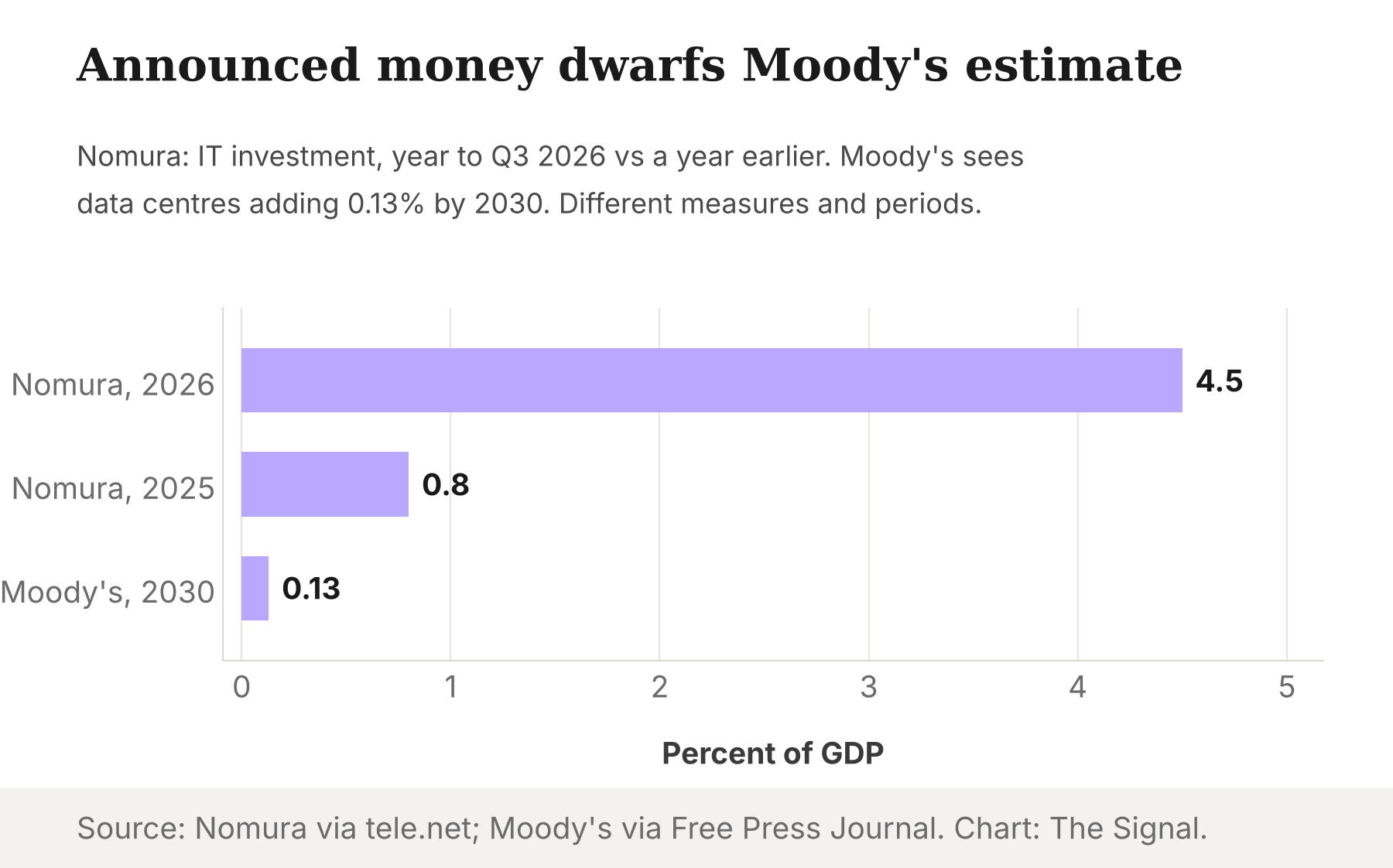
On 22 October 2026, Nomura reported that investments in India's information technology services sector reached 4.5 per cent of gross domestic product over the four quarters from late 2025 to the third quarter of 2026. A year earlier the same measure stood at 0.8 per cent. That is a rise of more than five times in twelve months, and the cause is easy to name: data centres.
The headline reads as a boom that has already arrived. Read it that way and India's economy is already being rebuilt around data centres.
It is worth slowing down on that.
Where the 4.5% comes from
Nomura's note leans on CMIE, which tracks investment projects as they are announced, not as they are built. The note says IT accounted for about 28.4 per cent of total new investment projects announced, according to CMIE data. That is a share of announcements.
A Bank of Baroda report built on the same CMIE data shows how sharp the jump is. IT announcements rose to ₹9.46 trillion in the first half of FY27 from ₹0.70 trillion in the first half of FY26. That is about 13.5 times the year before, in a sector the bank's economists call a "phenomenon of 2026", driven by "the rush to put up data centres".
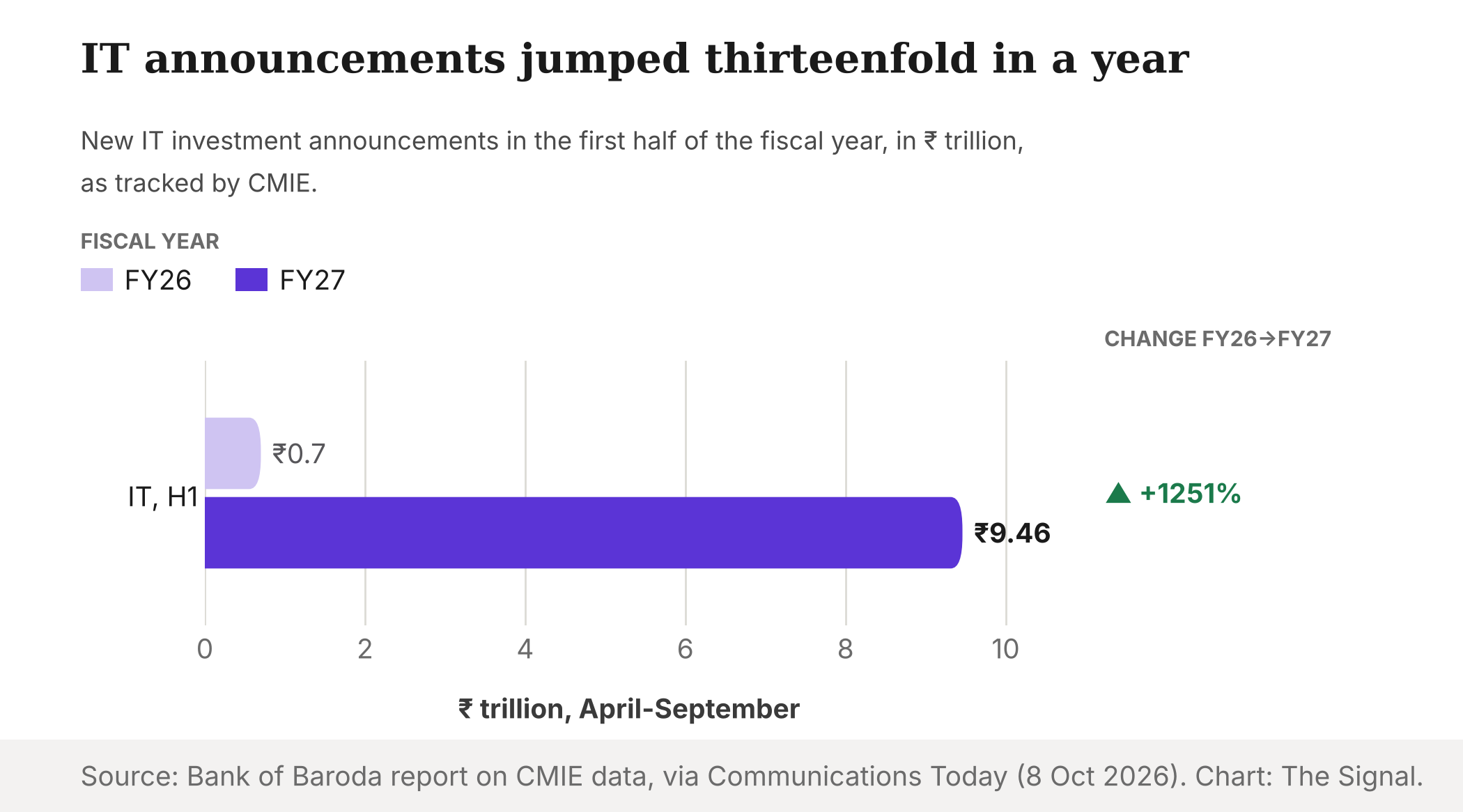
An announcement is a promise with a rupee figure attached. The announcement count alone cannot tell you how much of it will be spent, or when.
The number that carries the thesis
Now set the 4.5% against the one independent estimate of what data centres will actually add to the economy. Moody's Ratings says the sector may contribute only 0.13% to GDP by 2030, even though announced data centre investment has crossed $250 billion.
Divide one by the other and Nomura's 4.5% is about 35 times Moody's 0.13%. The two are not like for like. One is a measure of investment over a year to September 2026, the other a contribution to GDP at the end of the decade. But that is exactly the point. The 4.5% says how much money has been promised in one year. The 0.13% says how little of it is expected to show up as output.
Why spending does not become GDP
Moody's flags the dependence on imported equipment,, and says employment generation from the sector is also expected to remain limited. Equipment bought abroad adds to investment, but the value of making it accrues elsewhere. Little of the spending is left to circulate at home.
Compare this with the rest of the investment economy. MoSPI's national accounts put gross fixed capital formation at ₹30.26 lakh crore at current prices in the April to June quarter of 2026, or 34.3 per cent of GDP, with real growth of 11.9 per cent. Six months of IT announcements, at ₹9.46 lakh crore, equal about 31 per cent of that single quarter's total investment. That is large. It is also not yet in the quarterly accounts at anything like that weight, which is what you would expect if much of it has not been spent.
The honest objection
The strongest case against this reading is that announcements are the leading edge of real spending. Capital projects take years, and a number that jumps thirteenfold in a year, as the CMIE-based IT figures did, is a signal that something real has changed, even if the cash arrives later. Nomura's note adds that a tax holiday for foreign companies in the 2026-27 Union Budget also lifted announcements, which fits that story: policy moved first.
That case is fair. It explains why the 4.5% should not be dismissed. It does not explain why it should be read as output. Moody's does not say the money is fake. It says the contribution to GDP stays small. Both can be true.
There is also a reason the external accounts have not yet registered the build. The RBI reports that India's current account deficit was US$4.2 billion, 0.5 per cent of GDP, in April to June 2026, with net services receipts of US$51.6 billion. A deficit of that size does not yet show an import wave, though one quarter cannot settle the question.
The Signal
The 4.5% tells you what builders and investors intend. The 0.13% tells you what the economy is expected to keep. Watch two things in the next three quarters. If gross fixed capital formation and the external accounts start to move, the promises are turning into spending. If the announcements keep rising while those figures do not, the boom is being counted before it is built.
A forecast of money is not the same as a fact of output.
Reporting basis: the 4.5% and 0.8% of GDP and the 28.4% share are from Nomura's research note, as reported by tele.net, which cites CMIE; only that report, not the note itself, was reviewed. The IT announcement figures are from a Bank of Baroda report based on CMIE data, as reported by Communications Today. The 0.13% and the $250 billion are Moody's Ratings estimates, as reported by the Free Press Journal, and the import and employment points rest on that single report. GDP and investment figures are from MoSPI's Q1 2026-27 press note and the balance of payments figures from the RBI. The 13.5-fold rise, the 35-times gap and the 31 per cent share are The Signal's calculations from those figures.