
India's core industries grew faster in September than in August. The Index of Core Industries rose 7.9 percent in September 2026 on a year-on-year basis (provisional), up from 5.9 percent in August, according to the Office of Economic Adviser in the commerce ministry's industry department. Iron ore, electricity, coal, refinery products and cement all grew at close to 10 percent or better. The easy read is a manufacturing economy shifting up a gear, and a Reserve Bank that has just started raising rates now has one more reason to keep going.
It is worth slowing down on that. A year-on-year rate compares this September with last September. It says nothing about whether output improved from the month before, and the release's own index levels answer that question differently.
The level went down
The index is a single number built from nine industries, set to 100 in 2022-23. In August 2026 it stood at 120.4. In September 2026 it was 118.3 (provisional). Growth accelerated while the index fell by 2.1 points, or 1.7 percent, in a month.
How can both be true? Because of the comparison month. The index was 109.6 in September 2025, the lowest of the 13 months the release tabulates. Measured against that weak month, 118.3 is 7.9 percent higher. Had September 2026 simply matched August's 120.4, the same arithmetic would have produced growth of about 9.9 percent. The jump in the rate is mostly a statement about how poor last September was.
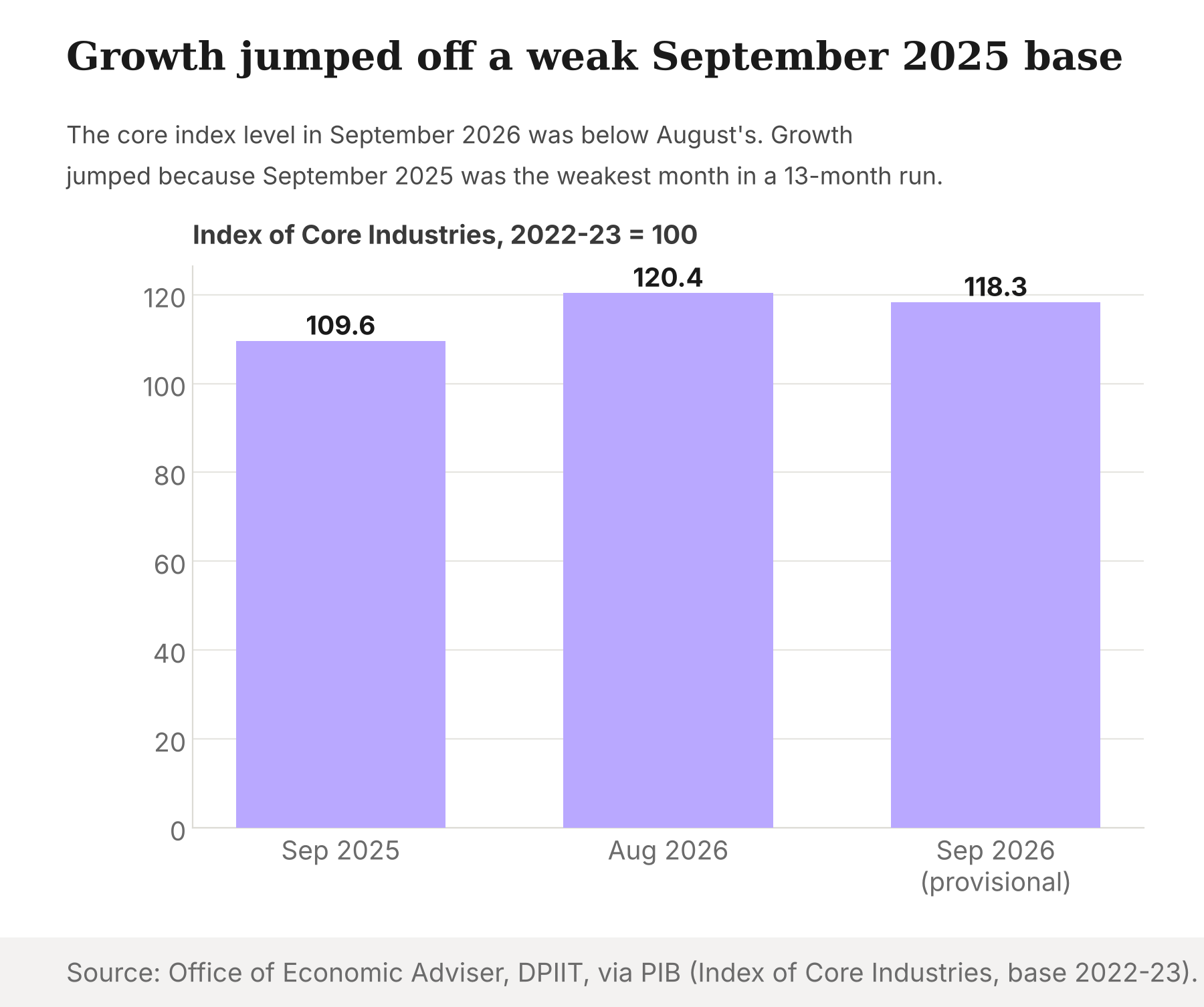
This is not a data error or a trick. The low base is a fact about September 2025. But it changes what the print can tell you about momentum, which is the thing a rate-setter wants to know.
One sector did almost half the lifting
The weights matter here. The new series gives electricity a weight of 30.932 out of 100, refinery products 22.572 and steel 17.584, with iron ore at 4.905. Multiply each weight by the change in its index between September 2025 and September 2026 and the contributions are clear. This is our calculation from the release's own indices.
| Industry | Weight (of 100) | Index, Sep 2025 | Index, Sep 2026 | Contribution to the rise (points) |
|---|---|---|---|---|
| Electricity | 30.932 | 115.2 | 128.3 | 4.05 |
| Refinery products | 22.572 | 99.0 | 109.2 | 2.30 |
| Steel | 17.584 | 133.0 | 139.5 | 1.14 |
| Iron ore | 4.905 | 91.5 | 108.3 | 0.82 |
| Coal | 5.596 | 91.5 | 101.3 | 0.55 |
| Cement | 4.41 | 110.1 | 120.9 | 0.48 |
| Crude oil | 7.43 | 93.3 | 92.0 | -0.10 |
| Natural gas | 3.841 | 100.7 | 96.1 | -0.18 |
| Fertilisers | 2.731 | 109.5 | 96.7 | -0.35 |
Source: PIB, Office of Economic Adviser, September 2026 release for weights and indices. Contributions are The Signal's calculation.
The index rose 8.7 points over the year, from 109.6 to 118.3. Electricity supplied 4.05 of them, about 46 percent. Add refining and the two sectors account for 6.35 points, or 73 percent of the gain. Iron ore, the headline grower at 18.4 percent, contributed 0.82 points, because its weight is small.
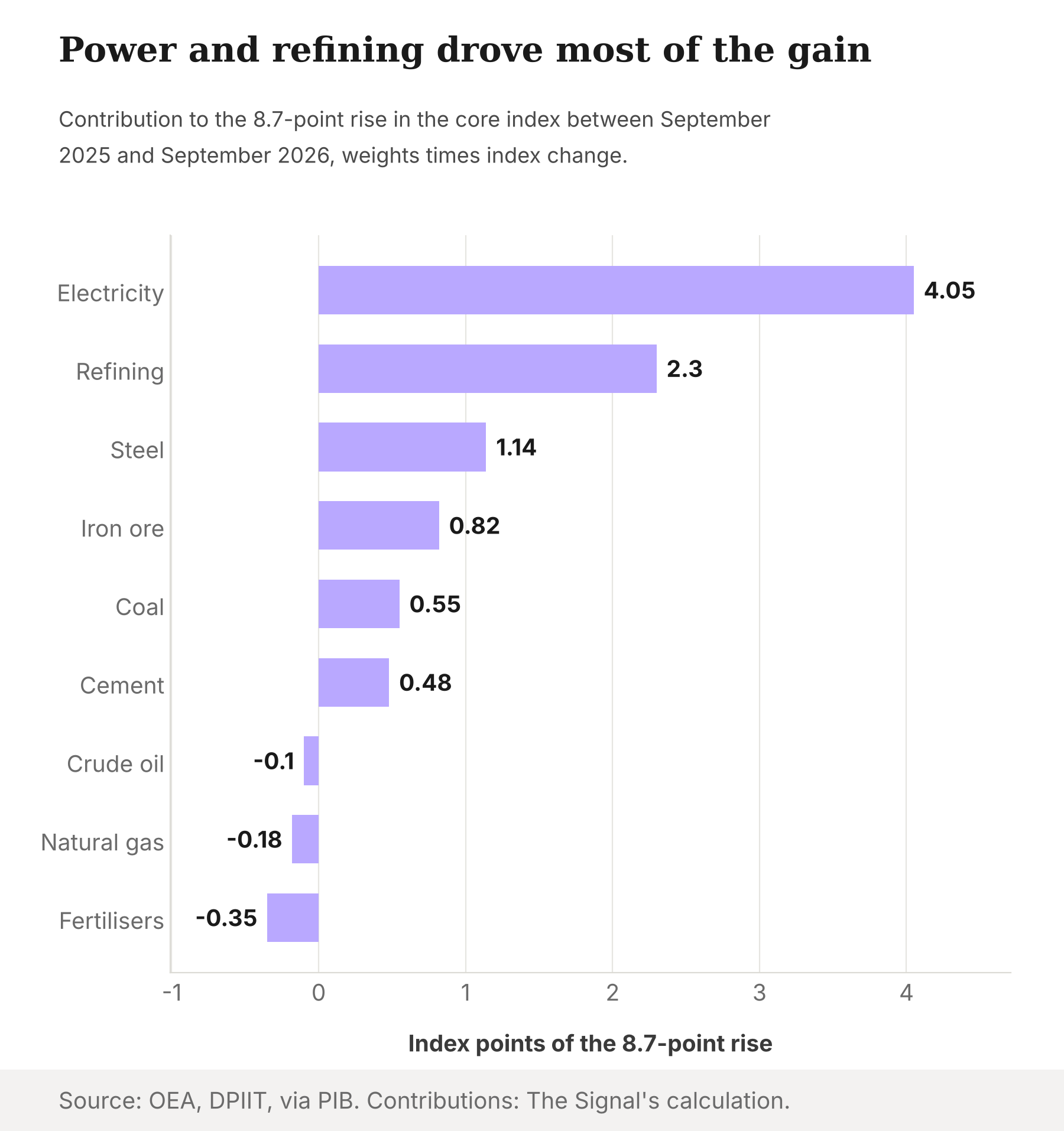
Electricity also shows the base effect at its sharpest. Its index was 135.1 in August 2026 and 128.3 in September, a drop of 5.0 percent in a month. It still grew 11.4 percent year-on-year because September 2025's electricity index was only 115.2. A sector can fall month to month and set a strong annual rate in the same breath.
Iron ore is new, and lumpy
The series itself changed this year. The new base-2022-23 series added iron ore, lifting the number of core industries from eight to nine. Iron ore is volatile: its index was 91.5 in September 2025, 96.1 in August 2026 and 108.3 in September 2026. It is a real industry with a real 18.4 percent rise, but a lumpy small-weight component is exactly where a base effect can swing the annual figure, and it makes the headline harder to compare with older prints in the discontinued series.
The honest objection
The strongest case against this reading is that a growth rate is what the policy world reads, and 7.9 percent is a real number about a real economy. Output really is higher than a year ago in six of nine industries, and the index level of 118.3 is well above 109.6.
That is fair. The point is narrower. The step up in the growth rate from 5.9 to 7.9 percent is not evidence that the economy sped up in September, because the level fell from 120.4 to 118.3. A rate-setter who treats the jump as fresh momentum is reading the calendar, not the plant floor.
The Signal
The timing matters for the Reserve Bank. The MPC voted unanimously on October 7 to raise the repo rate by 25 basis points to 5.50 percent, shifted to calibrated tightening, and said rate cuts are off the table in the near term. Its minutes say CPI inflation rose to 4.8 percent in August 2026 from 4.5 percent in July. The case for tightening rests on inflation, not on the core sector. A 7.9 percent print could be waved around as proof of overheating, but a growth rate built on a weak comparison month is a poor witness.
The test is the October reading. If the index level climbs back above August's 120.4, the strength is real and the hawks have a better argument. If it stays near 118, the September jump was arithmetic, and the case for a pause gets easier to make. A growth rate tells you how far you have come from last year's low. Only the level tells you where you are standing.
Reporting basis: the core industries data (growth rates, index levels and weights) come from the Office of Economic Adviser in the Department for Promotion of Industry and Internal Trade, via the Press Information Bureau release of 21 October 2026, and the series change comes from its 20 July 2026 release. The September 2026 figures are provisional and subject to revision. The repo rate decision, stance and forward guidance come from the Reserve Bank of India's Governor's Statement, and the August inflation figure from the MPC minutes. The piece therefore rests on two independent origins, and every load-bearing number rests on one of them. The month-on-month change, the 9.9 percent counterfactual, the industry contributions and their shares are The Signal's calculations from those figures.