
The headline read of Barclays' announcement is simple. A big bank says artificial intelligence lets it run with fewer people, and 5,000 of them are going. On 22 October 2026, Reuters reported that Barclays said it is cutting around 5,000 jobs, or 5% of its workforce, this year. The bank's chief financial officer, Anna Cross, said 1,000 roles have already gone, with the remainder to be cut by the end of the year.
That is the story every outlet is running. It leaves out the more useful question for an Indian reader: where do these people sit?
What Barclays has said, and what it has not
Barclays tied the cuts to technology. Its third-quarter results announcement lists "structurally reducing the cost base through expected technology-enabled FTE reductions" as a performance highlight, and records structural cost actions of £201m in the third quarter, with a further c.£300m planned for the fourth. FTE means full-time equivalent, the standard way to count staff so that part-timers are not counted as whole people.
On the shape of the cuts, the one detail on record is the function. Reuters reports that "around 60% of the overall job cuts will impact staff in support functions such as developers."
The Reuters report gives no country split. That absence matters, because Barclays' own filings show a workforce that has been tilting toward Asia for three years.
The workforce the cuts land on
Barclays' 2025 annual report counts 93,000 FTE at the end of 2025. The UK held 44,700 of them, or 48%. Asia-Pacific held 33,600, or 36%. The Americas had 11,100 and Central Europe, Middle East and Africa had 3,600.
The direction of travel is the interesting part. Asia-Pacific stood at 31,100 FTE at the end of 2023 and 32,300 at the end of 2024, per the same filing. The UK went from 45,000 to 45,200 to 44,700. Across the two years, Asia-Pacific added 2,500 people, about 8%, while the UK lost 300.
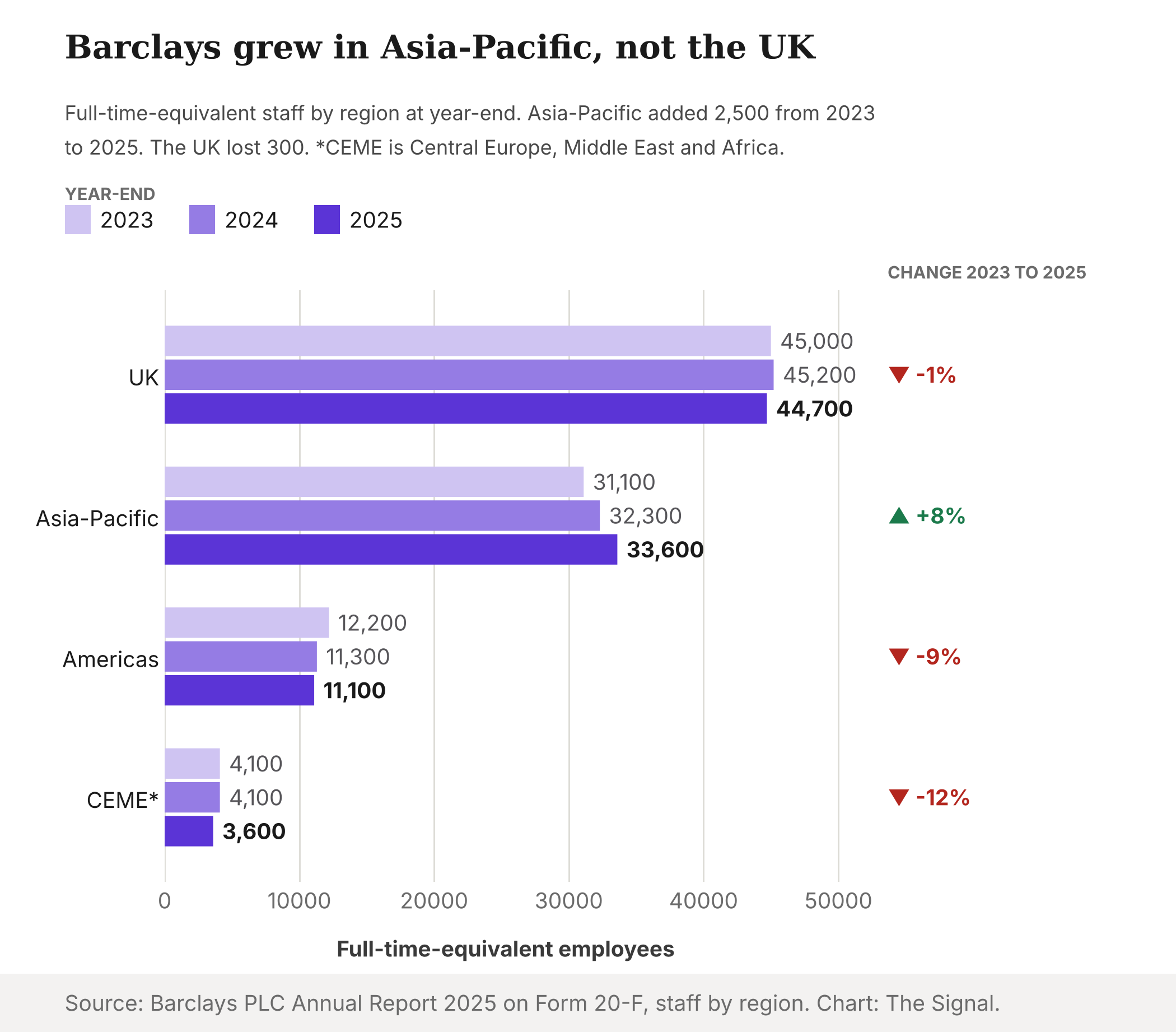
Reuters puts the cut at 5,000 roles, or 5% of the workforce, against 93,000 FTE in the annual report. Asia-Pacific is 36% of that base, so the other regions together are 64%. We cannot tell from the disclosures how the cuts divide between them.
Where "support functions" sit
The same annual report shows how the bank splits its staff by segment. Its Head Office segment, which the filing says "comprises central support, central treasury operations, Barclays Execution Services assets, the Payment Acceptance business and legacy businesses," held 61,600 of the 93,000 FTE at the end of 2025. That is 66% of the group.
Set that beside the cuts and the picture shifts.
| Share of the 5,000 cuts | Share of staff, end-2025 | |
|---|---|---|
| Support functions (cuts) / Head Office segment (staff) | About 60% | 66% |
| Everything else | About 40% | 34% |
Sources: Reuters, via Euronext, for the 60% figure; Barclays 2025 Form 20-F for staff by segment. The two categories are not defined identically, so the comparison is indicative.
Sixty percent of the cuts (Reuters) against 66% of the staff (Barclays 20-F) means support is not being hit harder than its weight. If the categories line up, the front-line businesses are absorbing a slightly larger share of the cuts than they hold of the payroll. The common reading is that AI eats the back office first. These numbers say the back office is shouldering about its proportionate share, because it is most of the bank.
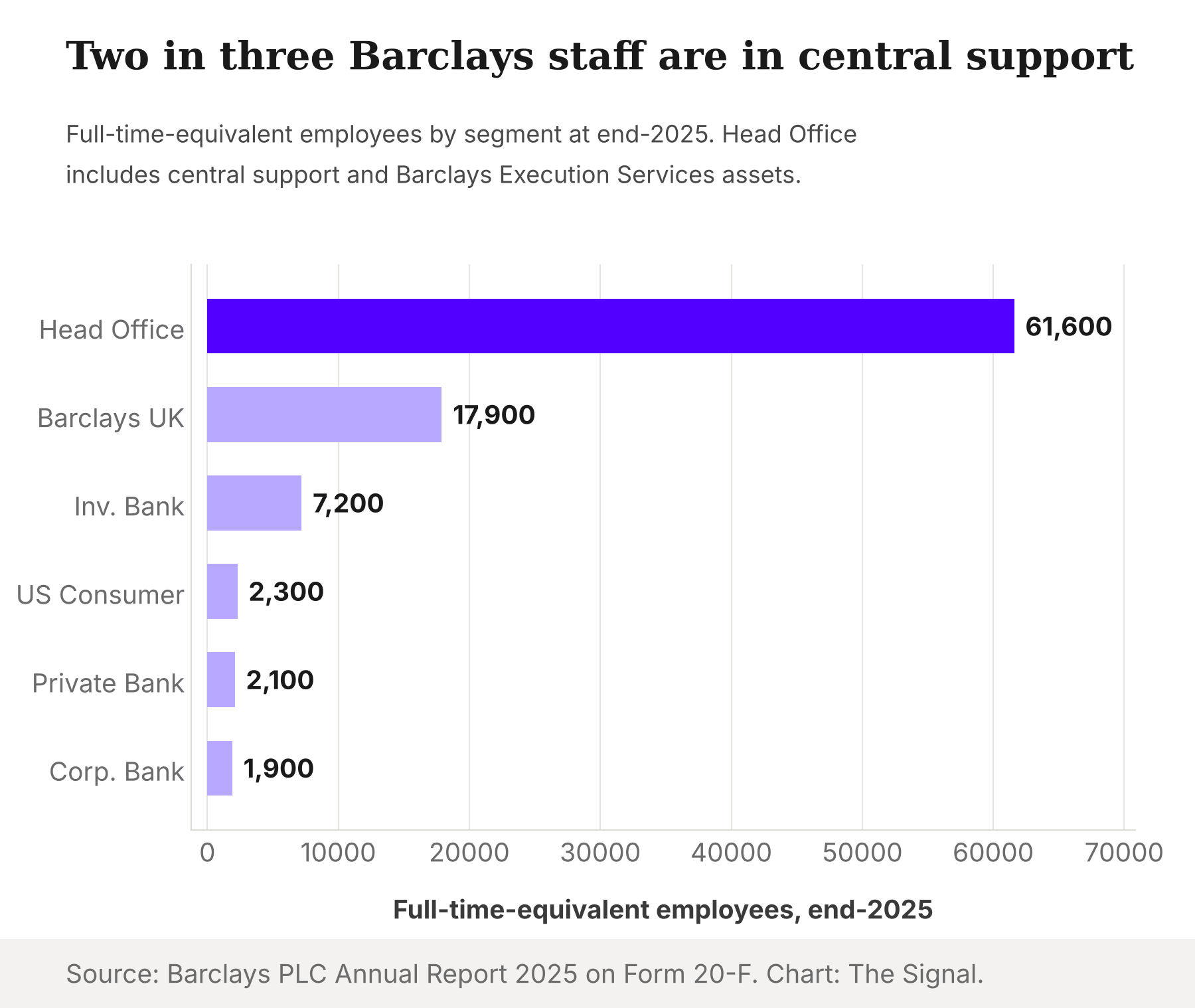
The point that matters for India is a different one. Barclays' filing shows two in three staff in central support and 36% in Asia-Pacific, so a technology-led cost programme has to reach into both.
Why India's service centres are in the frame
Barclays says its Global Service Centre in India is "located across Mumbai, Noida and Chennai with a campus in Pune," and that the bank has operated in India for over 30 years. Barclays does not publish an India headcount in the filing we reviewed, and Asia-Pacific is a wider region than India. We therefore do not claim a number for India. We claim the exposure: a growing Asia-Pacific base, a stated India service hub, and a cost programme aimed at support roles.
Zoom out and Barclays is one tenant in a very large building. The FY2026 Zinnov and NASSCOM landscape report counts 2,117 global capability centres, or GCCs, in India, across 3,728 units, employing 2.36 million people. A GCC is a company's own captive centre in India doing work for its parent. An earlier edition of the study, as ThePrint reported, put GCC employment at over 1.9 million in the financial year 2024. That implies about 24% growth in two years.
A bank that says technology will cut support headcount is testing whether the cheapest support role is one a model does. That is our inference, not a Barclays statement.
The honest objection
The strongest case against this reading is that none of it is established. The Reuters account does not say where the roles are. Asia-Pacific includes places other than India. Head Office is an accounting segment, not a job description, and Reuters' "support functions" may not map onto it. A cut could fall mostly on UK developers, who are expensive per head, and still save the most money.
There is also a reason to expect a modest India effect even if Asia-Pacific is touched. The roles that technology replaces first are repetitive processing roles. Those can sit in any location, and the same tools that thin a service centre also raise what each remaining person there can do.
Both points stand, and both argue for caution on any India number. Neither removes the exposure, which comes from where Barclays' own staff count says its people are.
The Signal
Barclays has given the market a number and a function, per Reuters, and no map. Its annual report shows the ground the cuts will be drawn on: 93,000 staff, 36% in Asia-Pacific, 66% in central support.
For India's service-centre industry, the test is not whether one bank's 5,000 lands there. It is whether "technology-enabled FTE reductions" becomes the line other banks reach for next, aimed at the same support layer that GCCs were built to hold. Watch Barclays' full-year results for a regional split, and the next round of GCC hiring data for any bank shifting from adding staff to adding tools.
Reporting basis: the 5,000-job figure, the 5% share, the roughly 60% support-function share and the 1,000 roles already gone are per Reuters, as carried by Euronext, and were not checked against a Barclays statement. Structural cost action figures and the technology-enabled FTE language are from Barclays' Q3 2026 results announcement, filed with the US SEC. Staff by region and by segment are from Barclays' 2025 Annual Report on Form 20-F. The India service-centre locations are Barclays' own statement in a December 2024 press release. India GCC counts and employment are from the Zinnov and NASSCOM FY2026 report, which is industry-compiled research, with the earlier 1.9 million figure as relayed by ThePrint. No source we reviewed gives Barclays' headcount in India or the geography of the cuts. The 2,500 and 300 changes, the 8% and 24% growth rates, the 64% share and the comparison of cut share to staff share are The Signal's calculations from those figures.