On 7 October the Reserve Bank of India raised the policy repo rate by 25 basis points to 5.50 per cent and changed its stance to calibrated tightening. The textbook sequel is familiar. Loan rates rise first, and fixed deposit rates follow as banks compete for savers. Anyone holding a deposit is entitled to expect a raise.
It is worth slowing down on that. The sequel depends on banks needing money, and this year they have had plenty. One source of that money breaks the usual script.
The number that matters is 119.2
The RBI's Governor reported that net inflows under non-resident deposits rose sharply to US$119.2 billion during April to August 2026. The same five months a year earlier brought in US$5.6 billion. That is roughly 21 times as much.
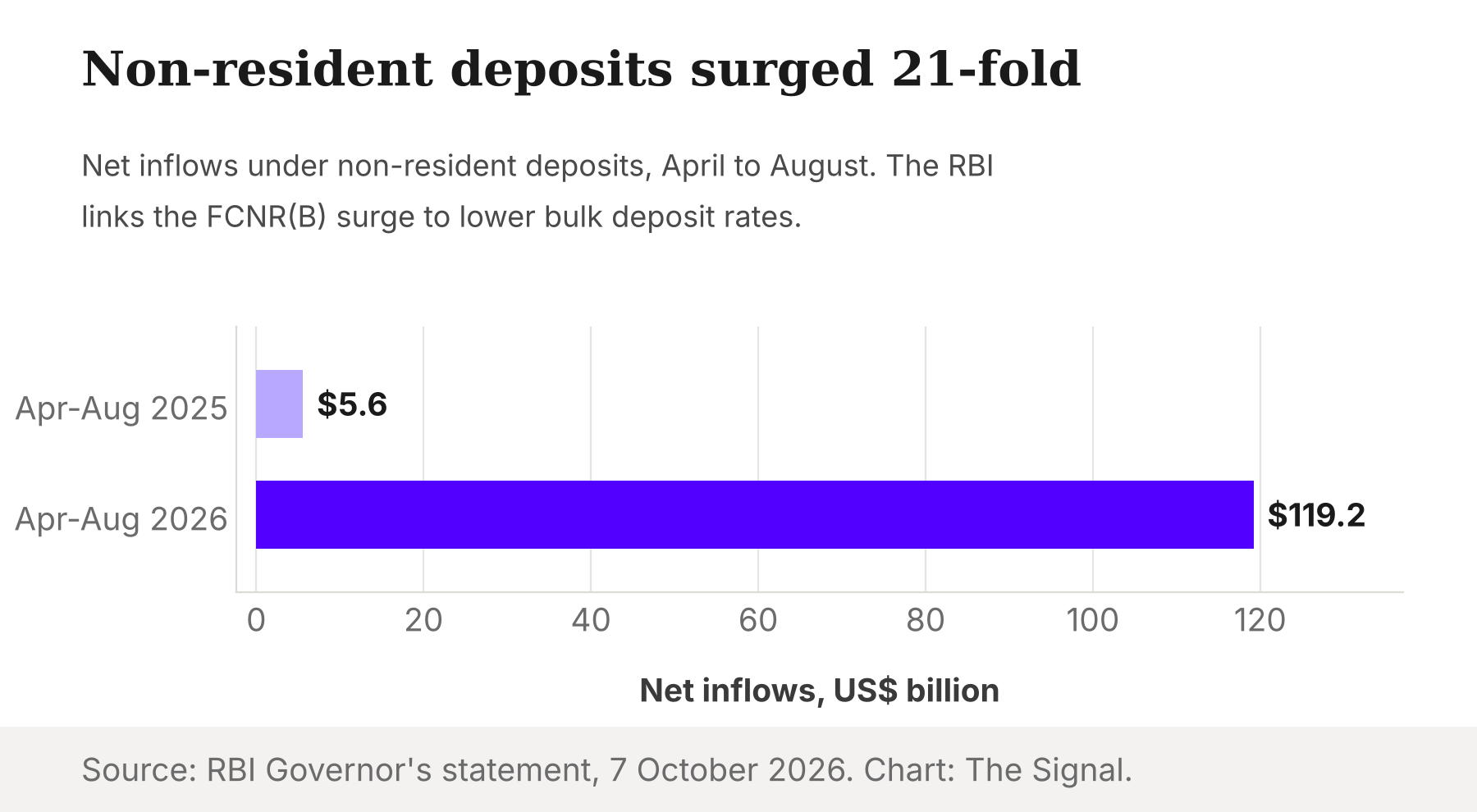
Most of it came through one door. The RBI introduced a special USD-INR swap facility covering FCNR(B) deposits, ECBs and OFCB inflows on 8 June 2026, with the facility for FCNR(B) deposits open only to deposits mobilised till 31 August. By 18 September, All India Radio reported, relaying RBI data, that inflows had passed US$143.5 billion, of which US$132.98 billion was FCNR(B).
Those dollars were converted into rupee liquidity for banks. Business Today reported that surplus liquidity was more than Rs 11 lakh crore in the first week of September, before the RBI began absorbing it.
The RBI has already named the link
The central bank does not leave this to inference. Its Governor's statement links lower bulk deposit rates to a surge in liquidity from mobilisation of FCNR(B) deposits.
The broader rate data point the same way. In July and August 2026, the RBI reported that the weighted average lending rate on fresh rupee loans hardened by 8 bps while the weighted average domestic term deposit rate moderated by 28 bps. Borrowers were paying slightly more on new loans. Savers locking in new deposits were getting markedly less.
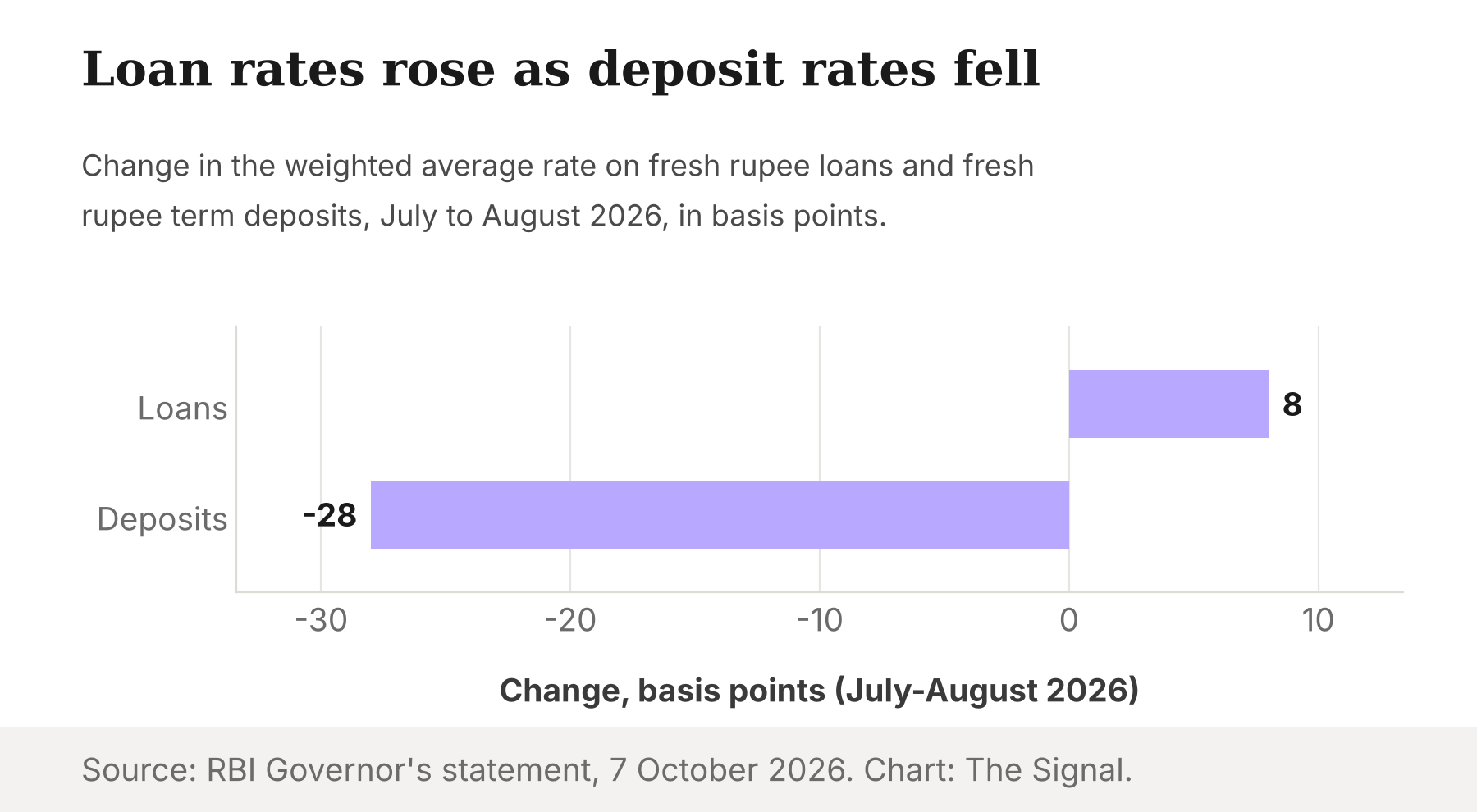
The gap between the two moves is 36 bps, per the RBI's July to August figures, and it opened before the repo rate moved at all. A hike does not change who has the bargaining power. Banks hold surplus cash, so they have little reason to bid for rupee deposits.
Why the hike lands on borrowers first
The call rate shows how loose the system still is. The weighted average call rate traded 14 basis points below the policy repo rate since the August policy. When overnight money in the market costs less than the RBI's own policy rate, banks are not scrambling for funds.
Liquidity is also not scarce on average. System liquidity stood at an average daily surplus of Rs 5.9 lakh crore since the August 2026 meeting, according to the Governor's statement.
Loans respond to the repo rate through their pricing formulas. Deposits respond to competition. With the competition muted, the hike reaches borrowers first and savers late, if at all. That is our reading of the RBI's own data, not a statement from the RBI. It has not said fixed deposit rates will stay put, and we found no published rate sheet from a large lender after the hike to test it against.
The honest objection
The strongest case against the thesis is that the cash is temporary. The RBI has been draining it, and credit is growing fast. Outstanding credit grew 18.13 per cent year on year and deposits 17.31 per cent as of 15 September 2026. Lending is outrunning deposits by 0.82 percentage points. If that gap persists while the surplus shrinks, banks will have to pay up for rupee deposits, hike or no hike.
There is also an inflation argument. The RBI projects CPI inflation at 5.2 per cent for 2026-27, with the third quarter at 6.0 per cent. A saver earning less than that loses ground in real terms, and a public that notices may move money.
Both points are fair. Neither erases the present position. The credit gap is under one percentage point, and the swap-funded surplus is still large. The deposit race starts when the surplus ends, not when the repo rate rises.
The Signal
The hike was a statement about inflation. Deposit rates are a statement about funding, and the two are being set by different forces this autumn. A single policy lever moved one of them.
Watch two things. The first is whether the daily surplus now averaging Rs 5.9 lakh crore falls toward balance. The second is whether credit growth stays ahead of deposit growth. If both happen, fixed deposit rates will rise because banks are short of money, not because the repo rate went up. Until then, the rate that rose is the one on the loan.
Reporting basis: the repo rate decision, inflation projections, liquidity, rate changes, credit and deposit growth, non-resident inflows and the call rate are from the RBI's MPC resolution and Governor's statement of 7 October 2026. The swap facility terms are from the RBI press release of 14 August 2026. The swap inflow total is from All India Radio, relaying RBI data, and the September liquidity peak rests on a single source, Business Today. The 21-fold multiple, the 36 bps gap and the credit-deposit gap are The Signal's calculations from those figures.