
India's trade agreement with New Zealand comes into force today, 20 October 2026, according to Commerce Minister Piyush Goyal, as reported by All India Radio. The apple provisions are the ones Indian orchard states are watching. The surface read is a question of volume: how many tonnes of New Zealand fruit can now enter at a lower duty?
The tonnage is easy to state. India has granted a quota of 32,500 tonnes in the first year, rising to 45,000 tonnes by year six, at a 25 percent duty and a minimum import price of $1.25 per kilogram. Beyond the quota, a 50 percent duty applies, according to Outlook Business, reporting the Commerce Ministry's terms.
It is worth slowing down on what that number does and does not do.
The quota is already smaller than this season's shipments
New Zealand's apple exports to India rose 63 percent from the 2024 season, from 27,000 tonnes to 45,000 tonnes so far in the 2026 season, with shipments continuing, FreshPlaza reported in July, citing New Zealand's Trade Minister Todd McClay. India moved from New Zealand's seventh-largest apple market to its fourth-largest in two years.
Set that against the quota. The year-one quota of 32,500 tonnes is about 28 percent below the 45,000 tonnes already shipped this season. Put the other way, shipments this season are about 38 percent above the quota.
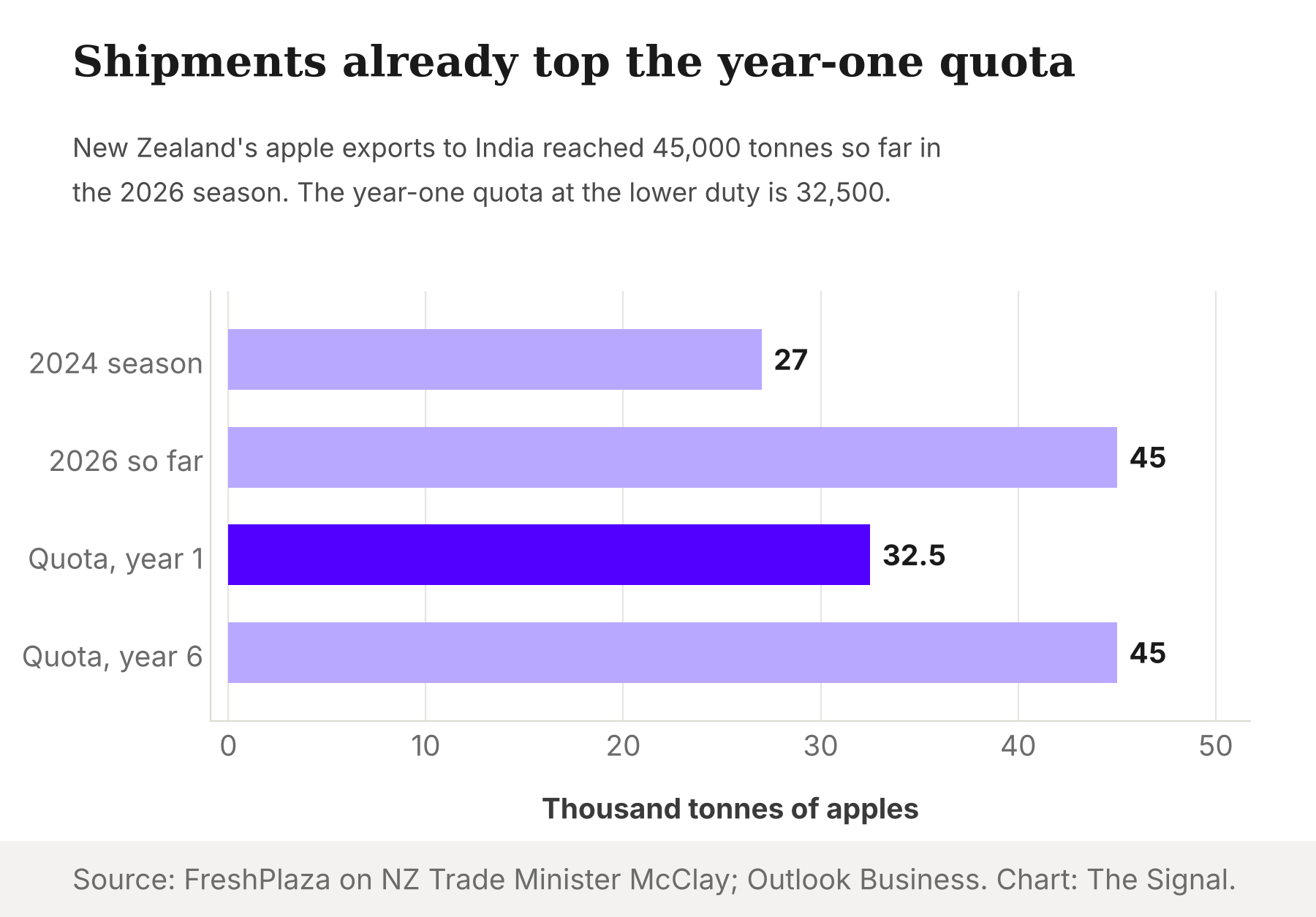
The comparison is not clean, and it should be read with care. A season is not a quota year, and the deal limits the concession to an April to August window, so the 2026 total includes fruit that shipped before the treaty and at the old 50 percent duty. The sources also do not agree on the baseline. The Commerce Ministry's figure, as reported by Outlook Business, was that New Zealand was exporting 23,602 tonnes of apples to India at the full duty, and New Zealand's trade ministry wrote in its own summary that the apple and kiwifruit quota volumes "are greater than current exports to India". Neither matches 45,000 tonnes. The likely explanation is different periods and different bases, but no source says so.
What can be said is that if exports hold near this season's level, the quota binds. A binding quota changes what the deal is. It is not a ceiling on what New Zealand can send, because anything above the quota still enters at 50 percent. It is a ceiling on how much of that trade gets the discount. If New Zealand ships 45,000 tonnes in a quota year, about 12,500 tonnes, or roughly 28 percent, would pay the full duty. That is The Signal's calculation, and it assumes volumes hold.
Against India's market, the quota is a sliver
Now put the quota next to India's own apple economy. The Global Trade Research Initiative says India imported about 558,000 tonnes of apples in FY2025, roughly 22 percent of domestic production, and produces about 2.5 million tonnes annually, as reported by FreshPlaza. A USDA Foreign Agricultural Service report, relayed by FreshPlaza, forecast 2024/25 output at 2.55 million tonnes, with Jammu and Kashmir supplying about 70 percent and Himachal Pradesh nearly 20 percent.
Against those figures, the year-one quota of 32,500 tonnes equals about 5.8 percent of FY2025 apple imports and about 1.3 percent of annual production. At the year-six level of 45,000 tonnes, it is about 8 percent of imports and under 2 percent of production.
Even in year six, the New Zealand quota is about 8 percent of India's apple imports.
India already buys more than half a million tonnes of apples from abroad. The New Zealand quota is a small addition to a market that already has foreign supply in it, and New Zealand's 45,000 tonnes this season are themselves only a fraction of that import total.
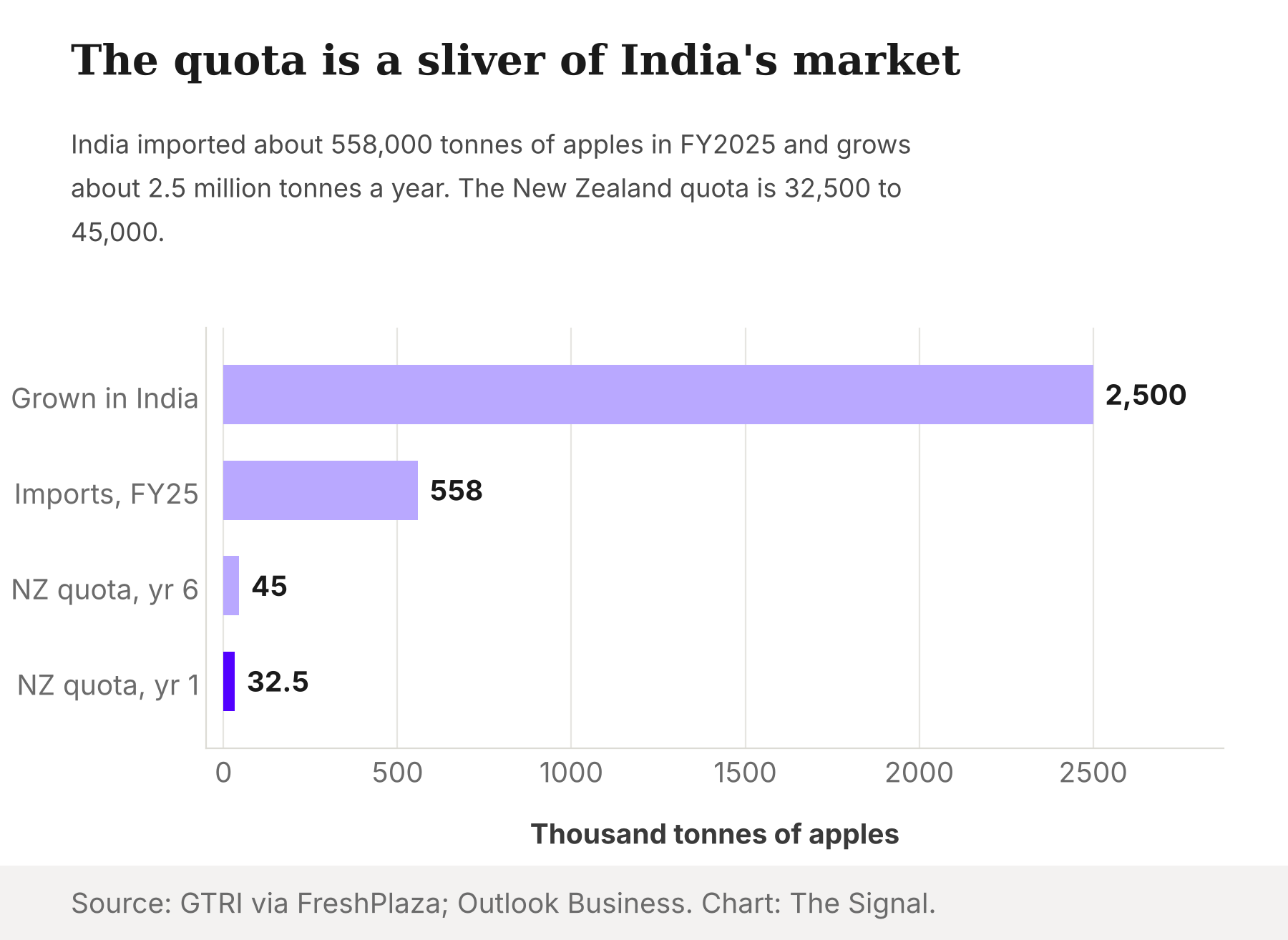
The import and production figures come from a trade group and a USDA forecast and cover different periods, so the ratios are a scale check, not a precise share.
What shapes the rest of the terms
With the quota binding on the discount, the other terms decide how much the discount is worth to growers and exporters.
First, the duty cut applies only inside a seasonal window. Imports under the arrangement will be permitted during the April to August period, Business Standard reported in April. That is five months of the year.
Second, the price floor. The concession comes with a minimum import price of $1.25 per kilogram, so cheap fruit cannot use the 25 percent rate to undercut local growers.
Third, the out-of-quota rate: anything above the cap pays the old 50 percent.
The sources reviewed here do not say how much of New Zealand's 45,000 tonnes arrives between April and August. That is the missing number. If most of it already lands in those months, the quota is the operative limit. If much of it lands outside them, the window is the tighter constraint on exporters.
The honest objection
Not everyone in India reads the terms as modest. Congress MLA Kuldeep Singh Rathore said the import window "will put immense pressure on prices and hurt farmers' incomes," in Business Standard's account, and warned that falling prices could discourage investment in orchards in the hill states.
That concern has a sound core. A quota that is 1.3 percent of national production can still matter if it is concentrated into a window of a few months and into the fruit that competes most directly with a particular state's crop. A national share does not capture price effects in a specific season. The quota also grows by roughly 38 percent between year one and year six, and growers are right to ask whether the floor price and the window will hold as it does.
There is a counter-case from the exporters' side. If a quarter or more of New Zealand's 45,000 tonnes pays the full duty, the deal is less generous than the 25 percent headline suggests, and the price floor is the instrument built for the growers' fear. Whether $1.25 per kilogram is high enough to protect a hill-state grower is not something these sources can settle.
The Signal
The apple quota looks like a limit on New Zealand and works like a limit on the discount. Shipments this season already exceed it, the volume above it pays the old duty, and a five-month window and a price floor surround what remains. India has given New Zealand the first apple access it has granted in any trade agreement while keeping the full duty on everything above the quota.
The numbers to watch are the monthly arrivals from April to August 2027 and the share of them that clears the $1.25 floor. If shipments again run well above 32,500 tonnes, the quota is a toll, not a gate. If they fall back toward the quota, the deal opened less than it promised.
Reporting basis: the entry-into-force date is per Commerce Minister Piyush Goyal's statement, as reported by All India Radio. The apple quota volumes, duty rates, minimum import price and the Commerce Ministry's 23,602-tonne export figure are per Outlook Business, reporting the Commerce Ministry's terms, and were not checked against the treaty text or a ministry notice. The 45,000-tonne season figure and the 63 percent increase are per FreshPlaza, reporting New Zealand Trade Minister Todd McClay's remarks, a single source whose basis for the season is not stated. New Zealand's trade ministry is the source for its statement that the quotas exceed current exports, and as a party to the deal it speaks for New Zealand's reading. India's import and production figures are the Global Trade Research Initiative's, via FreshPlaza, and the state shares are a USDA Foreign Agricultural Service report, via FreshPlaza. The April to August window and the Congress MLA's objection rest on a single Business Standard report, reposted on bilaterals.org. The ratios, percentages, the 38 percent and 28 percent comparisons and the 12,500-tonne margin are The Signal's calculations from those figures.