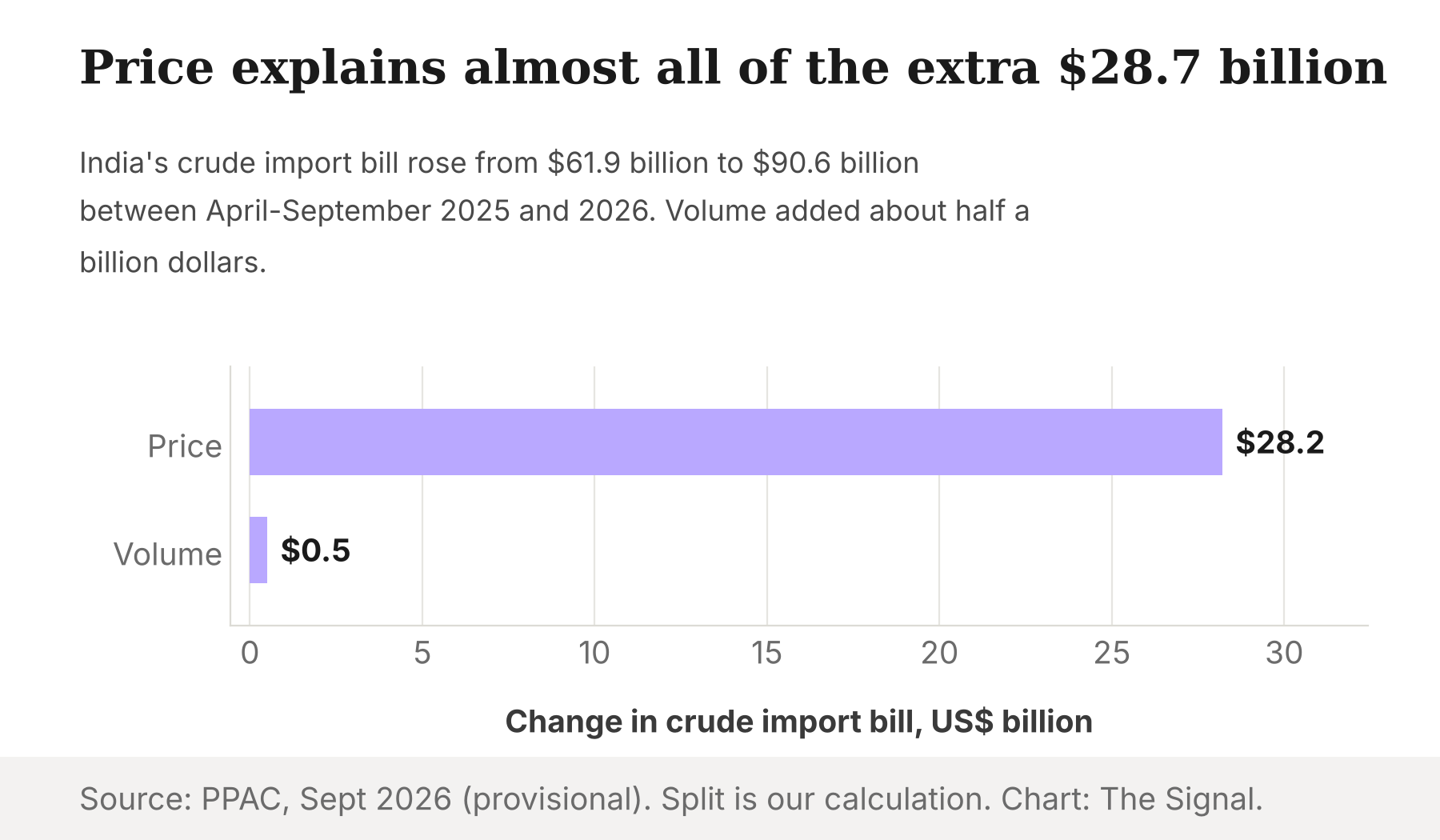
India's crude oil import bill for April-September 2026 was $90.6 billion, or about ₹8.53 lakh crore, against $61.9 billion a year earlier. That is an extra $28.7 billion in six months, a rise of 46 percent. The easy reading is a demand story: a bigger economy, more cars, more refineries, more barrels coming off tankers at Indian ports.
It is worth slowing down on that. The Petroleum Planning and Analysis Cell (PPAC), the oil ministry's statistics arm, reports that crude imports grew just 0.8 percent in April-September, to 122.7 million tonnes from 121.8 million tonnes. And domestic use did not surge either: consumption of petroleum products fell from 118.7 million tonnes to 114.8 million tonnes over the same period. India bought about the same oil and burned less of it. It still paid nearly $29 billion more.
The number that carries the story is $738
Divide the bill by the tonnage and the story is one line long. In April-September 2025, India paid about $508 for each tonne it imported. In April-September 2026, it paid about $738. That is a 45 percent jump in unit cost on a 0.8 percent jump in volume.
| April-September | 2025 | 2026 | Change |
|---|---|---|---|
| Crude imported (million tonnes) | 121.8 | 122.7 | +0.8% |
| Crude import bill (US$ billion) | 61.9 | 90.6 | +46% |
| Implied cost per tonne (US$) | about 508 | about 738 | +45% |
Source: PPAC Monthly Ready Reckoner, September 2026 (provisional). Cost per tonne is The Signal's calculation from the bill and volume.
Split the $28.7 billion rise in the PPAC bill into its two causes and volume explains only about $0.5 billion of it. Price explains about $28.2 billion.
The pressure is also not fading. PPAC says the Indian crude basket averaged $116.09 a barrel in September 2026, against $90.19 in August 2026 and $69.61 in September 2025. September's price is two-thirds above the same month last year. The five-month picture was already the same: ThePrint, citing PPAC data, reported an April-August bill of $74.8 billion on 100.7 million tonnes, against $50.4 billion on 101.1 million tonnes a year earlier. With September's basket well above August's, the second half starts from a higher run-rate than the first half averaged.
The net bill is smaller than the headline
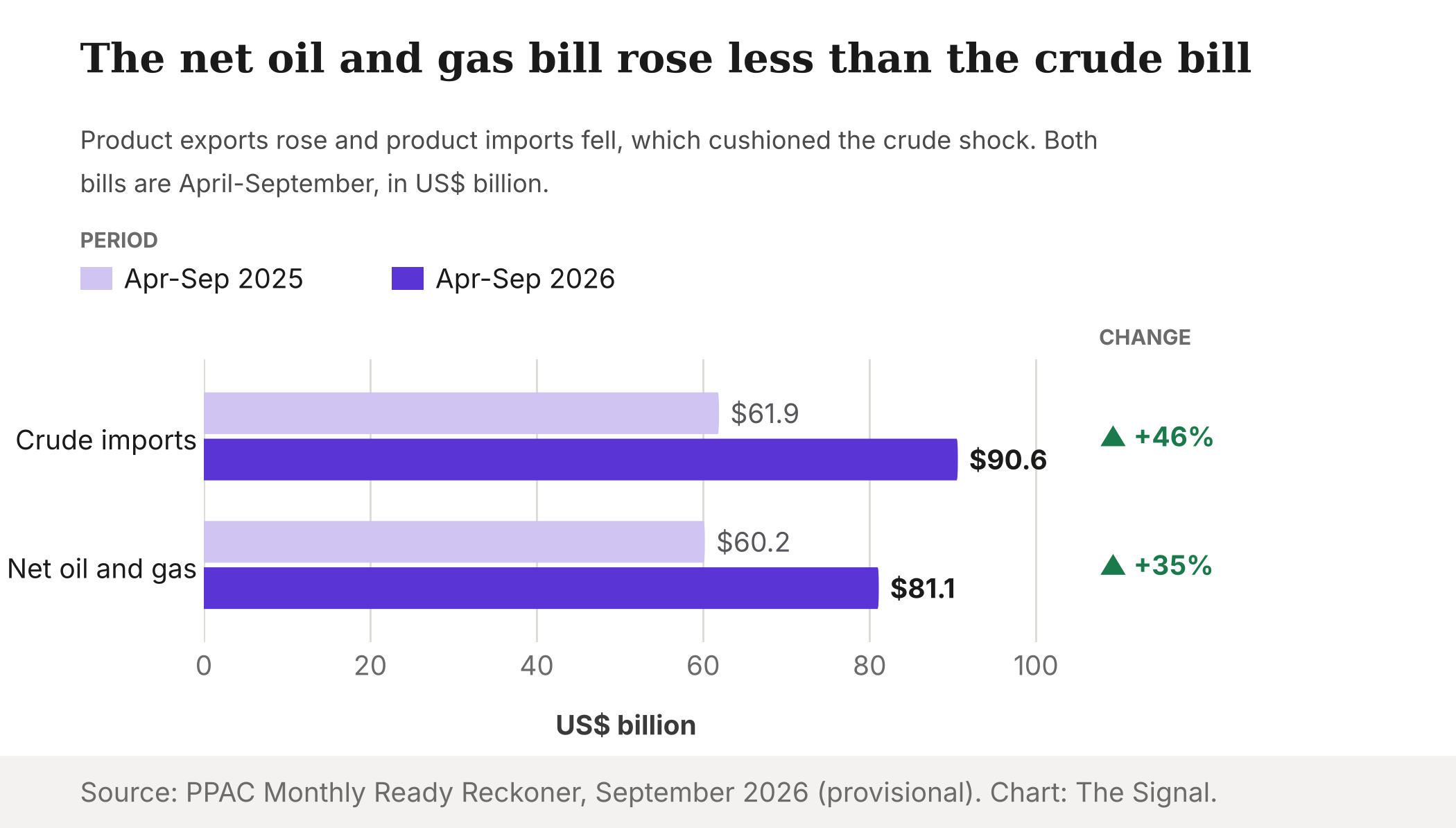
India is not only a buyer of oil. It refines crude and sells products abroad, and that side of the ledger moved the other way. PPAC's table shows net oil and gas imports rising from $60.2 billion to $81.1 billion in April-September. That is a rise of $20.9 billion, or 35 percent, not $28.7 billion.
The gap closes because petroleum product imports fell from $11.4 billion to $8.6 billion while product exports rose from $19.9 billion to $26.6 billion. Refiners turned expensive crude into products that also sold at higher prices abroad. Between them, the two product lines swung by about $9.5 billion in India's favour.
Oil still weighs more heavily on India's import basket than a year ago. Petroleum was 22.7 percent of India's gross imports by value in April-September, up from 19.5 percent.
The current account barely flinched
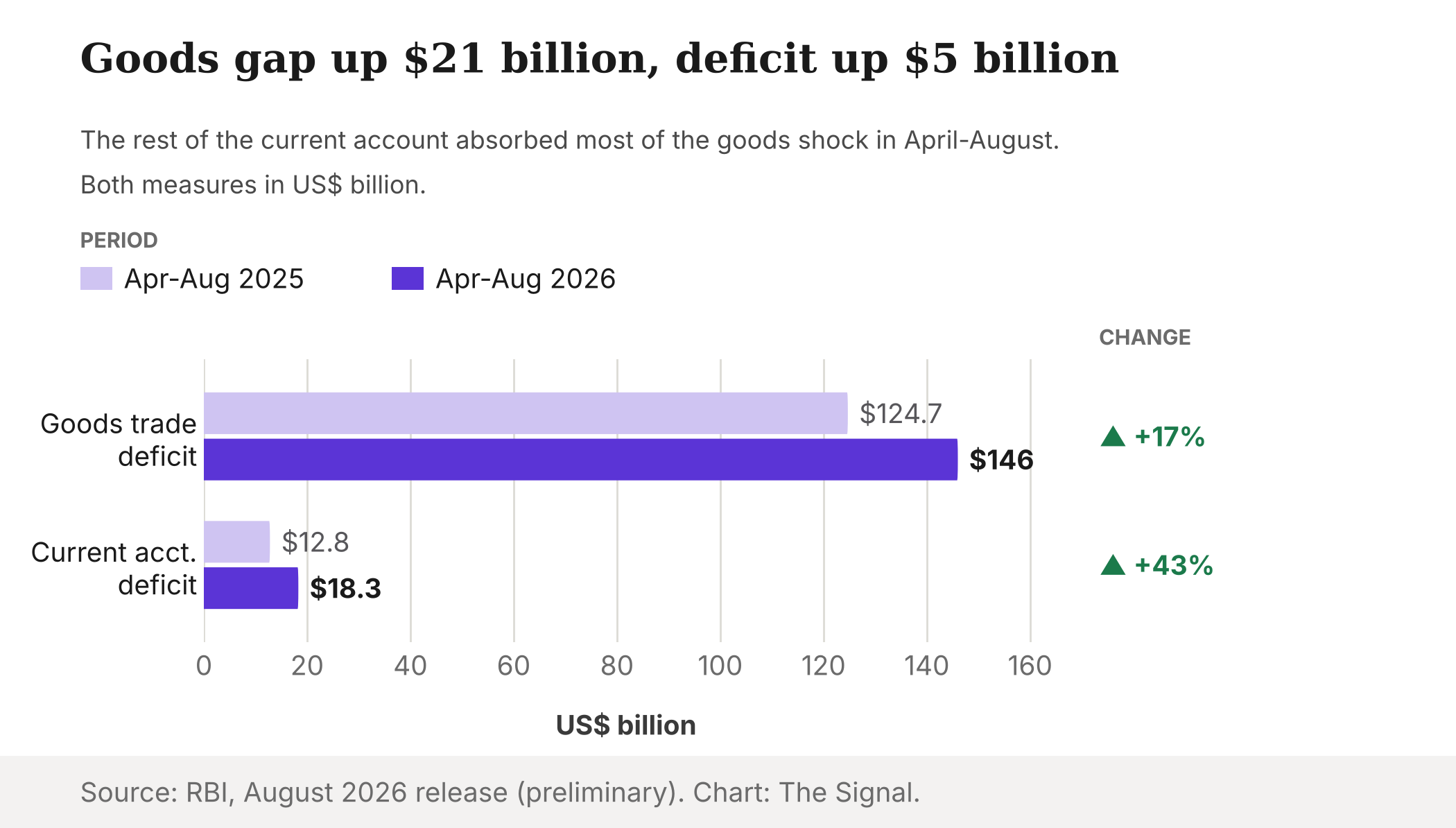
A bigger oil bill should widen the current account deficit, the gap between what India earns from the world and what it pays out. It did, but only modestly. The Reserve Bank of India's August release shows the April-August 2026 current account deficit at $18.3 billion, against $12.8 billion a year earlier, while the merchandise trade deficit rose to $146.0 billion from $124.7 billion.
The goods gap widened by $21.3 billion. The current account deficit widened by $5.5 billion. The rest of the current account, which includes services exports and money sent home by Indians abroad, absorbed about $15.8 billion of the shock. For the April-June quarter, the RBI reports a current account deficit of $4.2 billion, or 0.5 percent of GDP, with the merchandise deficit at $86.1 billion against $68.9 billion.
The strain shows up on the financing side
If the current account held, the pressure had to go somewhere. The RBI's quarterly release shows where. In April-June, foreign portfolio investors pulled out a net $9.6 billion, and foreign exchange reserves fell by $8.1 billion on a balance-of-payments basis. A deficit of 0.5 percent of GDP is small. The point is that it arrived in a quarter when portfolio money was leaving and reserves were falling.
The exchange rate is where households and firms feel it. PPAC's own September data uses a rate of ₹95.48 to the dollar. Because crude is priced in dollars, a weaker rupee multiplies a dollar price shock when it is converted into the rupee bill that refiners and the government have to fund.
The honest objection
The strongest case against alarm is in the numbers above. A current account deficit of 0.5 percent of GDP in April-June is modest. Net oil and gas imports rose less than the headline. Services and remittances are cushioning the goods gap. On that view, the $29 billion figure is a scary headline attached to a manageable adjustment.
That case is real, and it explains the first half well. It is weaker as a forecast. The cushion from product exports exists only while product prices stay high relative to crude, and PPAC's own figures are provisional and flagged as subject to revision. The September basket price of $116.09 already sits well above August's. And the first-quarter data show that when the cushion is working, the cost is still being paid, just in a different place: reserves fell $8.1 billion and portfolio investors left rather than the current account taking the whole strain.
The Signal
The headline number, $90.6 billion against $61.9 billion, is a price bill and not a volume bill, and the difference matters. A volume problem can be managed with efficiency or substitution. A price problem can only be hedged, cushioned or waited out. India has used the cushions it has: refined product exports, services receipts and remittances, and reserves.
Watch three things. The first is whether the Indian basket stays near September's $116.09, which would push the second-half bill above the first. The second is whether product exports keep offsetting the crude bill, which is the cushion most exposed to a change in refining margins. The third is whether the July-September balance-of-payments release shows portfolio outflows like April-June's $9.6 billion again. India did not buy more oil this year. It bought the same oil at a different price, and the bill is still arriving.
Reporting basis (PPAC, RBI): crude import volumes, bills, consumption, product trade, the Indian basket price and the exchange rate are from the Petroleum Planning and Analysis Cell's September 2026 Monthly Ready Reckoner, which is provisional and subject to revision; each rests on that single compiler. The April-August bill is per ThePrint's report of PPAC data, which was verified as a relay rather than at PPAC itself, and is not load-bearing here. Current account, trade deficit, portfolio flow and reserve figures are from two Reserve Bank of India releases, both preliminary. The cost per tonne, the price and volume split of the bill, the rise in net oil and gas imports, the offset from product trade, and the amount absorbed by the rest of the current account are The Signal's calculations from those figures.