
The usual way to talk about India's "$5 trillion economy" is as a growth target. India grows fast, so the date arrives when it arrives. The IMF's latest numbers say something less comfortable. In the October 2026 World Economic Outlook database, the IMF projects India's GDP at current prices at about $4,996 billion in 2028 and $5,542 billion in 2029. Taken literally, India misses the $5 trillion line in 2028 by about $4 billion, or roughly 0.09 percent of the total.
That is a rounding error. And a rounding error is exactly the point. When a milestone is that close, growth is not what decides whether it is met. The exchange rate is.
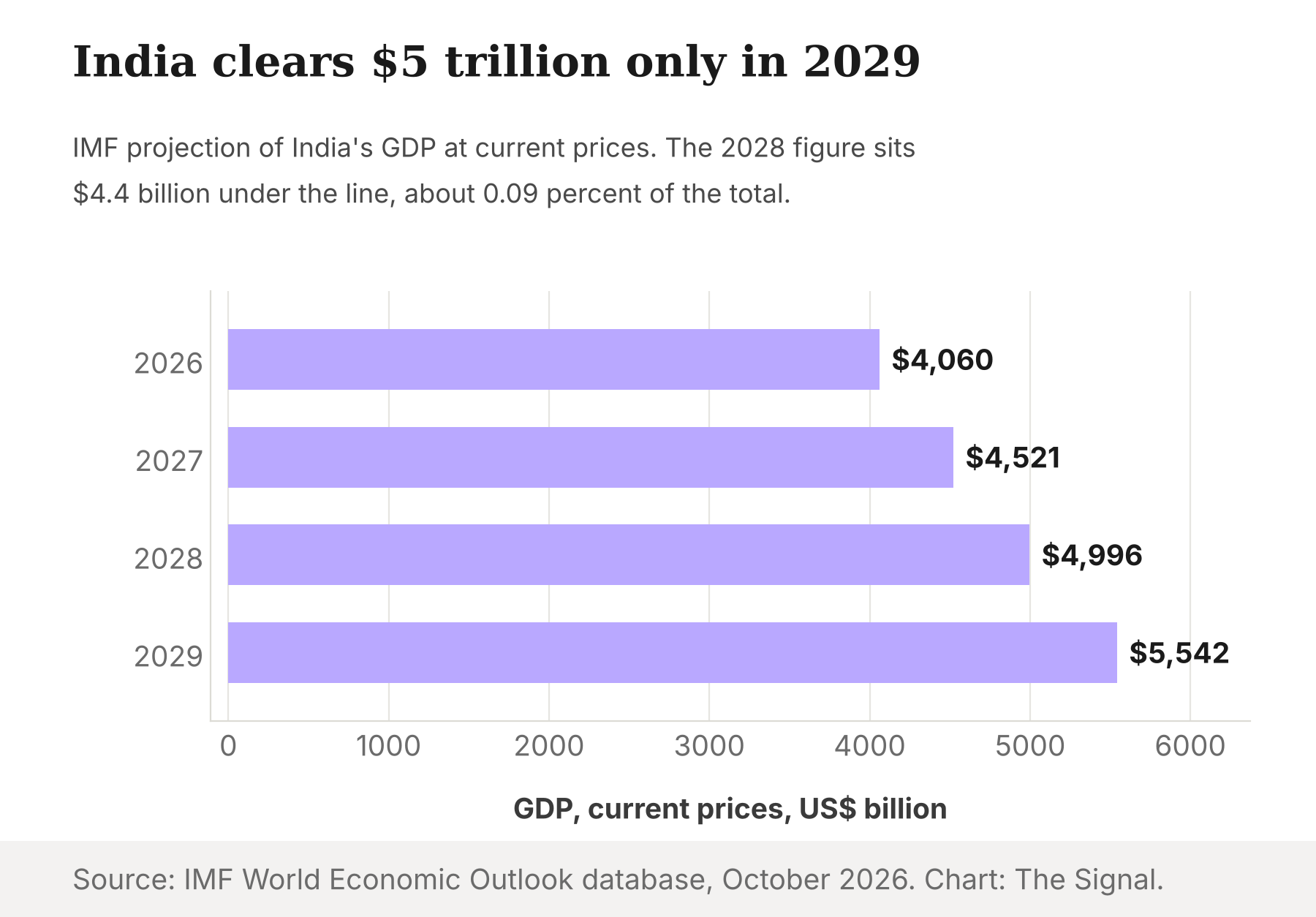
Dollar GDP is a rupee number divided by a price
The $5 trillion goal is measured in US dollars, but India earns and counts its output in rupees. A dollar GDP figure is the rupee figure divided by the exchange rate. Growth raises the numerator. A weaker rupee raises the denominator, and eats the gain. The IMF's dollar series for India is built that way.
The most recent full year shows the scale of the numerator. MoSPI's provisional estimates put nominal GDP at ₹346.36 lakh crore in 2025-26, up from ₹318.07 lakh crore in 2024-25, with real growth of 7.7 percent. That is nominal growth of about 8.9 percent.
Now the denominator. The RBI reference rate was 95.0194 rupees per dollar on 16 October 2026, after 96.6149 on 9 October. At today's rate, $5 trillion is ₹475.1 lakh crore, which is 37 percent above the 2025-26 level. At the 8.9 percent nominal pace of 2025-26 and a rupee that stays at about 95, that takes about 3.7 years from the end of 2025-26, so the line is crossed in the year to March 2030. This is a scenario, not a forecast: it simply shows how far the rupee-side number has to travel at today's exchange rate.
What the IMF's path quietly assumes
The IMF's own path is faster than that scenario. It projects real growth of 7.0 percent in 2026 and 2027, and 6.9 percent in 2028 and 2029. Yet its dollar GDP rises 11.4 percent in 2027, 10.5 percent in 2028 and 10.9 percent in 2029, from the figures above.
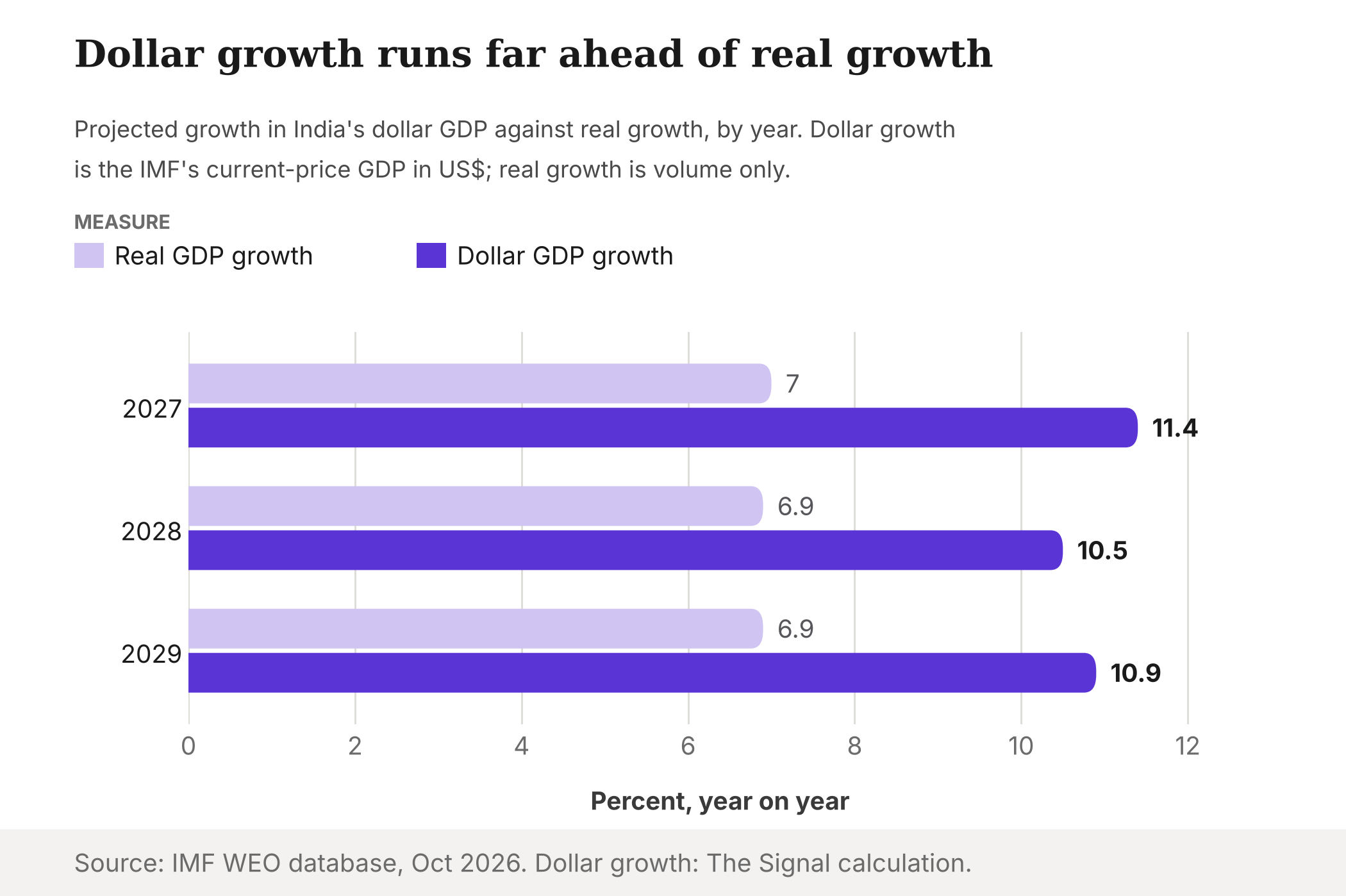
The gap between the two bars is price. Dollar GDP grows about 3.6 to 4.4 points faster than real GDP each year, which is the pace of price rises measured in dollars. The same database has Indian consumer-price inflation at 5.0 percent in 2026 and 4.4 percent in 2027. If domestic prices rise about 4 to 5 percent a year and the dollar value of output still rises almost as fast as that, there is little room in the path for the rupee to keep sliding. In other words, the 2029 date is not a pure growth call. It is a growth call with a quiet assumption of a steadier currency inside it. These are the Signal's inferences from the IMF's published series, not an IMF statement about its exchange-rate assumption.
The date has already slipped once on the rupee
This is not hypothetical. In November 2025 the IMF's Article IV work moved the $5 trillion milestone to FY29, a full year later, and Business Today reported the rupee's depreciation as the primary driver of the downgraded dollar forecast. The same report said the IMF had assumed the rupee at 87 and 87.7 per dollar in FY26 and FY27. The rupee has since traded above 95. Growth did not disappoint in that period. The denominator did.
What a 1 percent move is worth
At $5 trillion, a 1 percent weaker rupee removes about $50 billion from the dollar figure. That is arithmetic, and it is about eleven times the $4.4 billion gap to the line in 2028. The 2028 miss is therefore not a verdict on India's growth. A rupee that was about 0.1 percent stronger across the year would have put the 2028 figure over the line.
The same logic works on rankings. The IMF has the United Kingdom at $4,268 billion in 2026, against India at $4,060 billion. A gap of about $208 billion is 5 percent of India's total, or roughly what a 5 percent move in the rupee does by itself.
The honest objection
The strongest objection is that a milestone measured in dollars is a vanity number. Indians pay for things in rupees, and a weaker rupee can help exporters. Real growth of 7.0 percent in 2026 and 2027 is real whatever the currency does, and the jobs, incomes and tax receipts are all rupee things.
That is correct, and it is why the dollar date should not be treated as the goal. But the dollar figure is not irrelevant either, because comparisons with other economies are made in dollars. The IMF Executive Board itself urged greater exchange rate flexibility, with interventions aimed at addressing disorderly market conditions, which is a recognition that the currency path matters to how the economy absorbs shocks. So the objection narrows the claim without removing it: the $5 trillion date is a currency milestone as much as a growth one.
The Signal
India does not need faster growth to reach $5 trillion sooner. It needs a rupee that stops falling. On the IMF's October 2026 numbers the country is $4.4 billion short in 2028 and $542 billion over in 2029, and the exchange rate moves more than that in days. Between 9 and 16 October the RBI reference rate went from 96.6149 to 95.0194, a 1.7 percent swing worth about $80 billion at the $5 trillion scale.
The number to watch is not GDP. It is the rupee, now at 95.0194 per dollar, in the quarters before March 2029. Every leg down pushes the date out; every leg up pulls it in.
Reporting basis: the dollar GDP, real growth and inflation projections are the IMF's October 2026 World Economic Outlook database, read directly from the IMF's DataMapper interface. Nominal GDP for 2025-26 is MoSPI's provisional estimate, from its press note carried by the Press Information Bureau. The rupee reference rates are the RBI's, as republished by the Metropolitan Stock Exchange of India, which is the relay that was checked. The November 2025 IMF exchange-rate assumptions and the finding that depreciation drove the downgrade are per Business Today, reporting on the IMF's Article IV work; the IMF Executive Board's call for exchange rate flexibility is from the IMF's own press release. The dollar growth rates, the rupee-denominated threshold of ₹475.1 lakh crore, the 3.7-year scenario, the $50 billion sensitivity and the 2028 shortfall are The Signal's calculations from those figures.