On October 13, 2026, NPCI, the body that runs UPI, put off a new merchant fee two days before it was due to start. Its steering committee decided to postpone the rollout for the festive season, and Moneylife reports that "the charges will be implemented immediately after Diwali, on a date to be notified separately." The consensus read is a reprieve: shoppers and shopkeepers get a quiet festival, and the fight can wait.
It is worth slowing down on that. A date moved. The reason for the fee did not. UPI is free to use because the government pays part of the bill, and that part is small.
What the fee actually is
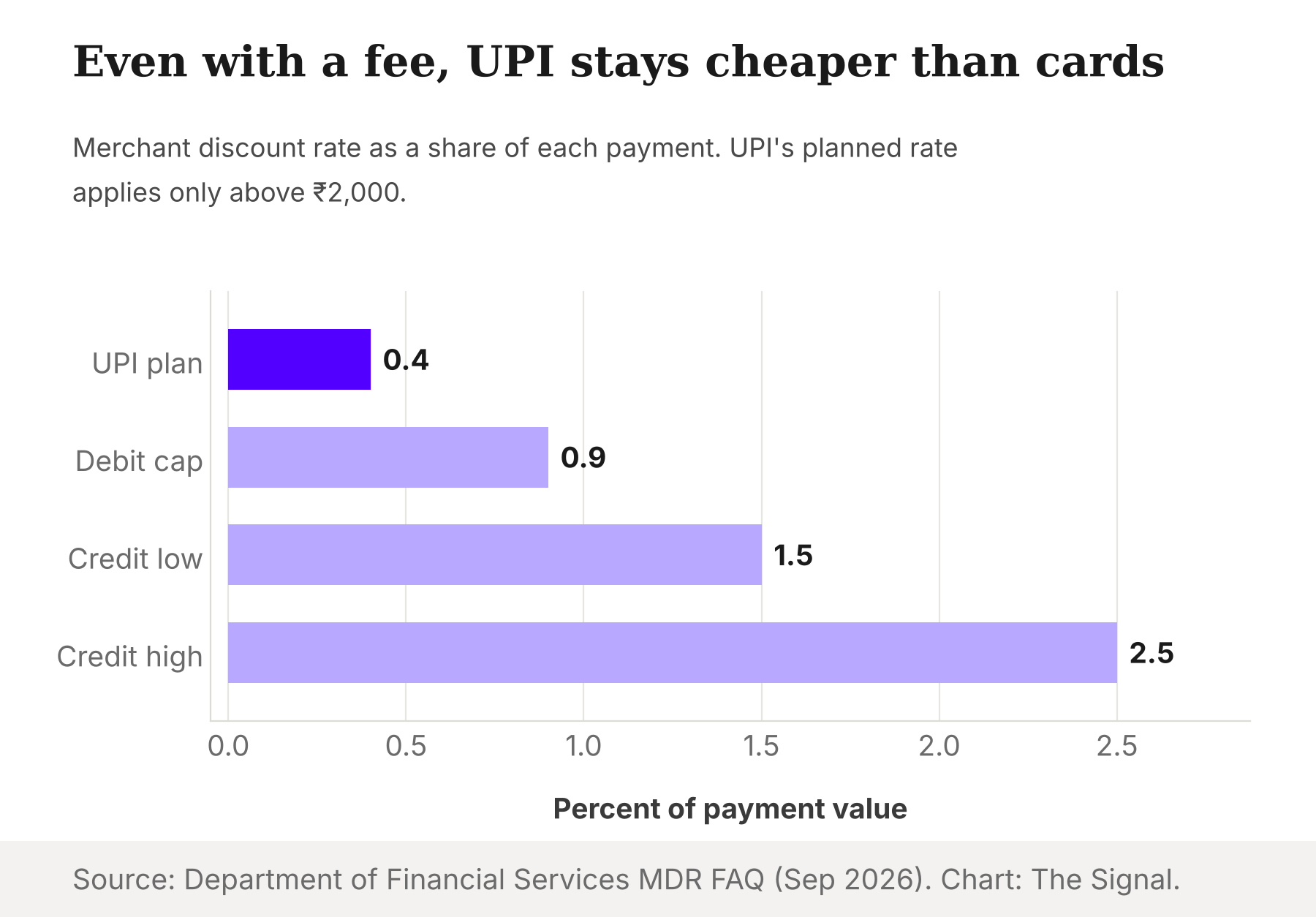
The charge is a merchant discount rate, or MDR: a small percentage the merchant pays on each sale. Under the Finance Ministry's September design, a nominal MDR of 0.4% applies to merchant payments above ₹2,000. Payments of ₹75,000 and above are capped at ₹300. Flat ₹5 fees apply above ₹2,000 in sectors such as railways, telecom, insurance, fuel and agricultural inputs.
Most people will never meet it. The ministry says about 96% of person-to-merchant transactions stay unaffected, and that small merchants receiving up to ₹1 lakh a month through UPI QR codes keep zero MDR. Banks have also been advised to ensure that merchants do not pass the charge on to customers.
The 96% is less surprising than it sounds. UPI processed 24.07 billion transactions worth ₹29.37 lakh crore in September 2026, according to Outlook Money's report on NPCI data. Divide one by the other and the average payment is about ₹1,220 (our calculation, across all UPI, including person-to-person transfers). The typical UPI payment sits well under the ₹2,000 line, so most never meet the fee.
The number that carries the story
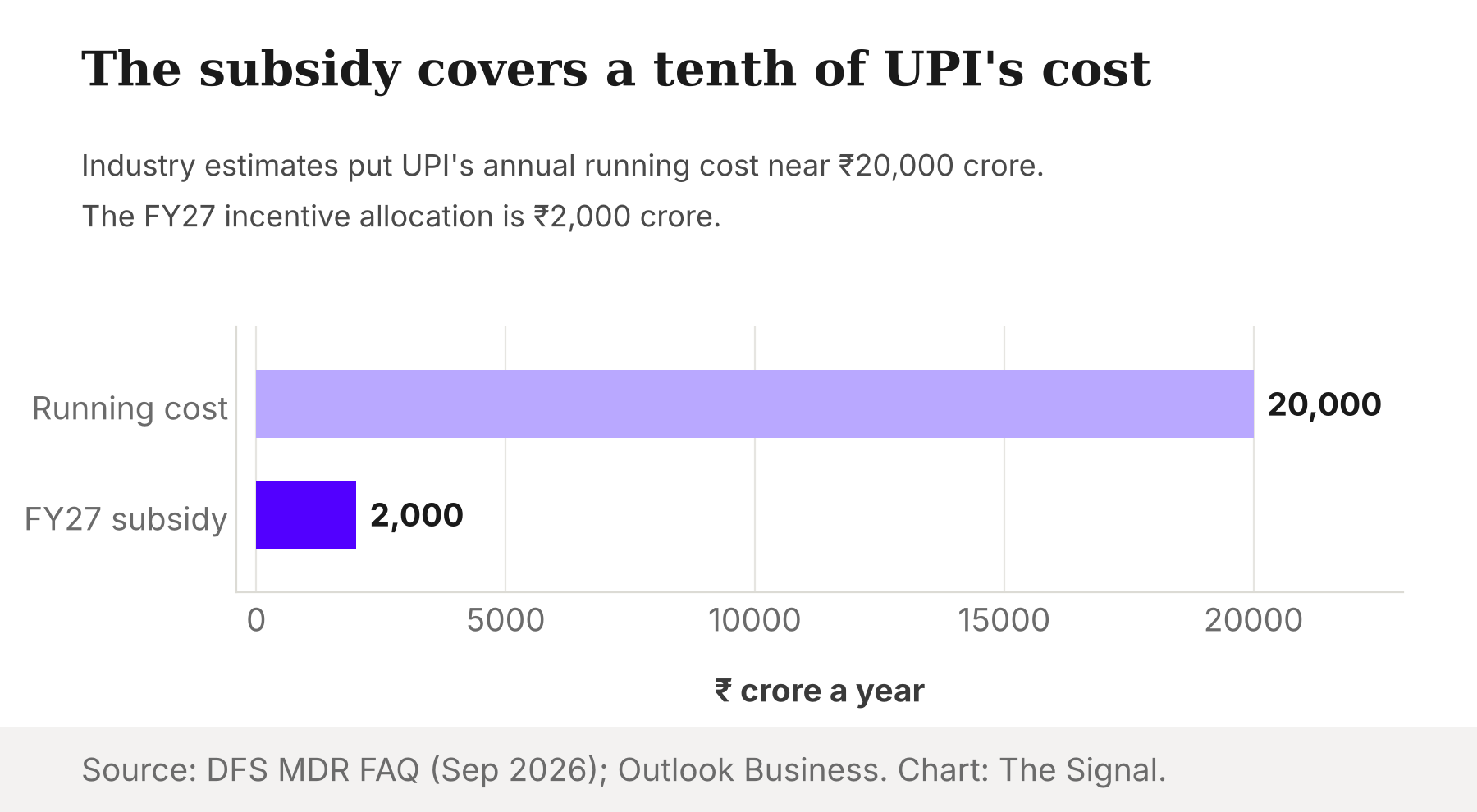
The number to hold is one tenth. The Finance Ministry's own FAQ says industry estimates put the cost of running UPI at about ₹20,000 crore annually, covering payment operations, server bandwidth, fraud prevention and bank technical support. Against that, the government has allocated ₹2,000 crore for FY27 under its incentive scheme, as Outlook Business reports. Two thousand against twenty thousand is one tenth.
That gap did not appear this year. MDR on merchant UPI payments was zeroed from January 2020: a CBDT notification dated December 30, 2019 removed it. The state then agreed to compensate the industry through an incentive. The allocation was ₹1,389 crore in FY2021-22, ₹2,210 crore in FY2022-23 and ₹3,631 crore in FY2023-24, according to the same ministry release.
Set that against FY27. The ₹2,000 crore allocation is about 45% below the FY2023-24 figure, even though UPI volume has kept climbing: September's count was 23% higher than a year earlier. The subsidy shrinks while the system it props up grows. Someone absorbs the difference, and today that is banks and payment apps.
Why the fee, and why it has to start somewhere
The ministry's FAQ is blunt about intent. Annual subsidies, it says, were designed as short-term bridge funding rather than a permanent measure to compensate the industry. The incentive itself, approved by the Cabinet in 2025, pays 0.15% of transaction value on transactions up to ₹2,000 to small merchants. It is a reimbursement, not a funding model.
The design choice is to charge by size. Payments up to ₹2,000 and small-merchant receipts stay free, and the fee applies only to specified merchant payments above ₹2,000. Because the average UPI payment is about ₹1,220, the fee lands on the minority of payments that are large. That is how part of the cost can shift without most users noticing.
The rate is also low next to the alternatives. The FAQ notes that credit card MDRs typically range from 1.5% to 2.5%, while debit card MDRs are capped at 0.90%.
The honest objection
The strongest case against the fee is that it is small, and small fees still change behaviour. A merchant who pays 0.4% on a ₹10,000 sale pays ₹40. A merchant with a thin margin may decide cash costs nothing and ask the customer to pay that way, or add a quiet surcharge. The ministry has advised banks to ensure merchants do not pass the charge on, but an instruction to banks is not the same as a shopkeeper's counter.
That case is real, and nothing in the data here can settle it. What the data does say is narrower. MDR will apply to only about 4% of merchant transactions, with a ceiling of ₹300 per transaction at ₹75,000 and above. If the risk is a flight to cash, it sits in that 4%, not in the tea stall. Delay does not remove the cost. It leaves it where it sits today.
The Signal
The delay buys a quiet Diwali and a bargaining window. It does not change the arithmetic. UPI costs about ₹20,000 crore a year to run, the subsidy covers about a tenth, and the Finance Ministry has already called that subsidy a bridge.
Watch two things. The first is the date NPCI notifies, because no revised date or change in rates has been announced. The second is the next Budget line for the incentive: if it falls again while volume rises, the fee is not a phase but a destination. Free was never the absence of a price. It was a price someone else was paying.
Reporting basis (the Ministry of Finance PIB release and the FAQ): the MDR design, the 96% and 4% shares, the 2020 zero-MDR notification, the 2021-24 allocations and the card comparison are from Ministry of Finance material, namely its PIB releases and the Department of Financial Services FAQ, as published. The NPCI deferral is per Moneylife, reporting an NPCI statement, and the FY27 allocation is per Outlook Business, citing a parliamentary committee report; both rest on a single outlet each and neither was checked against the primary document. September UPI volumes are NPCI data as relayed by Outlook Money. The ₹20,000 crore running cost is an industry estimate quoted by the ministry, not an audited figure. The average payment of about ₹1,220, the one-tenth subsidy share and the 45% fall in the allocation are The Signal's calculations from those figures.