On 16 October 2026, the oil marketing companies put out their ethanol tender for the supply year that starts in November. It asks for around 11 billion litres, which is 1,100 crore litres in the units the industry uses, and it carries one line that changes who gets to sell: sugar diversion for ethanol "be reduced to zero for ethanol supply year 2026-27", with no offers sought for ethanol from sugarcane juice, sugar or sugar syrup.
The easy read is a sugar story. ETV Bharat links the move to poor rainfall in Maharashtra and Karnataka, which raised the risk of lower sugar output. Keep cane for the kitchen, run the fuel programme on something else. That is a sensible reading, and it is incomplete.
It is worth slowing down on the volume. The tender did not shrink to match the lost feedstock. It asks for more.
The quarter of supply that just left
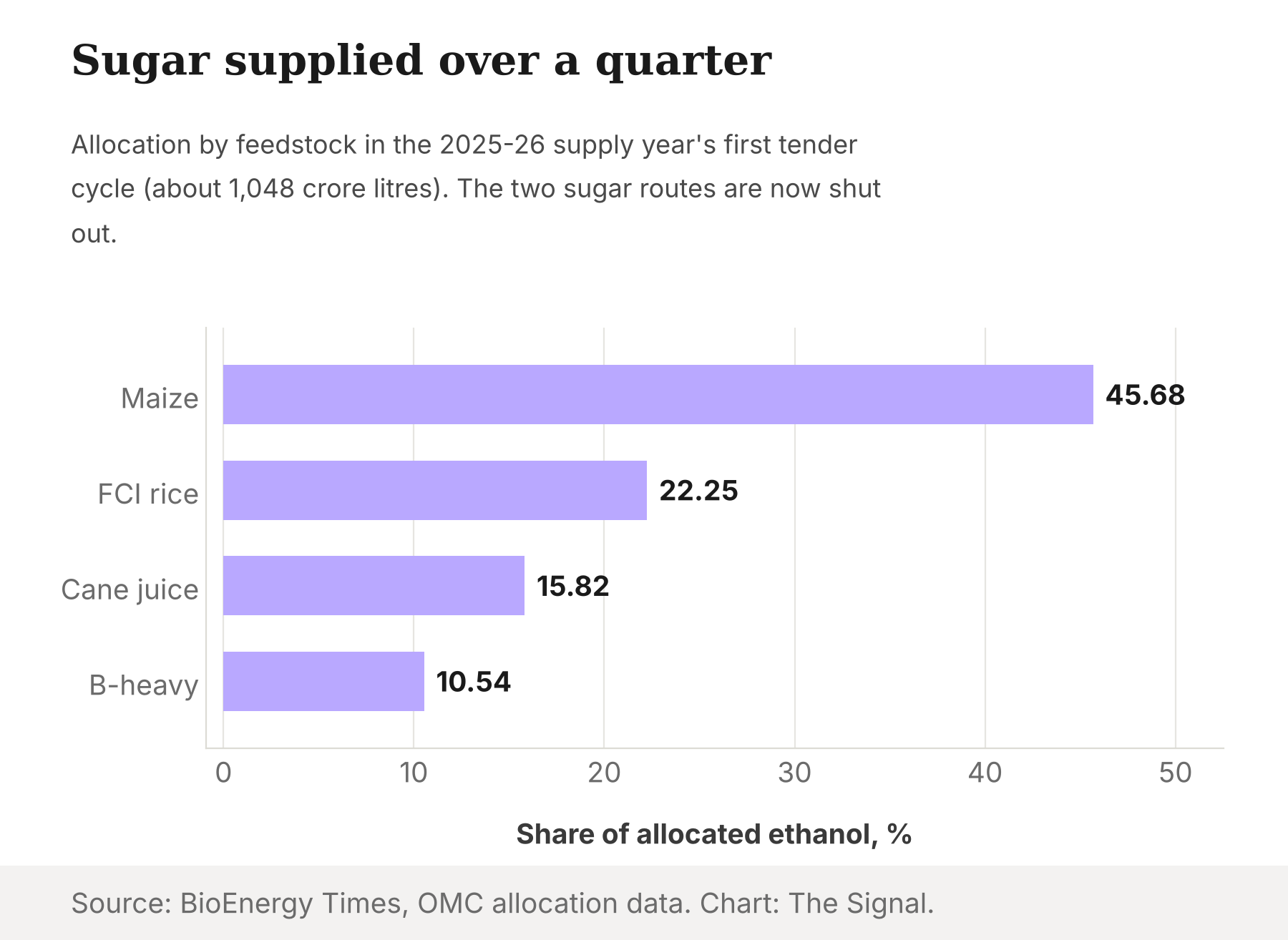
Sugar was not a rounding error in last year's programme. In the first tender cycle of the 2025-26 supply year, oil companies allocated about 1,048 crore litres, with maize at 45.68 percent, FCI rice at 22.25 percent, sugarcane juice at 15.82 percent and B-heavy molasses at 10.54 percent. FCI rice is surplus rice sold by the Food Corporation of India. Sugarcane juice and B-heavy molasses together made up 26.36 percent of that allocation, a little over a quarter.
Actual deliveries followed the same pattern. By the end of August 2026, supplies of 895 crore litres included 345 crore litres from maize, 214 from FCI rice, 149 from sugarcane juice and 107 from B-heavy molasses, according to data compiled by the All India Distillers' Association. The two sugar routes delivered 256 crore litres, about 29 percent of the total.
The number that carries the argument
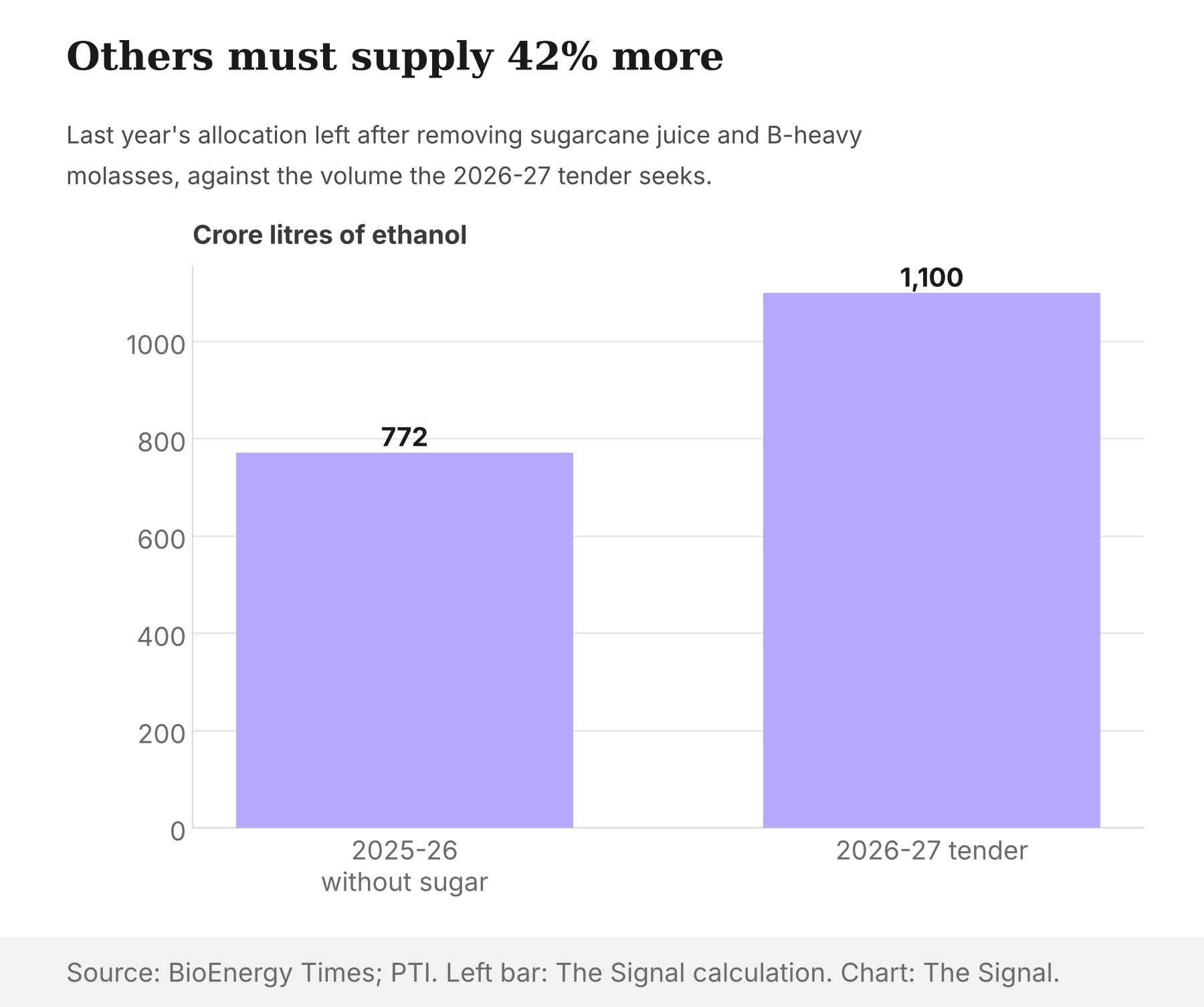
Take the sugar routes out of last year's first-cycle allocation and 73.64 percent of 1,048 crore litres remains, about 772 crore litres. This year's tender seeks about 1,100 crore litres. The remaining feedstocks, mainly maize and surplus rice, with a small role for C-heavy molasses, would have to deliver about 328 crore litres more than they were allocated last year. That is roughly 42 percent more. These are our calculations, and they compare a tender request with a completed allocation, so the real gap will depend on what bidders offer.
Capacity is unlikely to be the constraint. A PIB explainer puts India's ethanol production capacity at about 2,000 crore litres in 2026, against procurement of over 1,200 crore litres projected for 2025-26. The question is whether farmers and the Food Corporation will supply enough grain at the price on offer.
The price signal
That price just fell. The tender lowers the procurement price for maize-based ethanol to Rs 68.86 per litre from Rs 71.86, a cut of 4.2 percent. The Press Information Bureau had described the Rs 71.86 figure in July 2026 as what maize-based ethanol is procured at, before GST, transport and storage.
A buyer short of a feedstock does not usually cut what it pays for the substitute. Cutting the maize price while asking the remaining feedstocks for the larger volume says that the buyer expects grain to be available, or that it intends to lean on the price in a year when it holds the leverage. Either reading moves the food-versus-fuel question from the cane field to the grain market. Maize growers and the poultry and cattle-feed users who compete with distilleries for the same grain are the ones to watch.
The honest objection
The strongest case against reading this as a structural shift is that it is a one-year patch. The stated motive is a weak sugar crop. If cane recovers next year, mills will lobby to return, and the oil companies have excluded these feedstocks before and allowed them back later. On that view the tender is a pressure valve, and the grain numbers are a footnote.
That case is real, and it may be right about 2027-28. It does not explain this year's tender. A patch would be expected to hold volume and let the price rise to attract a replacement feedstock. This one raises the volume and lowers the maize price. Whatever the long-run plan, the 2026-27 supply year is being run on a grain-first assumption, and the prices will show soon whether that assumption holds. PIB data show blending reached 14.6 percent in 2023-24 and 19.2 percent in 2024-25, and the same table records 20 percent for November 2025 to June 2026, so the programme has little slack to lose supply.
The Signal
India's ethanol programme was sold as a way to absorb surplus sugar. This tender sets sugar diversion at zero and asks grain to do more, for less. The numbers to watch are the offers that come back against the volume sought, the maize price in the main producing states through the winter, and whether the oil companies reopen the sugar routes if offers fall short. If they do, the zero was a negotiating position. If they do not, the sugar mill has stopped being the programme's shock absorber and the grain bin has taken the job.
Reporting basis: the tender's volume, the zero sugar diversion and the maize price cut are per ETV Bharat and the Press Trust of India, both reporting the tender document issued by Bharat Petroleum for the oil marketing companies; the document itself was not reviewed, and the rainfall motive is as reported by ETV Bharat. The 2025-26 allocation shares are per BioEnergy Times, reporting the companies' first-cycle allocation, and the August 2026 supply figures are the All India Distillers' Association data as reported by Autocar Professional. Capacity, procurement volumes, blending rates and the earlier maize price are from Press Information Bureau publications of the Ministry of Petroleum and Natural Gas. The sugar-route totals, the implied grain gap and the percentage changes are The Signal's calculations from those figures.