
The headline read of Airtel's new plan is consumer relief. Airtel's Rs 185 prepaid plan includes unlimited local, STD and roaming calls and 300 SMS with 28 days of validity, according to TelecomTalk's report of the October 2026 listing. It carries no mobile data. For someone who uses a second SIM only to take calls, that is a plan built for them, and it exists because India's telecom regulator ordered it.
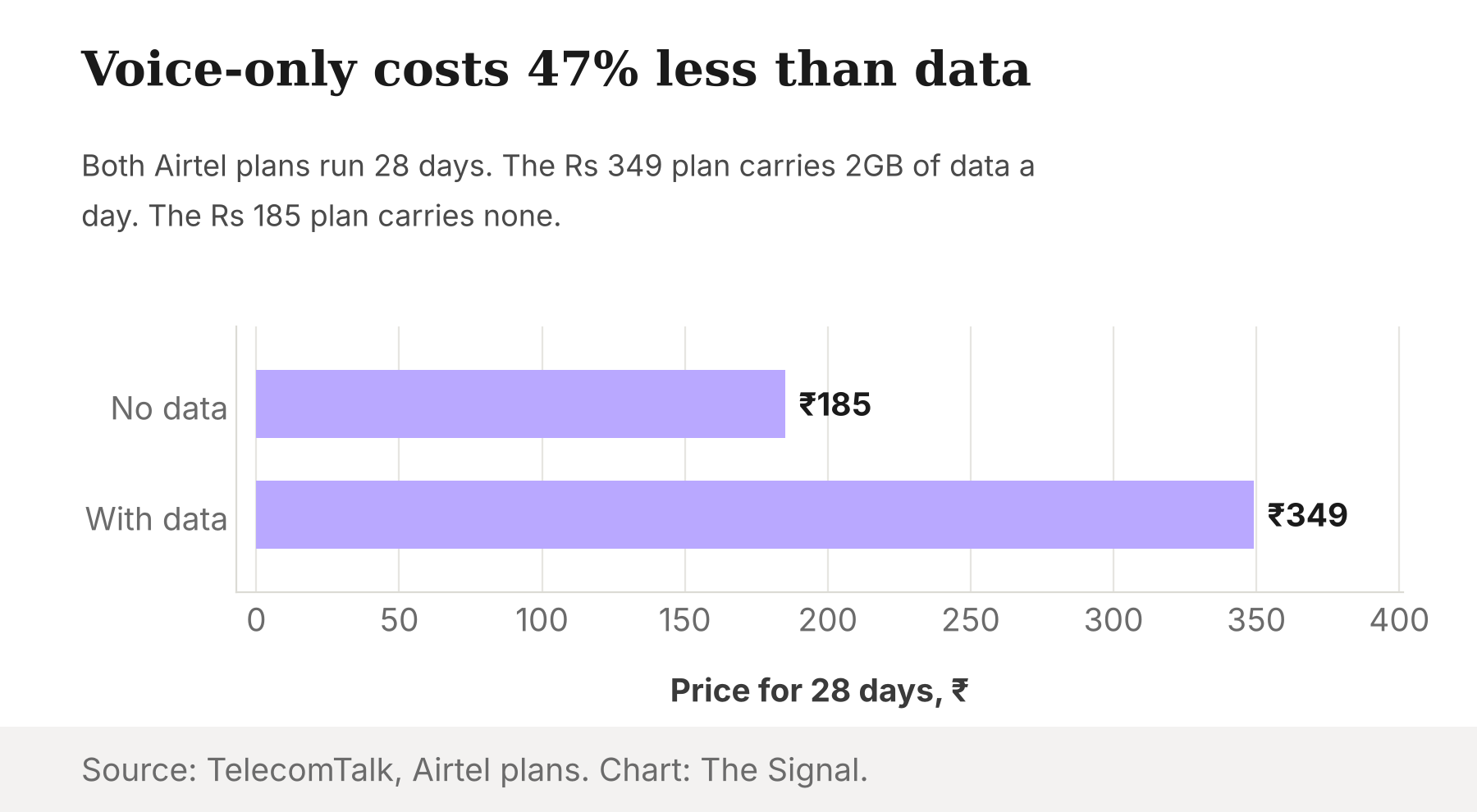
Slow down on the price. Airtel's Rs 349 prepaid plan, as TelecomTalk listed it in September 2026, gives 2GB of data a day, unlimited local and STD calls and 100 SMS a day. It also runs 28 days. Strip out the data and the price falls from Rs 349 to Rs 185, a cut of Rs 164, or 47 percent.
The rule got softer on the way to the gazette
The regulator did not ask for a particular price. It asked for a direction, and the wording moved.
TRAI's April 2026 draft said voice-and-SMS vouchers would be "priced with largely proportional reduction in tariff compared to Special Tariff Vouchers of corresponding validity with Voice, SMS and data". That is a test an outsider can apply. If data is half of what a customer pays for, the voice-only plan should cost about half.
The final text, notified on 21 September 2026, drops the test. It requires operators to offer Special Tariff Vouchers "with appropriate reduction in tariff, exclusively for Voice and SMS", for each validity of thirty days and under that they offer with voice, SMS and data. The rules take effect thirty days after publication in the Official Gazette. "Appropriate" is a word an operator can satisfy with almost any discount.
Airtel's discount is large, so the looser wording did not bite here. It matters because the next operator, or the next validity, may price differently.
The number that matters is not the discount
The discount is the visible figure. The sharper comparison is what a voice-only customer now pays against what Airtel's customers pay on average.
Scale the Rs 185, 28-day plan to a 30-day month and it costs about Rs 198. That is 25 percent below the Rs 264 average. The Rs 349 plan, scaled the same way, costs about Rs 374, which is 42 percent above it.
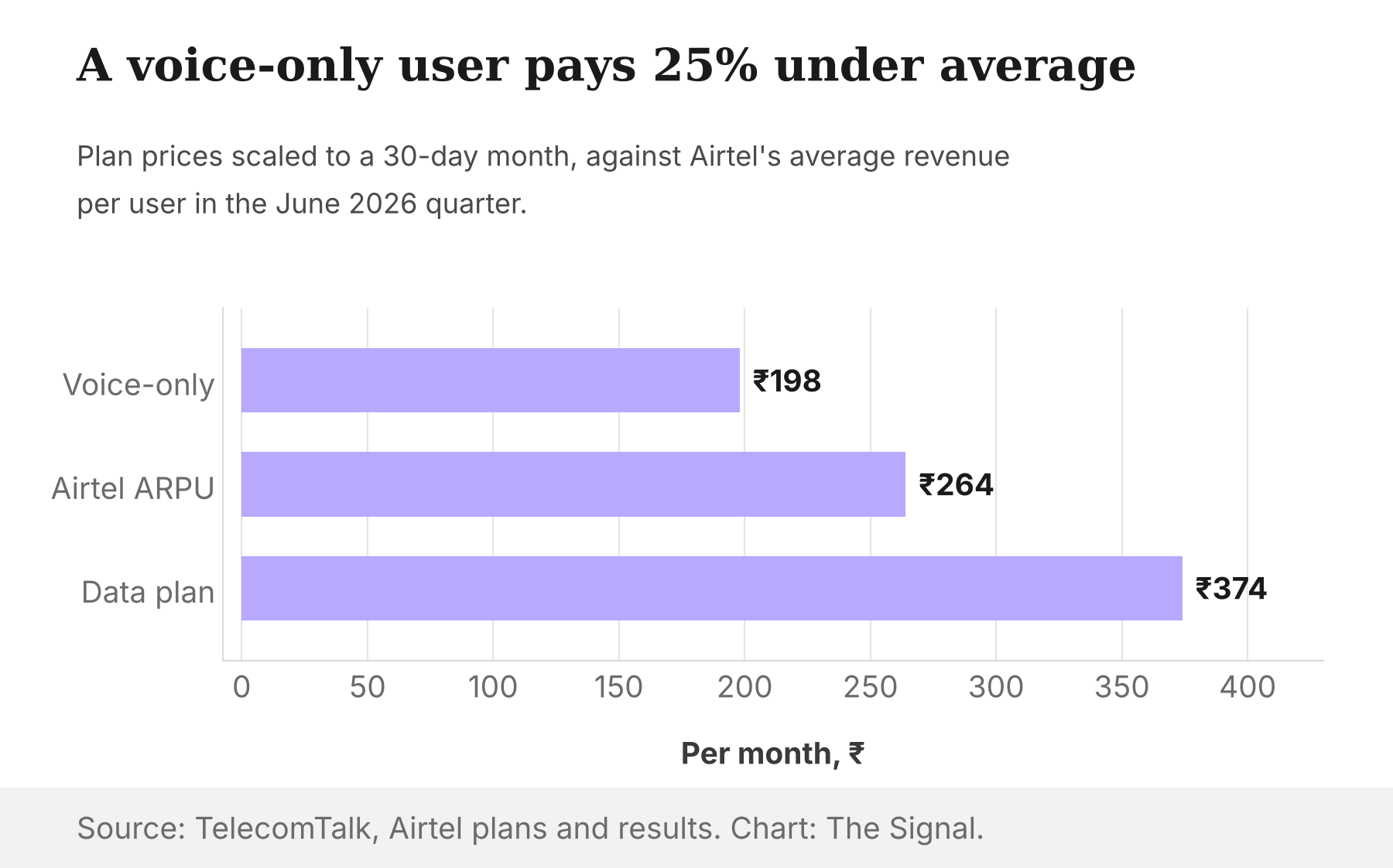
Here is the mechanism. Every customer who moves from the Rs 349 data plan to the Rs 185 voice-only plan lowers Airtel's monthly revenue from that customer by about Rs 176. If 1 in every 100 customers made that move, average revenue per user would fall by roughly Rs 1.76 a month, about 0.7 percent of the Rs 264 average. That is our calculation, and the 1 in 100 is an illustration, not a forecast. No source in this piece says how many customers will switch.
The honest objection
The strongest case against this reading is that the two plans are different products.
That is fair. The voice-only plan gives 300 SMS in total, while the data plan gives 100 a day. The rule's evident aim is to let customers who do not want data stop paying for it, and those customers may be a different group from the ones paying Rs 374.
If so, the plan costs Airtel little. A customer paying for data they barely touch can now step down to the Rs 185 plan. Which group is larger decides the outcome, and no source here measures it.
The Signal
TRAI wrote a rule that tells operators to cut prices and declined to say by how much. Airtel's first answer is a 47 percent cut against its own data plan. It also puts a floor under its price ladder at about Rs 198 a month, below the average customer.
Watch Airtel's next quarterly ARPU, which will show whether the plan pulled anyone down from higher plans. TRAI left the price to Airtel, and that figure will show what it chose to give away.
Reporting basis: Airtel's plan prices, validities and benefits are per TelecomTalk's listings of the October 2026 voice-only plan and the September 2026 Rs 349 plan, as relayed from Airtel, and have not been checked against Airtel's own plan pages. Airtel's average revenue per user is as reported by TelecomTalk from the company's Q1 FY27 results. TRAI's draft and final regulations are quoted from the regulator's own published notifications, which are a separate and primary origin. The Rs 349 figure rests on a single TelecomTalk listing, and nothing here establishes that it is Airtel's cheapest plan with data. The 47 percent cut, the 30-day monthly equivalents of Rs 198 and Rs 374, the 25 percent and 42 percent gaps to average revenue per user, and the Rs 1.76 illustration are The Signal's calculations from those figures.