
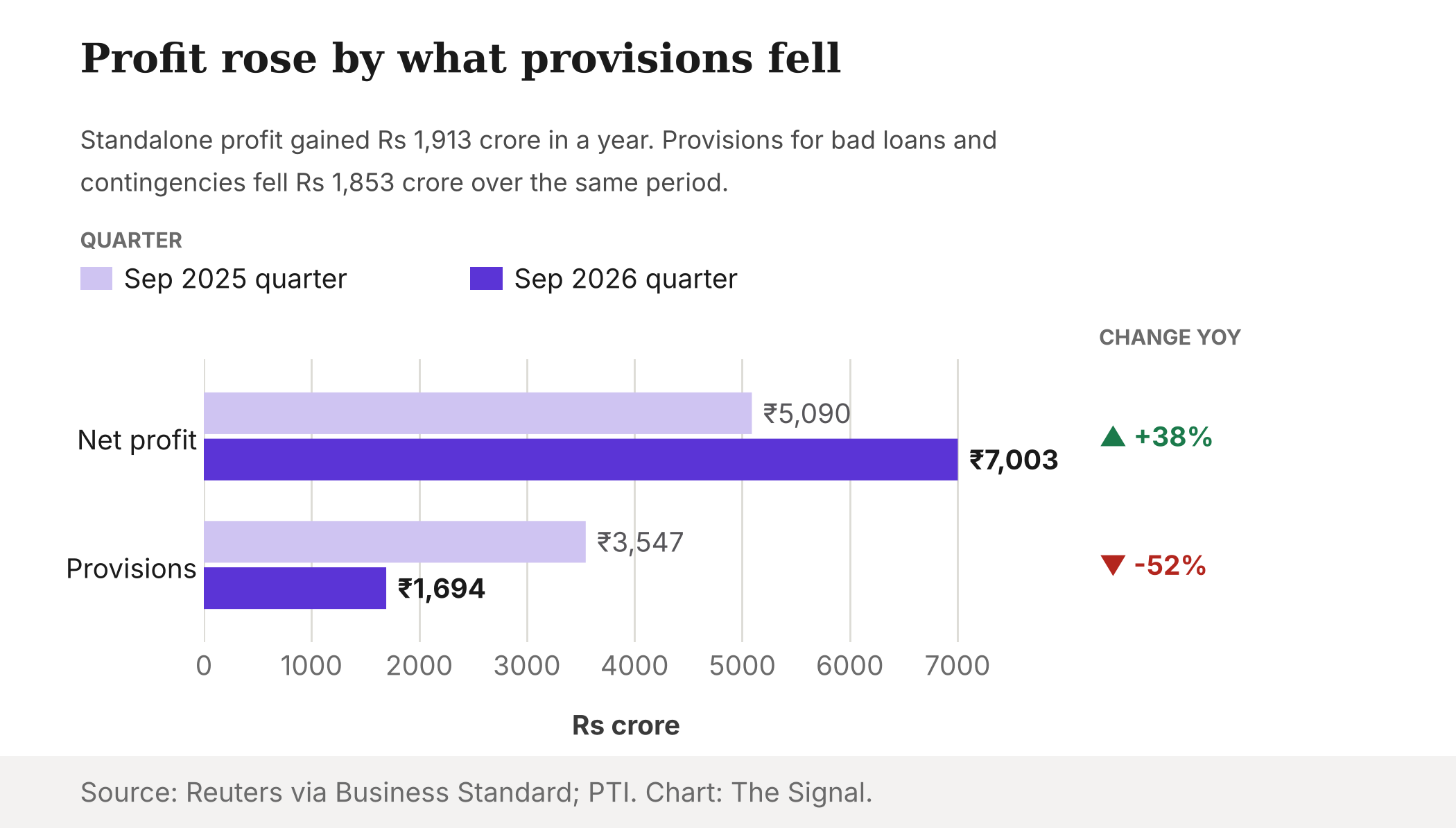
Axis Bank's headline reads like a strong quarter. The lender posted a stand-alone net profit of ₹7,003 crore for the quarter ended September 30, 2026, compared with ₹5,090 crore a year earlier, a rise of 37.6 percent. The same report adds that analysts had expected ₹7,124 crore, so the result narrowly missed. The easy read is a bank growing profit at nearly 40 percent with a small blemish against forecasts.
It is worth slowing down on that. A bank's profit is what remains after it sets money aside for loans that may go bad, and that line moved far more than the business did. Provisions for potential bad loans and other contingencies fell 52.2 percent to ₹1,694 crore. A year earlier they were ₹3,547 crore, up from ₹2,204 crore. That is a fall of ₹1,853 crore. Profit rose by ₹1,913 crore.
The two moves are nearly the same size. They are not identical in kind, because provisions are counted before tax and profit after it, but the match shows where the year's gain came from.
A charge that did not repeat
The year-ago quarter was unusually heavy. Axis said that following an RBI advisory, post its FY25 annual inspection, it made in Q2FY26 an additional one-time standard asset provision of Rs 1,231 crores for two discontinued crop loan variants. That single charge is two-thirds of the ₹1,853 crore fall in provisions.
Strip it out and the picture is more modest. Without the charge, year-ago provisions were ₹2,316 crore, so this quarter's ₹1,694 crore is still lower, by about 27 percent. Bad-loan costs did improve. But add the full ₹1,231 crore back to last year's ₹5,090 crore profit, without adjusting for tax, which overstates the base, and the year-ago figure becomes ₹6,321 crore. Against that, ₹7,003 crore is a rise of about 11 percent. The true figure sits somewhat above it, and far below 38.
The engine ran slower than the loan book
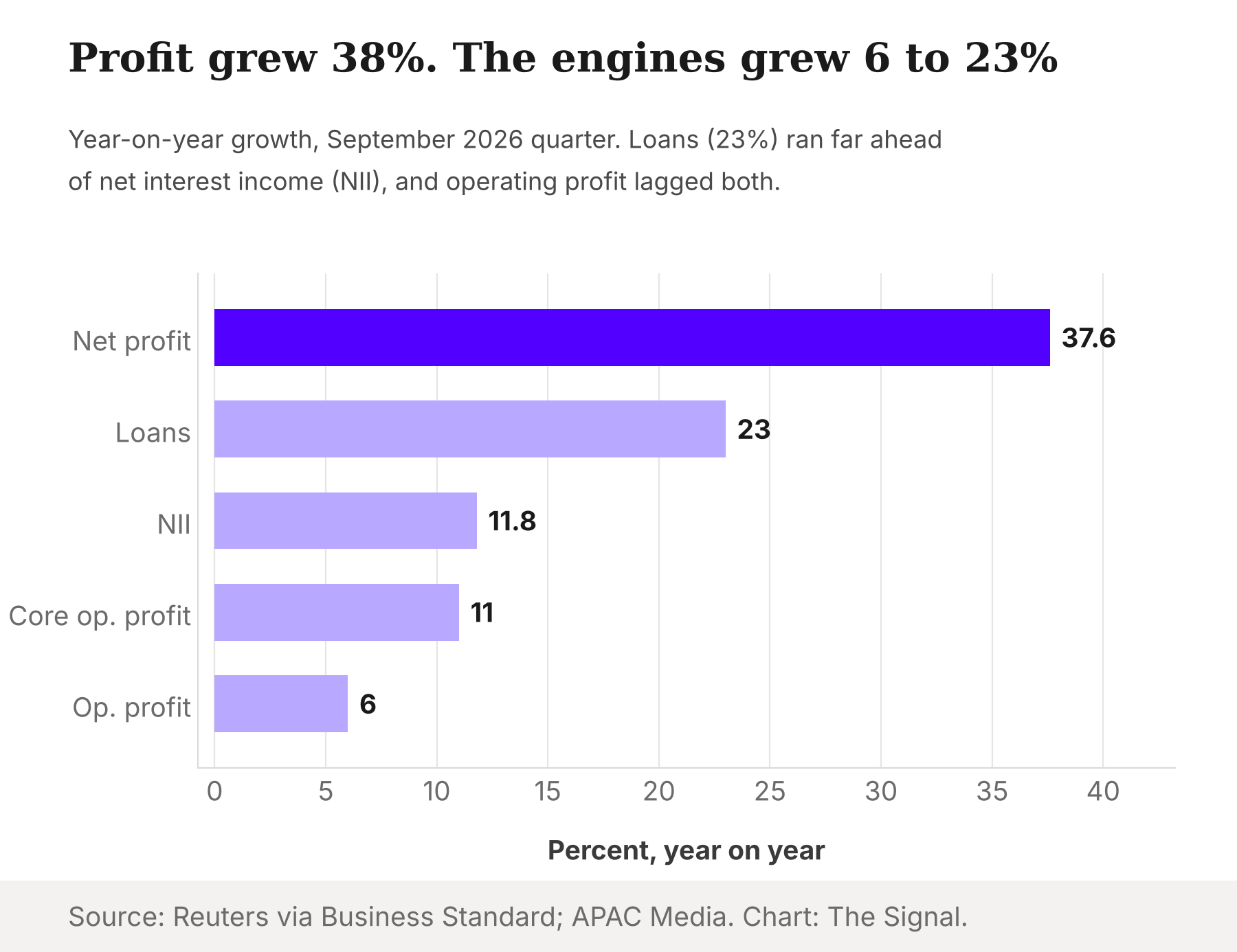
Growth in the business itself was uneven. Loans rose 23 percent, and net interest income, the gap between what the bank earns on loans and pays on deposits, grew 11.8 percent to ₹15,371 crore. Lending grew about twice as fast as the income it produced.
The reason is margin. The net interest margin was 3.36 percent, or 3.47 percent excluding the impact of foreign currency non-resident (FCNR-B) deposits, the share of interest income the bank keeps on its earning assets. A year earlier it had narrowed to 3.73 percent. That is 37 basis points lost in twelve months.
The result shows in operating profit, the earnings before provisions. It rose 6 percent to ₹11,083 crore, while core operating profit rose 11 percent to ₹10,998 crore. The gap between the two comes from trading income: other income fell 1.4 percent to ₹6,531 crore as rising bond yields and rupee volatility weighed on treasury income.
The sequential picture is flatter still. In the previous quarter, net interest income was ₹14,646 crore, up 8 percent on the year, and the quarter's net profit was ₹7,114 crore. This quarter's ₹7,003 crore is ₹111 crore lower, even as net interest income rose about 5 percent in three months.
The honest objection
The strongest case against this reading is that provisions are a real cost, and spending less on them is real profit. Nothing in the accounts treats the saving as an illusion. There is also a cushion behind the number. Axis said in July that it holds cumulative provisions of ₹15,608 crore, above and beyond its bad-loan provisioning, as of June 30, 2026. The bank is not running thin.
That is all true, and it answers a different question. Nobody disputes that Axis earned ₹7,003 crore. The question is what rate of growth to carry forward. A gain from a one-time charge falling out of the comparison does not recur next year, and a loan book growing 23 percent a year will, over time, need more provisions, not fewer. Growth of 38 percent is a poor guide to next year. Growth of 11 percent in core operating profit is a better one.
The Signal
Axis Bank's quarter is two stories sharing one number. One is a bank growing its loan book by 23 percent. The other is a margin that fell from 3.73 percent to 3.36 percent, 37 basis points, which left operating profit growing 6 percent. The 38 percent figure blends them, and it flatters the second.
Watch two things. First, next year's comparison: the September 2027 quarter will face a base with no ₹1,231 crore charge in it, so profit growth will have to come from the engine, not a lighter provisions line. Second, the margin. If it stabilises near its current level while loans keep compounding, the gap between profit and operating profit will close from below. If not, the loan book will keep outrunning what it earns. A profit rise is only as durable as the line that produced it.
Reporting basis: the profit, net interest income, provisions, other income and analyst-consensus figures for the latest quarter are per Reuters, as carried by Business Standard. The net interest margin and the operating and core operating profit figures rest on a single report by APAC Media, which matched the Reuters figures wherever the two could be compared. The year-ago provisions, the one-time crop-loan provision, the year-ago margin and the bank's statement about that provision are per PTI, as carried by Outlook Business. The June 2026 net interest income, profit and cumulative provision figures are from Axis Bank's own first-quarter press release. The profit growth rate, the changes in profit and provisions, the provisions excluding the one-time charge and the growth rate against an unadjusted base are The Signal's calculations from those figures.