On 13 October 2026, Hyundai Motor Group announced that it would invest USD 15.5 billion in India from 2026 through 2032, according to its own newsroom release. Business Today carried the same figure, describing a seven-year plan. The headlines wrote themselves: one of the world's larger carmakers is doubling down on India, and the number is big enough to sound like a verdict on the country's manufacturing future.
It is worth slowing down on the number. A pledge this size is only as informative as the detail behind it, and the detail is thin.
One line carries a price tag
The release gives exactly one dollar figure below the headline. Hyundai says approximately USD 700 million is planned for its R&D centre, including a vehicle testing track, as Business Today reports it. Autocar Professional reports the same R&D line and lists the other pieces of the plan: manufacturing expansion at Hyundai and Kia, supplier development and new mobility businesses. None of those carries an amount.
Seven hundred million dollars is about 4.5 percent of the $15.5 billion. The other 95.5 percent, roughly $14.8 billion, is described by purpose but not by size.
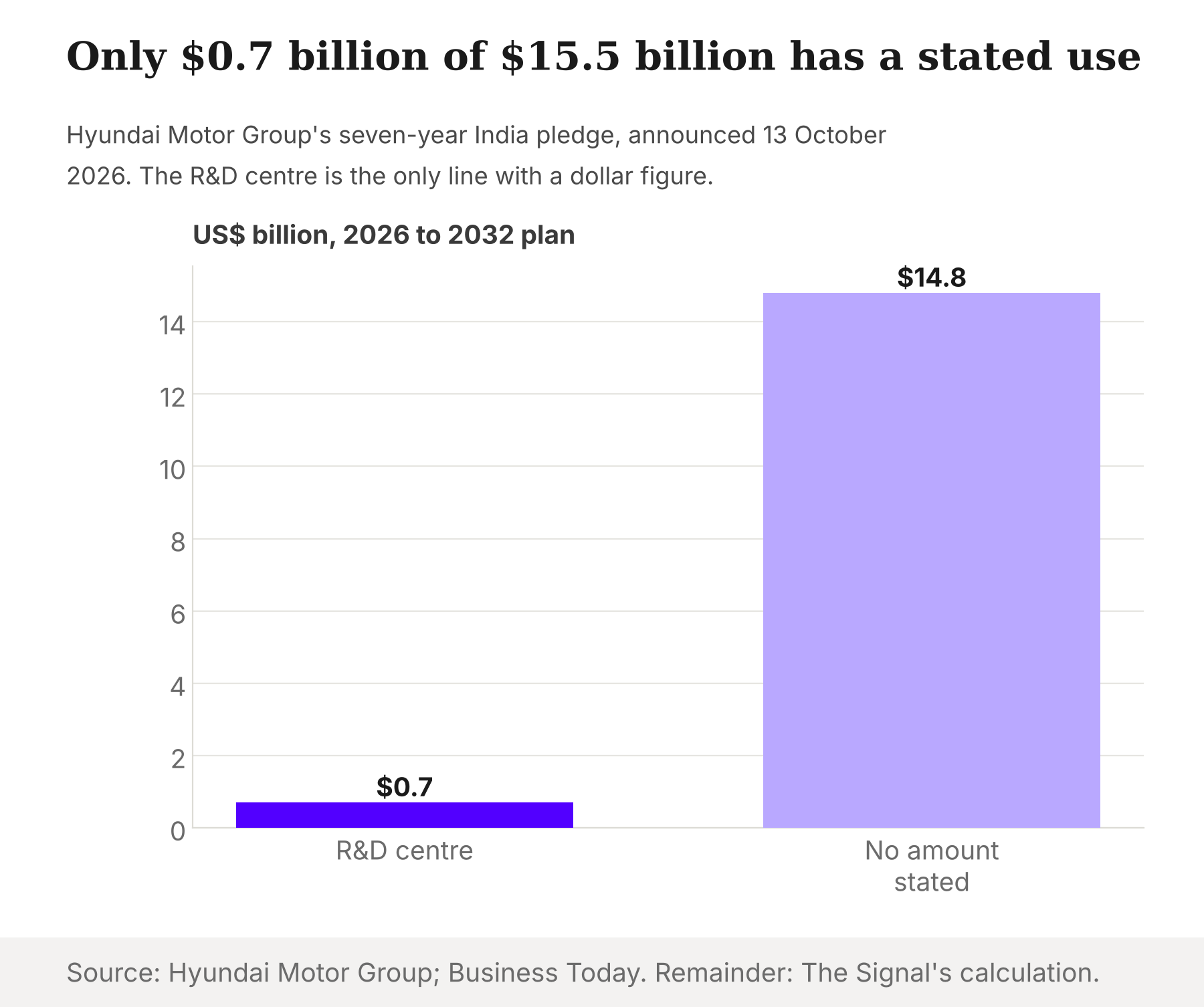
Spread evenly, the pledge works out to about $2.2 billion a year over its seven years. That is an average of a plan the company has not broken down by year either.
The capacity question the pledge skips
The most concrete business case for spending is capacity. Autocar Professional reports that the group's combined annual production capacity in India currently exceeds 1.4 million vehicles, made up of 824,000 at Hyundai's Chennai plants, 170,000 at Pune and 431,000 at Kia's Anantapur plant.
Hyundai Motor India has been using it. The company sold a record 77,916 vehicles in September 2026, as Autocar Professional reports, citing the company. Of those, 20,750 were exports, about 27 percent of the month's volume.
Annualise that record month and it comes to roughly 935,000 vehicles, against 994,000 of capacity at the two Hyundai-branded sites (Chennai plus Pune). That is about 94 percent, on The Signal's rough arithmetic. It is a loose comparison: sales are not production, one month is not a year, and September was Hyundai's best month on record. But it points at why the group wants more plant. What the release does not say is how many more vehicles the $15.5 billion buys.
A different pledge, with the detail in it
Hyundai has shown it can be specific. In October 2025, Hyundai Motor India announced plans to invest ₹45,000 crore by the financial year 2030, as Outlook Business reports. That plan came with a locally made electric SUV by 2027 and a market share target. The two pledges are not the same thing: the first covers the Indian subsidiary alone, and the new one covers the whole group, including Kia. The Signal has not tried to reconcile them, because the October 2026 release does not.
That gap in comparability is itself the point. A reader cannot tell from the October 2026 announcement how much of the $15.5 billion is the ₹45,000 crore already promised, and how much is new.
The honest objection
The strongest defence of the pledge is that group-level announcements are meant to be envelopes. They signal intent to a government that wants factories, and the line items follow later in plant-level filings. On this view, counting how much is itemised on day one measures the format of the press release and not the seriousness of the plan.
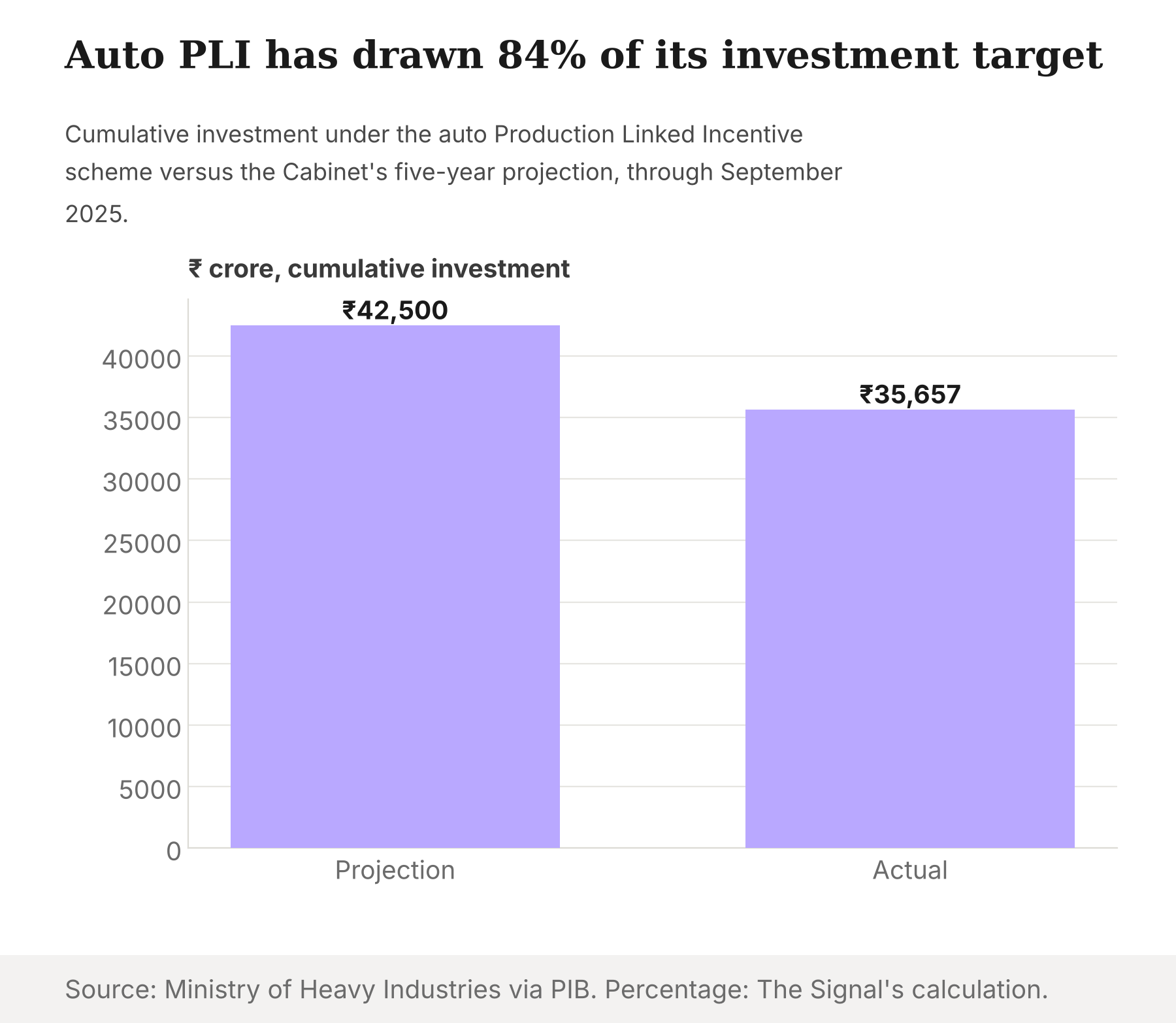
There is something to that, and the scale is not trivial. The government's own scheme for autos offers a yardstick. Under the production-linked incentive programme for autos, cumulative investment reached ₹35,657 crore through September 2025, against a five-year projection of ₹42,500 crore, according to the Ministry of Heavy Industries via PIB. That is about 84 percent of the target, from a scheme covering the entire industry.
But the objection answers a different question. Nobody doubts that Hyundai will spend money in India. The question is what the money is for, and an envelope cannot answer it. The one use that has a price is an R&D centre and a test track, which on its face adds no vehicles of capacity.
The export base it lands on
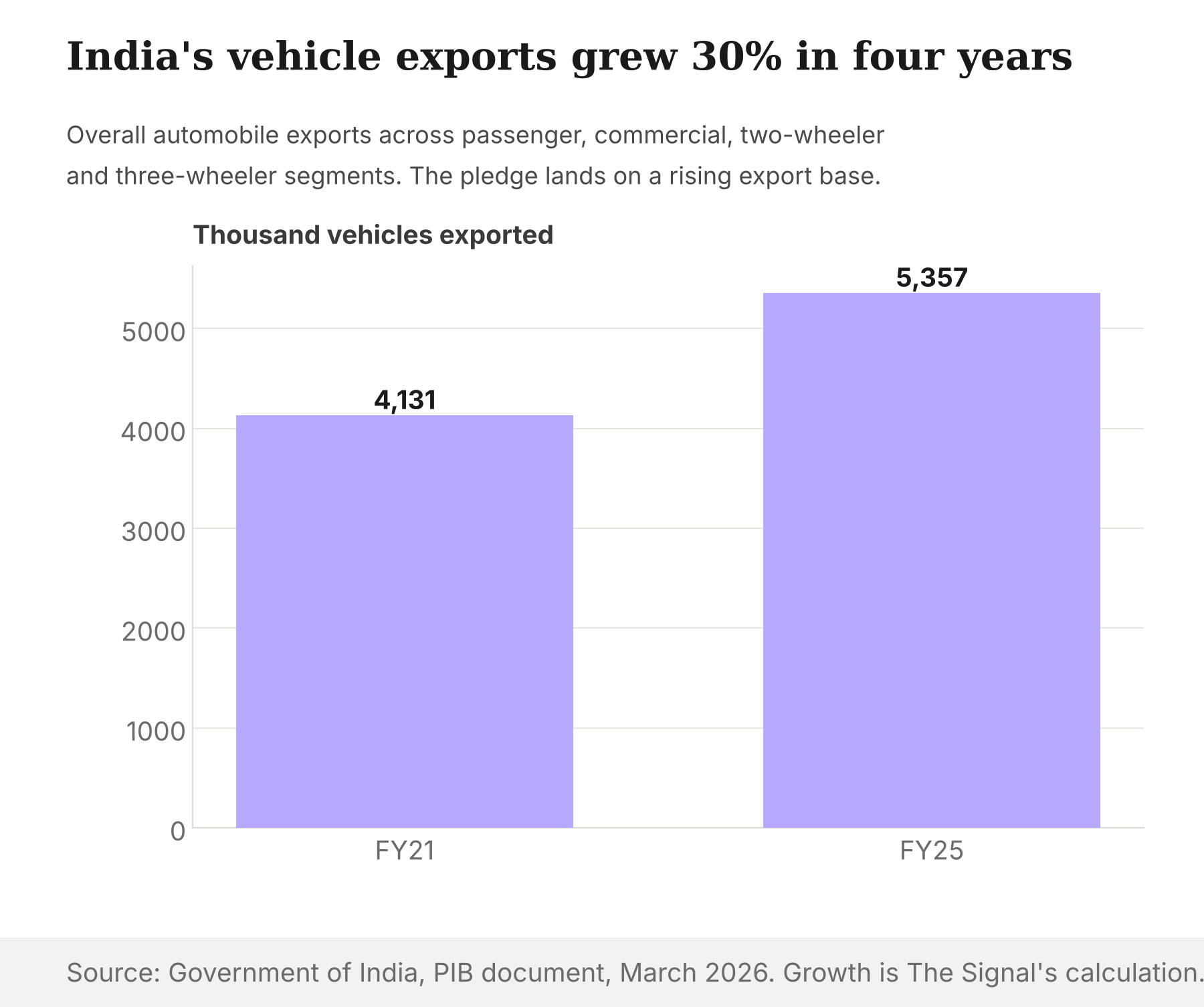
The export story is real, even if the pledge does not quantify it. Hyundai says India will become one of the leading global export platforms for the Group. India's overall automobile exports rose from 4,131 thousand vehicles in FY21 to 5,357 thousand in FY25, according to a March 2026 government document, an increase of about 30 percent across all segments.
The latest data on Hyundai's own exports is monthly and noisy, so it settles nothing alone. It does show exports at more than a quarter of September's volume. If the group is serious about the platform role, the next filings should show it in export-linked capacity and not only in the headline.
The Signal
The $15.5 billion is a ceiling on ambition, not a measure of commitment. What is committed, in dollars, is a $700 million R&D centre. Everything else is a direction of travel, and it arrives with no capacity target, no electric-vehicle amount and no split between Hyundai and Kia.
Watch three things over the next year. First, whether Hyundai Motor India or Kia India files plant-level figures that add up to a visible share of the $15.5 billion. Second, whether the separate ₹45,000 crore plan is folded into the group number or stands beside it. Third, whether Pune, which will scale up in phases, gets a stated number of vehicles. A pledge becomes an investment when it has a line item, a plant and a date.
Reporting basis: the $15.5 billion pledge, the 2026 to 2032 window and the capacity figures come from Hyundai Motor Group's own newsroom release, as relayed and corroborated by Business Today and Autocar Professional, which reported the $700 million R&D line and the plant-level capacity; these three rest on one underlying announcement, so they count as a single origin for the pledge itself. The September 2026 sales figures are Hyundai Motor India's, as reported by Autocar Professional. The ₹45,000 crore October 2025 plan is Hyundai Motor India's, as reported by Outlook Business. Scheme investment figures are from the Ministry of Heavy Industries via a PIB release dated 31 December 2025, and the export series is from a March 2026 PIB document. The 4.5 percent share, the $14.8 billion remainder, the $2.2 billion annual average, the 27 percent export share, the 94 percent capacity comparison, the 84 percent scheme share and the 30 percent export growth are The Signal's calculations from those figures.