The September headline is easy to read. India imported 585,000 tonnes of LNG from Oman, according to Kpler ship-tracking data reported by IANS, a 27 percent share of the month's imports and 11.6 percent more than in August. Oman is the largest supplier. Qatar, long the anchor of India's gas supply, is nowhere near the top, and the country that replaced it appears to sit safely outside the Gulf's most dangerous waterway. On that reading, India has diversified its way out of trouble.
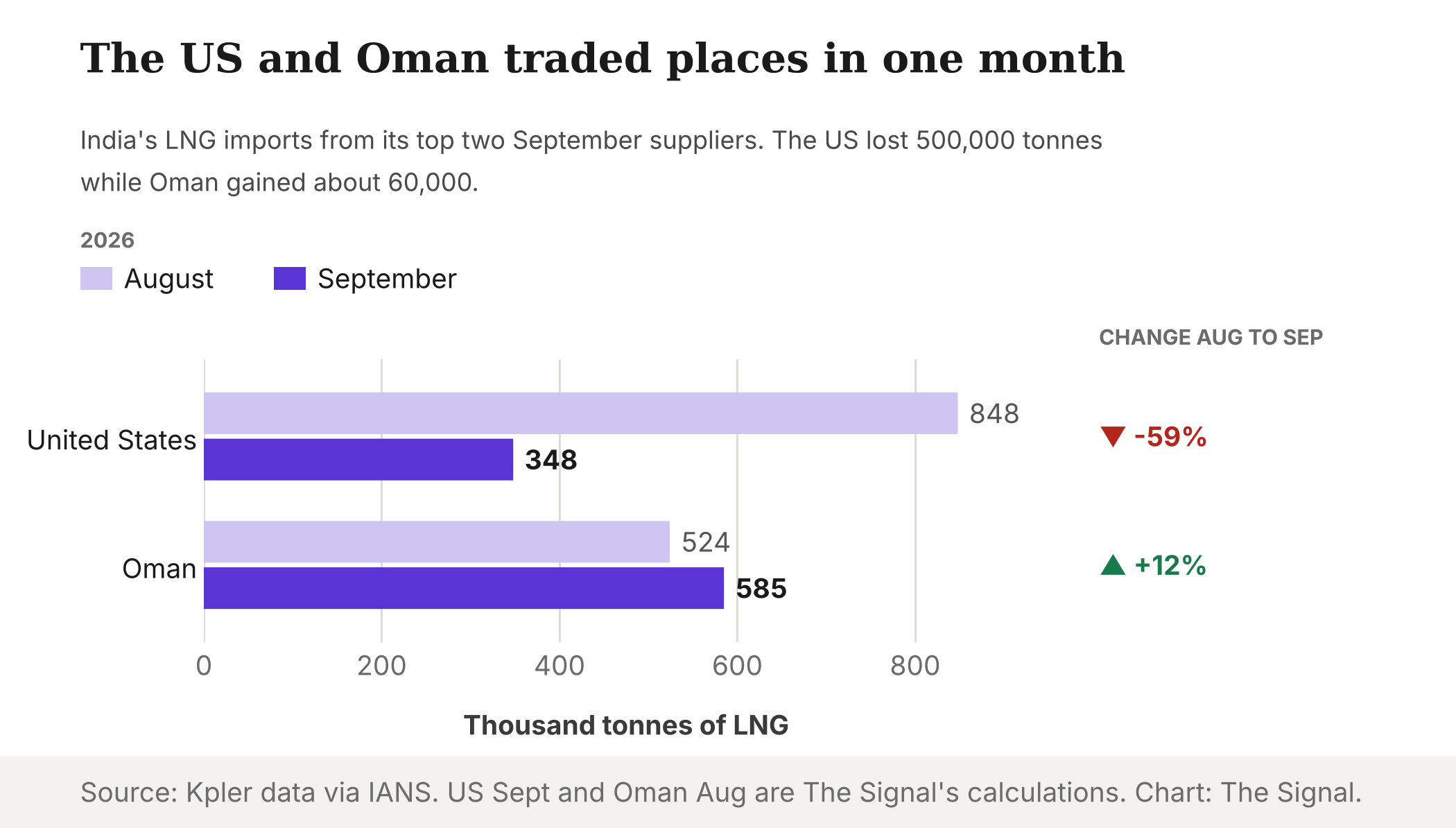
It is worth slowing down on that. The same report says the US had topped the supplier list in August with 848,000 tonnes and slipped to third place, with American shipments down 59 percent. A 59 percent fall from 848,000 tonnes leaves about 348,000 tonnes. Oman's August volume, backed out of its 11.6 percent rise, was about 524,000 tonnes. The two did not swap places because Oman surged. They swapped because the US dropped by roughly 500,000 tonnes while Oman gained about 60,000.
Oman won the ranking by 61,000 tonnes while the US fell by 500,000.
The top spot, in other words, was decided by one supplier's cargoes disappearing in a single month, per the Kpler data.
The number that did not recover
The more telling figure sits further down the ranking. Qatar, once India's dominant supplier with a market share of around 45 percent, fell to sixth position, according to the same Kpler-based reporting, after Iran's strike on Ras Laffan Industrial City in March.
The damage there is not a passing outage. Iranian missiles hit Ras Laffan on March 18 and 19, knocking out two LNG production trains and a gas-to-liquids plant, about 17 percent of Qatar's LNG export capacity, or roughly 12.8 million tonnes a year. The report says company officials put repairs at three to five years, and that QatarEnergy declared force majeure on several long-term contracts. That is a statement about Qatar's own capacity. It is separate from any question about shipping lanes.
The shipping-lane question is real too. About 20 percent of global LNG trade transited the Strait of Hormuz in 2024, primarily from Qatar, the US Energy Information Administration reports. The same EIA analysis puts Qatar's flow through the strait at about 9.3 billion cubic feet a day in 2024 and the UAE's at about 0.7. Those are 2024 figures, the latest year in the source, and they describe the exposure before this year's strikes. They explain why a buyer would want cargoes that never enter the strait. As a matter of geography, Oman's terminal sits on the Indian Ocean side of it, which is the plain reason Omani gas appeals to a buyer worried about Hormuz. None of the sources here quantifies how much of India's recent shift was driven by that route risk rather than price or cargo availability.
Supply shrank while the names changed
The ranking also obscures a quantity. India's overall LNG imports fell 14 percent month on month to 2.17 million tonnes in September, from 2.5 million tonnes in August. Rearranging suppliers did not add molecules. The month's biggest change was a loss.
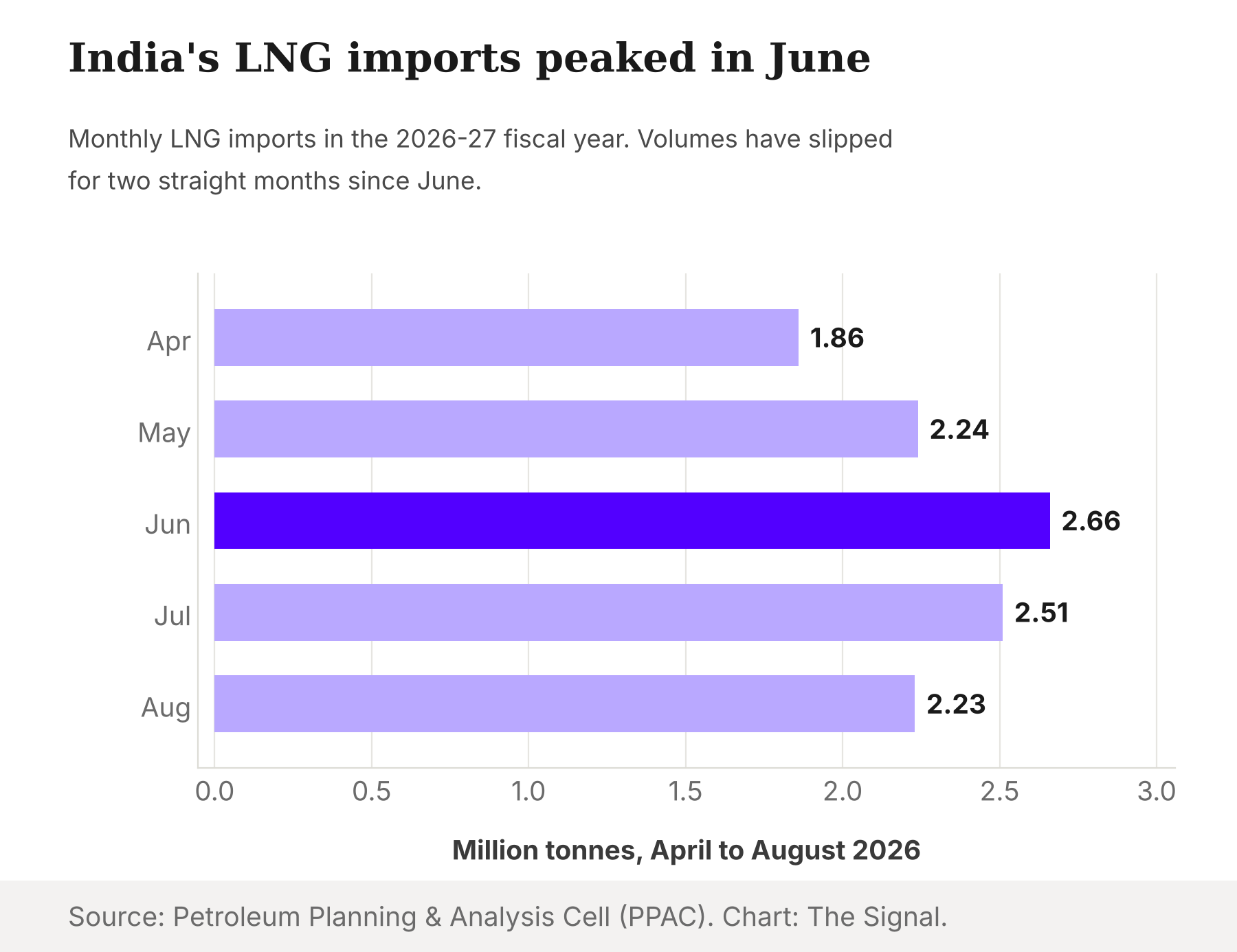
Official data tell a similar but not identical story, and the gap between the two is itself a caution. India's Petroleum Planning & Analysis Cell recorded 2.23 million tonnes of LNG imports in August, against Kpler's 2.5 million for the same month: a difference of about 12 percent between the two trackers. The PPAC series runs from 1.86 million tonnes in April to a peak of 2.66 million in June, then 2.51 million in July and 2.23 million in August. PPAC's file did not yet carry September when we read it, and it gives totals only, with no breakdown by supplier. Every supplier ranking in this piece therefore rests on a single commercial tracker, relayed by wire copy.
The honest objection
The strongest case against this reading is that a monthly ranking is the wrong lens. Supply contracts are long, and one weak month for American cargoes may reflect where spot ships happened to be, not any change in India's strategy. That is fair, and it supports the point rather than undermining it. If the headline supplier can change on a swing of roughly 500,000 tonnes in American cargoes, then "top supplier" is a statement about one month of trade. It tells a reader little about how secure the supply is.
The other fair objection is that Oman is a real and growing supplier: its volume rose 11.6 percent in September. That is true, and the rise is modest next to the American drop. Oman can be a durable supplier while the title it holds stays unstable.
The Signal
India's gas supply lost its former anchor to missile damage that, by the company's own estimate, will take three to five years to repair. The replacement pattern so far looks like a rotation of cargoes, not a new foundation. The month's hard fact is that total imports fell 14 percent while the names at the top of the list changed.
Watch three things: whether PPAC's September file lands near the Kpler total, whether American cargoes return in October, and whether Qatar's share recovers while repairs run. A ranking is a headline. A supply is gas that arrives.
Reporting basis: the supplier volumes, shares and Qatar's historical market share are from Kpler ship-tracking data, as reported by IANS and carried by The Hans India and the Free Press Journal; that is one origin, not two, and the load-bearing supplier ranking rests on it alone. Monthly import totals are from the Petroleum Planning & Analysis Cell. The Hormuz transit shares and Qatar and UAE flows are from the US Energy Information Administration for 2024. The Ras Laffan damage figures are from All India Radio's report of the QatarEnergy statement. The US September volume, Oman's August volume, the roughly 500,000 and 60,000 tonne changes and the 12 percent tracker gap are The Signal's calculations from those figures.