The headline from the Centre's accounts for the first five months of 2026-27 looks manageable. Gross tax revenue was Rs 14,31,903 crore in April to August 2026, against Rs 13,43,963 crore a year earlier, according to the Controller General of Accounts. That is growth of 6.5 percent. Corporation tax, income tax, central GST and customs all grew. The Budget's tax target, on this reading, is a matter of pace.
It is worth slowing down on one line. Union excise duty collections were Rs 86,687 crore in April to August 2026, against Rs 1,11,927 crore in the same months of 2025-26, the Controller General of Accounts reports. That is a fall of 22.6 percent, on a line the Budget expects to grow.
The cut that opened the gap
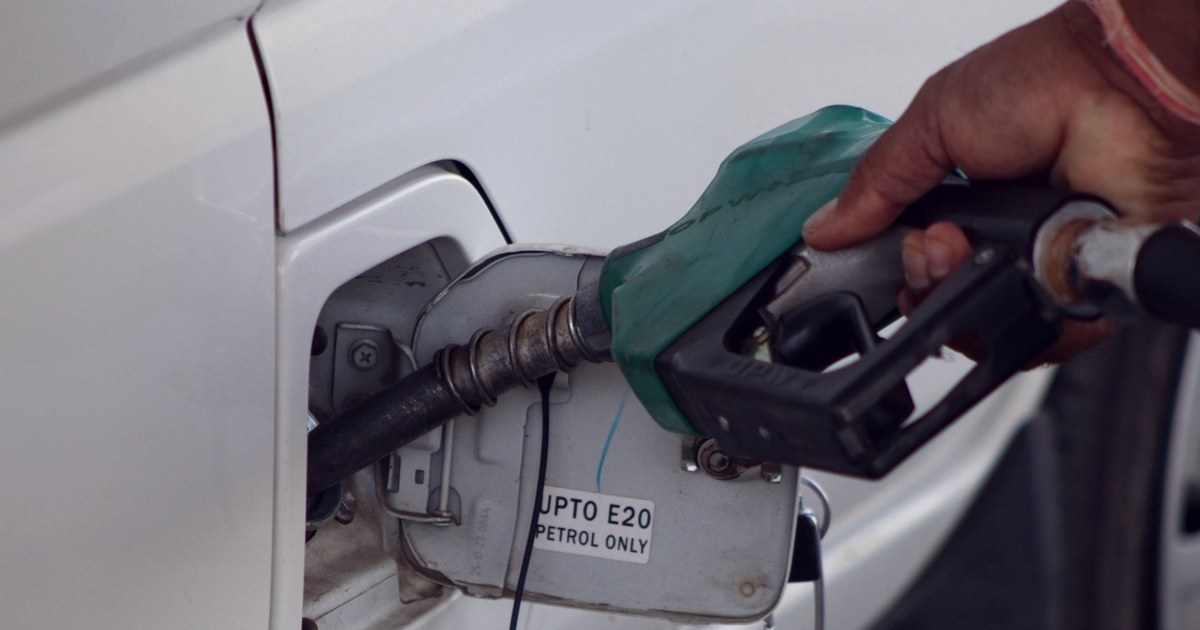
The cause is a decision, not a downturn. On 27 March 2026, a Press Information Bureau release stated that the government had reduced excise duty by Rs 10 per litre on both petrol and diesel, with crude having risen from about $70 to about $122 a barrel in under four weeks. Pump prices did not change. The release says the cut directly reduces the under-recoveries being absorbed by the public sector oil marketing companies, then about Rs 26 a litre on petrol and Rs 81.90 on diesel, a combined roughly Rs 2,400 crore a day.
The Budget was written before that. The Receipt Budget sets the 2026-27 Budget Estimate for union excise duties at Rs 3,88,910 crore, against a 2025-26 Revised Estimate of Rs 3,36,550 crore. The provisional outcome for the year to March 2026 was Rs 3,41,851 crore. So the Budget assumed excise would grow 13.8 percent on the 2025-26 outcome. After a duty cut of this size, it is running 22.6 percent below last year.
The petroleum sector's own contribution tells the same story from the other side. Petroleum Planning and Analysis Cell data show the sector paid Rs 3,08,381 crore in excise in 2025-26 (provisional), and its total contribution to the central exchequer was Rs 4,75,739 crore that year and Rs 64,583 crore in the first quarter of 2026-27 (provisional). One quarter at Rs 64,583 crore is about 46 percent below a quarter of the 2025-26 total, which is Rs 1,18,935 crore.
What September to March has to deliver
The arithmetic of the remaining seven months is where the target gets hard. The provisional accounts for 2025-26 put union excise duties at Rs 3,41,851 crore for the full year. Subtract the Rs 1,11,927 crore collected in April to August 2025, and September to March 2025-26 produced Rs 2,29,924 crore.
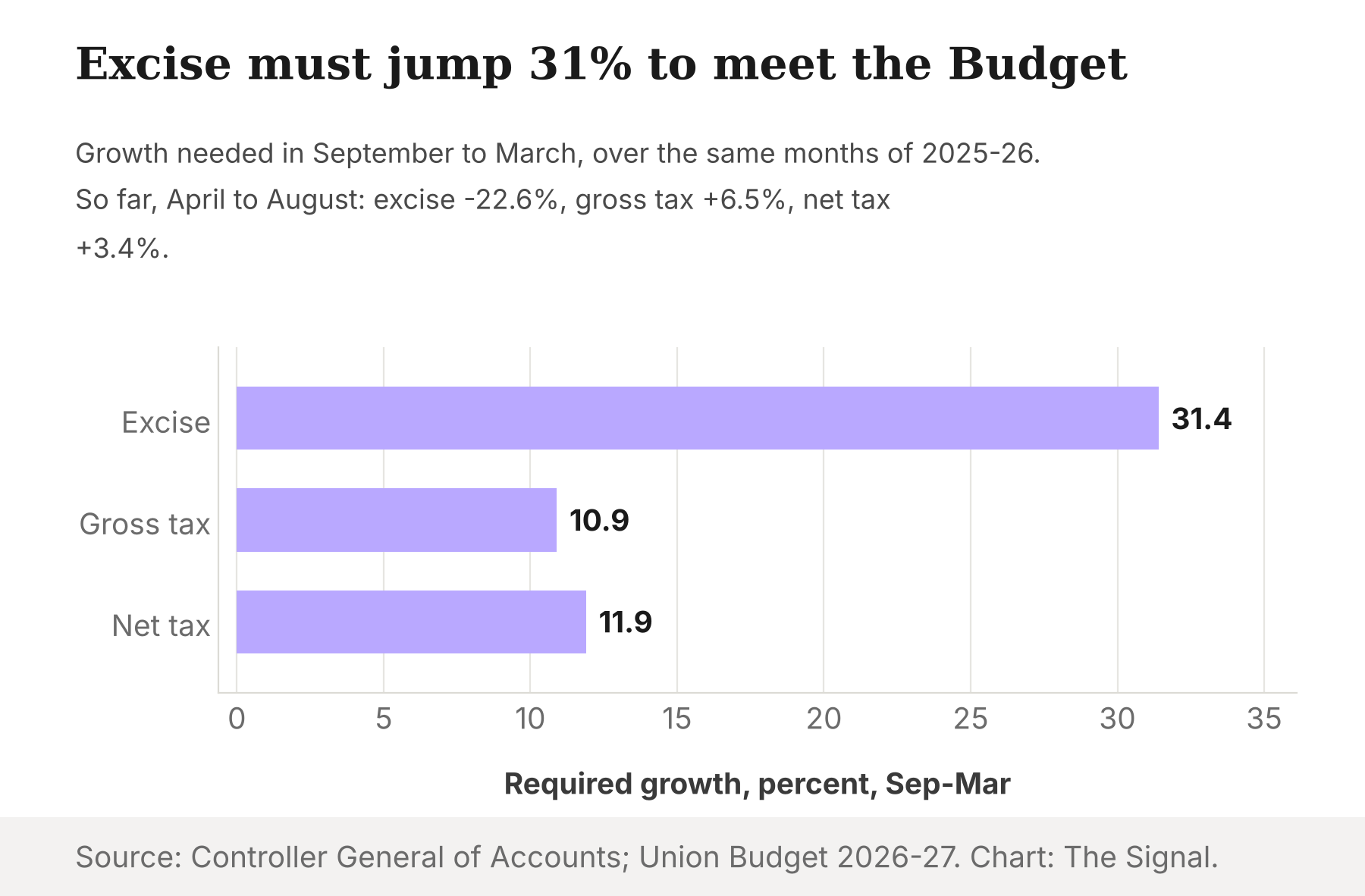
To reach the Budget Estimate of Rs 3,88,910 crore, September to March 2026-27 must produce Rs 3,02,223 crore, after the Rs 86,687 crore already collected. That is growth of 31.4 percent on the same months a year earlier, from a line that has just shrunk by 22.6 percent. If excise merely matches last year over those seven months, the full year ends near Rs 3,16,611 crore, about Rs 72,300 crore short of the Budget Estimate.
The headline target the Budget uses is net tax revenue, the Centre's share after the states' cut. The Budget at a Glance puts the 2026-27 Budget Estimate for the Centre's net tax at Rs 28,66,922 crore and gross tax revenue at Rs 44,04,086 crore. Net tax here is gross tax less assignment to states and the NCCD amounts transferred to the disaster fund, which is how the accounts treat it.
For April to August 2026, gross tax was Rs 14,31,903 crore, the states' assignment was Rs 5,90,391 crore, and NCCD transfers were Rs 3,591 crore. That leaves net tax of Rs 8,37,921 crore. For April to August 2025 the same calculation gives Rs 8,10,407 crore, so net tax has grown 3.4 percent. For the full year 2025-26, provisional gross tax was Rs 40,24,347 crore, with Rs 13,92,971 crore assigned to states and Rs 8,112 crore in NCCD transfers, leaving net tax of Rs 26,23,264 crore. To reach Rs 28,66,922 crore, net tax in September to March must grow 11.9 percent over the same months of last year. The first five months delivered 3.4 percent. These net figures are The Signal's calculations from the accounts.
The rest of the system is on pace, not ahead of it
A reasonable reader would ask whether the other lines can carry the gap. They are doing well. Corporation tax rose to Rs 2,64,520 crore from Rs 2,29,295 crore, and taxes on income other than corporation tax rose to Rs 4,95,454 crore from Rs 4,41,013 crore. Together that is Rs 7,59,974 crore against Rs 6,70,308 crore, growth of 13.4 percent. Central GST reached Rs 4,50,721 crore against Rs 3,90,502 crore, up 15.4 percent. Customs collections were Rs 1,06,516 crore against Rs 83,062 crore, up 28.2 percent.
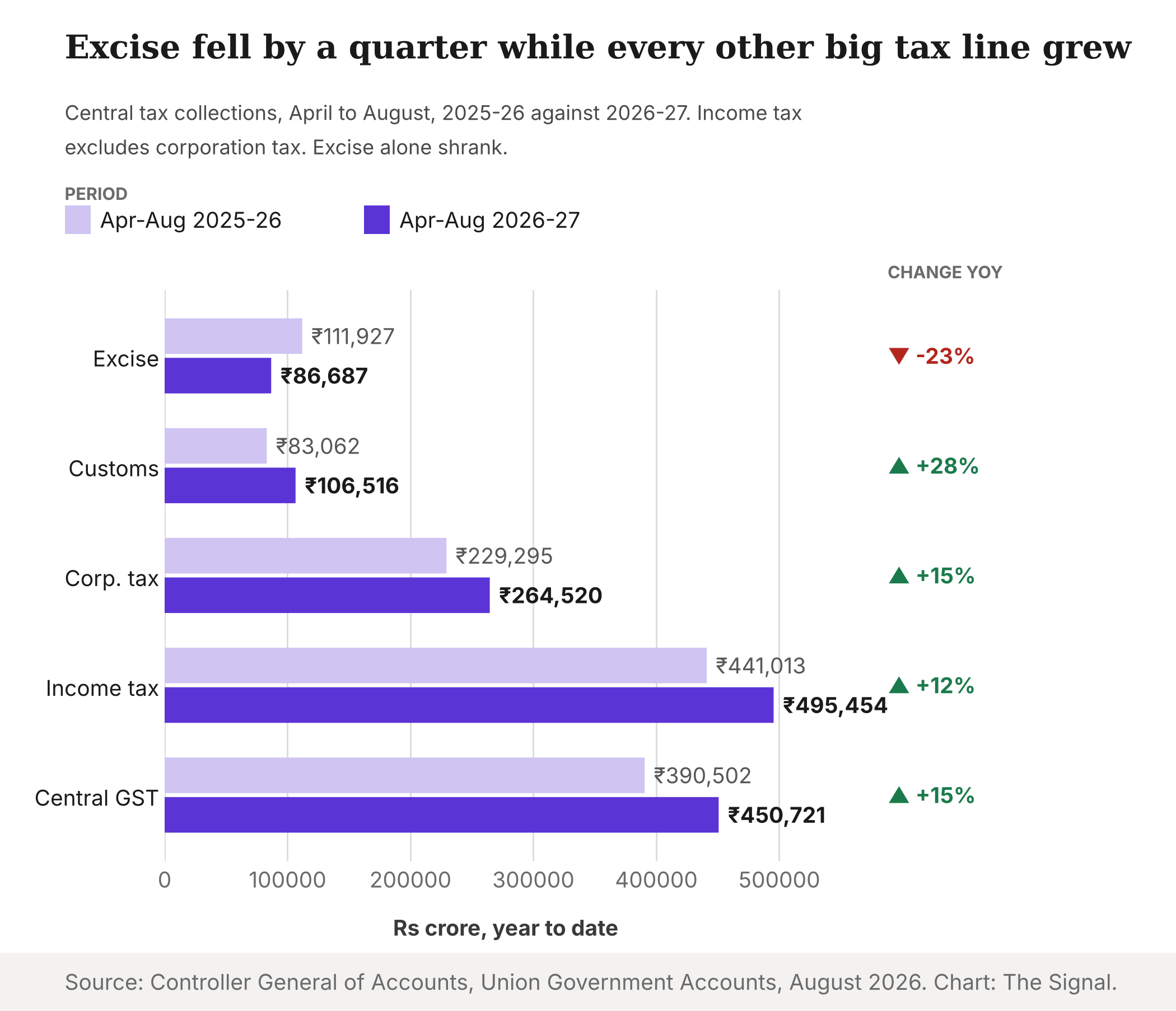
The comparison that matters is with what the Budget required. Strip excise out of both the target and the outcome. The Budget's gross target of Rs 44,04,086 crore less its excise estimate of Rs 3,88,910 crore leaves Rs 40,15,176 crore for everything else. Last year's provisional gross tax of Rs 40,24,347 crore less excise of Rs 3,41,851 crore leaves Rs 36,82,496 crore. Everything else therefore needs to grow 9.0 percent for the year. In April to August, it grew 9.2 percent: Rs 13,45,216 crore against Rs 12,32,036 crore, once gross tax of Rs 14,31,903 crore and Rs 13,43,963 crore are cut by the excise figures of Rs 86,687 crore and Rs 1,11,927 crore.
That is the finding. The rest of the tax system is running about two-tenths of a point ahead of what the Budget required, which is a cushion of roughly Rs 6,000 crore over a full year. It is nowhere near the Rs 72,300 crore that excise alone could leave open against its Budget Estimate of Rs 3,88,910 crore, given September to March excise of Rs 2,29,924 crore last year. Strong direct taxes and customs are keeping the other lines on budget. They are not rescuing the one line that is off it.
The honest objection
The strongest case for calm is that the gap is small and the calendar is long. Excise is a minor part of the whole: Rs 3,88,910 crore of a Rs 44,04,086 crore gross target, under 9 percent. A Rs 72,300 crore miss is about 1.6 percent of gross tax revenue. Tax growth can also bunch late in the year, and a duty set in March can be reset in any month. If the cut is reversed or fuel volumes surprise, the 31 percent requirement softens.
That case is fair, and it is why this is a question about margin rather than a forecast of failure. But it answers a different question. The Budget did not price a Rs 10 per litre cut. A reversal would restore revenue only by reversing the policy that kept pump prices flat, when, as of March, the oil companies were absorbing about Rs 2,400 crore a day in under-recoveries. And the net tax target sits behind a second hurdle: net tax growth of 3.4 percent so far against the 11.9 percent needed, with the states' assignment growing faster than gross tax. The states' assignment rose to Rs 5,90,391 crore from Rs 5,30,148 crore, up 11.4 percent against gross growth of 6.5 percent.
The Signal
The tax system outside excise is performing, but only to plan, as the Controller General of Accounts' August figures show. That means the target does not hold because the economy is outrunning the Budget. It holds, if it holds, only if excise recovers from a fall of 22.6 percent to growth of 31 percent, or if the Centre accepts a miss and absorbs it elsewhere in the accounts. Watch the monthly accounts for September and October. If excise collections stay near the April to August run rate of about Rs 17,300 crore a month, the Rs 72,300 crore hole is the number to hold the Budget to. A tax cut that keeps pump prices still is not free; it is a line in the accounts that someone has to fill.
Reporting basis: monthly tax collections for April to August 2026 and 2025, and the provisional full-year 2025-26 collections, are from the Controller General of Accounts' Union Government Accounts, which compile the Centre's receipts. Budget Estimates and the 2025-26 Revised Estimate are from the Union Budget's Receipt Budget and Budget at a Glance, published by the Ministry of Finance. The March 2026 excise cut, the crude price move and the oil marketing company under-recoveries are from a Press Information Bureau release. Petroleum sector payments to the Centre are from the Petroleum Planning and Analysis Cell. Everything here rests on four official origins, and no news outlet's reporting is used. The net tax figures, required growth rates, the Rs 72,300 crore gap, the ex-excise comparison, the 13.8 percent Budget assumption and the quarterly petroleum comparison are The Signal's calculations from those figures.