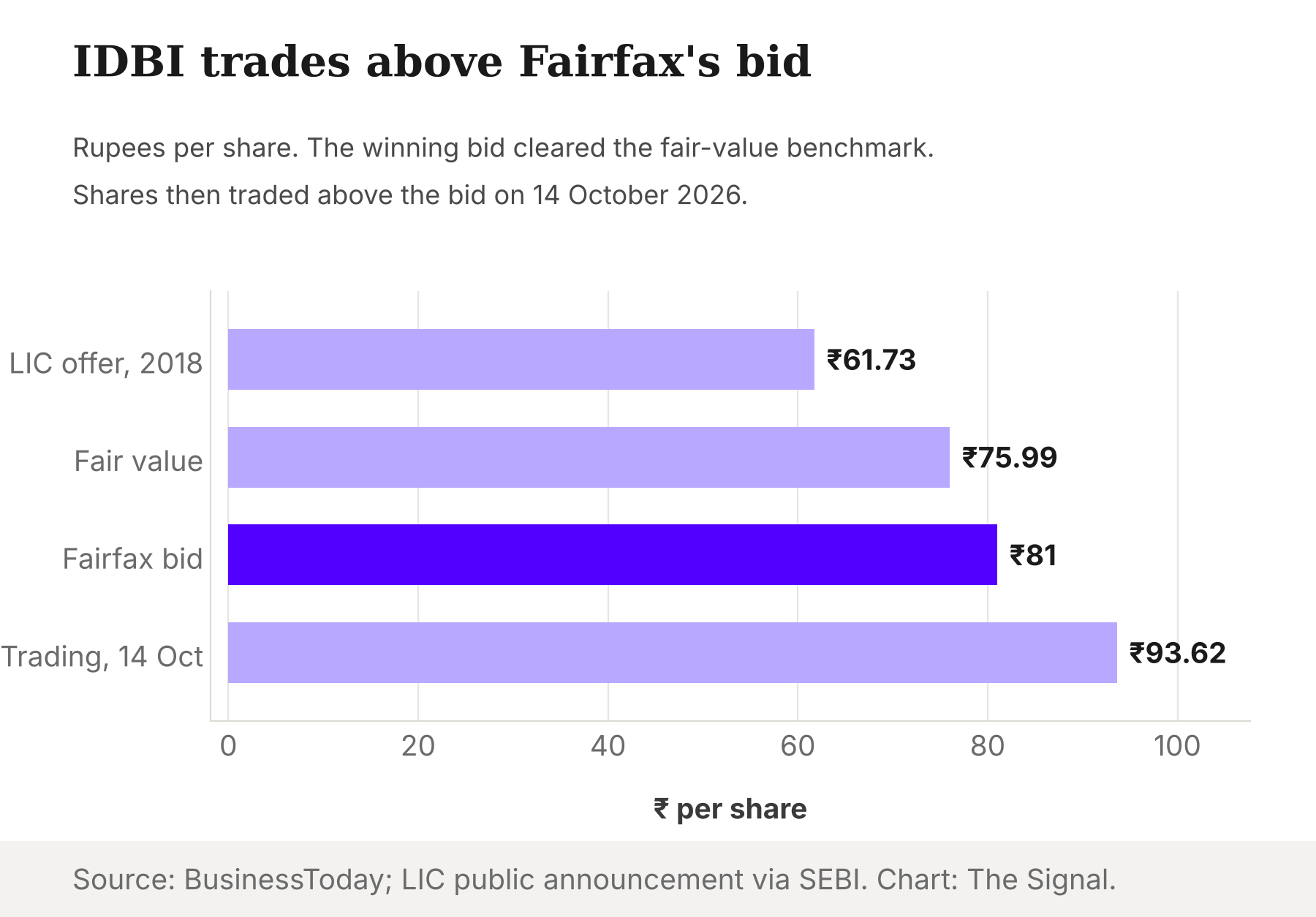
On 14 October 2026 the Cabinet Committee on Economic Affairs cleared the sale of a 60.72% stake in IDBI Bank to Canada Inc., the parent of Fairfax Financial Holdings, for Rs 52,878.08 crore. The government sells 30.48% and LIC sells 30.24%. The winning bid was Rs 81 a share, against a fair-value benchmark of Rs 75.99 set from two independent valuations. By that measure the process worked: a competitive bid, 6.6% above the benchmark.
The same day, IDBI Bank shares rose 13% to Rs 93.62. That is 15.6% above the price the buyer is paying for control.
It is worth slowing down on that gap. A control sale is supposed to price in a premium over the market. Here the market has priced in a premium over the control sale.
Four prices for one bank, and the newest is the highest. The chart sets LIC's 2018 offer price beside the fair-value benchmark and winning bid and the 14 October trading price.
What the headline number leaves out
Rs 52,878 crore is the price of the 60.72% that changes hands. It is not the value of the bank, and it is not everything the state will realise. The government and LIC will together hold 34% of the restructured entity, and Fairfax must also make an open offer to minority shareholders. Neither the size nor the price of that offer has been published.
Work backwards from the deal terms and the scale becomes visible. Rs 52,878.08 crore at Rs 81 a share is about 653 crore shares, and since that is 60.72% of the bank, IDBI has roughly 1,075 crore shares outstanding (our calculation). At Rs 81 the whole bank is worth about Rs 87,000 crore. At Wednesday's Rs 93.62 it is worth about Rs 1.01 lakh crore.
Two consequences follow. Priced at the day's Rs 93.62 rather than the Rs 81 bid, the stake being sold would be worth about Rs 8,200 crore more than Fairfax is paying. And the 34% the state keeps is worth about Rs 34,200 crore at that price, so every rupee on the share price moves the state's remaining holding by roughly Rs 365 crore.
The open offer is where the state gets a second price
SEBI's takeover rules require that an open offer be made for a minimum of 26% of the target company's share capital. The same SEBI guidance sets the minimum offer price for frequently traded shares as the highest of four figures: the negotiated price in the share purchase agreement, the acquirer's 52-week VWAP, the highest price the acquirer paid in the prior 26 weeks, and the volume weighted average market price over the 60 trading days before the announcement. The negotiated price here is Rs 81. The 60-day average is whatever the tape says, and the tape just moved up.
Now count the shares that could answer such an offer. Before the sale, the government held 45.48% of IDBI Bank and LIC held 49.24%. That leaves 5.28% with everyone else (our calculation). A 26% offer is almost five times the entire public float.
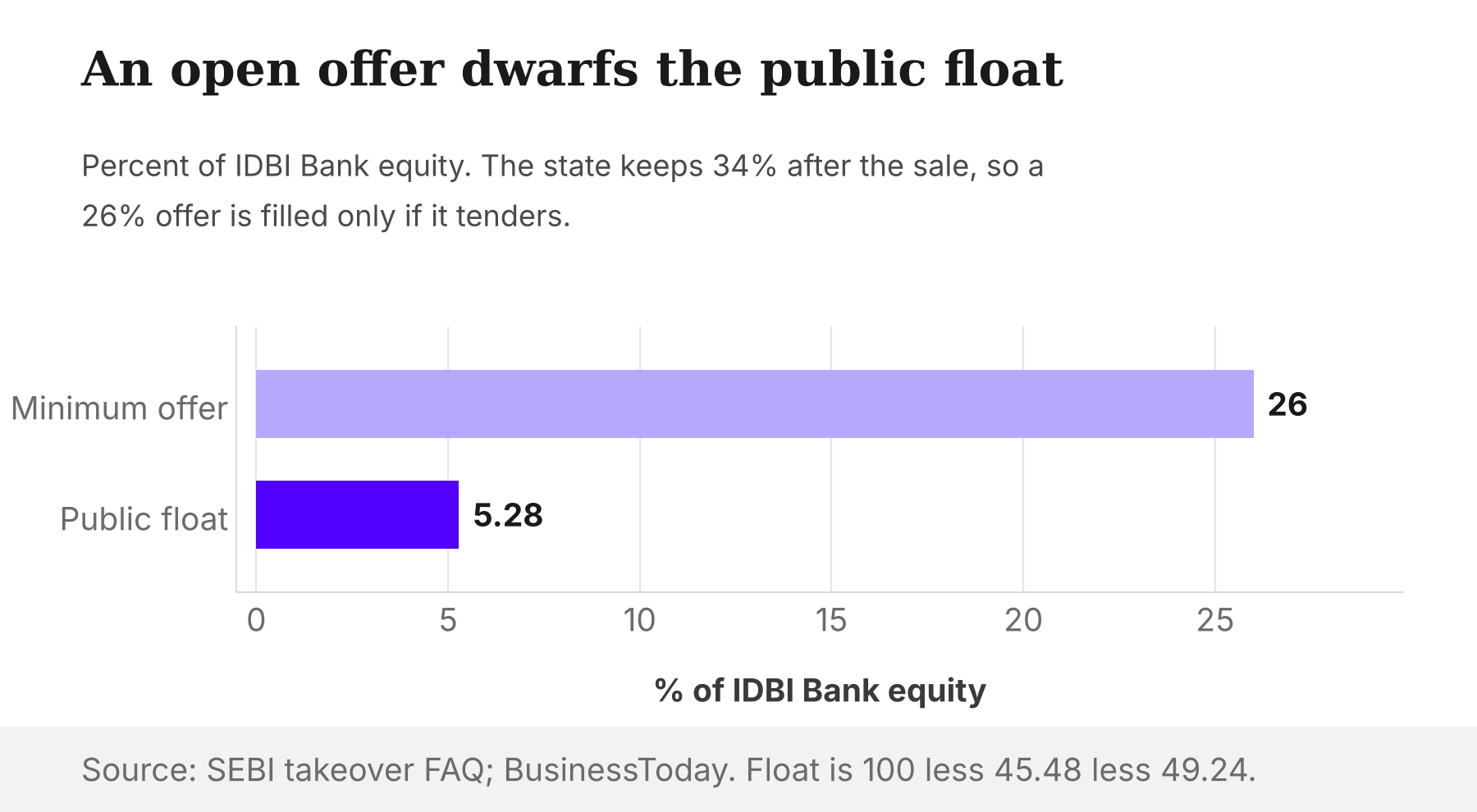
If the offer is sized at the regulatory minimum of 26%, it cannot be filled from the public alone. The only other sellers are the government, with 15% left, and LIC, with 19%, 34% between them. The open offer would then work as a second sale window for the state, priced no lower than Rs 81 and possibly higher. That is why the Rs 52,878 crore headline may understate the price the state ultimately collects, and why the market is paying more than the bid for shares it expects Fairfax to have to buy.
This is a reading of the rules, not a disclosed plan. The size of Fairfax's offer, and whether the government and LIC would tender into it, are not public.
The precedent LIC set in 2018
LIC knows this mechanism from the other side. In October 2018 it made an open offer for 26% of IDBI Bank's fully diluted voting capital, 2,04,15,12,929 shares, at Rs 61.73 a share in cash, as the first step to taking a 51% controlling stake. Fairfax's Rs 81 is 31% above that offer price. LIC is now a seller, in the same bank, on the other side of the same rule.
The honest objection
The strongest case that Rs 81 was fair is that the price was set by process, not by the tape. The fair-value benchmark came from two independent valuations, and the bid cleared it. A stock that jumps 13% in a day on deal news is often overshooting, and a bank with a 5.28% public float is a thin market where a few buyers can move the price. The 14 October price is one session, and the same stock has traded as low as Rs 61.01 and as high as Rs 118.38 in the period the government looked at.
That case is real, but it explains the size of the jump, not its direction. A control buyer who also faces a mandatory open offer, and who must either merge its CSB Bank stake into IDBI Bank or exit it within two years, is a buyer with reasons to pay more than the first price. The market is betting on those reasons.
The Signal
The government has said that once completed this will be the largest FDI in the financial sector of the Indian economy so far. It is also a test of how much of a public sector bank's value a control sale captures. Watch three things. First, the open offer: its size against the 5.28% float, and its price against the 60-day average. Second, whether the government and LIC tender their remaining 34% or hold it. Third, the share price against Rs 81 as the Reserve Bank's fit-and-proper review and the Competition Commission's clearance play out. If the stock stays above the bid, the state will have sold control at a price the market has not accepted as final.
Reporting basis: the approval, the Rs 52,878.08 crore price, the Rs 81 bid and the Rs 75.99 benchmark are per BusinessToday's report of the government's decision. The 34% retained stake, the open offer requirement, the CSB Bank condition and the "largest FDI" statement are per the Press Trust of India, as carried by DT Next. The Rs 93.62 share price is per BusinessToday's market report for 14 October 2026, and the July 2026 shareholding of 45.48% and 49.24% is per BusinessToday. The open offer size and price rules are per SEBI's published FAQ on its takeover regulations, and the 2018 offer is per LIC's public announcement filed with SEBI. Several of these reports rest on the same government statement, so the facts of the deal should be read as one origin, not four. The share count, implied valuations, public float, price gaps and per-rupee sensitivity are The Signal's calculations from those figures.