China's September customs data landed on October 14 with the kind of numbers that invite a simple story. Exports rose 36.3% from a year earlier, imports rose 31.0%, and September's trade surplus widened to $133.53 billion, according to Reuters reporting on the customs figures. The surplus has reached $938.11 billion in the first nine months of 2026. The simple story is that China is shipping far more of everything, and the world is absorbing it.
The monthly pace is accelerating
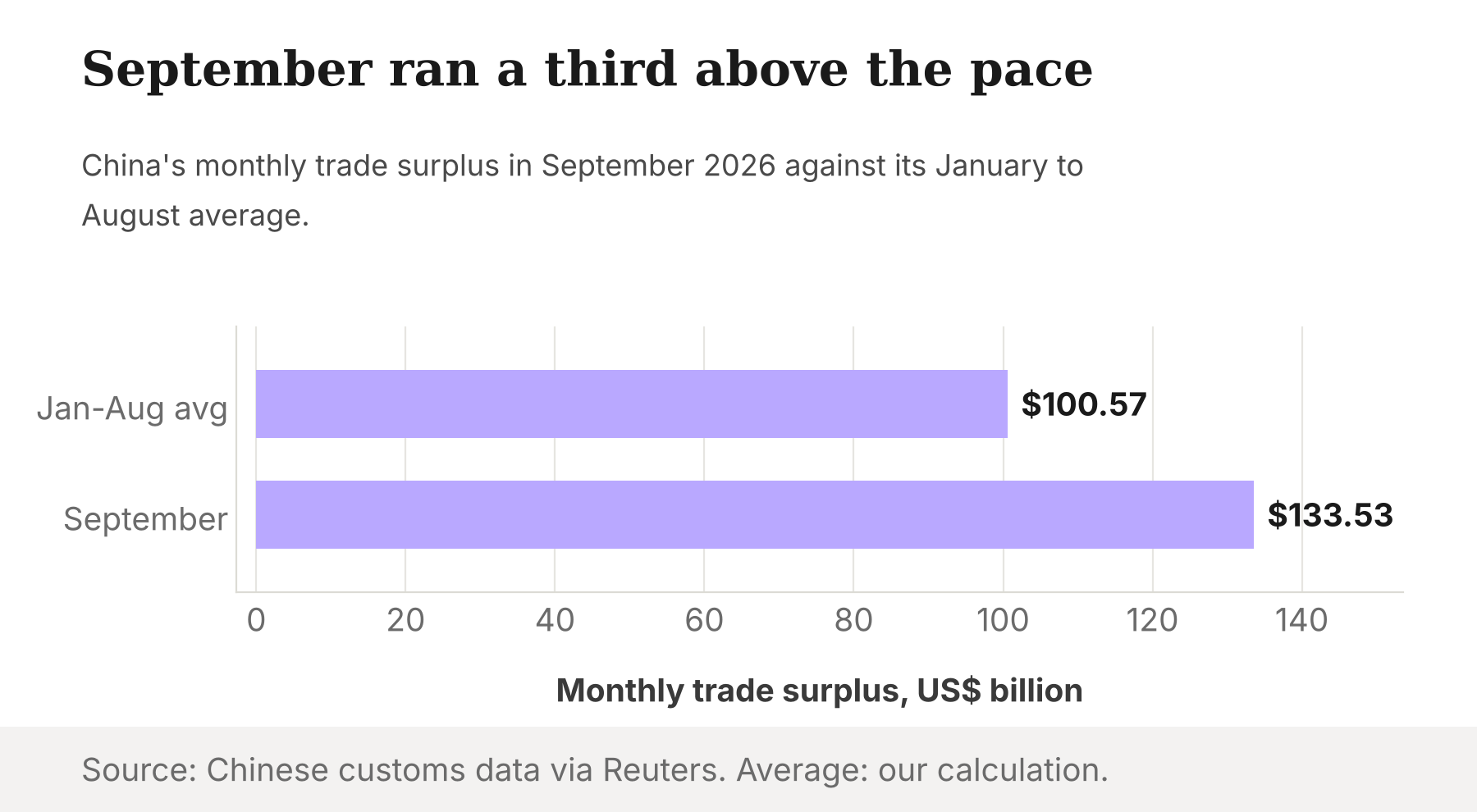
Take the nine-month surplus of $938.11 billion and strip out September's $133.53 billion. The first eight months add up to $804.58 billion, an average of about $100.57 billion a month. September ran roughly a third above that pace. The $1 trillion mark needs only another $61.89 billion, which at September's rate is a matter of weeks, not quarters.
It is worth slowing down on what is being sold
The composition matters more than the total. Semiconductor exports rose 108.1% year on year in value terms in the first nine months, per the same Reuters report. Note the phrase "in value terms". A dollar figure can double because more units ship, because each unit costs more, or both. The September summary does not separate them for chips, but an earlier period does. In January and February 2026, integrated circuit export value rose 68.9% to 304.67 billion yuan while volume rose 13.7% to 52.46 billion units, per TrendForce citing China's customs data. Value grew about five times as fast as units, which points to price, not just shipments.
Analysts say price is a large part of it. Nomura calculated that AI-related products made up 45.2% of China's export growth in August 2026, in analysis reported by ICIS, and warned that the "extraordinary price effects of this cycle have not yet shown any signs of having peaked". That is the hidden cause behind the headline. A surplus built on cheap goods shipped in bulk is a story about factory capacity. A surplus lifted by dearer AI components is a story about who is bidding for scarce hardware, and at what price.
The Reuters report offers a useful contrast. Auto exports expanded more than 50% in both value and volume terms. That is a boom in physical quantity. The chip figure is reported only in value, so the two growth rates should not be read as the same kind of surge.
Why India should care
The International Monetary Fund has flagged the imbalance itself. Its 2026 External Sector Report says excess current account balances increased in 2025, driven by China and the United States. Other economies are, by arithmetic, on the other side of those balances.
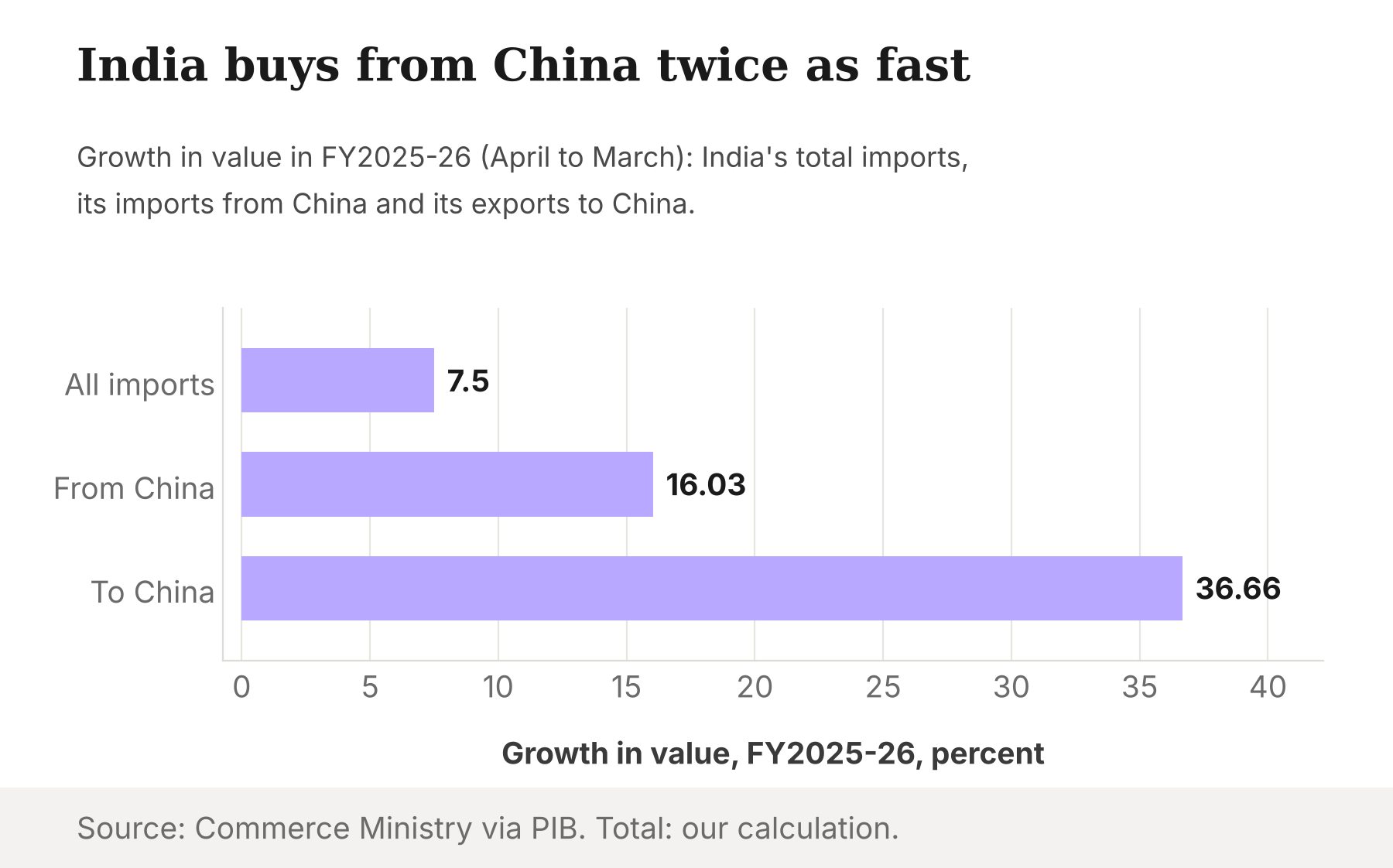
India is one of them. In FY2025-26 (April to March), India's merchandise imports were $774.98 billion, against $721.20 billion the year before, and its merchandise trade deficit widened to $333.19 billion from $283.50 billion, per the Ministry of Commerce and Industry. That is import growth of about 7.5%. Within it, China was among the top import sources by value growth at 16.03%, roughly twice the overall rate.
The mix of what India buys from China is what ties it to China's hardware cycle. A Koan Advisory and Institute of Chinese Studies analysis, reported by ThePrint, finds that electrical machinery and electronics (HS Chapter 85) accounted for $43.1 billion of India's trade deficit with China in FY2026. The same analysis reports that China supplied 54.3% of India's HS 8517 imports (phones and telecom equipment) and 29.5% of its HS 8542 imports (integrated circuits).
So the pricing of electronics in China is not an abstraction in India. Those $43.1 billion of electronics and electrical machinery in the FY2026 deficit are imports Indian buyers pay for in dollars. If AI-driven price effects spread to the components India imports, some of that bill reaches Indian importers.
The honest objection
The strongest case against this reading is that price is not the whole story. China's September import growth of 31.0% shows real demand moving in both directions, and the auto export growth of more than 50% in value and volume is genuine quantity. The sources here give a price-and-volume split for chips only for January and February, so a claim that the surplus is "mostly price" cannot be proved from public customs summaries. What the evidence does support is narrower: a large share of the export growth is AI-linked, the chip number is a value figure, and Nomura sees price effects still building.
The India comparison has limits too. The India figures cover FY2025-26, a full fiscal year, while the China figures are for September 2026. They describe different periods and are not a like-for-like trend.
The Signal
China's record surplus is a signal about the AI hardware cycle as much as about Chinese factories. If the price effect fades, the surplus can shrink without a single factory slowing down. If it persists, the cost reaches India through the electronics it already imports from China, $43.1 billion of its deficit with China in FY2026. The number to watch is not the next surplus print. It is whether China's chip exports show up in unit volumes, not just dollars.
Reporting basis: China's September 2026 trade figures, the semiconductor value growth and the auto export growth are per Reuters reporting on Chinese customs data, carried by Investing.com; they were verified in that report, not in the customs release itself. The AI-related share of August export growth and the price-effect quote are Nomura's, as reported by ICIS. The early-2026 chip volume and value figures are TrendForce's, citing China's customs data. The excess-balances statement is from the IMF's 2026 External Sector Report. India's FY2025-26 import, deficit and country-growth figures are from the Ministry of Commerce and Industry, via a Press Information Bureau release. The electronics deficit and the China import shares are from a Koan Advisory and Institute of Chinese Studies analysis, as reported by ThePrint, and rest on that single report. The eight-month surplus and monthly average, the gap to $1 trillion and India's total import growth are The Signal's calculations from those figures.