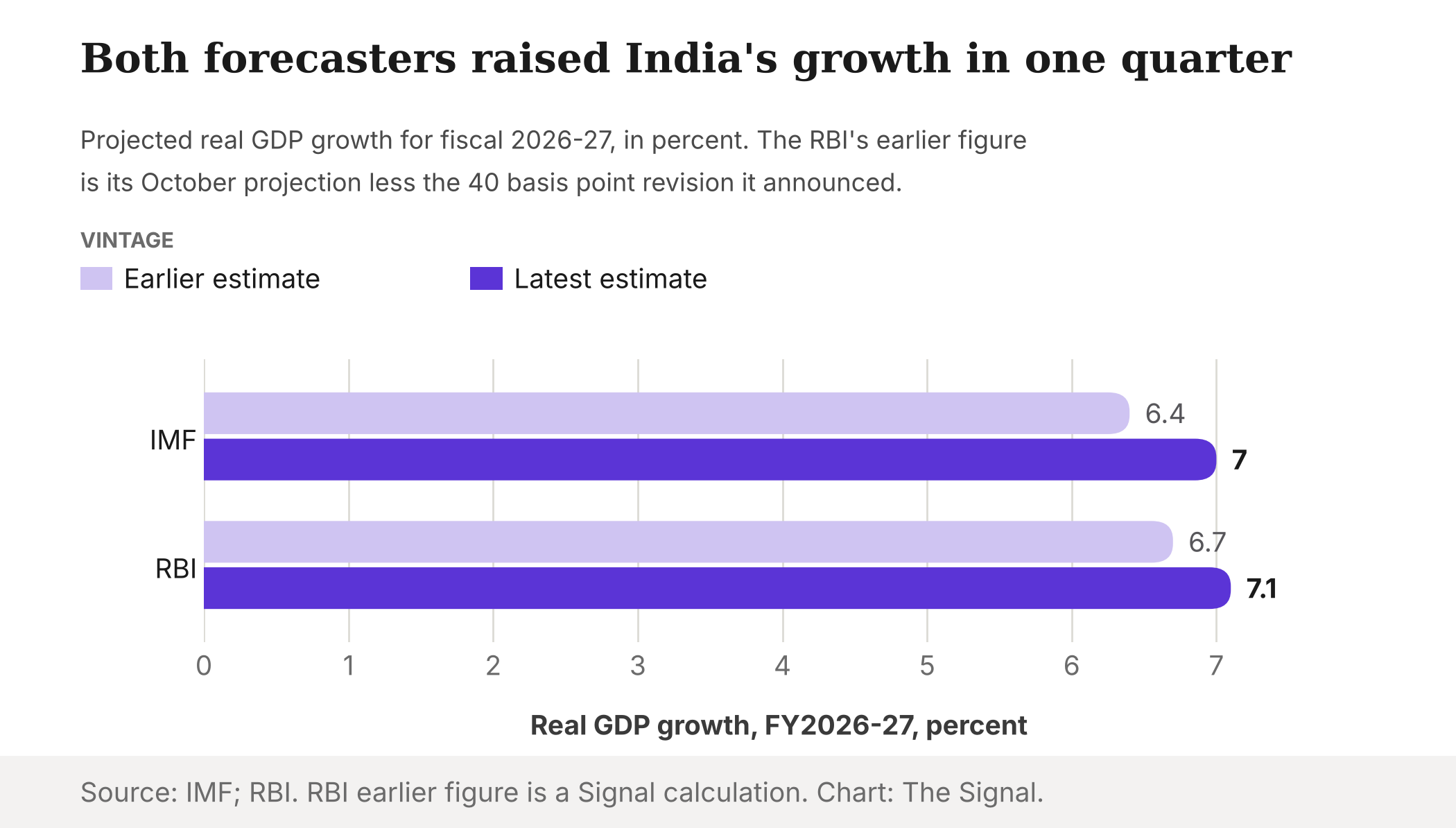
The headline of this week's economic news is good. The IMF now projects India to grow 7 percent in both fiscal 2026-27 and 2027-28, against its July estimates of 6.4 percent and 6.7 percent, as Deccan Chronicle reports the Fund's October outlook. The IMF's own October database shows the same 7 percent for the coming two fiscal years. In July, the Fund had India at 6.4 percent, "supported by strong momentum in private consumption and services activity." Three months later the forecast is 0.6 percentage points higher.
The Reserve Bank of India got there first. On 7 October its Monetary Policy Committee projected real GDP growth of 7.1 percent for 2026-27, which the Governor's statement describes as an upward revision of 40 basis points. A basis point is one hundredth of a percentage point, so that is 0.4 points. Subtracting it puts the RBI's earlier figure at 6.7 percent. Both forecasters raised India's growth in the same quarter, by similar amounts, and landed within 0.1 points of each other.
The easy read is that India is strong, so everyone is raising their numbers. It is worth slowing down on one detail. In the same resolution that carried the 7.1 percent, the MPC voted unanimously to raise the repo rate by 25 basis points to 5.50 percent and changed its stance to calibrated tightening. A central bank that expected growth to be a problem would be cutting. This one raised its growth forecast and its rate on the same day.
One cause, two outputs
The two moves are not in tension. They are the same observation read twice. The IMF's stated reason for the upgrade is "resilient domestic demand and robust services activity," and it cites "stronger-than-expected momentum," as Deccan Chronicle reports. Demand that surprises on the upside raises the growth forecast. Demand that surprises on the upside also raises prices, unless supply expands to meet it.
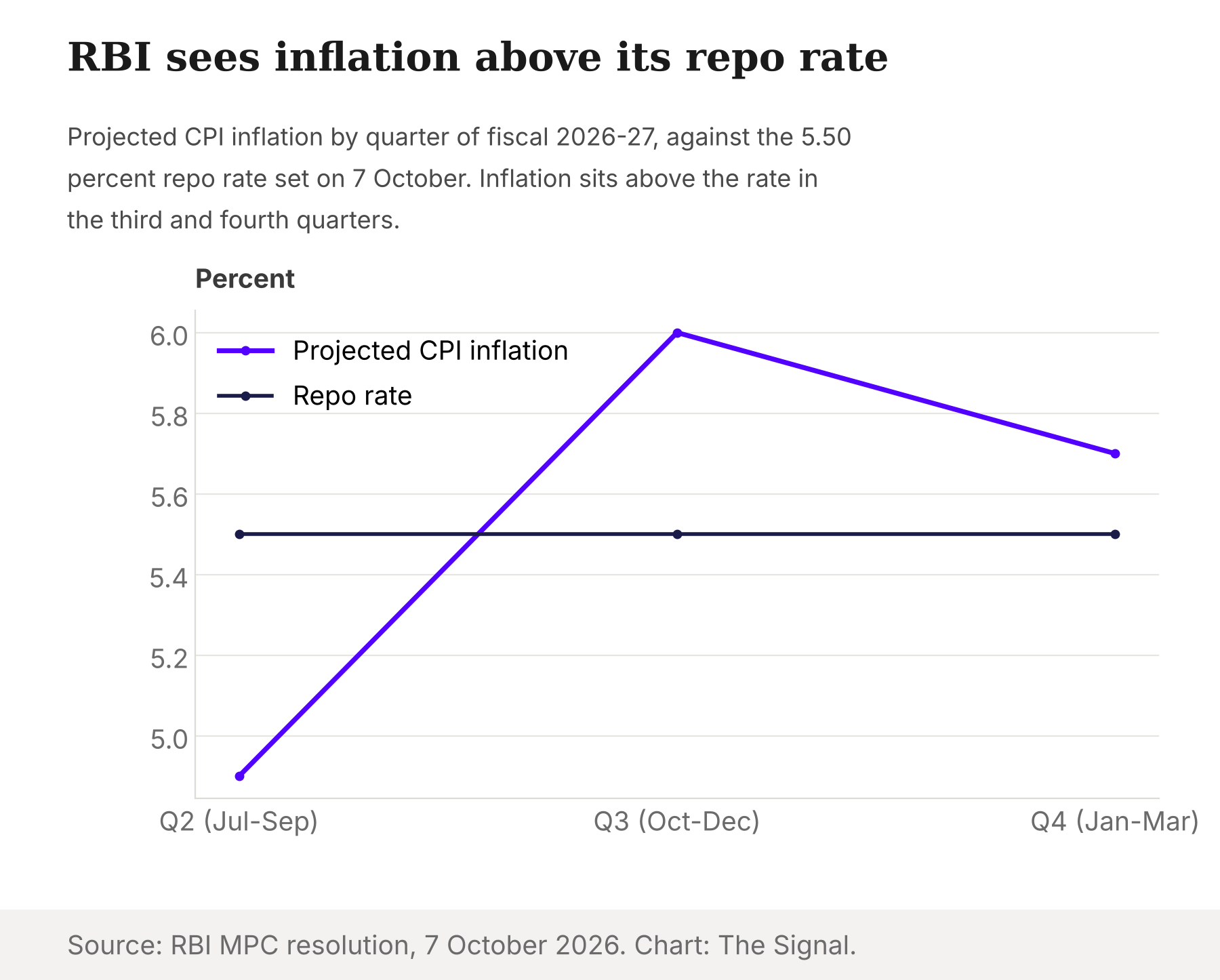
The RBI's forecast says which one it expects. The central bank projects CPI inflation of 5.2 percent for 2026-27, with 4.9 percent in the second quarter, 6.0 percent in the third and 5.7 percent in the fourth. The IMF is close to it. Its October database has India's inflation at 5.0 percent for the same fiscal year. So the 7 percent growth both institutions now expect comes with roughly 5 percent inflation attached.
Where the rate sits against its own forecast
Set the new repo rate against the RBI's quarterly path and the hike looks less like a squeeze and more like a partial catch-up. At 5.50 percent, the rate is 0.6 points above the RBI's projected inflation of 4.9 percent in the second quarter (July to September). It is 0.5 points below the 6.0 percent projected for the third quarter (October to December) and 0.2 points below the 5.7 percent projected for the fourth (January to March). The gap turns negative for the two quarters still to come.
The latest actual reading is already at the line. MoSPI reports retail inflation of 5.54 percent in September 2026, provisional and on the new 2024 base. That is 0.04 points above the new repo rate. In plain terms, the rate that was just raised still sits a hair below the inflation already in the shops.
This is the sense in which the growth upgrade and the hike are one argument. A forecaster who raises growth on the strength of consumption is, in effect, telling the central bank that the economy has less slack than it assumed. The central bank's response is the hike.
The honest objection
The strongest case against this reading is that the inflation is not demand-led at all. The same MoSPI release puts food inflation at 7.74 percent in September, 2.2 points above the headline rate, with rural inflation at 6.08 percent against 4.88 percent in cities, a gap of 1.2 points. Food prices follow monsoons and supply chains, not the policy rate. If that is what is lifting the RBI's forecast, a hike mostly taxes borrowers for the weather. The IMF's wording also leaves room for a supply story, since it points to "growing evidence of stronger growth potential," which would mean the economy can run faster without overheating.
That case is real, and it explains why the hike is only 25 basis points. But it does not remove the arithmetic. Even if food is the spark, both institutions are now forecasting growth near 7 percent with inflation at or above 5 percent. The RBI's own projection has inflation at 6.0 percent in the third quarter, which is not a food-only number once the harvest comes in. The upgrade and the price pressure arrive together, and a supply-side reading has to explain why they do.
The Signal
India is being forecast to grow faster and to get more expensive at the same time, by two institutions that do not share a model: the IMF and the RBI. That is a different story from "India is strong." It means the growth upgrade is partly a price signal: the extra demand is real, and the RBI is treating it as demand that has to be paid for.
Watch two things. The first is the RBI's next policy meeting: if the third-quarter inflation print comes in near the RBI's 6.0 percent forecast, a rate still below inflation invites a second hike. The second is the split between food and everything else in the October and November CPI releases. If core prices stay quiet while food drives the number, the upgrade is the better story. If they move together, the growth is arriving with a bill attached.
Reporting basis: the IMF growth and inflation projections are from its October 2026 World Economic Outlook database, the origin verified here. The earlier July growth figure is from the IMF's July 2026 World Economic Outlook Update. The earlier July and fiscal 2027-28 estimates and the IMF's stated reasons for the upgrade are per Deccan Chronicle's reporting on the October outlook, and rest on that single secondary source. The repo rate decision, the vote, the growth projection, the basis point revision and the inflation projections are from the RBI's 7 October 2026 resolution and Governor's statement. September retail and food inflation are from MoSPI's press release. The RBI's earlier growth figure, the quarterly gaps between inflation and the repo rate, and the food and rural-urban gaps are The Signal's calculations from those figures.