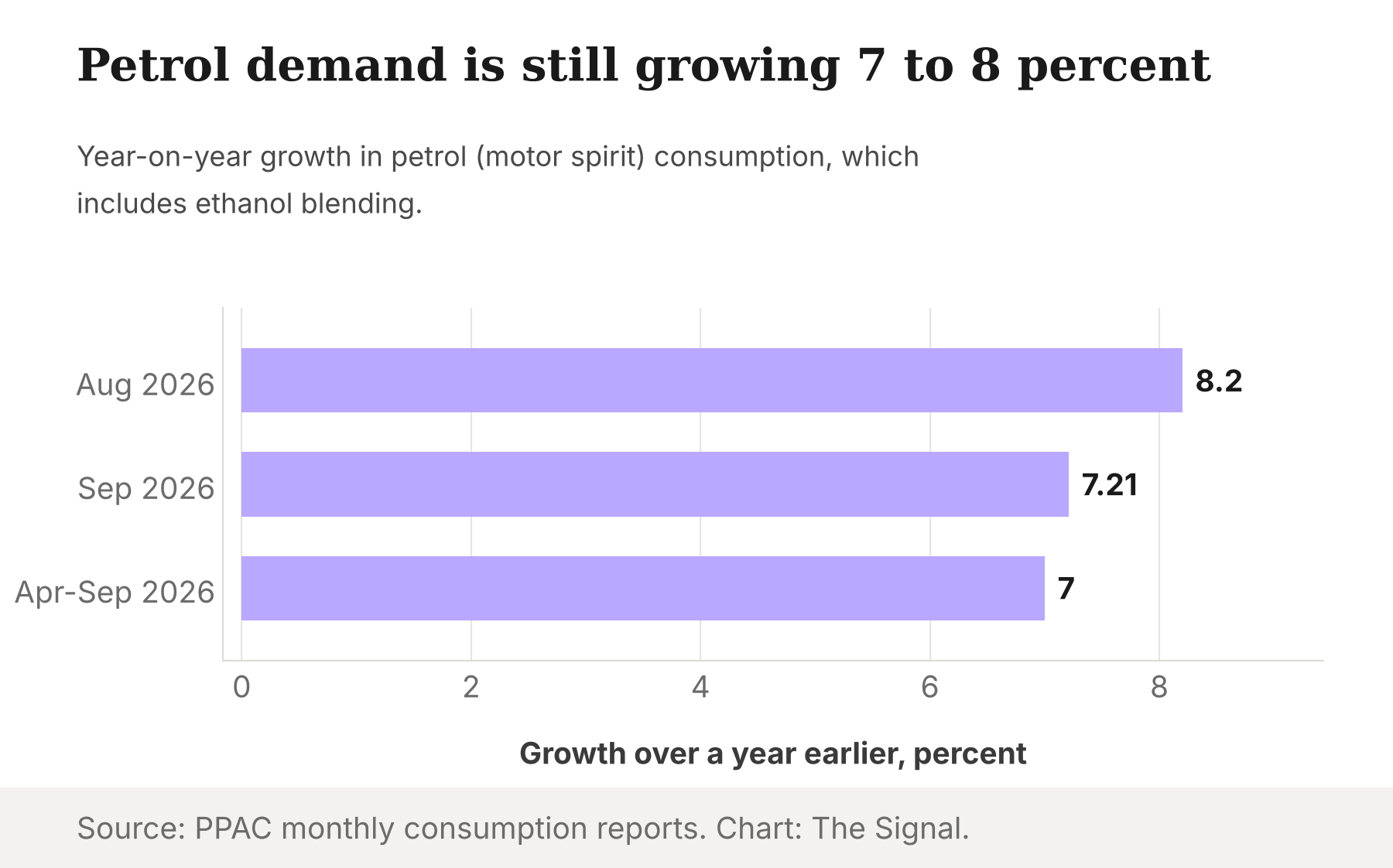
The headline of the summer was that India's car buyers had turned away from petrol. Petrol and ethanol vehicles held 40.85% of passenger vehicle registrations in August 2026, down from 46.37% a year earlier, according to dealer-body FADA data reported by the Free Press Journal. In the same release, CNG, hybrid and electric cars together reached 41.95%, up from 35.26%. For the first time, the alternatives edged past petrol.
Autocar Professional, citing VAHAN registrations, found the same direction earlier in the summer: petrol was 49.6% of passenger vehicle sales in June 2026, against 54.2% in 2025. The easy conclusion is that India's petrol problem is quietly solving itself, and that fuel demand and the import bill will follow the share down.
It is worth slowing down on that. Share describes the mix of what was sold. It does not describe how much petrol the country burned.
The number that did not move
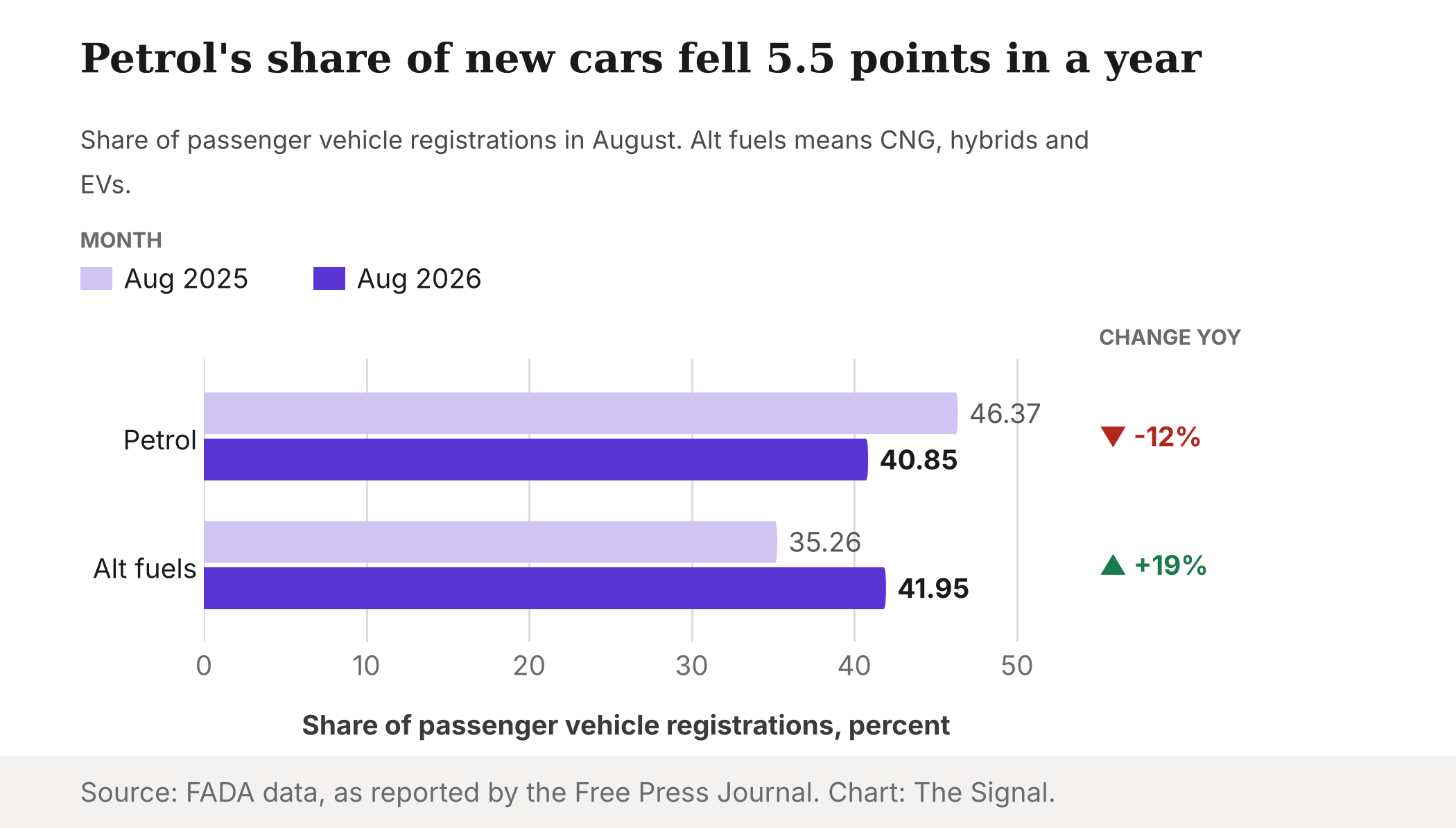
Here is the figure that carries the argument. India's petrol consumption was 3,644 thousand tonnes in September 2026, up 7.21% from 3,399 thousand tonnes a year earlier, according to the Petroleum Planning and Analysis Cell's flash report. Over April to September, the same report puts consumption at 22,673 thousand tonnes, up 7.00%. The September numbers are provisional.
August tells the same story, and it is the month in which petrol's share hit its low. PPAC's August review records petrol consumption of 3.84 million tonnes, up 8.2% from 3.54 million tonnes in August 2025. So in the exact month that petrol lost five and a half points of share, petrol demand grew faster than in September or over April to September as a whole.
Share fell because the pie grew
The two facts only look contradictory if you forget the denominator. PPAC's review reports passenger vehicle retail sales up 16.14% to 4.02 lakh units in August 2026. Autocar Professional puts the figure at about 401,000 units, up 16%, which agrees to rounding.
When the whole market grows 16%, a falling share can still mean a rising volume. Apply August's shares to August's market and the arithmetic is plain.
Petrol cars held their volume in August, even as their share slipped.
| Measure | August 2025 | August 2026 |
|---|---|---|
| Petrol and ethanol share of registrations | 46.37% | 40.85% |
| Passenger vehicle retail sales | about 3.46 lakh | 4.02 lakh |
| Implied petrol and ethanol cars | about 1.60 lakh | about 1.64 lakh |
Sources: FADA data via the Free Press Journal for shares; PPAC for 2026 sales and the 16.14% growth rate. Implied units are our calculation.
Our calculation backs out the August 2025 market from PPAC's 16.14% growth rate, then multiplies each market by its petrol share. The result is a petrol-car count that rose about 2% while the share fell 12% in relative terms. This is a rough figure, because it mixes registration shares with retail-sales totals, but the direction is robust: the petrol car did not disappear from showrooms. The alternatives grew faster, and took the incremental buyers.
There is a longer-run caution here too. Autocar India reported that petrol's share of calendar 2025 passenger vehicle sales fell from 59.44% to 53.27%, with about 1.3 lakh fewer petrol cars sold than in 2024. So 2025 was a year in which petrol volumes did fall. The 2026 rebound in petrol units therefore partly reflects a weaker base, which is one reason to avoid reading a single month as a trend.
Cars are not the whole tank
Passenger cars are one claimant on India's petrol. The same PPAC review shows that two-wheeler sales rose 19.69%, faster than passenger vehicles. The fuel-mix debate in cars says nothing about the scooters and motorcycles that run on petrol.
That matters because the share headline is only about cars. A reader who sees "petrol loses to CNG and EVs" imagines a transition in fuel demand. What the data show is a transition in the mix of new cars, sitting on top of a fuel market that is still growing 7.21% a year.
The honest objection
The strongest case against this reading is that petrol demand is a lagging indicator, and PPAC's latest consumption data cannot yet show the effect of newer cars. A buyer who chooses CNG or an EV this year cuts petrol demand for as long as the car is kept, and the effect on consumption simply has not arrived yet. If alternatives keep taking this share of new sales, the trend must eventually bend consumption.
That case is real, and nothing here disputes the direction. But it is an argument about timing, not about whether the share headline equals a demand headline. A flow of new cars shifts the fleet slowly, and the fleet is what burns fuel. We could not source a figure for the on-road fleet split by fuel type, and the piece does not pretend otherwise. What we can say is that the consumption data, which measure the actual fleet running today, show no bend yet.
A second objection is that petrol consumption is inflated by ethanol. PPAC notes that motor spirit consumption includes ethanol blending, which stood at 20.0% in August 2026. So some of the growth is a blended biofuel rather than crude-derived gasoline. That affects what the import bill looks like, and it is worth separating when PPAC publishes the blend-adjusted split. It does not change the claim here, which is about the gap between a sales-share headline and total fuel volume.
The Signal
The petrol share of new cars is a good measure of consumer taste, and a poor measure of national fuel demand. The first is a percentage of one month's sales. The second is the sum of every petrol car, scooter and motorcycle already on the road.
Watch two numbers over the coming months. If PPAC's monthly petrol growth drops toward the low single digits while alternatives keep their share of new sales, the fleet is finally turning over. If petrol keeps growing at this pace while the share headline keeps falling, the transition is real in showrooms and still invisible at the pump.
A share is a snapshot of who is buying. A barrel is a record of who is driving.
Reporting basis: petrol consumption, the passenger-vehicle and two-wheeler retail growth rates, and the ethanol blend are from the Petroleum Planning and Analysis Cell's September flash report (provisional) and its August consumption review. August fuel-mix shares are FADA data as reported by the Free Press Journal, a single secondary relay of the dealer body's figures. The June share is VAHAN data as reported by Autocar Professional, and the calendar-year 2025 shares are as reported by Autocar India. The Autocar Professional retail total matches PPAC's to rounding. The on-road fleet split by fuel could not be sourced and is not used. The implied petrol-car counts and the share changes are The Signal's calculations from those figures.