On 7 October 2026, the Reserve Bank of India's Monetary Policy Committee voted unanimously to raise the policy repo rate by 25 basis points to 5.50 percent and moved its stance to calibrated tightening. Five days later, the statistics ministry published September's inflation. Retail inflation on the Consumer Price Index was 5.54 percent, and food inflation was 7.74 percent. The headline number is now four hundredths of a point above the rate the central bank had just set. The easy read is that the RBI was caught out and has more to do.
It is worth slowing down on that. The print was not a surprise to the RBI. It was close to the middle of the path the bank published the same week, and that path is the real story.
The September number was already in the forecast
The RBI's October resolution projects CPI inflation of 5.2 percent for 2026-27, with the second quarter (July to September) at 4.9 percent, the third at 6.0 percent and the fourth at 5.7 percent. Set that beside the monthly prints. The ministry's August release put July 2026 inflation at 4.45 percent, and the September release shows August revised to 4.83 percent and September at 5.54 percent. The average of the three months is 4.94 percent (our calculation), which rounds to the RBI's 4.9 percent. The central bank forecast the quarter almost exactly.
So the September jump did not break the RBI's model. It confirmed it. What matters is what that same model says comes next.
Policy stays below inflation for three quarters
The repo rate is now 5.50 percent. The RBI's own projections for the coming quarters sit above it in each of the next three: 6.0 percent in the third quarter, 5.7 percent in the fourth, and 5.6 percent for the first quarter of 2027-28. The gap between the rate and projected inflation is therefore about 0.5 points in the October to December quarter, 0.2 points in January to March and 0.1 points in April to June.
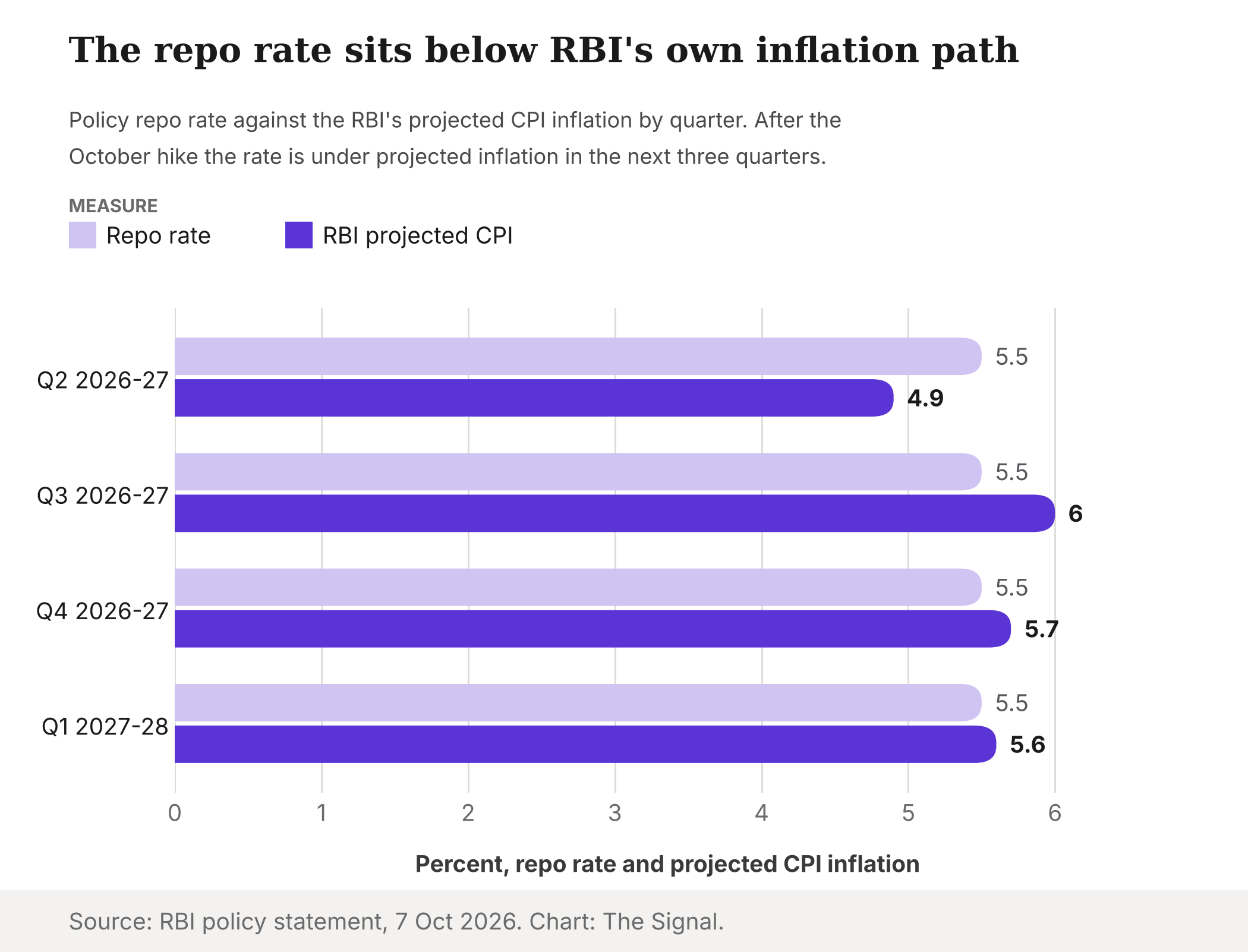
In plain terms, the real policy rate, which is the repo rate minus inflation, is slightly negative today (5.50 minus 5.54) and is forecast to stay there. Borrowing is being priced at less than the rate at which prices are rising. The RBI did tighten. It tightened to a level that its own numbers say does not yet restrain anything. The Governor's statement is blunt about the backdrop: inflation and its outlook are not benign as they were last year, with headline inflation expected to average almost 5.8 percent over the next three quarters.
Food, and the countryside, did the work
The ministry's breakdown shows where September's rise came from. Rural inflation was 6.08 percent and urban 4.88 percent, a gap of 1.2 points. Food inflation rose from 5.97 percent in August to 7.74 percent, a jump of 1.77 points, while the headline moved 0.71 points and the urban rate 0.57 points.
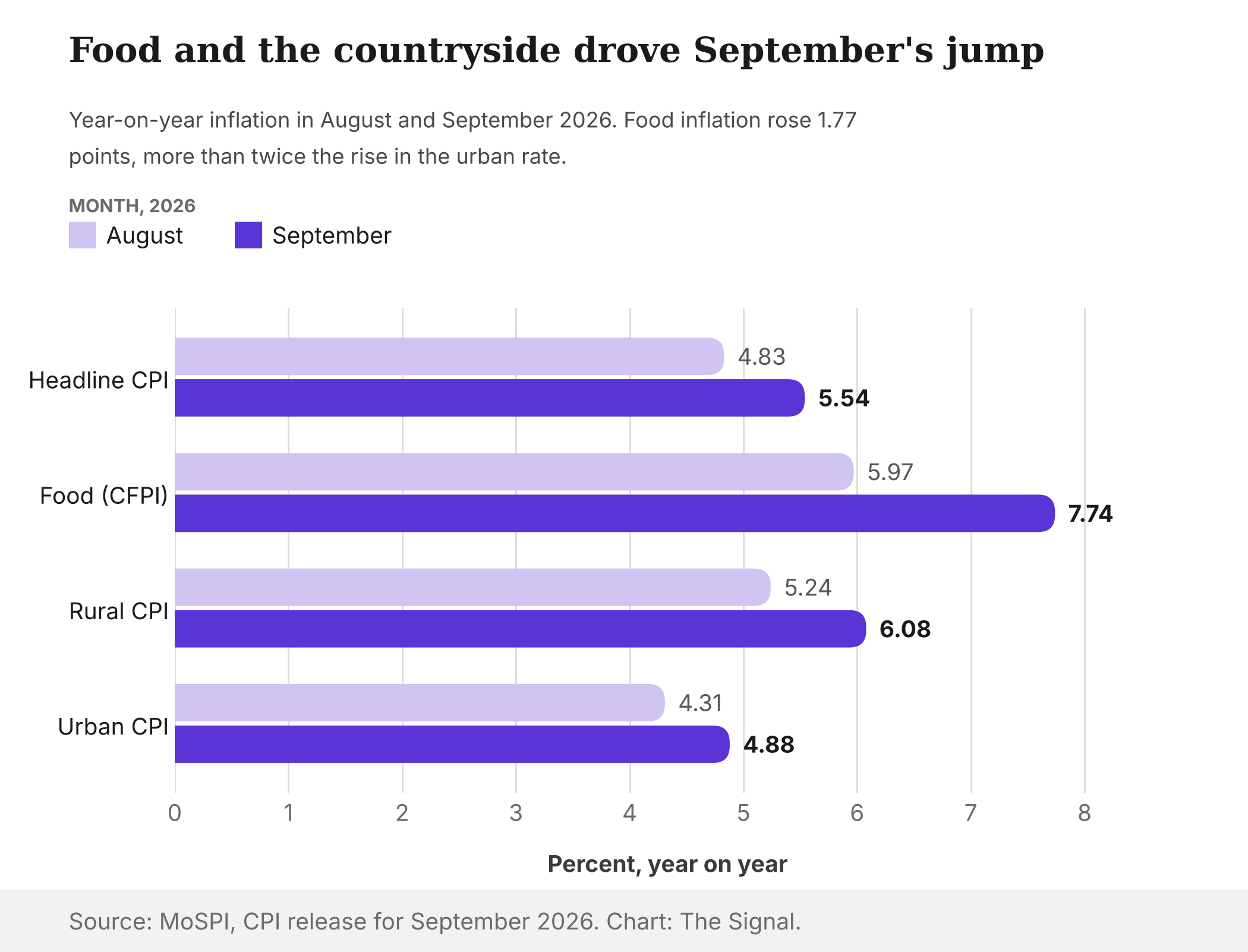
One item stands out. Onion inflation was 108.09 percent in September, up from 48.78 percent in August. Across the CPI's divisions, food and beverages ran at 7.36 percent while housing and fuels was at 2.74 percent and health at 1.40 percent. The pressure is concentrated in what households buy most often, which is why it is felt so widely even when large parts of the basket are quiet.
The RBI had already flagged the shape of this. Its Governor said food price increases have become more broad-based, with notable spikes in items such as sugar and onion. September's data says the spike in onions got worse, not better.
The honest objection
The strongest case against reading too much into the negative real rate is that central banks are meant to look through supply shocks. Onion and sugar prices are driven by crops and stocks, not by demand that a higher repo rate can cool. The place where policy has leverage is underlying inflation, and there the picture is calmer. The RBI said core inflation rose to 4.2 percent in August from 3.9 percent for three straight months, and its Governor's statement has core at 4.4 percent for the financial year. Against core of 4.2 percent, a repo rate of 5.50 percent is a real rate of about 1.3 points (our calculation). On that view, the RBI is not behind at all. It is holding a restrictive rate against the part of inflation it can affect.
That case is real, and it is probably why the committee stopped at 25 basis points. But it has a limit. The same statement notes that the share of items with inflation above 4 percent rose to about 37 percent in August, and food and core are not sealed from each other when price rises last through several quarters. A food shock that the RBI's own path has lasting through the third quarter and into 2027-28 starts to look like part of the baseline.
The Signal
The September print did not push the RBI behind the curve. The RBI had already placed itself there, in writing, five days earlier. The repo rate is 5.50 percent, and the bank’s own path has inflation at 6.0, 5.7 and 5.6 percent in the next three quarters. Either food prices fall faster than the RBI expects, or the next policy decision has to close a gap the October one left open.
Watch two things. The first is whether onion and vegetable inflation retreats in the October print, because the RBI's third-quarter 6.0 percent assumes it does not. The second is whether core inflation, 4.2 percent in August, moves toward the 4.4 percent the bank projects for the year. If core holds near 4 percent, the committee can wait. If it climbs, the real rate is the problem, not the onion. A hike that leaves the rate under the forecast is a pause with a rate attached.
Reporting basis: every inflation figure is from the Ministry of Statistics and Programme Implementation's CPI press releases for August and September 2026 (base year 2024=100, September provisional), read from the ministry's published PDFs. The repo rate, vote, stance, inflation projections, core inflation and the quoted assessments are from the Reserve Bank of India's 7 October 2026 policy resolution and the Governor's statement, read on the RBI's website. The piece therefore rests on two origins, both official, and none of its numbers is independently cross-checked against a third source. The quarterly average of 4.94 percent, the gaps between the repo rate and projected inflation, the real rate against core and the point changes between August and September are The Signal's calculations from those figures.