The headline number in India's draft steel policy is hard to miss. The draft aims to raise steelmaking capacity to 600 million tonnes by 2047, from 220 million tonnes in fiscal 2026, according to a report on the draft that Reuters reviewed. That is a rise of about 2.7 times. Read the figure at face value and it sounds like a national stretch goal, the kind that needs a decade of heroic building.
It is worth slowing down on that. The target is not the hard part.
The target asks for less than India just did
Capacity rose from 110 million tonnes per annum (MTPA) in 2015 to 220 MTPA as of March 2026, according to PRS Legislative Research's summary of a parliamentary committee report. That is a doubling in about eleven years, or roughly 6.5 percent a year. Going from 220 to 600 million tonnes over the 21 years to 2047 needs roughly 4.9 percent a year. Both rates are our calculation.
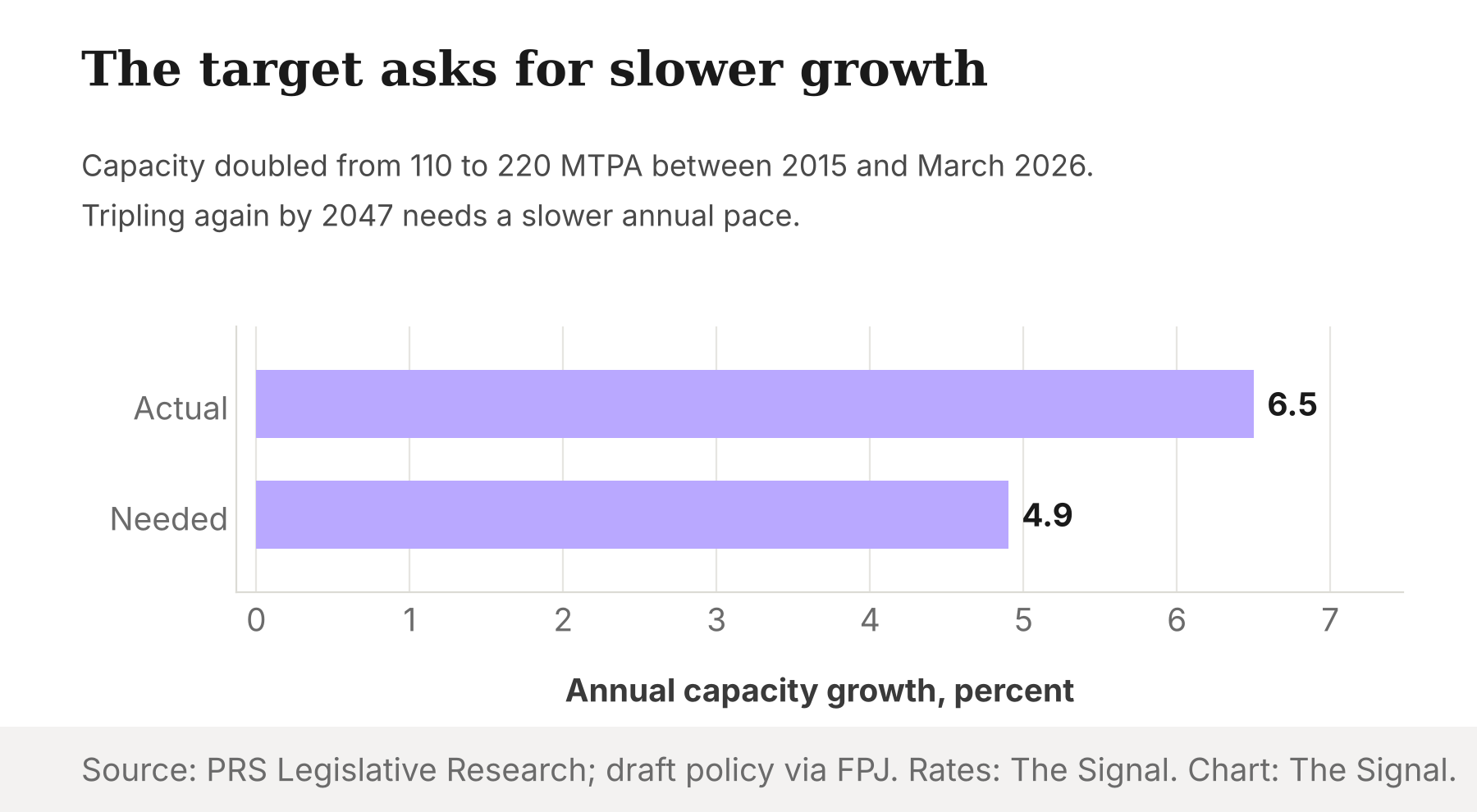
So the draft does not ask the industry to build faster than it already has. It asks it to keep going at a slower pace for twice as long.
There is a second reason the furnace count is not the constraint. The Ministry of Steel told the Lok Sabha that crude steel capacity and production in 2024-25 were 200.33 million tonnes and 152.18 million tonnes. Production was about 76 percent of capacity. In 2024-25, a quarter of what India could already make went unmade.
The number that carries the argument
The coal figure sits further down the draft. Coking coal demand is expected to reach 214 million tonnes, the report on the draft says. Coking coal is the grade of coal that blast furnaces need to turn iron ore into steel. It cannot be swapped for the ordinary coal used in power plants.
India does not dig much of it. The Ministry of Coal's year-end review states that domestic raw coking coal production was 59.6 million tonnes in fiscal 2024-25, against a target of 83 million tonnes for 2025-26. Against that base, 214 million tonnes is about 3.6 times what the country mines today.
The official fix is Mission Coking Coal. The Standing Committee notes that the mission aims to cut import dependence to 65 percent by 2030 by raising domestic raw output to 140 million tonnes. Even if that lands on time, 214 million tonnes is still about 1.5 times the 2030 goal.
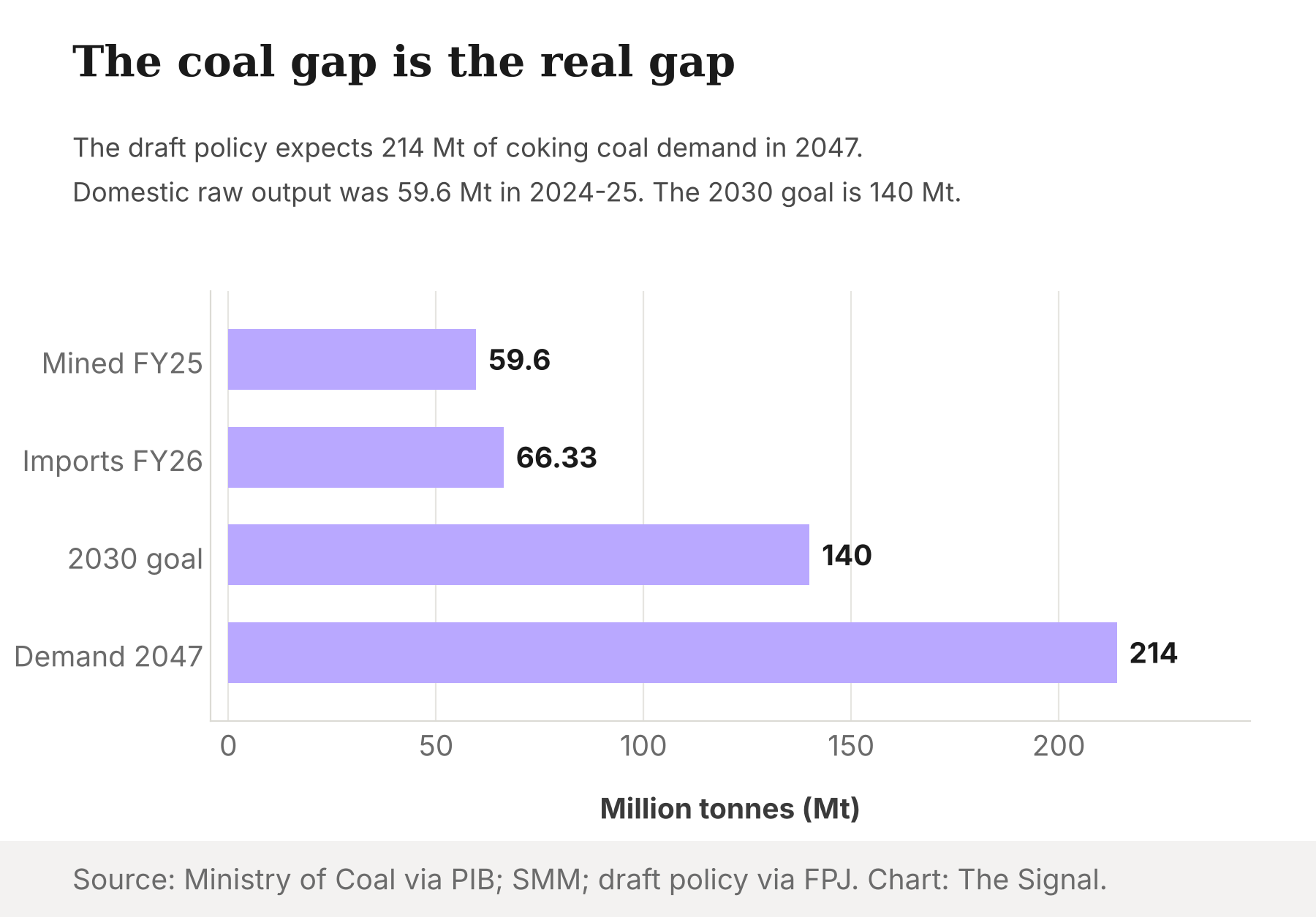
The bars measure different things (raw output, imports, a target and a demand projection), so they do not add up. What they show is scale: the bars on the right describe a supply chain that does not yet exist.
Where the shortfall lands
Today the shortfall is filled from abroad. The Standing Committee found that India's import dependence for coking coal stood at around 85 to 90 percent in 2024-25, with 54 percent of imports coming from Australia alone. Coking coal imports rose 15.2 percent to 66.33 million tonnes in fiscal 2025-26, from 57.58 million tonnes a year earlier, SMM's analysis reports.
Apply the committee's 85 to 90 percent dependence range to the draft's 214 million tonnes of 2047 demand and imports would be roughly 182 to 193 million tonnes. Against the 66.33 million tonnes imported in fiscal 2025-26, that is about 2.7 to 2.9 times as much. At the mission's 65 percent, imports would still be about 139 million tonnes, or 2.1 times as much. These are our calculations, and they assume the committee's dependence share applies to the draft's demand figure, which neither source states.
Each added tonne of capacity therefore deepens a dependence on a few sellers. That is a bill paid in foreign exchange and a risk concentrated in one supplier country.
The tension inside the draft
The same draft also wants steel to get cleaner. It targets around 1.54 tonnes of carbon dioxide per tonne of crude steel by 2047, down from 2.54 tonnes currently. That is a cut of about 39 percent. Coking coal is the main source of those emissions in blast-furnace steelmaking, so the draft is projecting rising coal demand and falling emissions per tonne together.
Both can be true only if the route mix shifts. More of the new capacity would have to come from processes that burn less coking coal. The draft's figures do not tell a reader how far that shift goes, and that is the open question.
The honest objection
The strongest case against this reading is that a 2047 projection is a planning number, not a purchase order. Technology, scrap availability and policy can all cut coking coal use well before then, and a ministry projecting 214 million tonnes has presumably already folded in some of that. Targets also slip. The National Steel Policy 2017 envisaged 300 million tonnes of capacity and 255 million tonnes of production by 2030, and capacity stood at 220 million tonnes in March 2026.
That case is fair on timing, and it explains why the figure may not be reached. It does not remove the dependence. Whatever the mix, a steel sector that nearly triples will need more coking coal than India mines, and the plan for closing that gap is a mission whose 2030 goal is still far above current output.
The Signal
The draft policy will be judged on its capacity figure, but capacity is the easy variable. India doubled capacity from 110 to 220 MTPA between 2015 and March 2026, faster than this plan requires, and still left about a quarter of it idle in 2024-25. The variable that decides whether 2047 is reached, and who profits, is coking coal.
Watch three things: the final policy's coking coal and import-dependence assumptions, the yearly output of domestic raw coking coal against its 83 million tonne target for 2025-26, and the Australian share of imports. If domestic output tracks the 2030 goal, the policy is a build plan. If it does not, it is an import plan with a steel logo on it.
Reporting basis: the 2047 capacity target, the coking coal demand projection and the carbon-intensity target come from the draft National Steel Policy as reviewed by Reuters, relayed here through a single Free Press Journal report, so they rest on one secondary account of an unpublished draft. Historic capacity, the import-dependence range and the Mission Coking Coal goal come from the Parliamentary Standing Committee on Coal, Mines and Steel, as summarised by PRS Legislative Research. The 2024-25 capacity and production figures and the National Steel Policy 2017 targets come from the Ministry of Steel, via PIB. Domestic raw coking coal output comes from the Ministry of Coal, via PIB. Coking coal import tonnages come from a single commercial source, SMM's analysis. The growth rates, multiples, utilisation share, emissions cut and implied import volumes are The Signal's calculations from those figures.