The easy read of India's data centre boom is that the grid is being planned for it. The government says as much. On 27 July 2026 the Minister of State for Power told Parliament that an additional load of 26.3 GW from AI data centres is projected by 2031-32, to be integrated into the grid and served mainly by renewable capacity. A number, a date and a plan: it sounds settled.
It is not settled, and the numbers show it. The same ministry had a different figure four and a half months earlier.
Three official numbers for one year
In March 2026, a PIB release on a Rajya Sabha reply said electricity demand from data centres was estimated at 13.56 GW by 2031-32. The July figure is 26.3 GW, which Business Standard noted is nearly double that earlier projection. A PIB backgrounder dated 14 September 2026 then attributed a third number to the Central Electricity Authority: demand could reach 17 GW by 2031-32.
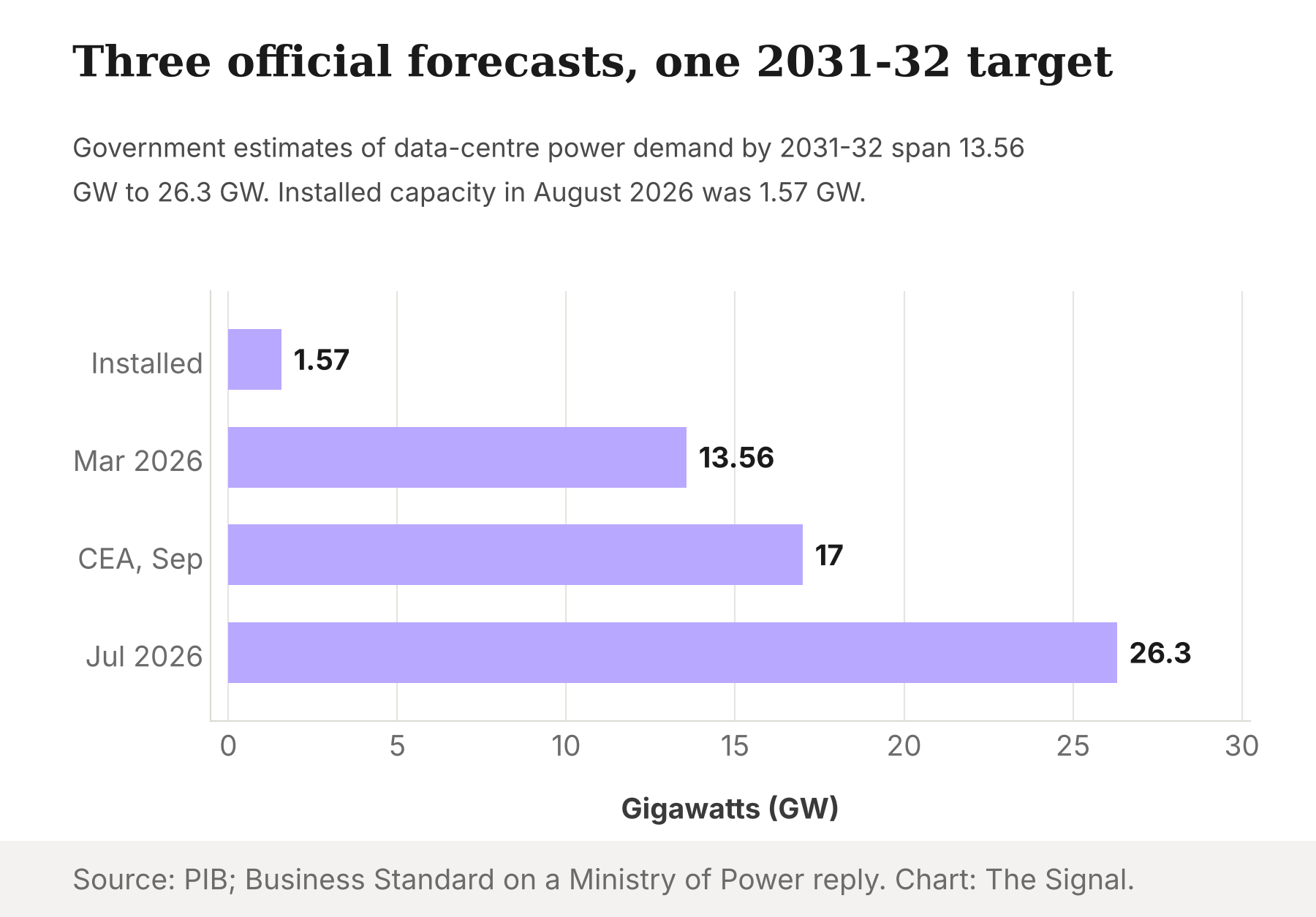
The gap between the lowest and highest figure is 12.74 GW. For scale, installed data centre power capacity was 1.57 GW as of August 2026. The disagreement among official estimates is about eight times the entire industry as it stands today. The July figure alone is nearly 17 times today's base.
Part of the reason the figure moves is how it is built. Ministry officials said the current number is based on projects that various states have submitted to establish data centers. That is a pipeline of proposals, not a measured load. Proposals move with every memorandum of understanding signed.
The grid plan was sized to a different number
The transmission build-out is governed by the National Electricity Plan. A PIB release from March 2025 says it adds central and state lines at 220 kV and above to meet the projected peak electricity demand of 388 GW by the year 2032. In July 2026 the ministry cited the same 388 GW, from 289 GW in FY27, according to the Central Electricity Authority's midterm review of the 20th Electric Power Survey.
That implies a rise in peak demand of 99 GW between FY27 and FY32. Set the July data centre estimate of 26.3 GW against it and one sector accounts for more than a quarter of all projected peak growth.
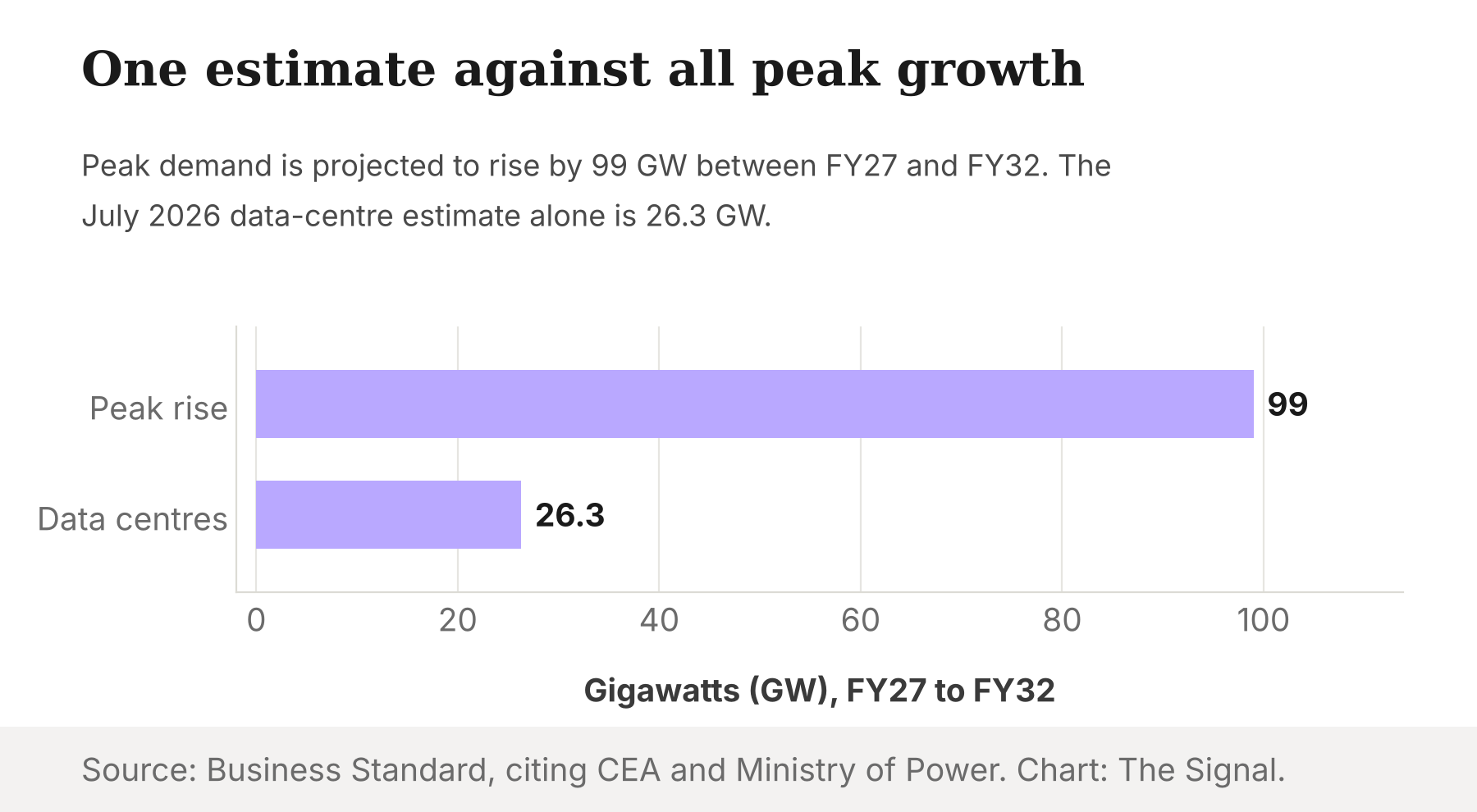
Two cautions apply. Peak demand and data centre load are different measures, so the ratio is a scale check, not an accounting identity. And the documents reviewed here do not say whether the 388 GW baseline already contains the 26.3 GW. If it does, the plan absorbed a doubling without comment. If it does not, the plan and the forecast are describing two different futures.
Who pays is a rulebook question
Consumers will want to know who funds the new lines and substations, and the record answers only part of that. For inter-state lines, the rule is set by the regulator. Under CERC regulations, inter-state transmission charges are shared by drawee DICs, short for Designated ISTS Customers. The regulation defines that group broadly: a DIC is any user of an inter-state transmission element and includes generating stations, State Transmission Utilities and distribution licensees. In other words, the bill is pooled across users of the network, and the users named include the state distribution companies that sell power to households and businesses.
What the sources do not show is how a specific data centre's connection costs are allocated, or how much of the pooled charge a distribution company recovers from which class of customer. That is set in state tariff orders, which are outside what could be verified here. It would be wrong to say consumers will pay. It is fair to say the pooled design means a forecast error is shared, not borne by whoever caused it.
The honest objection
The strongest case for the government is that planning against a moving target is what planning is. Demand projections get revised in every sector, and a figure built from state-submitted projects will rise when states sign more projects. The ministry also says it is building transmission in a phased manner, which is a reasonable way to avoid stranding assets if the pipeline thins out.
That case is real. It explains why the number moves. It does not explain why the plan's own baseline did not. Phased build-out reduces the risk of over-building, but it raises the risk of under-building in the specific places where load lands first. The same officials noted that data centre loads can be extremely spiky and have steep gradients, which is a harder load to serve than the smooth growth in the survey.
The Signal
India has one data centre forecast for each audience: 13.56 GW for the March reply, 26.3 GW for the July one and 17 GW from the CEA in September. A grid cannot be built to three numbers, and a tariff cannot be set against a pipeline of proposals.
Watch two things. The first is whether the CEA publishes a single reconciled figure and says whether the 388 GW baseline includes it. The second is whether any state regulator writes data-centre-specific rules into a tariff order, which is where the question of who pays is actually answered. Until then, the cost of being wrong may sit in a pool that data centres share with everyone else.
Reporting basis: the March estimate and the August capacity figure are from PIB releases, one relaying a MeitY reply to the Rajya Sabha and one a September 2026 backgrounder that credits the CEA for the third figure. The July estimate and the FY27 and FY32 peak demand figures and the quote on phased transmission are per Business Standard, reporting the Minister of State for Power's written reply to Parliament and the CEA survey review; the Tribune carried the same reply and is the source for the officials' remarks on state submissions and load shape. The peak demand basis of the transmission plan is from a March 2025 PIB release. The charge-sharing rule is from a PIB release on a MNRE reply, and the DIC definition is from the CERC regulation text itself. The primary Rajya Sabha reply for the July figure was not retrieved, so that figure rests on press accounts of it. The gap between the lowest and highest estimates, the multiples of installed capacity, the rise in peak demand and its share are The Signal's calculations from those figures.