The case for fixing India's welfare data leans on one number. NITI Aayog's June 2025 report on data quality says erroneous or duplicate beneficiary records are inflating welfare outlays by an estimated 4 to 7 percent annually. It is a tidy figure for a tidy argument: clean the rolls, stop the leak, then build smarter systems on top. The report backs it with a table of recent clean-ups that read like proof.
It is worth slowing down on that table. The savings in it are mostly payments that were never made, which is a different thing from money that came back.
What the leakage figure is, and is not
The 4 to 7 percent range appears once in the 20-page report, in the executive summary, and the report calls it an estimate. The text puts it this way: duplicate and erroneous records "drain budgets, inflating welfare outlays by an estimated 4–7 per cent annually." The report does not say which schemes the range covers.
That matters for scale. Take four welfare-type lines in the Union Budget 2026-27. The Budget at a Glance lists food, fertiliser and petroleum subsidies at ₹2,27,629 crore, ₹1,70,781 crore and ₹12,085 crore in the budget estimates. The Expenditure Budget puts PM-Kisan at ₹63,500 crore. Together that is ₹4.74 lakh crore. Four to seven percent of it is ₹18,960 crore to ₹33,180 crore a year. These are The Signal's calculations, and they are an illustration of scale, since NITI Aayog does not define "welfare outlays."
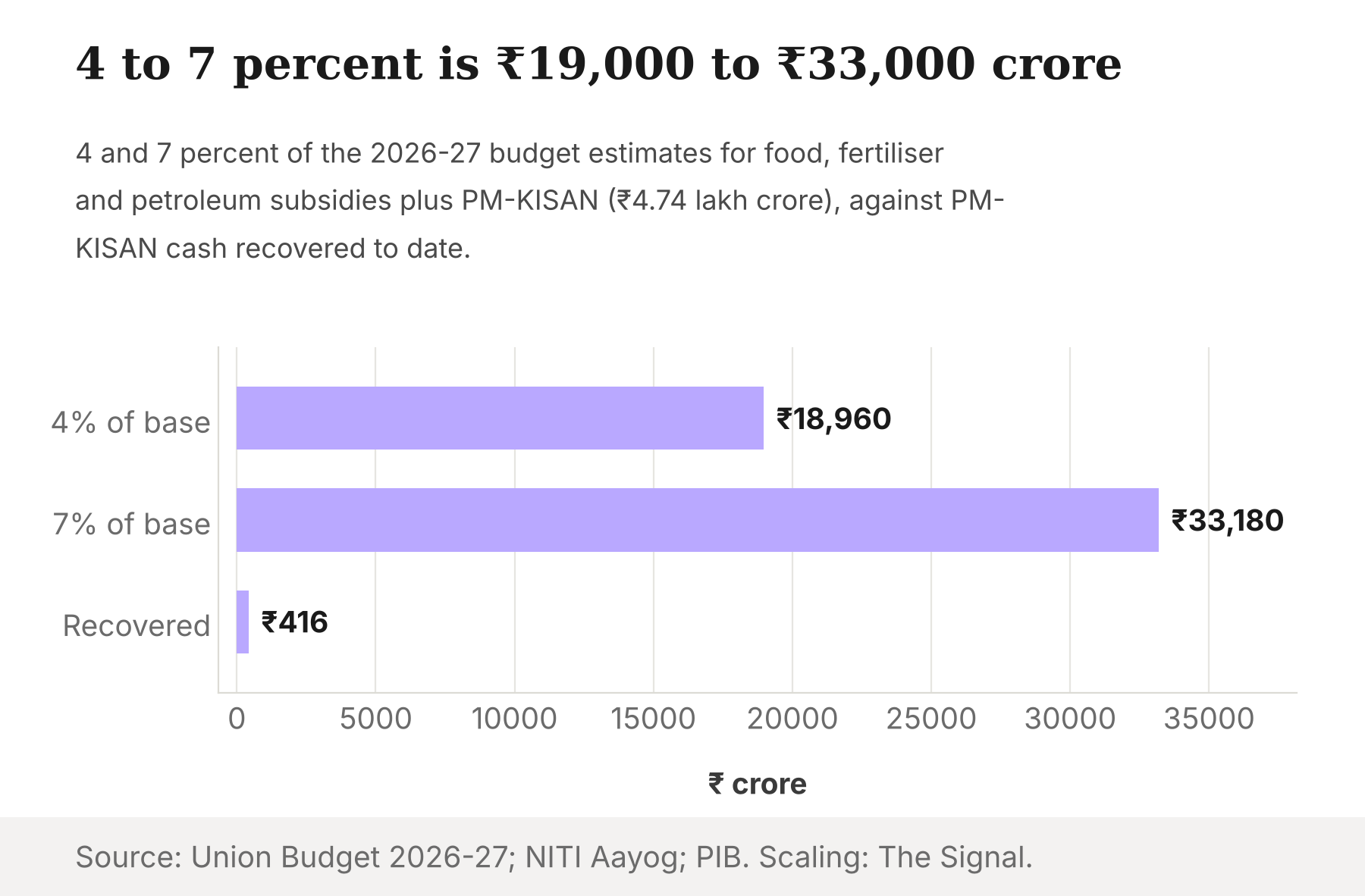
The ₹416 crore bar is the problem. It is the amount the Agriculture Ministry told Parliament in March 2025 has been "recovered from the ineligible beneficiaries so far across the country." Since the scheme began, the government says it has disbursed over ₹4.09 lakh crore through 21 instalments, as of March 2026. Cash recovered is about 0.1 percent of cash paid out. The two figures cover different dates, so treat the ratio as a sense of scale, not a precise rate.
Three clean-ups, three kinds of "saving"
NITI Aayog's table of recent clean-ups lists three actions: 17.1 million ineligible PM-Kisan names deleted, with estimated savings of ₹90 billion in FY2024; 35 million bogus LPG connections weeded out, with ₹210 billion over two years; and 16 million fake ration cards dropped, with about ₹100 billion a year. The word the report uses is "estimated."
Each of the three is built differently, and none is a cash recovery.
LPG is arithmetic on an assumption. The Petroleum Ministry's own 2016 release shows the method. It multiplied the blocked connections by an assumed 12 cylinders a year by the average subsidy per cylinder: 3.34 crore connections, 12 cylinders and ₹369.72 gives ₹14,818.4 crore for FY2014-15.
| Step | Value |
|---|---|
| Connections blocked | 3.34 crore |
| Cylinders assumed per connection per year | 12 |
| Average subsidy per cylinder, FY2014-15 | ₹369.72 |
| Estimated savings, FY2014-15 | ₹14,818.4 crore |
Source: Ministry of Petroleum & Natural Gas via PIB, 23 August 2016. The product is The Signal's check of the ministry's own arithmetic.
The formula assumes every blocked ghost connection would otherwise have drawn a full year of subsidised cylinders. That is a counterfactual, not a measurement. The ministry published it in response to news reports about a CAG report stating that direct LPG subsidy savings were less than the Government's claim. The dispute was about this exact gap between a claimed and a measured saving.
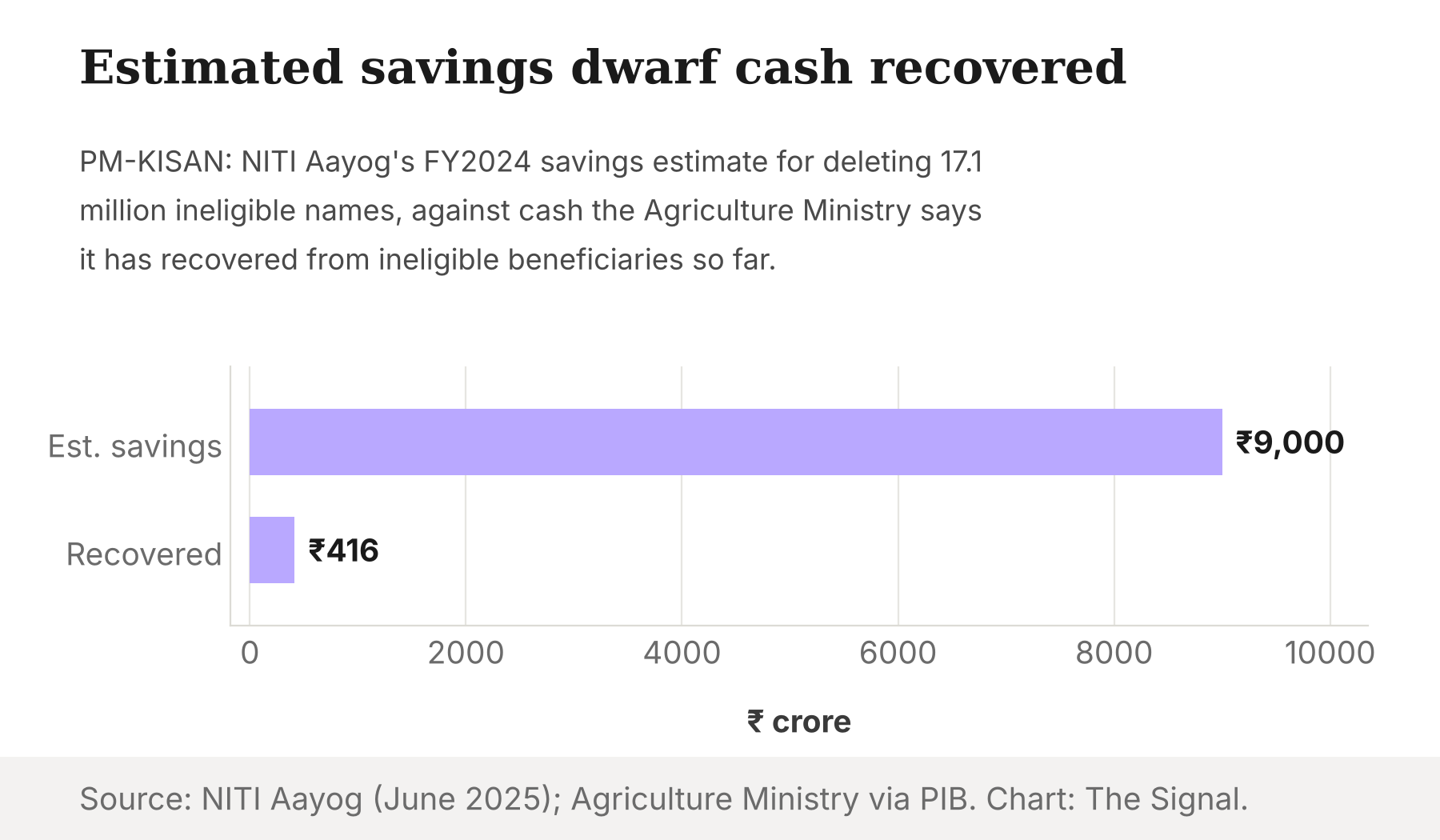
PM-Kisan is a stock of names, not a flow of cash. Deleting 17.1 million names removes future payments, and NITI Aayog counts the ₹90 billion as an estimate for FY2024. The ₹416 crore is what has come back from people who were paid and should not have been, per the Agriculture Ministry. The ₹90 billion is ₹9,000 crore, about 22 times the ₹416 crore. The two cover different people and different dates, but only one of them puts rupees back in the treasury.
Ration cards are counted by a running tally. States and UTs reported cancelling about 4.28 crore bogus ration cards between 2014 and 2021, according to a December 2021 release. NITI Aayog's table gives 16 million and no period for the count.
The clean-ups are also not new. The LPG savings estimate covers FY2014-15 and FY2015-16. The ration-card cancellations start in 2014. Even the most recent LPG count, 4.08 crore connections blocked, suspended or deactivated as of 1 July 2025, does not match the 35 million in NITI Aayog's table, and the two are dated years apart. A reader cannot tell from either document how much of the leak is still open today.
The honest objection
The strongest defence of the table is that a payment avoided is real money. A ghost name that would have drawn a transfer every year costs the treasury just as much as a leaked one, and counting it as a saving is standard budget practice. The budget even shows a faint trace. PM-Kisan's actual spending was ₹66,121.20 crore in 2024-25, and the 2026-27 estimate is ₹63,500 crore, the same figure used in the 2025-26 budget and revised estimates.
That case is right about the economics and thin on the evidence. A lower budget line can come from many causes, and a counterfactual saving cannot be audited the way a recovery can. The objection explains why the savings are plausible. It does not turn an estimate into a measurement.
Why this matters for the AI push
The same report argues that the next generation of services depends on clean records. Its own words are that where records are inconsistent, "each added layer inherits and amplifies a structural deficit." An AI system that decides who receives a benefit will inherit whatever the rolls get wrong, including the ghost names nobody has found.
There is a second, quieter inheritance. A model tuned to cut leakage needs a baseline for how much leakage there is. Today that baseline is the 4 to 7 percent estimate, supported by savings that are partly assumed. A system that reports it has cut leakage by half is making a claim against a number nobody measured.
The Signal
India has real evidence that cleaning welfare rolls works, and it has a ready-made headline number for the size of the prize. What it does not yet have is a measured leak. The first job of any AI targeting system is therefore not to find ghosts. It is to count them, scheme by scheme, and to report cash recovered next to payments avoided, as the ₹416 crore recovery figure already does for PM-Kisan.
Watch for the next PM-Kisan parliamentary reply. If the recovered figure moves from ₹416 crore toward a number within sight of the savings estimate, the clean-ups are paying in cash. If it stays flat while the estimates grow, the leak is being managed on paper. A saving you cannot recover is a forecast.
Reporting basis: the 4 to 7 percent range, the three clean-up savings estimates and the quotation on new services are from NITI Aayog's June 2025 report, which states the range once, without a stated method. The LPG calculation comes from a Petroleum Ministry release via PIB, and the 2025 connection count from another. The ration-card count is from a Food and Public Distribution release via PIB. The ₹416 crore recovery is from an Agriculture Ministry release via PIB, and the ₹4.09 lakh crore disbursement from a March 2026 release. Subsidy and PM-Kisan allocations are from the Union Budget 2026-27. The 2016 CAG report is known here only through the ministry's description of news coverage. The ₹4.74 lakh crore base, the 4 percent and 7 percent scalings, the 22-fold ratio and the 0.1 percent recovery share are The Signal's calculations from those figures.