On 7 October 2026, the Reserve Bank of India's Monetary Policy Committee voted unanimously to raise the repo rate by 25 basis points to 5.50 per cent, and changed its stance to calibrated tightening. The repo rate is the rate at which the RBI lends to banks, and it anchors borrowing costs across the economy. In August the committee had held it at 5.25 per cent with a neutral stance. The easy read of the October move is a central bank getting tough on prices. It did so while lifting its growth forecast for 2026-27 to 7.1 per cent, so nobody can say it is braking a weak economy.
It is worth slowing down on the word "tough". A hike is a statement about direction. What matters for borrowers and savers is where the repo rate sits against the inflation the RBI itself expects.
The repo rate is still behind the forecast
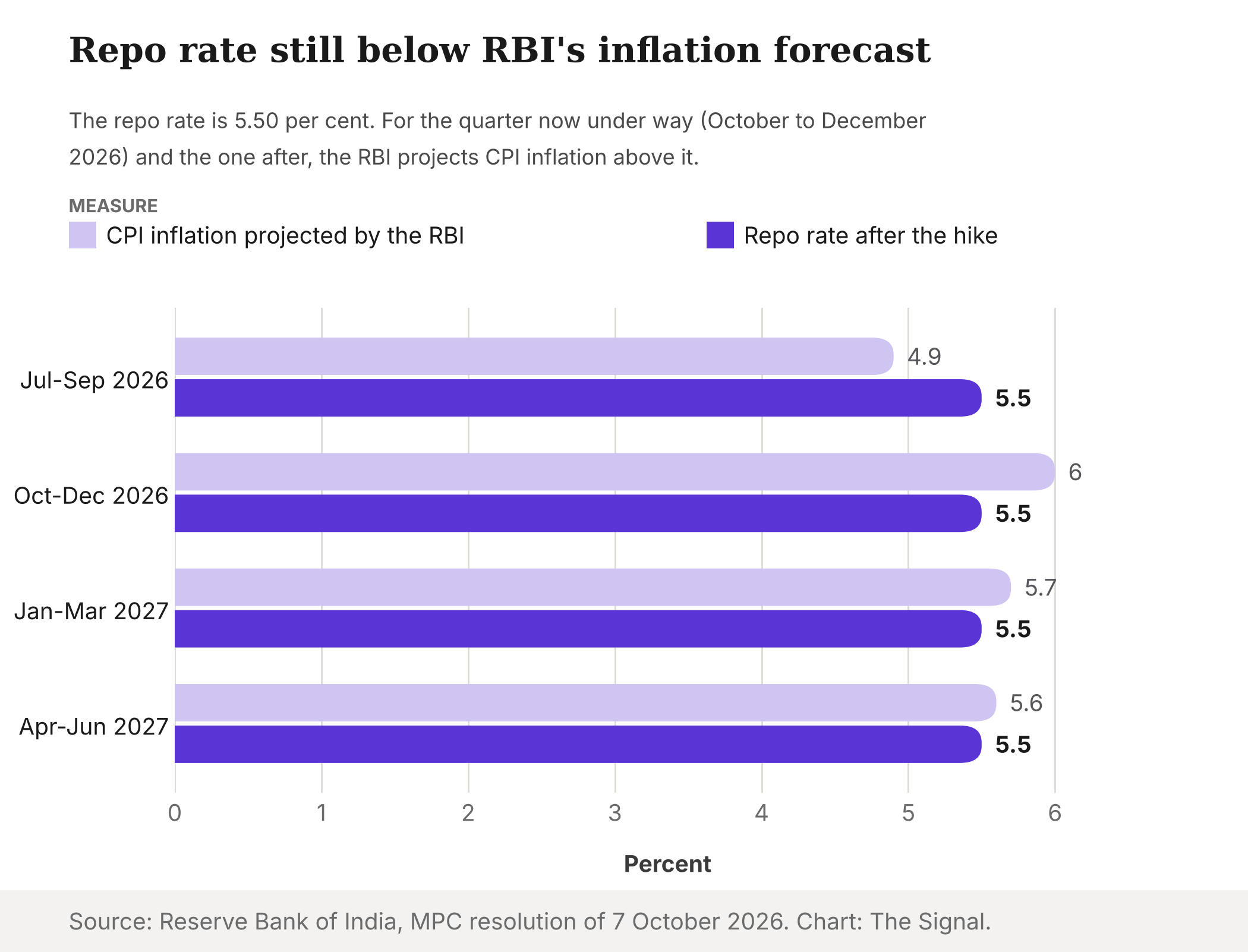
The RBI projects CPI inflation of 5.2 per cent for 2026-27, with 4.9 per cent in the second quarter, 6.0 per cent in the third and 5.7 per cent in the fourth. It puts inflation for the first quarter of 2027-28 at 5.6 per cent. Set those quarters against a repo rate of 5.50 per cent and the picture is plain. The July to September quarter has already closed, so the first row of the table below is history.
In the quarter now under way and the two after it, the RBI expects inflation to run above its own repo rate.
| Quarter | RBI projected CPI inflation (%) | Repo rate after the hike (%) | Repo minus inflation (percentage points) |
|---|---|---|---|
| July to September 2026 | 4.9 | 5.50 | +0.6 |
| October to December 2026 | 6.0 | 5.50 | -0.5 |
| January to March 2027 | 5.7 | 5.50 | -0.2 |
| April to June 2027 | 5.6 | 5.50 | -0.1 |
Source: Reserve Bank of India, MPC resolution of 7 October 2026, for the projections and the repo rate. The last column is The Signal's arithmetic.
The committee says as much in its own words. Headline CPI inflation is expected to average almost 5.8 per cent over the next three quarters, against a repo rate of 5.50 per cent. That is a real policy rate, meaning the repo rate minus inflation, of roughly minus 0.3 percentage points on the RBI's own numbers. The quarter now under way, October to December 2026, carries the widest gap, at half a point.
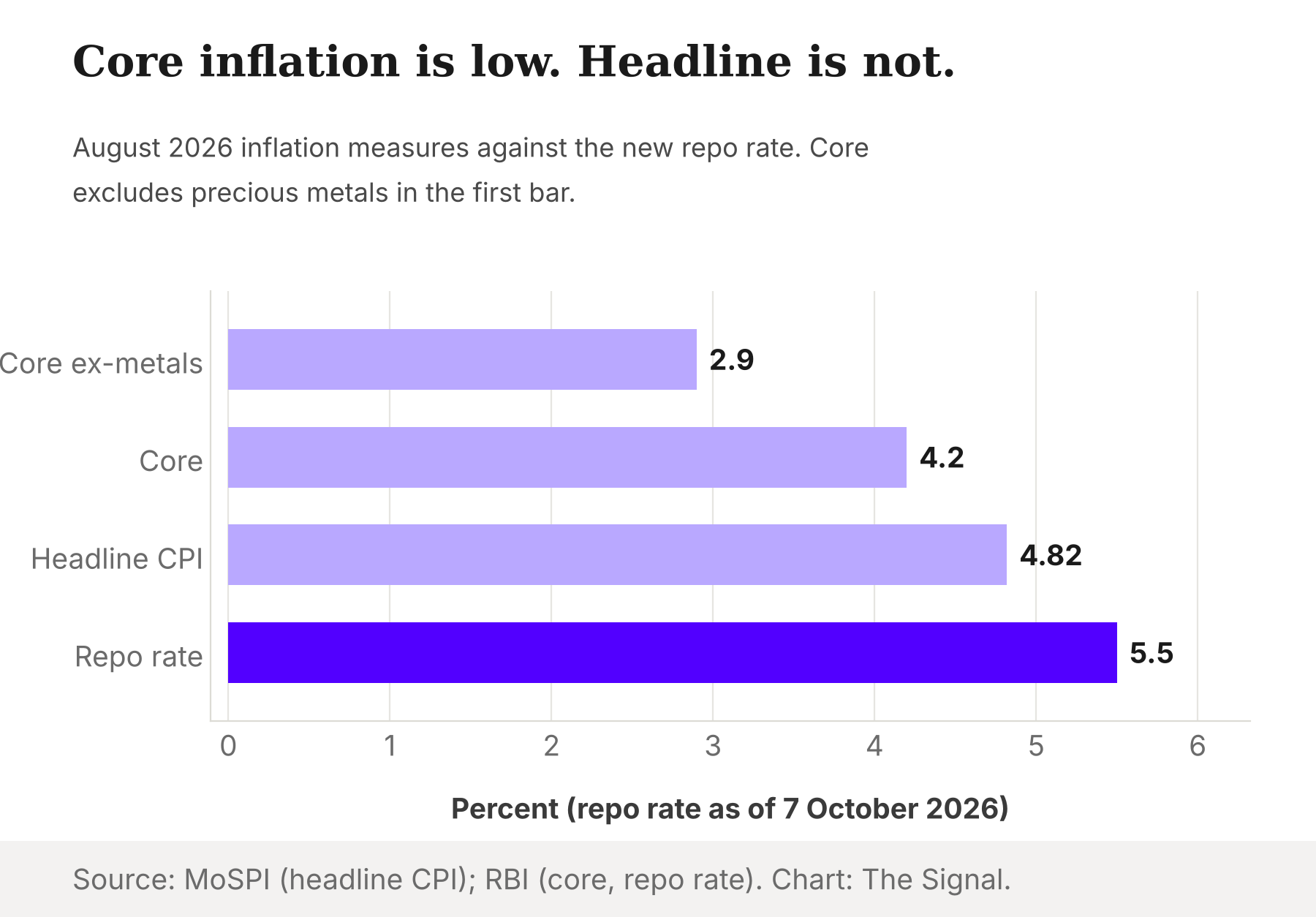
Looking backward flatters the hike. Retail inflation was 4.82 per cent in August 2026, so against the latest reading the real rate is positive by about 0.7 points. The gap closes because the RBI expects prices to speed up, which is the reason it moved.
Why raise at all, if growth is strong?
The committee gave a plain reason. With inflation expected to average almost 5.8 per cent, it said "recalibrating the policy rate is imperative". It also pointed outward. The US Federal Reserve raised its target range by a quarter point to 3-3/4 to 4 percent on 16 September 2026 on a 12-0 vote. With the repo rate at 5.50 per cent, India's policy rate now sits 1.5 points above the top of the Fed's range.
Strong growth is what gave the committee room. Real GDP grew 7.8 per cent in April to June 2026. The RBI now projects 7.1 per cent for 2026-27, with 7.2 per cent in the second quarter, 6.9 per cent in the third and 6.8 per cent in the fourth. In August it had projected 6.7 per cent growth and 5.0 per cent inflation for the year.
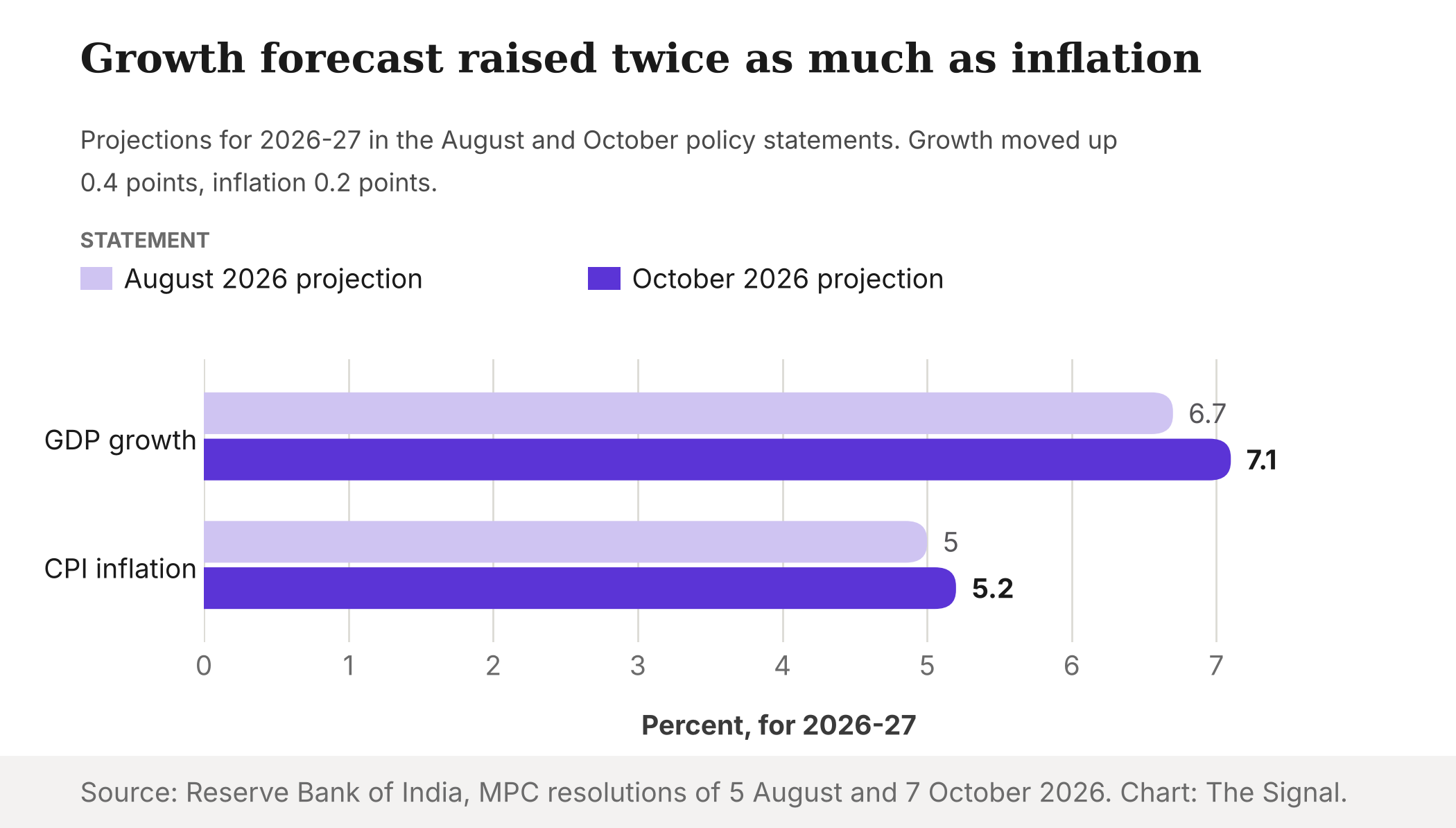
Between the August and October statements, the growth forecast moved up 0.4 points and the inflation forecast 0.2 points. The forecast for output rose twice as much as the forecast for prices. A central bank that expects the economy to absorb a tighter policy can afford a small hike, and that is what the committee delivered.
What the hike is aimed at
The underlying price data explain why the move is small. In August, core inflation was 4.2 per cent, and core inflation excluding precious metals was 2.9 per cent. Core inflation strips out food and fuel, the volatile parts of the basket. Headline inflation is above both, so food and fuel are doing the pushing.
A policy rate cannot lower the price of onions or crude. The committee acknowledges the limit. It sees only limited signs of supply side pressures getting embedded in pricing behaviour. The hike is a bet on expectations. The aim is to stop a food and fuel shock from becoming the price-setting habit of firms and households.
The honest objection
The strongest defence of the RBI is that the repo rate does not need to exceed forecast inflation to work. Policy acts with a lag. The committee is pricing the risk of second-round effects, not the headline number, and with core excluding precious metals at 2.9 per cent in August, a repo rate near 5.5 per cent is not loose against underlying prices. A real rate close to zero can be a sensible setting when the shock is on the supply side.
That case is sound as far as it goes. It does not cancel the arithmetic. The RBI chose the word "tightening" for its stance, and its own projections say the policy rate trails inflation in the quarter now under way and the two after it. Two members, Dr. Nagesh Kumar and Prof. Ram Singh, wanted the stance kept at neutral, so the committee itself was not of one mind on how far to lean. All six backed the hike, but only four backed the tightening label.
The Signal
The October decision is better read as a signal of direction than as a squeeze. The repo rate is 5.50 per cent, and the central bank's own path has inflation at 6.0 per cent in the quarter now under way. The next move depends on whether the supply shock spreads into core prices.
Watch two things. If core inflation excluding precious metals climbs from 2.9 per cent toward the 4.4 per cent the RBI projects for core overall this year, a second hike gets easier to justify. If food and fuel ease while growth holds near the 7.1 per cent the RBI projects, the committee will have raised rates into a forecast that never arrived. A rate that sits below the inflation you expect is a promise, not a brake.
Reporting basis: the repo rate decision, the vote, the stance, the projections, the core inflation readings and the committee's rationale are from the Reserve Bank of India's MPC resolution of October 2026 and its August 2026 resolution, which are the primary documents and were read directly. August retail inflation and first-quarter GDP growth are from MoSPI's National Statistics Office releases, read directly. The Federal Reserve decision is from the Federal Open Market Committee's own statement of 16 September 2026. The piece rests on three independent origins, the RBI, MoSPI and the Federal Reserve, and the RBI resolutions carry most of the load. The quarterly repo-minus-inflation gaps, the roughly minus 0.3 point real rate, the 0.7 point real rate on August inflation, the 1.5 point gap to the Fed and the comparison of the growth and inflation revisions are The Signal's calculations from those figures.