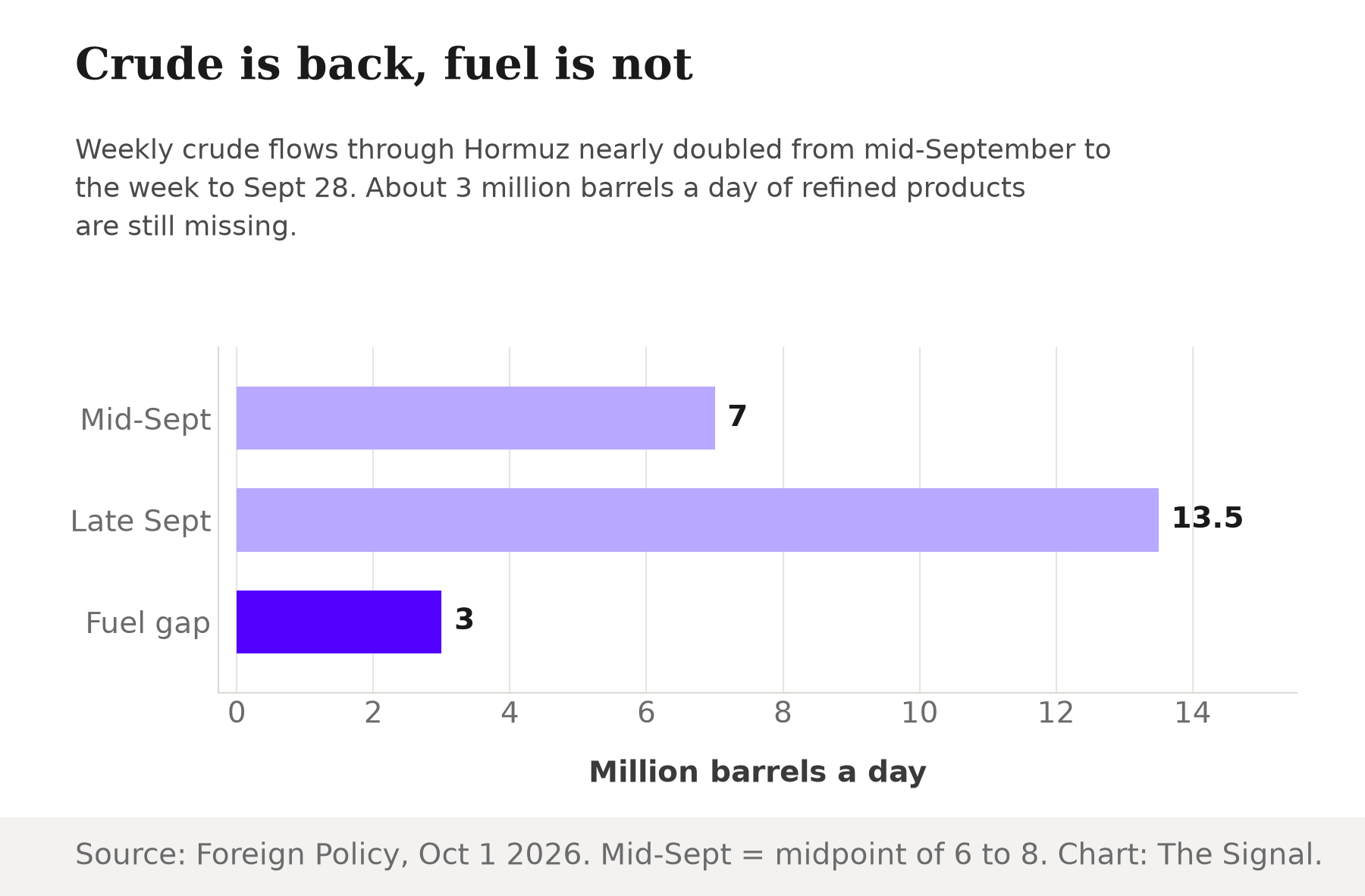
The recovery is real. Weekly crude flows through the Strait of Hormuz are now about 13.5 million barrels a day, nearly double the 6 million to 8 million of mid-September, according to Foreign Policy's reading of the tanker data. If oil were a simple story about barrels leaving the Gulf, prices would be falling.
They are not. After the G7 announcement, Brent briefly dropped below $100 a barrel, but rose to about $102. The G7 had just agreed to release 100 million barrels of oil and diesel from emergency stocks. A recovered crude flow and a coordinated stock release, and still a price above $100.
Crude is not what is scarce
It is worth slowing down on that. The recovery is real, but it is a recovery in one product. About 3 million barrels a day of refined products are still missing from the Hormuz equation, and refined product flows are just over half of what they were before the war.
Diesel shows the gap most sharply. The IEA's September report found that net exports of diesel and gasoil from the Gulf countries averaged 390 thousand barrels a day in August, just over a quarter of pre-war levels. The same report put US diesel prices above $200 a barrel in early September, 94 percent above pre-war levels.
So the price signal has moved. A tanker of crude can now get out of the Gulf. A tanker of diesel mostly cannot, and refineries elsewhere cannot make up the difference.
The price lives in the crack spread
The part of a diesel price that is not crude is the refining margin, known as the crack spread. The US Energy Information Administration defines it as the difference between the wholesale diesel price and the spot price of Brent crude. On September 14, US diesel averaged $6.29 a gallon, and the high crack spread on top of the elevated price of a barrel of crude had driven retail prices up.
That margin is not about to collapse. The EIA expects US average diesel crack spreads to exceed $2 per gallon from August through November. It also expects distillate inventories to drop below 100 million barrels in September and to stay below the five-year low through much of 2027. Stocks are the cushion, and the cushion is thinning: global oil stocks have fallen by more than 500 million barrels since the start of the war, as that report summarises the IEA's findings.
This is why the G7 release helps less than its headline suggests. Neil Atkinson, a former IEA official quoted by Al Jazeera, said it doesn't deal with the fundamental problem that the global supply remains lower than normal. A stock release spends the cushion. It does not rebuild the refineries or reopen the product routes.
Where India feels it
India is mostly a crude importer that refines at home, so the crude recovery should matter. It does, but the pump price follows the products. The rating agency ICRA estimates that Indian oil marketing companies ran negative marketing margins of around ₹8 per litre on petrol and ₹9 per litre on diesel in September, as Business Today reports it.
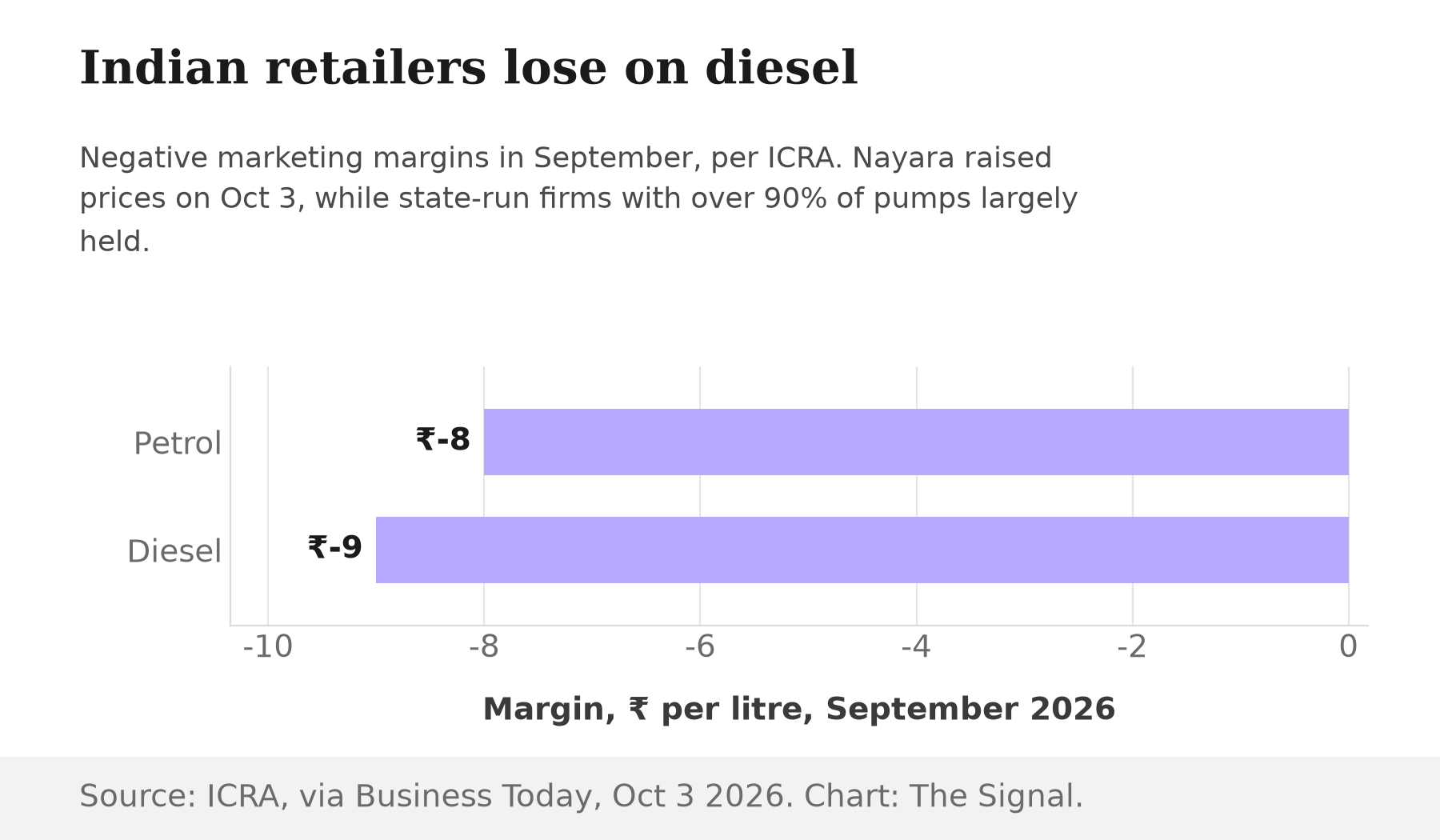
Prices have started to move at the margin. Nayara Energy raised petrol by ₹5 per litre and diesel by ₹3 per litre across its 7,108 stations on October 3. Indian Oil, Bharat Petroleum and Hindustan Petroleum, which control more than 90 percent of pumps, have largely held prices. Their losses do not disappear because crude flows recovered. They are carried on the companies' books until either global product prices fall or retail prices rise.
The honest objection
The strongest case against this reading is that the product gap is temporary. The EIA's own forecast assumes a return to normal tanker traffic through Hormuz in the near term, which would let Saudi and Kuwaiti refineries export more distillate. If crude flows could nearly double in two weeks, products might follow.
That is possible, and nothing here shows it will not happen. But the same EIA outlook warns that if Middle East flows remain constrained beyond 2026, crack spreads would be higher than forecast, and that Russian refinery outages are expected to continue pressuring global distillate prices through the first half of 2027. Crude can reroute. Diesel needs refineries. A fast crude recovery is not evidence of a fast product recovery.
The Signal
The headline number everyone watches, barrels leaving the Gulf, has stopped being the number that sets the price. The price now lives in the distance between a barrel of crude and a barrel of diesel, and that distance is widest exactly where India's retailers are losing ₹9 a litre.
Watch two things. First, whether Gulf diesel and gasoil exports climb back from the 390 thousand barrels a day of August. Second, whether the state-run retailers follow Nayara's October 3 increase. If crude keeps flowing and diesel stays scarce, the next adjustment will come at the pump, not at the port.
Reporting basis: crude and refined product flow figures are from Foreign Policy, reading tanker data. The August Gulf diesel export and September US diesel price figures are from the IEA's September Oil Market Report, as reproduced by Hellenic Shipping News, and the global stock draw is the IEA finding as summarised by Hydrocarbon Engineering; both rest on the IEA as a single origin and neither was checked against the IEA's own page. Brent and G7 figures, and the Atkinson quote, are per Al Jazeera. Crack spread, inventory and diesel price figures are from the US Energy Information Administration. The Indian retail margins are ICRA estimates and the Nayara price rise is reported, both via Business Today. The mid-September crude flow of about 7 million barrels a day in the chart is the midpoint of the reported 6 to 8 million range, and is The Signal's calculation.