On 1 October, India lowered the levy on its diesel exports again. The rate fell to ₹16 a litre, and the levy on aviation fuel fell to ₹10.50, according to the export-duty table kept by the Petroleum Planning & Analysis Cell, which compiles the figures from the customs and excise board. The easy read is that a wartime windfall tax is slowly being wound down as the emergency fades. Each cut is a little relief for refiners, and the rate keeps drifting toward zero.
It is worth slowing down on that. The same day, Reuters reported that Washington had told France and Germany to release emergency diesel stocks or face a possible US diesel export ban, citing a request for 120 million barrels of diesel in the next six months. The world's largest economy is threatening to close its export door on the day India nudges its own door open.
The two moves may not be linked, but they are not opposites either. They are the same kind of instrument, an export lever, pulled by two governments facing the same tight diesel market, and the Indian version shows how it works.
The levy was built as a valve
All India Radio reported the government's announcement of 27 March. It cut domestic petrol and diesel excise by ₹10 a litre in view of the West Asia crisis, and it set export duties of ₹21.50 a litre on diesel and ₹29.50 on aviation turbine fuel "to ensure adequate availability of these products for domestic consumption."
Read that purpose carefully. Nothing in it mentions raising revenue from a windfall. The aim is to keep fuel at home. The two decisions came together: the government subsidised the pump price and taxed the export price, so that a refiner would have no reason to ship a litre abroad that a domestic buyer could use.
That makes the levy a valve. Its job is to adjust how much of each barrel's output goes out of the country, and a valve is turned in response to conditions, not left alone.
The dial has not stayed still
The PPAC table makes the turning visible. The diesel levy rose to ₹55.50 a litre from 11 April, then fell to ₹8.50 on 1 July, climbed to ₹25.50 on 3 August, and stood at ₹20 on 16 September before the 1 October reset to ₹16. The government reviews it every fortnight.
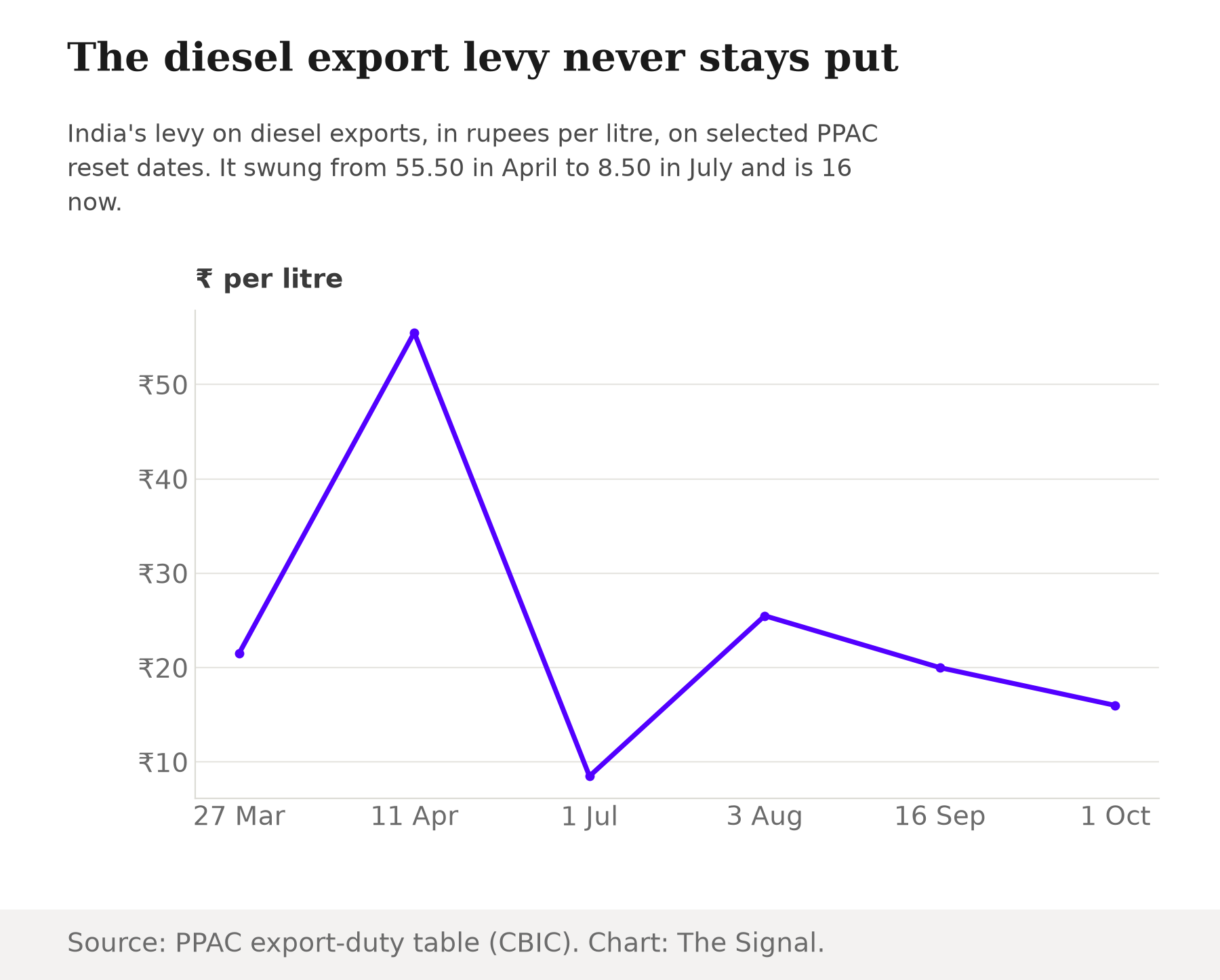
Between 1 July and 3 August the levy tripled, from ₹8.50 to ₹25.50. A tax built to collect a windfall does not behave like that, but a valve tightened because domestic supply looked thin does.
The current direction is downward. Measured against the PPAC table, the 1 October diesel rate is about 71 percent below the April peak and about a quarter below the opening rate in March. For aviation fuel the fall is steeper, from ₹29.50 at the start to ₹10.50 now, a drop of about 64 percent.
Aviation fuel flipped below diesel
One detail in the table is easy to miss. When the levies began, aviation fuel was taxed ₹8 a litre more heavily than diesel. By 1 October it is taxed ₹5.50 less.
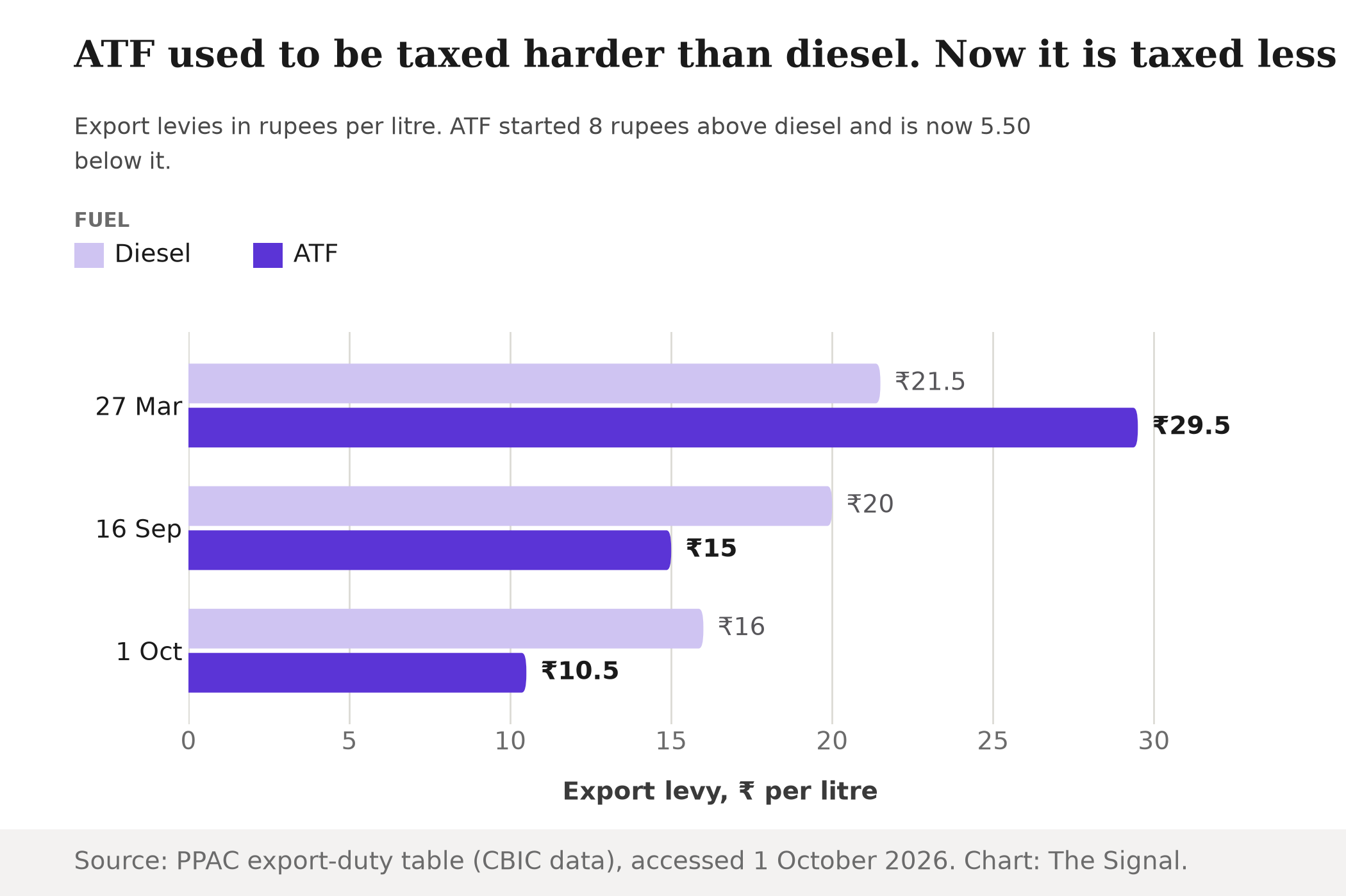
The gap has closed from one side only. Aviation fuel's levy has been cut harder, which suggests the government is now more willing to let jet fuel leave than diesel. That is an inference from the pattern, not something the notification states, and the government gives no reason for the ordering of the cuts. But the direction is consistent with a state that is comfortable releasing a product, and still careful about the one that moves its trucks, tractors and freight.
Why the timing matters
India is not a bystander in the diesel market. OPIS, citing PPAC data, reported that India's diesel exports rose 8.7 percent year on year and 82.1 percent from the previous month to 2.44 million tonnes in July 2026, and that gasoline and diesel together made up 68.3 percent of exported volumes. The levy was at its ₹8.50 low from 1 July, the month shipments surged.
That is a correlation across a single month, and it should not be pushed too far. Refinery schedules, ship availability and foreign margins all move volumes too. But it is the pattern a valve would produce: lower the levy and more fuel leaves.
Now set that against the other side of the ledger. Washington's request to Europe is large, and US Energy Secretary Chris Wright said the world had lost some Middle East diesel exports, which are being restored, and lost diesel exports from China. If the US does restrict its own exports, buyers short of diesel will have fewer places to look.
The honest objection
The strongest case against this reading is that the cuts are a response to lower international prices. The government says it reviews the levy every fortnight, and when margins fall, the windfall shrinks, and so does the tax. On that view there is no strategy here, only arithmetic.
That case is partly right, and the table cannot rule it out, because the government publishes the rates but not its reasoning. But it does not explain why the original notification was written around domestic availability rather than revenue, and a pure windfall tax would not have been paired with a ₹10 cut in pump excise. The government built a supply instrument and appears to be running it as one.
What the cut costs, and what it risks
Every rupee cut from the levy is a rupee a refiner keeps on an export litre. Every litre exported is a litre that does not sit in an Indian depot. The risk is domestic. The Finance Ministry's September review says oil prices spiked in September, global bond yields are climbing sharply and a lower risk premium on Indian debt is pressuring the rupee, according to Forbes India's report of it. A country that is already worried about oil prices and the rupee is loosening the brake on exports of its most-used fuel.
That is a bet that supply at home is comfortable enough to share. The bet may be right. It is also one that the fortnightly format lets the government reverse in two weeks, which is the whole point of building the instrument that way.
The Signal
The levy was never a windfall tax in spirit. On the evidence of the PPAC table, it is a dial that trades rupee revenue and domestic comfort for export volume, and on 1 October it moved toward the exporter just as Washington was reported to be moving the other way.
Watch two things. First, whether the next fortnightly review holds the cut or reverses it if a US ban lifts global diesel prices. Second, whether aviation fuel keeps falling faster than diesel, which would confirm which product New Delhi is more willing to let go. If the dial turns up again within a fortnight, the cut was a calculation about prices. If it keeps falling while Washington closes its door, India has decided to be the world's spare diesel tank.
A valve is only a policy until someone is thirsty.
Reporting basis: the export levy history is from the PPAC export-duty table, which cites the customs and excise board as its source. The March purpose statement is from All India Radio's report of the government announcement. The July export volumes are from OPIS, reporting PPAC data. The US request to Europe and the Energy Secretary's remarks are from a single Reuters exclusive that relies on anonymous sources, as syndicated by Yahoo. The Finance Ministry review is as reported by Forbes India, not the review itself. The percentage declines, the tripling between 1 July and 3 August, and the aviation fuel gap are The Signal's calculations from those figures. The reading of the levy as a supply valve is The Signal's interpretation.