
On 1 October 2026, India's carmakers published their September numbers, and most of them looked good. Maruti Suzuki's total sales rose 24.43 percent to 236,013 units, against 189,665 a year earlier. Hyundai Motor India sold 77,916 vehicles, its highest-ever monthly total, up 10.8 percent. Mahindra's total sales rose 15 percent to 114,874 units. The easy read is a strong festive run-up and an investor base that will reward it.
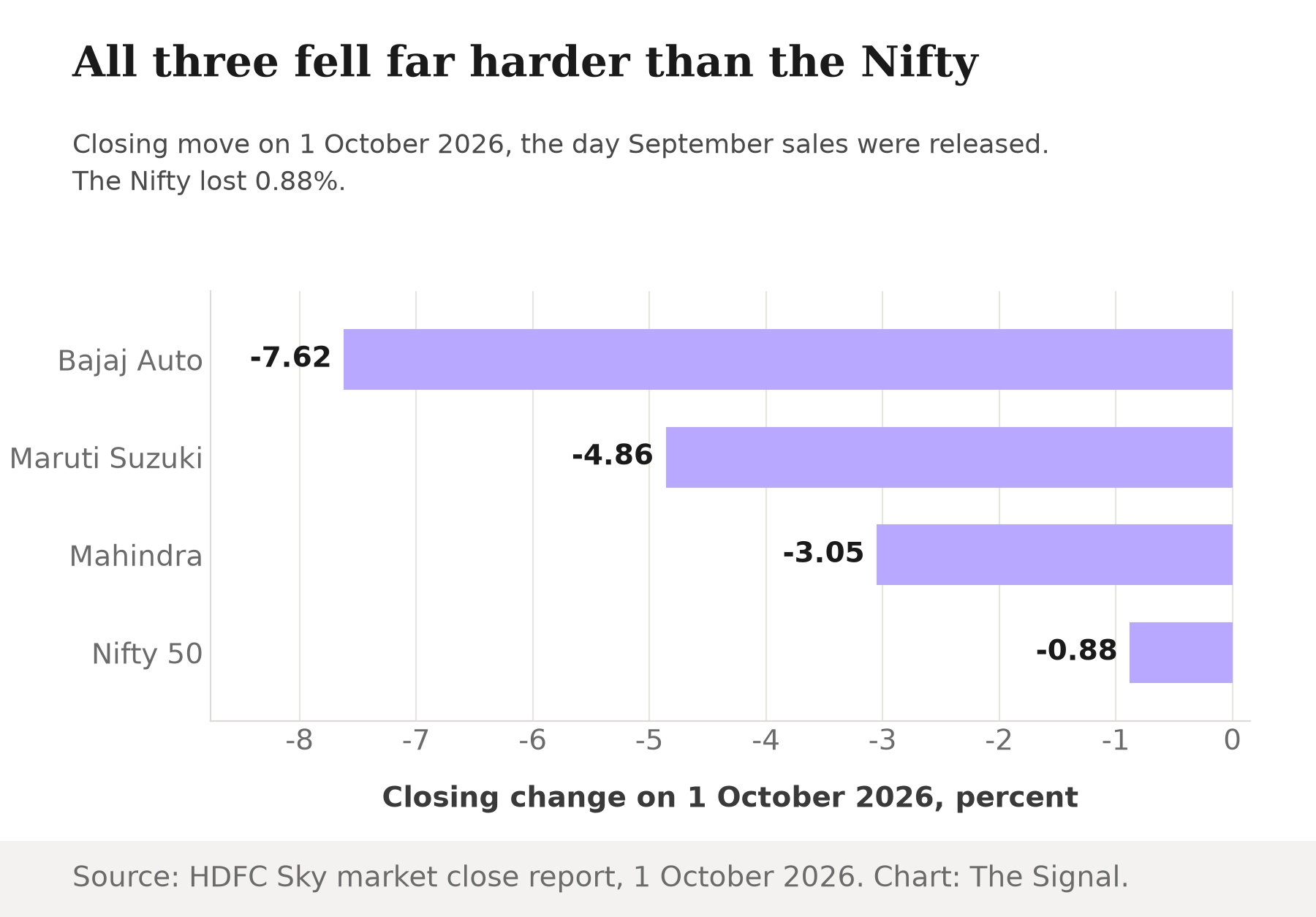
The market did the opposite. Maruti closed down 4.86 percent, Mahindra & Mahindra down 3.05 percent and Bajaj Auto down 7.62 percent, while the Nifty fell 0.88 percent. It is worth slowing down on that, because the shares did not fall for lack of growth. They fell because the growth had already been discounted.
The forecast was already high
Before the numbers landed, Jefferies had published projections. It expected September wholesale growth of 15 to 17 percent for Bajaj Auto, Maruti Suzuki and TVS Motor, and 9 to 10 percent for Royal Enfield, Hyundai and M&M. Take the midpoint of each range and compare it with what the companies reported.
| Company | Jefferies projection (midpoint) | Reported growth | Gap, points |
|---|---|---|---|
| Maruti Suzuki | 16% | 24.4% | +8.4 |
| Mahindra | 9.5% | 15% | +5.5 |
| Hyundai | 9.5% | 10.8% | +1.3 |
| Bajaj Auto | 16% | 5% | -11 |
Sources: Jefferies via The Tribune; Upstox; Autocar Professional; UNI. Midpoints and gaps are The Signal's calculations.
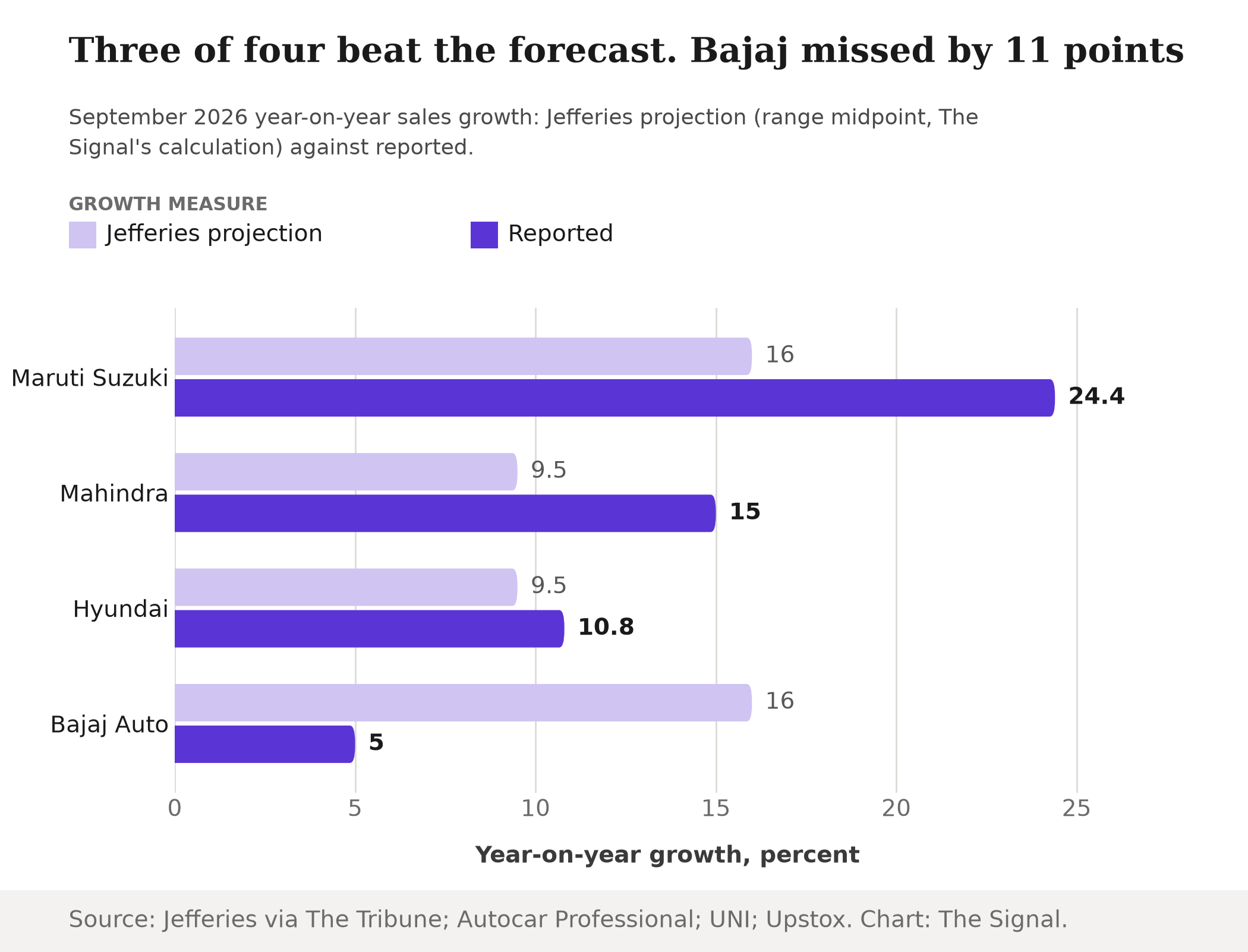
Three of the four beat the projection. Maruti beat it by roughly eight points. Yet Maruti's shares closed down 4.86 percent, more than Mahindra's, which also beat. A beat did not protect either stock. The only company that missed, Bajaj, took the largest fall.
The base made September look strong
The reason a beat is worth so little sits in Jefferies' own note. It said year-on-year growth was boosted by a low base, because September 2025 was hit by an early inauspicious period and by deferment ahead of the GST cut.
The deferment was rational. The cut took effect on 22 September 2025, and it took GST on two-wheelers up to 350cc, and on small cars, from 28 percent to 18 percent. A buyer who knew the tax was falling had every reason to wait. So the comparison month a year later contains almost no waiting, and any company that sold normally in September 2026 shows large growth against a depressed base.
That is the point the market priced. Growth measured against a trough says little about demand running at its own pace. Investors paid for a forecast that already included the flattery, so a beat on the headline number carried no news.
Bajaj shows what is underneath
Bajaj is the useful case because its headline hides its split. Total sales rose 5 percent to 538,443 units, but domestic sales fell 9 percent to 294,456 units, and exports rose 32 percent to 243,987 units. Domestic volume fell even against the same depressed September 2025 base. Exports carried the total.
Strip out the flattering base and that is a weak domestic market. Bajaj also missed Jefferies by 11 points on the midpoint, and its shares fell as much as 9 percent during the session. Mahindra's split is similar. Its total grew 15 percent, but domestic tractor sales fell 23 percent to 50,208 units, which the company attributed to the festive calendar shifting to October and a high September 2025 base after the GST reduction. The base cuts both ways. The same GST reduction also covered tractors, so tractors compared against a strong September 2025 while cars compared against a weak one.
The honest objection
The strongest case against this reading is that the market, not the sales, was the problem. Indian equities fell for an eighth straight week, the longest losing run in 25 years, foreign portfolio investors sold Rs 10,148 crore on 1 October, Brent was back at $100 and the US 10-year yield stood at 5.34 percent. Autos are rate-sensitive and fuel-sensitive, and any sector with that exposure would have sold off on such a day. On this view the September numbers were incidental.
That explains why the whole sector fell. It does not explain the size. The three automakers closed down 7.62, 4.86 and 3.05 percent against the Nifty's 0.88 percent, between three and nearly nine times the index move, and Bajaj, the one with the domestic decline, took the heaviest hit. One day cannot test this cleanly: Maruti beat by the most and fell more than Mahindra, so a forecast surprise alone does not rank the moves. The claim here is narrower. A beat against a base-flattered forecast did not buy protection in a tape that was already falling.
The Signal
September's sales were a measure of last September's absence of buyers, not this one's presence. The number that will say more is the next one: when the comparison no longer has a GST deferral in the base, growth has to come from customers who are actually buying. Watch Bajaj's domestic sales, which fell 9 percent to 294,456 units even with the base working in its favour. Once the base stops helping, only demand is left to carry the numbers.
Reporting basis: Bajaj Auto's and Mahindra's September 2026 volumes are per Autocar Professional's reporting of the companies' releases, and Hyundai Motor India's figures are per UNI's report of the company's announcement. Maruti Suzuki's sales and the intraday moves in the Nifty Auto index and Bajaj Auto are per Upstox, and the closing moves and market context are per HDFC Sky's market close report for 1 October 2026. The growth projections and the base-effect statement are Jefferies' view, as reported by The Tribune, and rest on that single secondary source. The GST rate changes and their 22 September 2025 effective date are from Press Information Bureau releases. The projection midpoints, the gaps to reported growth and the comparisons of share moves with the Nifty are The Signal's calculations from those figures.