The headline read of India's new fuel rules is about the target. On 29 September 2026 the power ministry notified the third round of Corporate Average Fuel Economy (CAFE) norms. The fuel-consumption benchmark tightens from 3.996 litres per 100 km in 2027-28 to 3.3273 litres per 100 km in 2031-32, an improvement of around 16.7 per cent, according to a PTI report carried by DT Next. Carmakers must hit that average across everything they sell. Tougher target, cleaner fleet: that is the story most coverage is running.
It is worth slowing down on that. A fleet average is an arithmetic object, and the rules decide how each car enters the sum. The figure to hold onto is three.
One electric car counts as three
Autocar India reports that battery electric and range-extended electric vehicles carry a 3.0 multiplier in the final norms. The Bureau of Energy Efficiency's September 2025 draft worked the same way. Each battery electric vehicle was counted as 3.0 vehicles, through an effective volume equal to the multiplier times units sold.
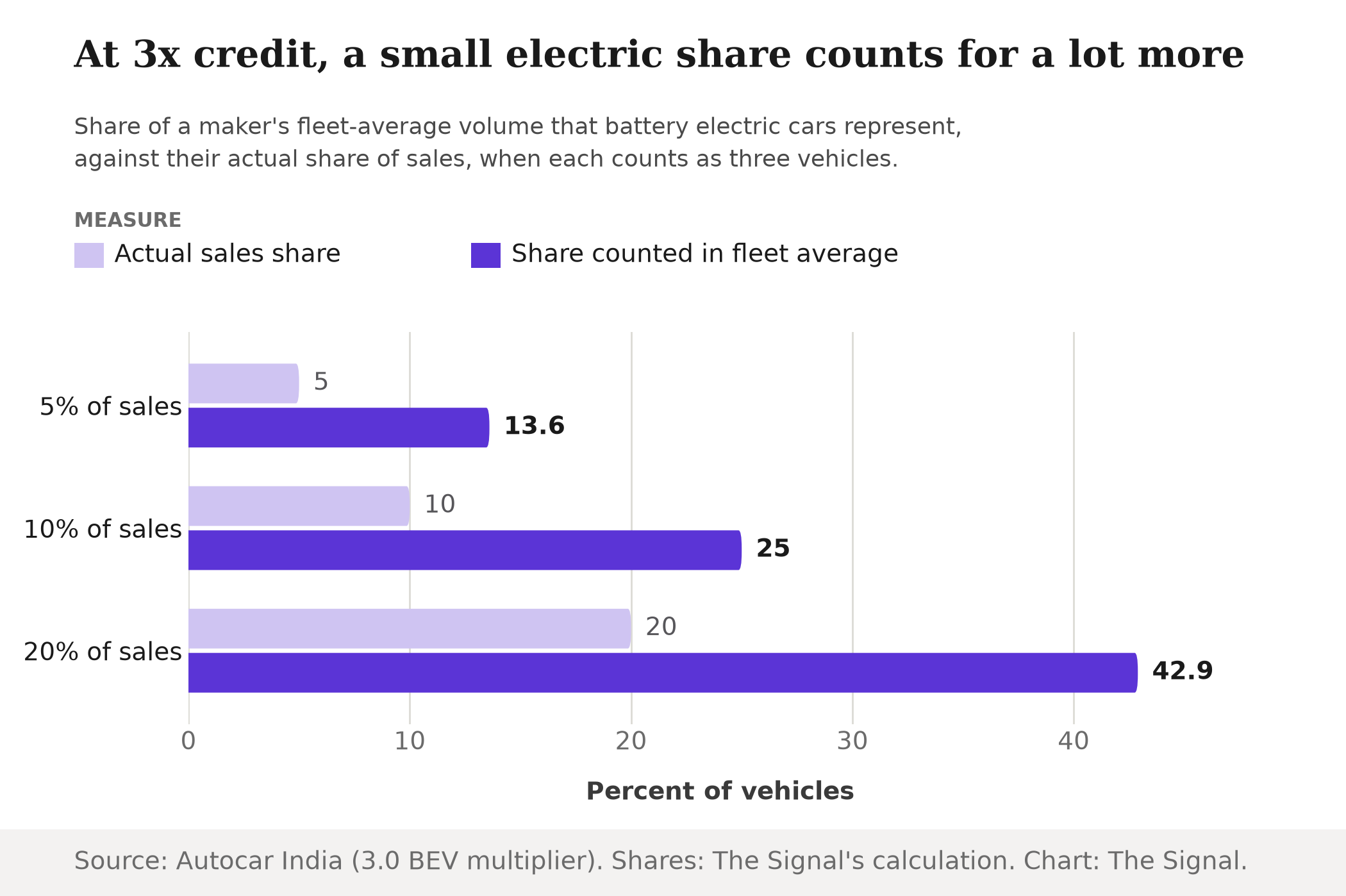
The consequence is easy to compute from the 3.0 effective-volume rule. If a maker sells 10 electric cars in every 100, the fleet average is calculated as if it sold 30 electric cars among 120 vehicles. Electric cars then make up 25 per cent of the volume that sets the average, not 10 per cent. At a 5 per cent sales share the counted share is 13.6 per cent. At 20 per cent it is 42.9 per cent. These are The Signal's calculations from the 3.0 multiplier.
The draft also puts every fuel on one scale: petrol-equivalent consumption for petrol cars is declared CO2 in grams per kilometre divided by 23.7135. Electric cars are measured in kWh and converted to the same petrol-equivalent scale, and each one then counts three times. A 16.7 per cent tighter target is demanding in the abstract. With a 3x credit it can be met by changing the mix at the margin, without changing a single petrol engine.
The concession that did not survive
The draft had offered something to the other end of the market. Petrol cars of up to 909 kg unladen mass, 1,200 cc and 4,000 mm length could claim a further 3.0 g CO2/km reduction, capped by the draft at 9.0 g/km cumulatively. The final notification dropped it, and the reference weight rose from 1,082 kg to 1,229 kg, about 13.6 per cent.
The politics were about one company. Tata Motors and Mahindra objected that the concession would benefit only Maruti Suzuki, which dominates an estimated 95 per cent of India's small-car market, S&P Global's AutoTechInsight reported. Maruti had pushed for the relief.
The concession was also smaller than it looked. The draft target moved with weight: it was 0.002 x (W - 1170) + c, where W is a fleet's average unladen mass in kilograms. Multiply by 23.7135 and each kilogram is worth about 0.047 g of CO2 per km of target. On that arithmetic, the 3.0 g concession equalled roughly 63 kg of extra fleet weight. The Signal's calculation rests on the draft formula. The final slope was not available to us, so treat it as an illustration of scale, not the final number.
Where the volume already is
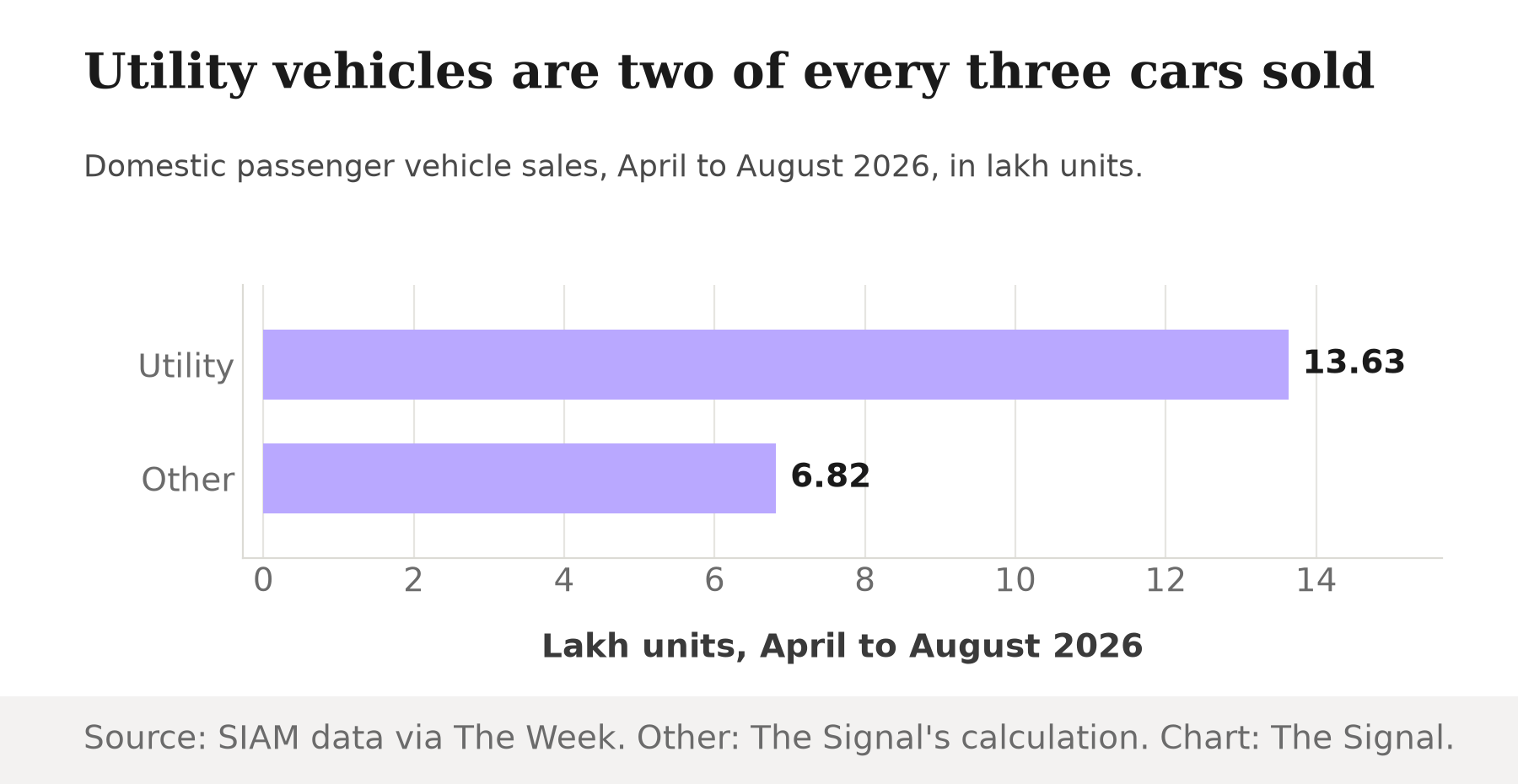
The market is not waiting for the rule. Domestic utility vehicle sales climbed 30.7 per cent to 13,62,527 units in April to August 2026, according to The Week citing SIAM data. Total domestic passenger vehicle sales in that period were 20,44,696 units, so utility vehicles were about two in three, and the remaining 6,82,169 units were everything else. That is The Signal's subtraction. A year earlier the trend was already visible: SIAM put the utility vehicle share at 66 per cent in April to June 2025, while the passenger cars segment shrank 11.2 per cent.
Read together, the two facts point one way. The rule counts electric volume at triple value and offers small petrol cars no separate relief. The market is already tilting to heavier vehicles. Under a weight-based formula, heavier fleets are set looser targets, so that tilt does not by itself make compliance harder. How each maker fares depends on its own mix of weight and electric share, and that is not yet public.
The honest objection
The strongest case against this reading is that the small-car concession was always a one-company favour, and removing it treats every maker alike. That is the argument Tata and Mahindra made, and it has force. A lighter fleet also starts with a lower target under the draft's weight formula, so lightness is not ignored. The multiplier is also technology-neutral in principle: any maker can sell electric cars and claim it. On that view the rule is even-handed and the outcome is simply a function of who invests.
The answer is that even-handed rules can still allocate cost unevenly. A 3x credit is worth most to the maker that already sells electric cars in volume, because its multiplier applies to a large base. A maker whose volume is concentrated in low-priced petrol cars has to build that base first, or pay for the gap. Autocar India reports credits are priced from Rs 2,500 per g CO2/km in FY2028 to Rs 4,500 in FY2032. Nothing in the public record yet shows which maker ends up short.
The Signal
The target gets the headline, but the multiplier does the work. At 3x, a modest electric share moves the fleet average by more than its size suggests, so the first compliance years will be decided by electric volume rather than by engine efficiency. Watch the first compliance-year results once the norms take effect on 1 April 2027. If the makers that sell the most small petrol cars report a shortfall and buy credits, the removal of the concession will have had a price. If they close it with electric models, the concession was never the point. A fleet average rewards whoever controls the denominator.
Reporting basis: the formula, the 3.0 multiplier, the petrol-equivalent conversion and the 909 kg concession are from the Bureau of Energy Efficiency's September 2025 draft CAFE 2027 standard, which is the primary document we read; the final notification itself was not available to us, so its terms are per DT Next carrying a PTI report and per Autocar India, which report the same notification and may share a source. The Tata, Mahindra and Maruti positions and the 95 per cent small-car share are per S&P Global's AutoTechInsight and rest on that single source. Sales figures for April to August 2026 are SIAM data as reported by The Week, and the 2025 quarterly share and passenger car decline are from SIAM's own release. The counted electric shares, the 63 kg equivalence and the non-utility sales figure are The Signal's calculations from those figures.