
Ask the world whether artificial intelligence will cost people their jobs and the answer, this year, is a fairly settled yes. A Pew Research Center 37-country survey finds that in 34 of the 37 countries it polled, people on balance expect AI to destroy more jobs than it creates over the next 20 years. That is close to a global consensus, spanning rich democracies and poorer ones alike.
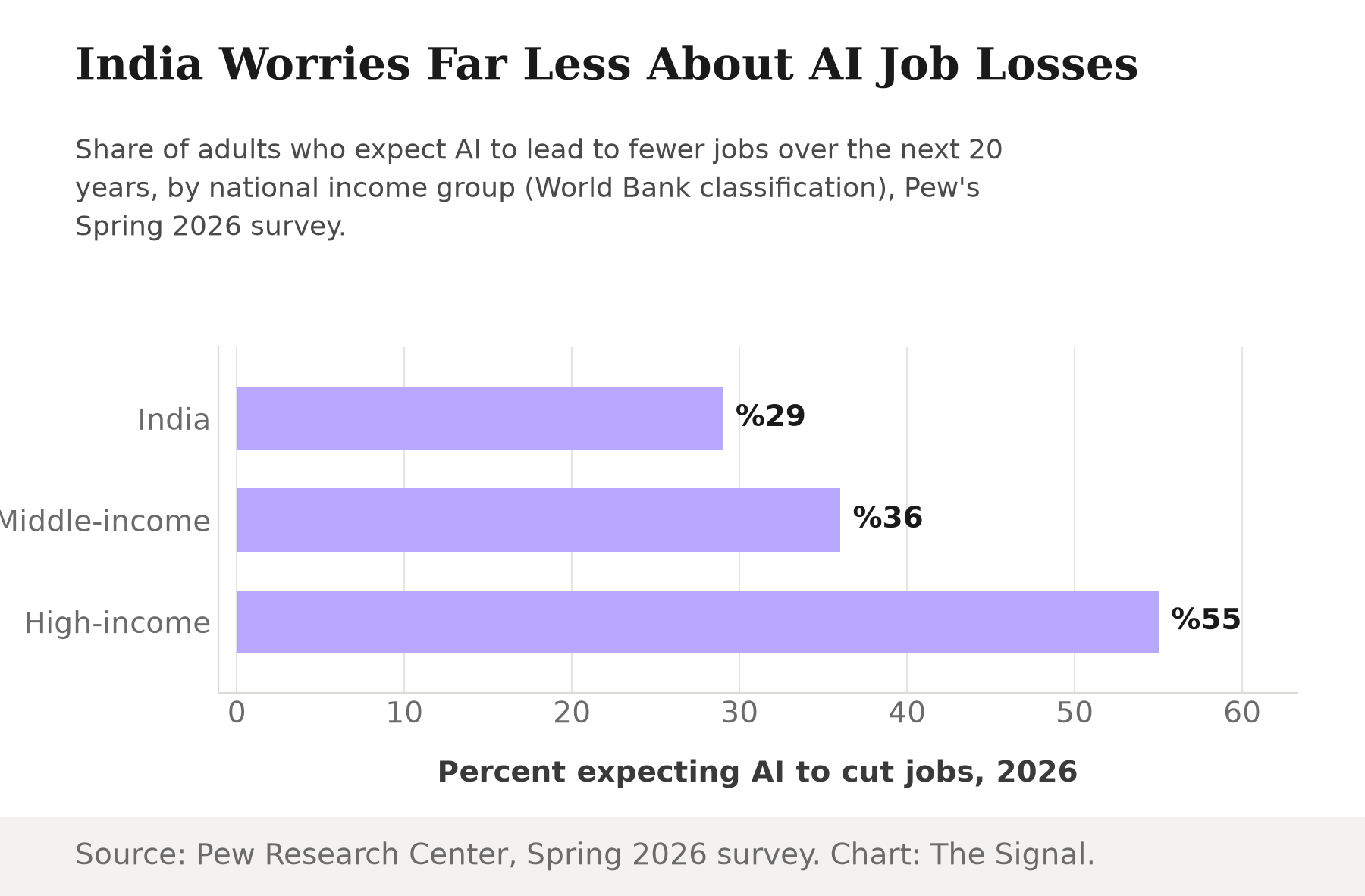
India is one of the outliers. ThePrint, reporting Pew Research Center's Spring 2026 Global Attitudes Survey, says only 29 percent of Indian adults expect AI to lead to fewer jobs in India over the next 20 years, against 21 percent who expect more jobs and 35 percent who are unsure. That is not a rounding difference from the global mood; it is a country sitting outside the argument entirely.
Worry about AI job losses rises sharply with a country's income.
Pew Research Center's Spring 2026 Global Attitudes Survey finds a median of 55 percent of adults across 18 high-income countries expect AI to cut jobs over the next 20 years, against a 36 percent median across 18 middle-income countries, the World Bank income group India sits in. India's own 29 percent sits below even that middle-income median. Pew reports that worry runs particularly high where GDP per capita is high, with roughly seven in ten adults or more in wealthy Australia, South Korea and the United States expecting AI to cut jobs over the next two decades. Set India's 29 percent against that 55 percent high-income median and the gap is nearly double.
The math behind the calm
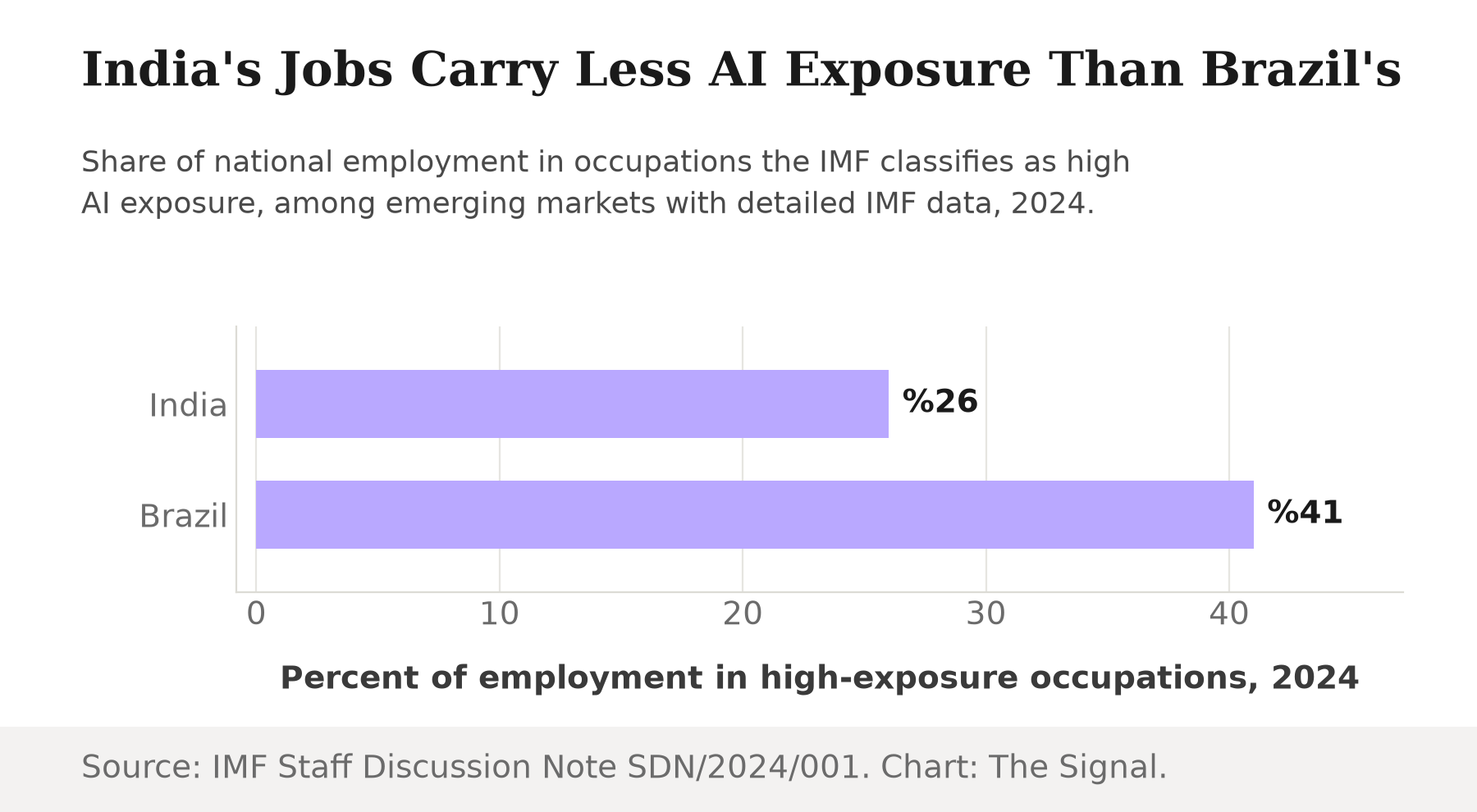
Some of that calm has a real basis. Job loss to AI depends on what a country's workers actually do all day, and India's occupation mix looks different from a wealthy service economy's. An IMF Staff Discussion Note estimates that high-AI-exposure employment among major emerging markets ranges from 41 percent in Brazil down to 26 percent in India, because most Indian workers are craftspeople, skilled agricultural workers or other low-skilled "elementary" workers, an occupation mix the IMF classifies as low-exposure. That estimate is from 2024, the most granular occupational breakdown of its kind available, and it is a structural fact about the labor force, not a survey opinion. It lines up with the survey: a country whose jobs are concentrated outside AI's reach would rationally worry less about AI.
The sector the average hides
That national average, though, hides the one part of the Indian economy built specifically to do AI-exposed work for the rest of the world. Nasscom's Annual Strategic Review 2025 says India's tech and IT-BPM industry generated over $282.6 billion in revenue in FY2025, of which $224.4 billion, about 79 percent, came from exports. The same review says the industry directly employed 5.8 million people in FY2025, after adding a net 126,000 new jobs in that fiscal year. Nasscom's Strategic Review 2026 projects the sector employing close to 6 million people and crossing $315 billion in revenue for the fiscal year that closed in March 2026, still hiring, still growing, and still overwhelmingly export-facing.
| Metric | FY2025 (actual) | FY2026 (Nasscom projection) |
|---|---|---|
| Total industry revenue | $282.6 billion | Over $315 billion |
| Export revenue | $224.4 billion (about 79%) | Not disclosed |
| Direct employment | 5.8 million | About 6 million |
| Net new jobs added | 126,000 | 135,000 |
Source: Nasscom's Annual Strategic Review 2025 and Strategic Review 2026. The Signal.
This is the kind of work the rest of the world is automating away. The World Economic Forum's Future of Jobs Report 2025 finds that clerical and secretarial roles, including administrative assistants, bank tellers and data entry clerks, are the job family employers globally expect to shrink fastest through 2030. Back-office data entry and processing is a meaningful slice of what BPO firms do for their overseas clients. India's IT-BPM sector is still hiring net new people today, but it sits inside the same job family the world's own employers say is about to shrink the fastest, and its business model depends on that not being true.
What New Delhi is funding anyway
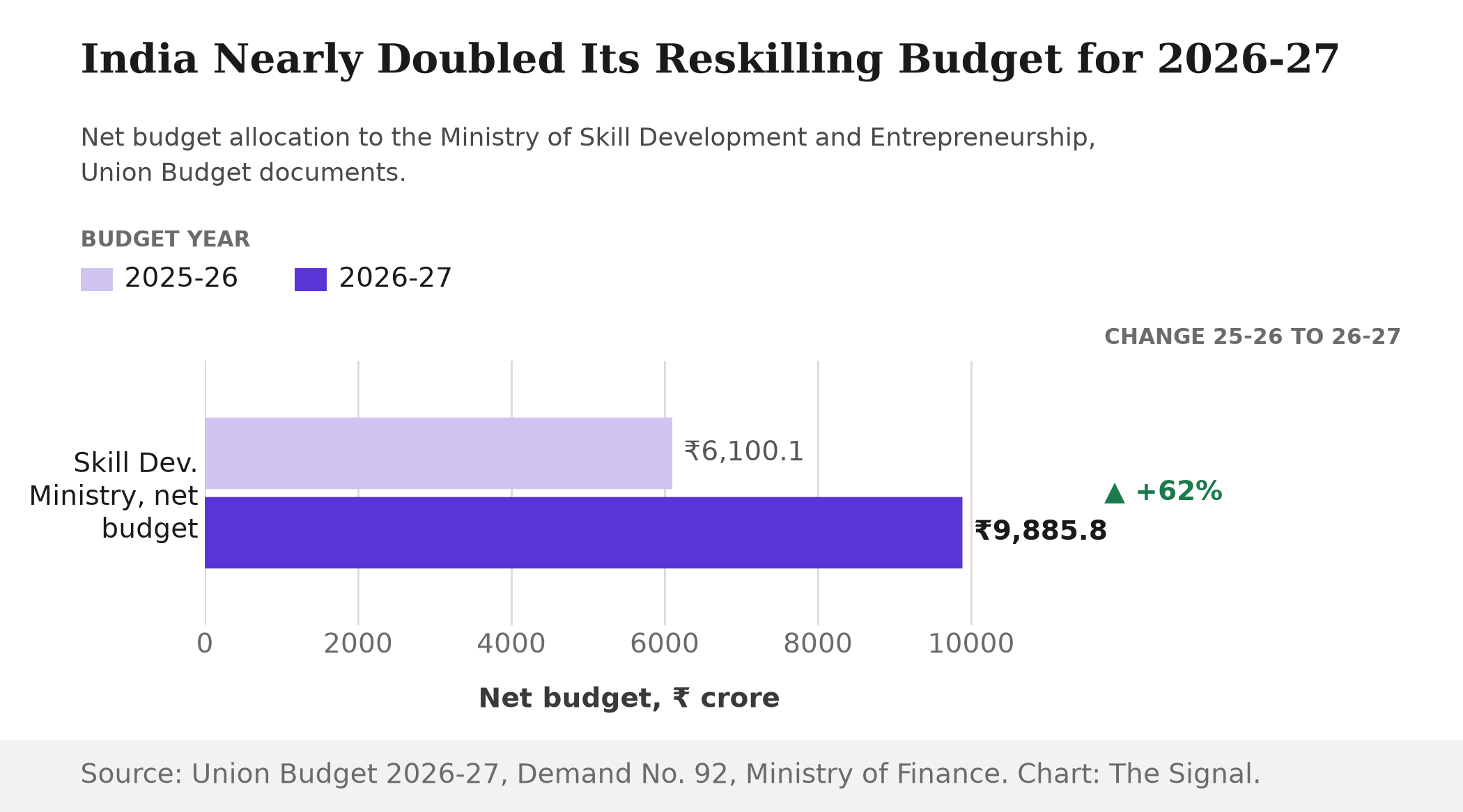
Here is the part of the picture the survey cannot see: what the government is actually spending on. India's Union Budget 2026-27 demand-for-grants documents show the Ministry of Skill Development and Entrepreneurship's net allocation rising to ₹9,885.80 crore, up from ₹6,100.10 crore in 2025-26, a jump of about 62 percent in a single budget cycle. That is not routine housekeeping; ministries do not usually get a nearly two-thirds budget increase in one year without a specific reason to move fast.
The money is being aimed with unusual specificity at the exact risk the survey respondents are not flagging. The Press Information Bureau reports that PMKVY 4.0, India's flagship short-term skilling scheme, has introduced 154 new "future-skill" job roles and 69 customised courses covering AI, Industry 4.0, green jobs and digital services, training 27.24 lakh candidates as of March 31, 2026. A scheme does not add dozens of AI-specific job roles unless someone inside the government has already concluded that AI-driven displacement is coming for a meaningful number of Indian workers. The public, on this evidence, has not reached the same conclusion. The state has started spending as if it has.
The honest objection
The strongest case against reading anything into this gap is that Indians may simply not know enough about AI to have an informed opinion either way, worried or calm. Business Standard, citing Pew Research Center's Spring 2026 survey, reports that only 13 percent of Indian adults say they have heard or read a lot about AI, below the 31 percent median across the 37 surveyed countries, while 39 percent of Indians have heard nothing about it at all. On that reading, India's low worry score is not confidence. It is a country being asked to rate a threat it has not yet heard described.
That case is real, and it should make anyone cautious about reading India's low expectation of AI-driven job losses as considered judgment rather than a shrug. But it does not explain away the budget. A public that has not heard of AI would have no reason to demand a 62 percent jump in skilling funds, and Nasscom's own hiring and revenue numbers show no domestic pressure campaign forcing the government's hand either. The reskilling money moved anyway, aimed specifically at AI-era job roles, ahead of public demand rather than in response to it. Low awareness explains the public's silence. It does not explain the ministry's urgency.
The Signal
Put the two data points next to each other and the honest reading is not that India is complacent about AI and jobs. It is that India's two institutions, its public and its state, are working off different information. The public is answering a survey about a technology that nearly four in ten Indians have never heard discussed. The government, meanwhile, is funding well over a hundred new AI-era job roles for a shift it has evidently already priced in, aimed at the same export-facing IT-BPM workforce that sits in the exact job family the World Economic Forum expects to shrink fastest worldwide. If the reskilling money actually reaches the BPO seat-fillers and data-entry clerks it is nominally for, India's calm survey numbers will look prescient in hindsight. If the money is absorbed by unrelated skilling programs while the exposed jobs keep humming until they don't, India's muted worry score will look like the last measurement taken before anyone thought to ask the right question. The number worth tracking from here is not how worried Indians say they are. It is whether PMKVY 4.0's AI-specific job roles actually show up inside Nasscom's next headcount.
Reporting basis: the global and India-specific AI job-loss worry figures and the income-group medians are from Pew Research Center's Spring 2026 Global Attitudes Survey, relayed for India via ThePrint's reporting of that dataset; the AI-awareness figures are from Business Standard's reporting of the same underlying Pew dataset. The occupational-exposure comparison between India and Brazil is from a single 2024 IMF Staff Discussion Note. India's IT-BPM revenue, export and employment figures are from Nasscom's Annual Strategic Review 2025 (actuals) and its Strategic Review 2026 (the following year's projection), both industry self-reported figures from the same trade body. The clerical and data-entry decline forecast is from the World Economic Forum's Future of Jobs Report 2025, a survey of global employers. The skilling budget figures are from India's Union Budget 2026-27 demand-for-grants documents, and the PMKVY 4.0 rollout figures are from a Press Information Bureau note citing the Ministry of Skill Development and Entrepreneurship. The 79 percent export share, the "nearly double" comparison between India and the high-income median, and the 62 percent budget increase are The Signal's calculations from those figures.